

M2P Fintech
Fintech is evolving every day. That's why you need our newsletter! Get the latest fintech news, views, insights, directly to your inbox every fortnight for FREE!
Co-lending scales only when modern loan origination system and a loan management system run splits, escrow, settlement and reconciliation on one record. Without that, every new partner adds another spreadsheet, and the co-lending platform stops being an advantage.
The model itself is sound. Banks bring low-cost capital, NBFCs bring reach and underwriting depth, and borrowers in underserved segments get credit faster. But most co-lending programmes hit the same wall around partner number three. Every new partner brings its own split ratio, interest computation, hurdle rate, escrow flow and reporting format. Reconciliation drifts. Audits get painful.
The problem is not the model. It is the stack. Co-lending bolted onto an LOS or run in a separate tool creates a second source of truth, and every day the two disagree.
This guide explains where co-lending programmes break, what a co-lending platform needs to do, and how M2P's Core Lending Suite runs co-lending natively inside origination and servicing.
Co-lending gives both partners something they cannot easily get alone:
It also comes with real costs: fragmented tech ecosystems, manual reconciliation, complex accounting and reporting, different underwriting standards at each partner, regulatory and legal complexity, and a model that is still evolving. Most of these costs trace back to software, not strategy.
Split logic lives outside the loan record. Principal and interest shares are calculated in a side system, then pushed back. Every rate change or prepayment risks a mismatch. Banks and NBFCs often use different day-count conventions too (for example 30/360 versus Actual/365), which means multiple repayment schedules for one loan.
Escrow is manual. PayIn and PayOut flows between originator, lender and borrower are tracked by ops, not by the platform. Receipts must be split across lenders with different allocation logic.
Partner onboarding takes months. Each new lender needs fresh rules, new reports and new integration work.
Reporting doubles. Both partners report to bureaus and regulators, so data has to match on both sides, every cycle. CLM2 compliance, real-time statements of account and audit trails all depend on that match.
Accounting lags. Journal entries are posted separately in each partner's books. Three-way ledgers, risk and payout splits and reversals are reconciled by hand.
Schedules go stale. Part-prepayment, restructuring and interest changes force schedule revisions on every side of the agreement.
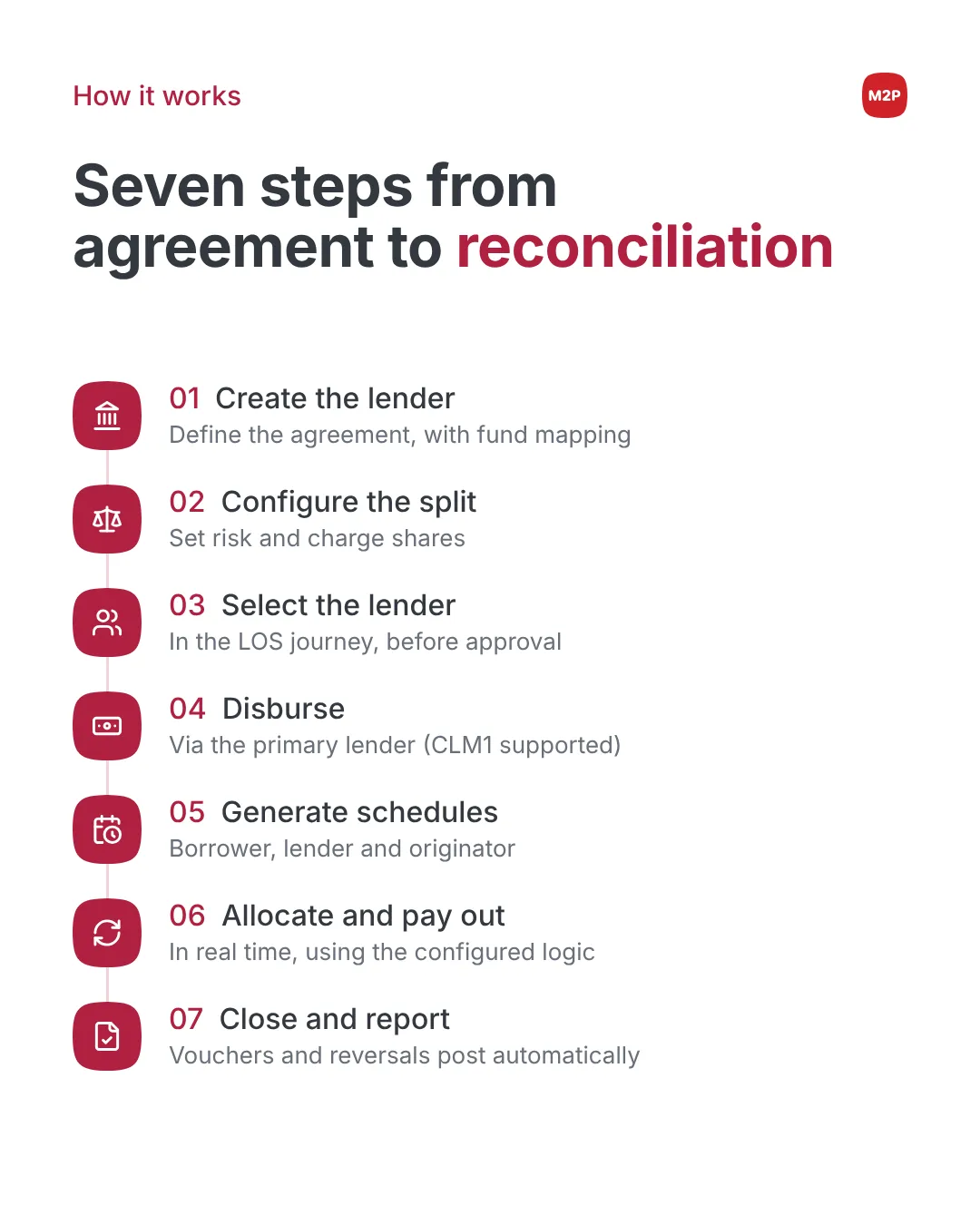
M2P's Core Lending Suite runs co-lending inside origination and servicing, not beside them. At origination, the Loan Origination System (LOS) handles co-lending from the first application:
Through servicing, the Loan Management System (LMS) carries the programme for the life of the loan. Co-lending is native to the LMS, so there is no side calculation to reconcile.
What breaks | What M2P's LMS does |
|---|---|
Side calculations for each partner agreement | Configurable capital contribution, hurdle rates, and principal or interest computation strategies |
Manual share calculations on every EMI | Real-time triple repayment schedules (borrower, lender and originator) with repayment allocation between all three |
Ops-tracked fund movement | Escrow integration via third-party providers, with PayIn and PayOut support |
End-of-month drift | Automated reconciliation with real-time data sync and retry mechanisms |
Duplicate reporting across partners | Dual bureau reporting and CLM reports |
Hand-reconciled ledgers | Automated journal entry and voucher posting, with reversals, synced across partner systems |
Other capabilities worth noting:
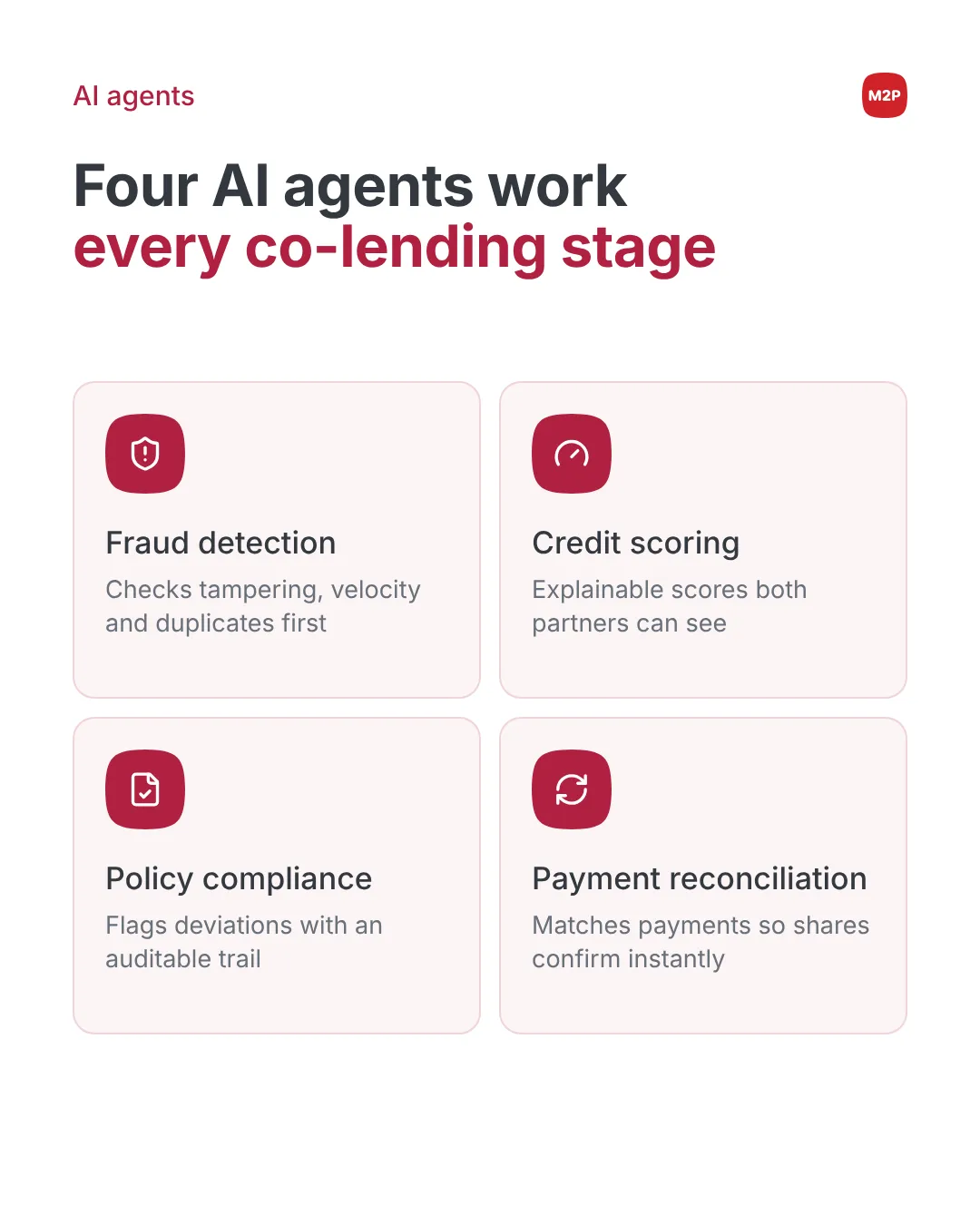
Co-lending multiplies the work in every stage, so the AI layer matters more, not less.
Because credit rules run through a configurable Business Rules Engine (BRE), M2P onboards new LSP partners in about three weeks. BRE-as-a-Service also lets lenders expose rules via API to partners and third-party touchpoints, so a new channel does not mean a new rulebook.
The same stack supports 15+ loan types, including MSME, LAP, auto, personal, education, BNPL and microfinance, so a co-lending book can grow across products without changing platforms.
On the roadmap: multi-lender orchestration for platform-led distribution, a real-time reconciliation dashboard with MIS auto-triggers, configurable APIs for external LOS and escrow systems, and pre-built templates for RBI CLM reports.
Scale your next co-lending partnership without adding ops headcount. Book a demo
What is a co-lending platform? Software that lets two or more lenders jointly originate, fund, service and report on loans, with automated splits, settlement and reconciliation.
Why does co-lending need a unified loan management system and loan origination system? Split rules, settlement and accounting must sit on the same loan record from application to closure, or the two partners' books drift apart.
Can M2P handle multiple co-lending partners on one book? Yes. The platform supports multi-lender selection, agreement mapping, and per-partner capital contribution, hurdle rates and interest strategies.
Does M2P integrate escrow for co-lending? Yes, through third-party escrow providers with PayIn and PayOut support.
How long does it take to onboard a new partner? About three weeks for a new LSP partner, using the configurable BRE.
What is a triple repayment schedule? A co-lending loan needs three schedules: one for the borrower, one for the lender and one for the originator. M2P generates all three in real time, including lender-specific day-count conventions.
Does M2P support CLM1 and CLM2 co-lending models? Yes. The co-lending module is configurable for both models and includes CLM reporting.
Tags

Fintech is evolving every day. That's why you need our newsletter! Get the latest fintech news, views, insights, directly to your inbox every fortnight for FREE!