

M2P Fintech
Fintech is evolving every day. That's why you need our newsletter! Get the latest fintech news, views, insights, directly to your inbox every fortnight for FREE!
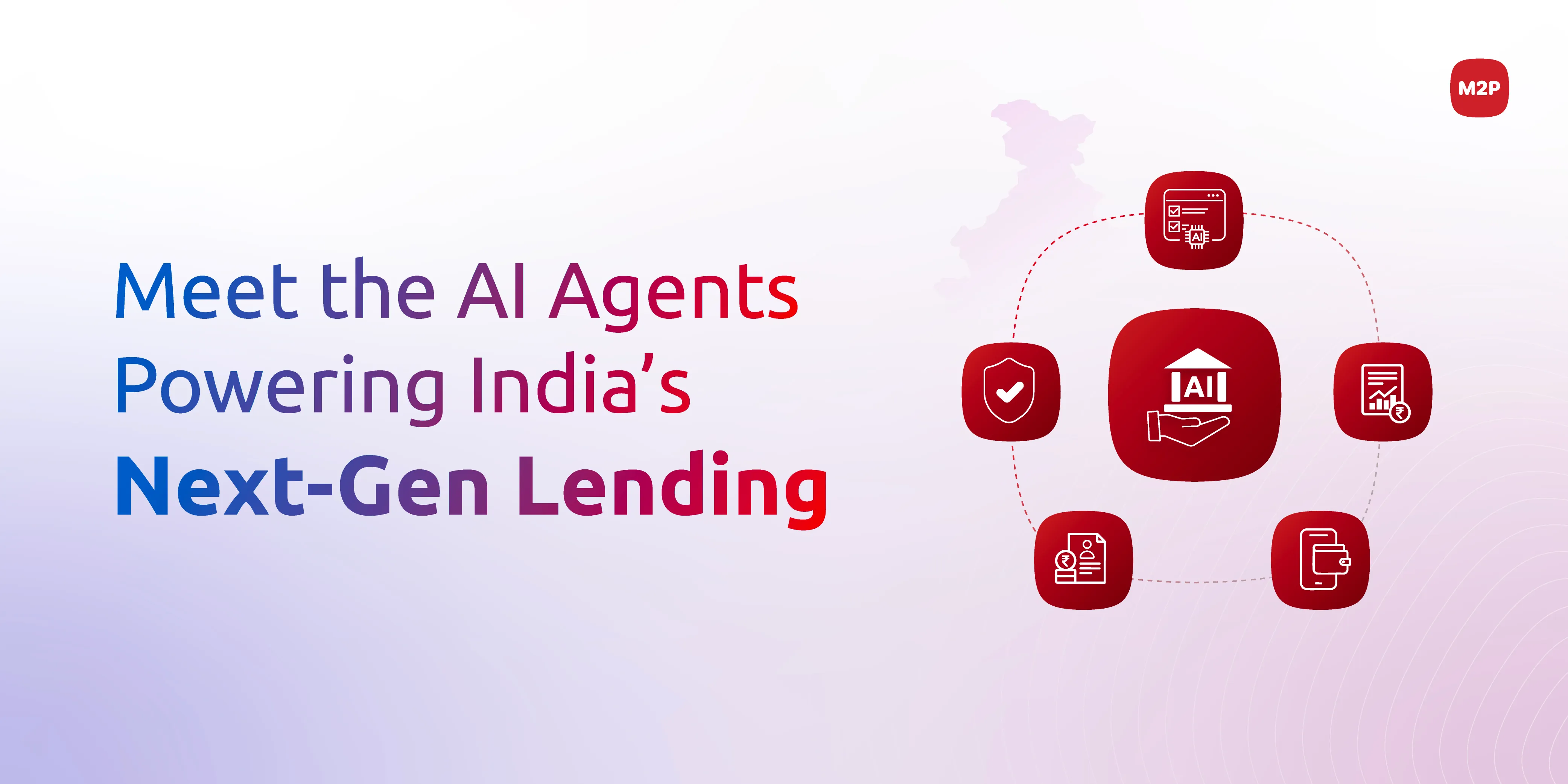
There is a version of AI in lending that most institutions have already tried. It looks like this: a bureau-integrated scoring model sitting inside the underwriting workflow, a document OCR tool bolted onto the LOS, a collections dashboard with risk segmentation. Each one is useful. Each one is isolated. Each one creates a new integration overhead while solving a narrow problem.
This is AI-enabled lending. It is not the same as AI-native lending.
The distinction matters enormously - not as a marketing label, but as an architectural reality that determines whether AI delivers compounding operational gains or stays in a collection of disconnected experiments. The difference comes down to one thing: agents.
In 2026, the most consequential shift in lending technology is the move from AI tools to AI agents - purpose-built, domain-trained systems that don't just process inputs but orchestrate multi-step workflows, act on decisions, and hand off to the next stage of the lifecycle with full context intact.
An AI tool answers a question. An AI agent completes a workflow.
When a document arrives in the origination queue, an AI tool might extract the text and flag anomalies. An AI agent classifies the document, extracts structured data, runs 200+ validation checks, reconciles against bureau data, updates the application record, routes exceptions to the right reviewer, and triggers the next step in the origination journey, without a human touching any of it until a genuine decision point is reached.
An AI agent in lending is a purpose-built, domain-trained system that autonomously orchestrates multi-step lending workflows - completing an end-to-end task such as document validation or collections campaign orchestration and handing off to the next lifecycle stage with full context intact.
Large, general-purpose AI models are impressive at many tasks and poor at the specific ones that lending requires. Lending is a domain where:
Errors have asymmetric consequences. A misclassified income document affects underwriting, approval, disbursement, and potentially collections years later
Auditability is non-negotiable. Every AI decision needs a traceable rationale for regulators, auditors, and risk teams
Context is stage-specific. Origination signals (identity, income, intent) are completely different from collections signals (behavior, capacity, sentiment, reachability)
Policy changes constantly. Agents with configurable rule layers absorb policy changes without retraining.
This is the agent-first architecture underpinning M2P's Core Lending Suite. What follows is a stage-by-stage breakdown of how it works in practice.
Origination is simultaneously the highest-volume and most error-prone stage of the lending lifecycle. Every dropout is a customer lost and a cost incurred with zero revenue. The origination agent layer collapses TAT and improves STP by automating every step that doesn't require human judgment.
Document Intelligence Agent
Classifies documents across 100+ types using ML-based classification models
Extracts structured fields using predefined taxonomy for each document type
Runs 200+ automated validation checks: completeness, blur detection, cross-field consistency, authenticity markers
Routes output to appropriate downstream system or reviewer queue automatically
Production metrics:
Loan document TAT: 24 hours → under 2 minutes
16+ document types extracted and validated per application
70+ document types classified, quality-checked, and auto-routed
STP improvement: 10x over manual processing
Conversational Application Agent
A multilingual chat and voice interface guiding borrowers through the application journey in real time - answering eligibility questions, clarifying required documents, handling incomplete submissions, and capturing structured data from unstructured conversations. Supports regional Indian languages for MFI, rural MSME, and direct-to-customer lending.
Instant Eligibility Agent
Runs soft bureau checks and affordability heuristics at the point of application - before the full credit assessment, to generate pre-approved offer ranges in seconds. Integrates with Account Aggregator for real-time financial data.
Output: a ranked set of offers (product, amount, tenure, ROI) tailored to the borrower's verified financial profile.
Underwriting is where lending economics is made or broken. Bad underwriting at origination shows up as NPA two years later. The challenge isn't speed alone - it's better decisions faster, with full auditability, across thin-file and informal-income borrower profiles.
Aggregates signals from CIBIL, Experian, Equifax, CRIF, bank statement analysis, GST return data, Account Aggregator feeds, and custom scorecard models, producing a composite credit score with explainable feature contributions.
Triangulated Household Income (HHI) Model for MFI/informal income:
Bureau signals (CRIF/Equifax): 45% weight
Field officer assessment inputs: 30% weight
AI-extrapolated income model: 25% weight
Every score output includes a human-readable rationale. This explainability enables underwriters to override, regulators to audit, and the model to be challenged and improved.
For secured lending, MSME, and LAP, the Credit Assessment Memorandum (CAM) traditionally requires an analyst to manually spread financials, compute 50+ ratios, benchmark against sector norms, and write the credit narrative, hours to days per case.
The CAM Agent automates the entire process: ingests financial statements (ITR, audited accounts, GST returns, bank statements), auto-computes the full ratio suite (DSCR, FOIR, EBITDA margins, trend analysis), benchmarks against sector data, red-flags credit risks, and generates a structured credit memo using NLG.
Production impact: CAM generation time reduced from days to minutes. Analyst throughput increases 5–8x on MSME and LAP portfolios
Operates across three layers simultaneously:
Identity: Synthetic identities, duplicate KYC, proxy attendance in group lending
Document: Tampering, OCR inconsistencies, metadata anomalies
Behavior: Graph analytics for suspicious application patterns - device clustering, address clustering, defaulter network linkages
For MFI: AI face match and liveness detection, geo-tagged and time-stamped audit trails, automated blacklist checks across geographies.
Addresses the core challenge in microfinance: most borrowers are in the informal sector with no formal income documentation. The Computer Vision Agent analyses field survey photographs to infer household economic status:
Validated Exterior: Classifies construction type (kutcha/semi-pucca/pucca) to assess asset stability
Interior Assets: Detects proxies for household income (appliances, furnishings, electronics)
Agricultural/Livestock: Counts and classifies farming assets for agriculture income estimation
Utility Vehicles: Identifies vehicle types as mobility and income indicators
Outputs feed directly into the Triangulated HHI Model — converting subjective field observations into objective, auditable data points.
Applies Operations Research models to field geography - village clusters, center locations, loan officer capacity, meeting constraints, to compute the optimal sequence of center meetings and travel routes. Pushes; sequenced GPS itineraries to the offline mobile app.
Physical travel distance reduced by up to 35%
More center visits per field officer per day without headcount increase
Coordinates the full pre-disbursal checklist: final document verification, sanction letter generation, e-signing, compliance holds, escrow routing for co-lending, multi-tranche payment scheduling. Executes disbursement through the appropriate payment gateway or CBS integration.
For co-lending; handles triple schedule generation (borrower, originator, partner), blended rate computation, fund split configuration, and escrow automation, aligned to RBI 2025 co-lending guidelines.
Automates sanction letter production, loan agreements, and KFS (Key Fact Statements), with regional language support, version control, and integrated e-signing. Eliminates legal and operations overhead while ensuring regulatory consistency.
The highest-ROI agent in the post-disbursal lifecycle. Detects credit deterioration before it becomes a DPD event. Monitors continuously:
Repayment behavior: Payment timing drift, partial payment patterns, NACH bounce frequency
Bureau signals: Monthly refreshes for new delinquency, hard enquiries, restructuring flags
Behavioral signals: App login frequency, support contact patterns, collateral market value
Transaction-level: Bank statement feed anomalies, cash flow interruptions
Portfolio economics: Accounts resolved at SMA-0 cost a fraction of those worked at 60+ DPD. The NPA never appears in the book.
Aggregates multi-channel receipts (NACH, UPI, BBPS, cash, field) into a single reconciliation view. FIFO logic: oldest overdue EMI first. For MFI; Offline-first cash reconciliation with auto-sync on connectivity restoration.
24x7 multilingual conversational agent: account queries, EMI reminders, statement requests, grievance intake, repayment assistance. Sentiment analysis flags distressed borrowers for proactive human outreach.
Runs propensity models against the live servicing portfolio to identify borrowers with the highest conversion likelihood on top-ups, product upgrades, or cross-sell offers. Outputs ranked next-best-action recommendations with offer parameters pre-computed through the BRE.
Replaces static calling lists with intelligent, dynamic account allocation and omnichannel campaign orchestration. Segments delinquent portfolio by DPD bucket, repayment propensity, and intervention history, routing each account to the optimal channel at the optimal time.
FIFO: Oldest overdue EMI collected first
Product-level apportionment strategy
Zero advance parking; excess knocks next scheduled EMI
Instant receipt sharing via PDF/SMS at point of collection
An AI‑driven field management platform that intelligently manages and optimizes on‑ground collection operations. The system enables geo‑clustering and route optimization to maximize agent productivity and coverage. Field agents are dynamically allocated based on performance history, skill sets, language capability, and local familiarity. Real‑time visit logging, geo‑tagged proof of visits, and on‑field digital payment collection ensure transparency, compliance, and faster recoveries.
Production impact: Enabled AI‑driven collections orchestration and field agent allocation through dynamic contract prioritization—driving more focused recovery actions and improved execution efficiency.
One of the compounding advantages of an agent-first architecture: agents share data. The Early Warning Agent's risk flags feed the Collections Orchestration Agent's segmentation model. Collections outcome data feeds back into Early Warning's predictive model. The system gets more accurate with every collection cycle. This feedback loop doesn't exist in a fragmented stack.
Explainable Decisioning: Every score, flag, and agent action produces human-readable rationale with decision metadata
Immutable Audit Trails: Every agent action logged end-to-end with full lineage — regulator queries answered in minutes
Policy-as-Code: Credit policy and compliance rules codified directly into agent workflow logic — policy updates propagate automatically
Controlled Learning Loops: Champion-challenger rollouts with human-in-the-loop gates. Risk owners retain rollback controls
Observability & Drift Monitoring: Real-time dashboards track model performance, decision distribution shifts, and operational KPIs
The agent layer described above is not a feature set; it is an architectural commitment that took years to build and that compounds in value over time.
Lenders considering point-solution AI integrations face a specific trap: each tool solves a problem in isolation but creates a new one at the integration boundary. The Document Intelligence tool outputs data that the Credit Scoring tool doesn't natively accept. The Early Warning model flags risk but has no direct pipe into Collections. The CAM generator requires manual transfer into the LOS.
When AI is built into the lending core - on a unified data model, with shared context across agents, and orchestration that manages handoffs automatically, the integration problem disappears. The compounding effect becomes the default, not the exception.
Lifecycle Stage | Agent | Primary Output |
Origination | Document Intelligence Agent | Validated, structured document data in <2 min |
Origination | Conversational Application Agent | Guided multilingual onboarding, reduced dropout |
Origination | Instant Eligibility Agent | Pre-approved offers in seconds |
Underwriting | Credit Scoring Agent | Explainable composite credit score |
Underwriting | CAM Generation Agent | Audit-ready credit memo in minutes |
Underwriting | Fraud Detection Agent | Identity, document, and behavioral fraud flags |
Underwriting | Computer Vision Agent | Objective HHI assessment (MFI/rural) |
Underwriting | AI Smart Scheduler | Optimized field routes, 35% travel reduction |
Disbursal | Disbursal Orchestration Agent | Same-day disbursal, compliant fund flows |
Disbursal | Document Generation Agent | Auto-generated sanction letters, agreements, KFS |
Servicing | Early Warning Agent | Pre-SMA risk flags, proactive intervention triggers |
Servicing | Payment Reconciliation Agent | Clean multi-channel cash application |
Servicing | Customer Service Agent | 24x7 query resolution, distressed borrower detection |
Servicing | Cross-Sell Agent | Propensity-ranked next-best-action offers |
Collections | Collections Orchestration Agent | Intelligent omnichannel recovery campaigns |
Collections | OTS Recovery Agent | Data-driven settlement for 180+ DPD accounts |
The lending institutions pulling ahead in 2026 share a common characteristic: they have stopped treating AI as a departmental tool and started treating it as operational infrastructure. The credit team doesn't run an AI model — they run a credit decisioning workflow where an AI agent handles the systematic steps and surfaces only the genuine decision points for human judgment. Collections don't use an AI dashboard; the agent orchestrates the recovery campaign, and the manager reviews exceptions.
This shift from AI as a tool to AI as the operating layer, is what makes the difference between AI that shows up in a product demo and AI that shows up in the P&L.
See the full agent stack in a live lending environment. Book a demo with M2P's lending specialists at https://m2pfintech.com/contact-us/
Fintech is evolving every day. That's why you need our newsletter! Get the latest fintech news, views, insights, directly to your inbox every fortnight for FREE!