

M2P Fintech
Fintech is evolving every day. That's why you need our newsletter! Get the latest fintech news, views, insights, directly to your inbox every fortnight for FREE!
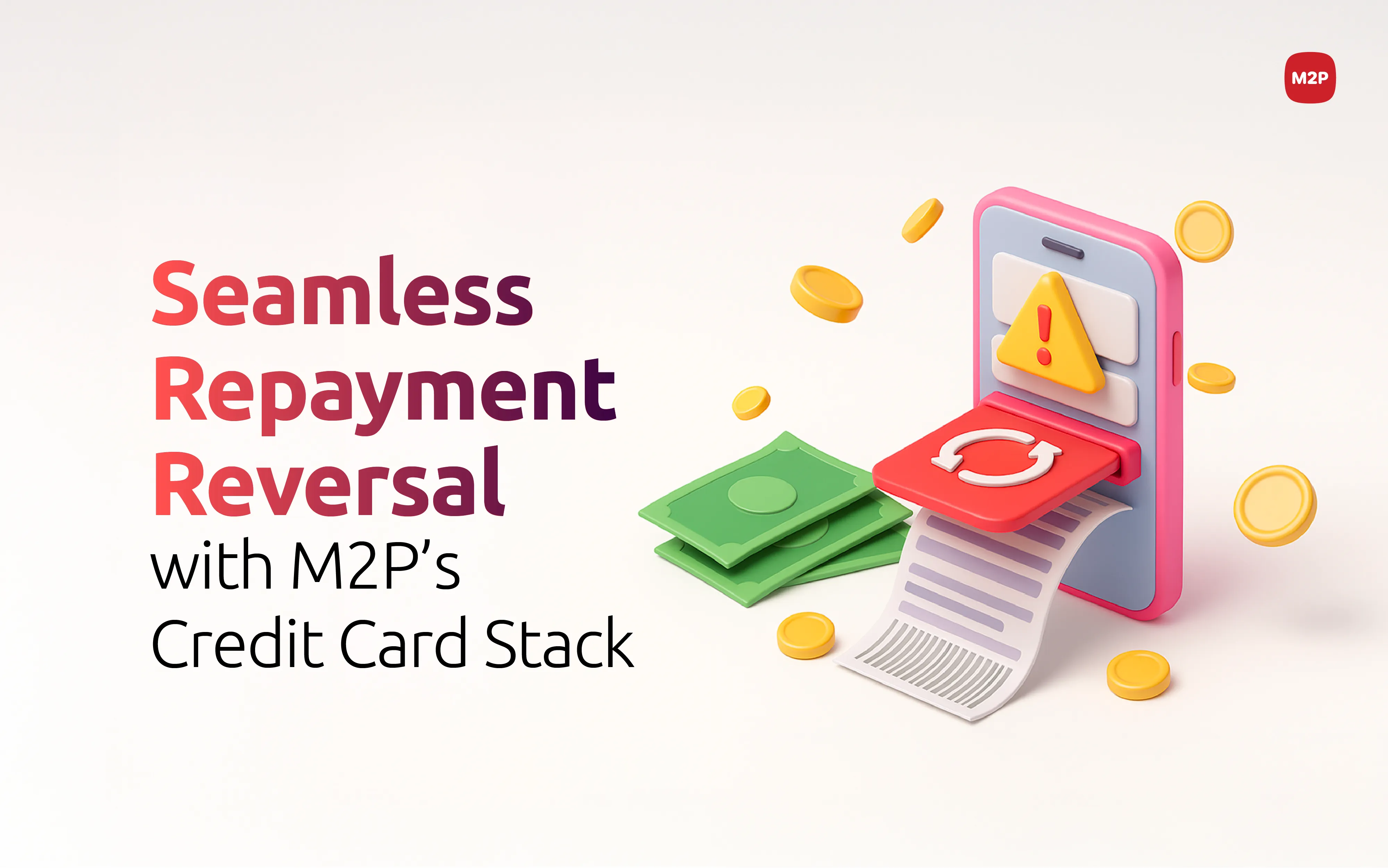
In modern credit card programs, operational excellence is no longer defined by how systems perform under ideal conditions, but by how reliably they recover when things go wrong. A single misapplied repayment can cascade across balances, billing cycles, delinquency metrics, customer statements, and regulatory reports.
For banks and fintech’s operating at scale, these errors often translate into manual interventions, audit exposure, delayed resolution, and erosion of customer trust. As transaction volumes grow and systems become more interconnected, traditional approaches to correcting repayment errors are proving inadequate.
This shift has elevated repayment reversal from a back-office fix to a frontline platform capability. Within M2P’s Credit Card Stack, repayment reversal is engineered natively to address this challenge ensuring errors are corrected accurately, transparently, and without disrupting dependent processes.
This blog explores why repayment reversal is a key operational functionality al and how M2P delivers it seamlessly at scale.
Let’s first jot down the structural complexities that make repayment errors so difficult.
In modern credit card platforms, repayments are deeply embedded within interconnected financial, risk, and customer workflows. What appears to be a single transaction immediately propagates across multiple system states, making reversals inherently complex and operationally sensitive.
Once a repayment is posted, it typically drives changes across:
Financial state: balances, available limits, and ledger positions
Billing workflows: statement generation and cycle calculations
Risk logic: DPD, delinquency status, and account blocks
Governance layers: reporting, audit trails, and regulatory records
Customer touchpoints: statements and transaction visibility
By the time an error surfaces, multiple processes are already locked in. Attempting a reversal without restoring every dependent state precisely can lead to data mismatches, audit gaps, and customer dissatisfaction. Unfortunately, many institutions still depend on manual solutions that are slow, error-prone, and unsustainable at scale.
Addressing these risks requires more than ad hoc fixes, it demands a native, intelligent solution. M2P delivers exactly that through its Credit Card Stack.
M2P addresses this challenge by integrating repayment reversal as a core module within its Credit Card Stack. This module allows seamless and controlled reversals of the latest unbilled cash repayments, ensuring financial accuracy, regulatory compliance, and operational continuity. By handling repayment errors natively, M2P eliminates the need for manual interventions, reduces risk, and allows banks and fintechs to maintain consistent operations at scale.
Significant cost reduction – By automating high-risk repayment workflows, banks and fintechs save on manual labor and avoid financial losses from errors
Robust risk mitigation – Accurate, controlled reversals ensure regulatory compliance and minimize exposure to penalties, audits, or operational failures
High operational efficiency – Faster error resolution and streamlined processes allow teams to focus on strategic, value-added tasks
Effortless scalability – The system handles increasing transaction volumes without extra overhead, supporting seamless business growth
Enhanced customer trust – Reliable and timely repayment corrections improve experience, strengthen loyalty, and reduce complaint
Repayment reversal is a foundation for resilient and scalable credit operations. M2P’s Credit Card Stack integrates this functionality at its core, helping businesses maintain accuracy, protect account integrity, and enhance customer trust.
Want to know how M2P’s Credit Card Stack operationalizes repayment reversal at scale?
Connect with us to know more.
Follow us on LinkedIn and Twitter for insightful fintech bytes curated for curious minds like you.


Fintech is evolving every day. That's why you need our newsletter! Get the latest fintech news, views, insights, directly to your inbox every fortnight for FREE!