

M2P Fintech
Fintech is evolving every day. That's why you need our newsletter! Get the latest fintech news, views, insights, directly to your inbox every fortnight for FREE!
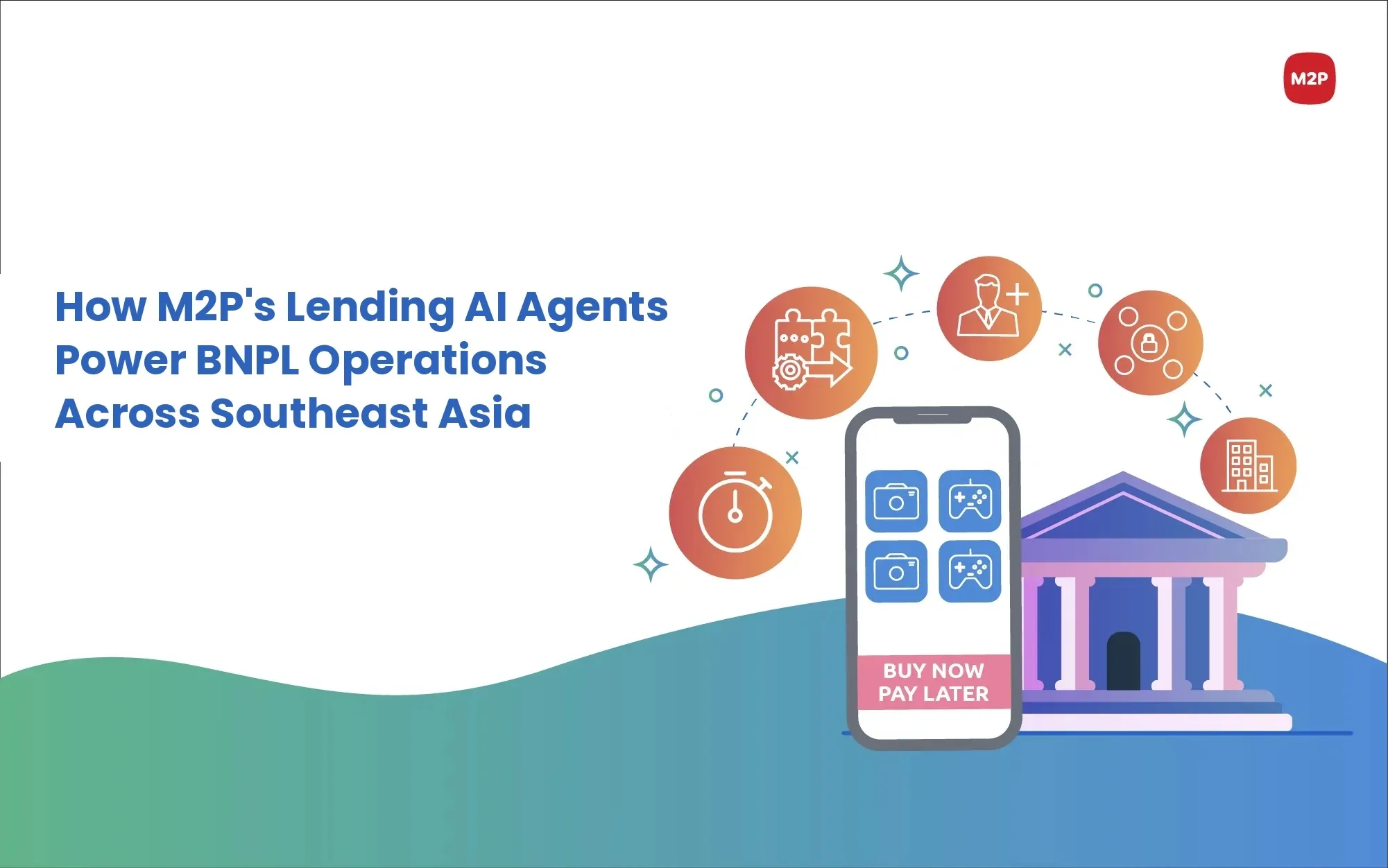
Across Southeast Asia, lending is increasingly becoming part of the purchase journey.
A customer chooses a product. They reach checkout. A credit option appears. The decision must happen almost instantly. If it takes too long, the customer drops off, the merchant loses the sale, and the lender loses the opportunity.
This is the reality of embedded lending and BNPL in Southeast Asia.
Credit is no longer limited to traditional loan application journeys. It is appearing inside e-commerce platforms, digital wallets, merchant apps, marketplaces, and point-of-sale experiences. For lenders, this creates a powerful growth opportunity. But it also creates a difficult operating challenge.
How do you make a credit decision in seconds without weakening risk control, while staying compliant with a regulatory landscape that is changing fast in every market you operate in?
That is where agentic credit decisioning, backed by a purpose-built AI-Powered BNPL tech stack, becomes important. AI agents work together behind the scenes to compress what traditionally took hours or days into a matter of moments. Credit assessment agents evaluate risk using bureau, banking, income, and alternative data signals, while fraud and policy compliance agents continuously validate applications against lender-specific controls. Once approved, document generation and disbursal orchestration agents automatically prepare agreements, trigger e-sign workflows, complete pre-disbursement validations, and facilitate fund release. This coordinated, agent-driven approach enables lenders to deliver near-instant checkout credit experiences without compromising governance, risk management, or regulatory compliance.
Southeast Asia has become one of the most active BNPL markets in the world. Industry estimates put regional BNPL payment growth in the range of 94–113% year-on-year recently, among the fastest of any region globally, well ahead of the roughly 21–22% CAGR projected for the global BNPL market through the next decade.
The eCommerce numbers tell the same story. Indonesia alone is projected to generate around $7.3 billion in BNPL eCommerce spend, with Vietnam (~$1.5 billion) and Thailand (~$1.4 billion) following, and Malaysia, the Philippines, and Singapore each contributing several hundred million dollars more. Across the wider Asia-Pacific region, BNPL now accounts for roughly a third of global BNPL revenue and is growing faster than any other region — and within that, in-app and platform-embedded BNPL (think Grab, Shopee, and similar super-apps) is the fastest-growing channel of all.
A few structural factors explain why:
A large underbanked population — Southeast Asia still has millions of adults with thin or no formal credit history, for whom checkout credit is often their first structured borrowing experience.
High mobile and internet penetration — countries like Malaysia and Singapore have internet adoption rates above 95%, and mobile wallets are now mainstream.
A booming digital commerce ecosystem — the ASEAN internet economy is now valued in the hundreds of billions of dollars, and BNPL has become a default checkout option rather than a niche add-on.
Post-pandemic spending discipline — many younger consumers actively prefer instalment-based BNPL over revolving credit card debt as a way to budget purchases.
For lenders and embedded finance players, this is a genuine growth market. But it's also a market where the regulatory ground is shifting under everyone's feet.
Unlike traditional lending, BNPL grew for years in a regulatory grey zone across most of Southeast Asia — usually because it was structured as deferred payment rather than a formal loan. That grey zone is closing fast, market by market.
Singapore has taken a self-regulatory route so far. The Singapore FinTech Association's BNPL Code of Conduct, developed under the Monetary Authority of Singapore's (MAS) guidance, requires accredited providers to restrict services to customers 18 and above, cap unassessed credit exposure at S$2,000 per provider, run credit checks against a dedicated BNPL credit bureau, and support customers in financial hardship. Compliance is currently voluntary but independently audited, and all accredited providers have maintained compliance since 2024 — though the cap applies per-provider rather than across the sector, a gap regulators are watching closely.
Indonesia moved from grey zone to formal regulation in late 2025. OJK Regulation No. 32/2025, effective mid-December 2025, creates Indonesia's first dedicated BNPL framework. It restricts BNPL provision to licensed commercial banks and financing companies (the latter needing prior OJK approval), mandates prudential risk management, consumer protection, and data protection standards, and requires periodic reporting to the regulator. Existing providers have until June 2026 to fully comply, with penalties ranging from written reprimands to licence revocation and fines of up to IDR 15 billion.
Malaysia has gone furthest toward hard law. The Consumer Credit Act 2025 came into force in March 2026, with licensing opening that June under a new statutory regulator, the Consumer Credit Commission (Suruhanjaya Kredit Pengguna). BNPL providers must now be licensed — not merely registered — with unlicensed operation carrying fines up to RM5 million and possible jail time. The Act also targets flat-rate interest calculation methods and requires full disclosure of the total cost of credit at checkout, putting real compliance obligations on merchants as well as lenders.
The Philippines regulates BNPL players primarily through the SEC's Lending Company Regulation Act licensing regime, layered with BSP oversight (Circular 1133 on online lending disclosure and consumer protection) where providers are bank-affiliated or engage in broader financing activity. Disclosure of loan terms and effective interest rates, AML compliance, and data privacy obligations under national privacy law all apply.
Thailand and Vietnam are earlier in the formalisation curve, but both are moving to bring digital lending and instalment credit under central bank and securities regulator purview as volumes grow — a pattern consistent with the rest of the region.
The common thread: licensing requirements, credit bureau reporting, affordability checks, and disclosure standards are all tightening at once, market by market, on different timelines. For a regional lender, that means the technology layer has to support policy configuration that varies by country — not a single hardcoded ruleset.
Traditional lending journeys were built around application review. A customer applied for a product, submitted information, uploaded documents, and waited for a decision. Even when digitised, the process often allowed time for checks, reviews, and back-office workflows.
Checkout credit works differently.
The customer is already mid-transaction. Their intent is immediate. The merchant expects a fast response. The platform cannot pause the journey for lengthy underwriting. A delay of even a few seconds can affect conversion.
In this model, credit decisioning becomes part of the customer experience. The lender must assess eligibility, risk, fraud signals, credit rules, and product fit — now increasingly including jurisdiction-specific compliance checks — without breaking the flow. The experience must feel instant to the customer, but controlled and compliant to the lender.
That balance is not easy to achieve with fragmented systems, and it's harder still across multiple regulatory regimes at once.
Many lending systems were not designed for embedded credit. They may depend on batch processes, manual checks, separate fraud tools, disconnected scorecards, or rigid workflows. When these systems are inserted into a checkout journey, latency increases and visibility decreases.
The result is usually one of two problems: either the decision is too slow, which hurts conversion, or the decision is too shallow, which increases risk — and, increasingly, compliance exposure.
Neither outcome works.
Embedded BNPL needs an architecture where sourcing, identity, eligibility, fraud, and credit policy work together in near real time. It needs orchestration, not just automation.
M2P's Core Lending Suite approaches with an an agentic chain across the embedded credit journey, built on five coordinated layers: a customer experience layer, multi-channel origination, a business rules engine, core loan management, and downstream data flows to the partner ecosystem.
Multi-channel origination. Leads and applications are captured consistently from web, app, POS, and partner touchpoints, with 50+ pre-integrated KYC, bureau, and AML services handling document collection and verification without manual back-and-forth. Underwriting parameters are configured per credit policy — and, critically, per jurisdiction — to check eligibility and mitigate risk before an application ever reaches disbursal. E-sign and docket generation carry the workflow through to disbursement automatically.
Conversational Application Agent: Multilingual chatbot for loan applications with voice-to-text capabilities and real-time eligibility feedback.
Instant Eligibility Agent: Performs pre-qualification, bureau soft pulls, affordability checks, and product recommendations in under 30 seconds.
GST Helper Agent: Automates GST data retrieval, turnover extraction, compliance verification, and business network analysis for SME/MSME lending.
Document Intelligence Agent: Enables automated document capture, OCR, classification, data extraction, and authenticity verification.
Field Agent Management System: Optimizes field operations through case assignment, route planning, document collection, and real-time visit tracking.
Business Rules Engine (BRE). This is where lender policy, risk appetite, and increasingly, local regulatory requirements get encoded as configurable rules rather than hardcoded logic. Lenders can define who qualifies, what limits apply (including jurisdiction-specific caps like Singapore's S$2,000 threshold or Malaysia's disclosure requirements), what risk thresholds matter, and when a case should be referred instead of instantly approved.
Bank Statement Analyzer Agent: Evaluates cash flows, account behavior, banking trends, and transaction patterns.
Credit Scoring Agent: Combines bureau and alternative data to generate explainable risk scores and underwriting recommendations.
GST Analytics Agent: Assesses GST compliance, turnover consistency, supplier concentration, and reconciliation insights.
Financial Spreading Agent: Extracts and analyzes P&L statements, balance sheets, cash flows, and financial ratios.
Income Verification Agent: Verifies salary credits, employment records, and repayment affordability.
Fraud Detection Agent: Detects document tampering, identity fraud, duplicate applications, and suspicious patterns.
Policy Compliance Agent: Validates applications against lender policies, risk thresholds, and regulatory requirements.
CAM Generation Agent: Automatically generates Credit Assessment Memos with financial analysis and risk summaries.
Drawing Power Agent: Calculates working capital limits based on stock statements, receivables, and utilization patterns.
Document Generation Agent: Creates sanction letters, agreements, and e-sign-ready loan documentation.
Disbursal Orchestration Agent: Automates pre-disbursal checks, workflow execution, account setup, and fund disbursement.
Loan Management System (LMS). Once a loan is disbursed, the LMS layer takes over the full post-disbursal lifecycle — EMI scheduling, repayment allocation, restructuring, and NPA and asset classification — configured for BNPL's specific rhythm of purchase-to-EMI conversion, dropline limits, and short repayment cycles. Product setup, amortization logic, and charge structures are all configurable rather than hardcoded, so a lender can support multiple BNPL variants without a separate build for each. A Customer Service Agent handles account queries, payment reminders, and grievance resolution across languages; a Payment Reconciliation Agent automates NACH/ECS matching across payment channels for instant confirmation; and a Cross-sell Agent uses propensity modelling to surface personalized product offers at the right moment in the repayment journey.
Collections. For the share of BNPL exposure that slips into delinquency, the collections layer runs a full recovery workflow — dynamic DPD and risk-bucket segmentation, multilingual digital engagement with disposition capture, one-click payment link and QR generation, and a field collector app with geo-tracking for cases that need an on-ground touch. An Early Warning Agent flags likely defaults early using payment behaviour and bureau signals; a Collections Orchestration Agent allocates cases across channels and tele-agents based on performance and language fit; and a Recovery Optimization Agent models recovery probability to recommend the right settlement terms — useful for keeping recovery costs proportionate given BNPL's typically smaller ticket sizes.
Accounting. Every lifecycle event — disbursement, repayment, waiver, write-off, reversal — triggers automated journal entry posting, with a full trial balance and GL report generated behind the scenes. This matters more in BNPL than in most lending, given the transaction volume and the high rate of returns, refunds, and cancellations that come with checkout-based credit. The same layer feeds the bureau reporting and portfolio reports lenders need to demonstrate compliance to regulators like OJK, MAS, or Malaysia's new Consumer Credit Commission.
Core systems — the behind-the-scenes orchestration. Once a transaction is approved, the loan management layer handles the full lifecycle:
Purchase — EMI conversions and Pay Later product configuration at the point of sale
Payback — repayment scheduling and multi-channel collection
Statement engine — automated statement generation on flexible billing cycles
Charges — customisable, configurable fees including processing, usage, and foreclosure charges
Foreclosure — foreclosure charge configuration with full process automation
Returns, reversals, refunds, and cancellations — orchestrated end-to-end for BNPL's uniquely high return-and-refund volume compared to term loans
Accounting and reporting — custom reports for NPA, collections, credit bureau submissions, GST, and merchant settlements
Data flows to the partner ecosystem. Every decision, transaction, and status update streams back to merchants, LSP partners, and the lender's own systems in real time, so nobody is operating on stale data.
The fraud-risk layer works within the same flow rather than as a bolted-on detour, and dashboards give the lender visibility into approvals, declines, referrals, channel performance, portfolio quality, and operational trends — the same visibility risk and compliance teams need to demonstrate adherence to regulators like OJK, MAS, or Malaysia's new Consumer Credit Commission.
The important point is that none of these agents work in isolation. They operate as one connected decisioning flow on a shared data layer.
BNPL isn't a smaller version of a term loan — it behaves differently, and the platform is built around that difference rather than assuming term-loan logic will stretch to fit.
Multiple BNPL models, natively supported — B2C and B2B BNPL, revolving line and dropline limit management, spend-and-convert or Spend Now Pay Later flows, checkout EMI, and straight-through-processing (STP) flows, all configurable without a separate build for each.
Instant loan booking — flexible billing dates, spend and transaction/withdrawal limit setting, and instant repayment schedules generated for the end customer the moment a purchase is approved.
Purchase-and-convert flows — purchases converted to a defined-tenure EMI on demand, with dropline and revolving limit management handled automatically.
Payment scenarios and returns — full and partial payment handling, waiver workflows, and comprehensive returns adjustments, since BNPL portfolios see materially higher return and cancellation volumes than instalment loans.
Tailored billing — daily, weekly, or monthly billing setups with dynamic bill and due-date management, and configurable charges for processing, usage, and foreclosure.
Robust, jurisdiction-ready reporting — custom reports spanning NPA, collections, bureau submissions, GST, and merchant settlement reconciliation, built to support the disclosure and audit requirements now being written into law across the region.
In checkout lending, speed is essential. But speed cannot be the only goal.
A lender still needs to control credit policy, risk exposure, eligibility criteria, limits, tenure, pricing, and exception handling — and now, increasingly, jurisdiction-specific compliance rules that differ between Singapore, Indonesia, Malaysia, and the Philippines. The system should be fast, but not uncontrolled.
M2P's agentic decisioning model supports this through configurable policy logic rather than hardcoded rules. AI can assist with data interpretation, signal evaluation, routing, and recommendation. But the decisioning framework remains policy-led and lender-controlled — which matters just as much for satisfying a regulator's audit request as it does for managing risk.
The embedded lending journey does not end at approval.
Lenders also need to monitor performance after credit is issued: which channels are generating quality applications, which customer segments are converting, which policies are producing stronger repayment outcomes, and where risk patterns — or compliance gaps — are emerging.
A connected decisioning layer gives lenders this visibility. Instead of looking only at final approvals, teams can analyse the full journey: sourcing, eligibility, decisioning, referrals, fraud indicators, and downstream performance, including the returns, refunds, and cancellations that make BNPL portfolios harder to reconcile than standard term loans. This creates a feedback loop that helps policies — and compliance posture — improve over time.
For lenders operating across multiple Southeast Asian markets simultaneously, each with its own licensing regime and disclosure rules, that feedback loop is close to a necessity, not just a competitive advantage.
The core benefit is simple: sub-second credit decisions that do not cost the sale, on infrastructure built to keep pace with a regulatory environment that is tightening market by market.
When decisioning works inside the transaction, lenders can approve eligible customers faster, reduce checkout friction, and support embedded BNPL at scale — while staying ahead of licensing, disclosure, and reporting obligations rather than retrofitting compliance after the fact. Merchants benefit from smoother conversion. Customers benefit from faster access to flexible payment options. Lenders benefit from controlled, policy-led, compliant growth.
The future of BNPL in Southeast Asia will not be won by speed alone, and it will not be won by compliance alone either.
It will be won by lenders that can combine instant experience, intelligent risk control, and jurisdiction-aware compliance in a single platform. M2P's agentic credit decisioning — and the BNPL tech stack behind it, by M2P’s Core Lending Suite, helps make that possible: instant credit at checkout, without compromising the fundamentals of responsible lending.
Tags

Fintech is evolving every day. That's why you need our newsletter! Get the latest fintech news, views, insights, directly to your inbox every fortnight for FREE!