

M2P Fintech
Fintech is evolving every day. That's why you need our newsletter! Get the latest fintech news, views, insights, directly to your inbox every fortnight for FREE!
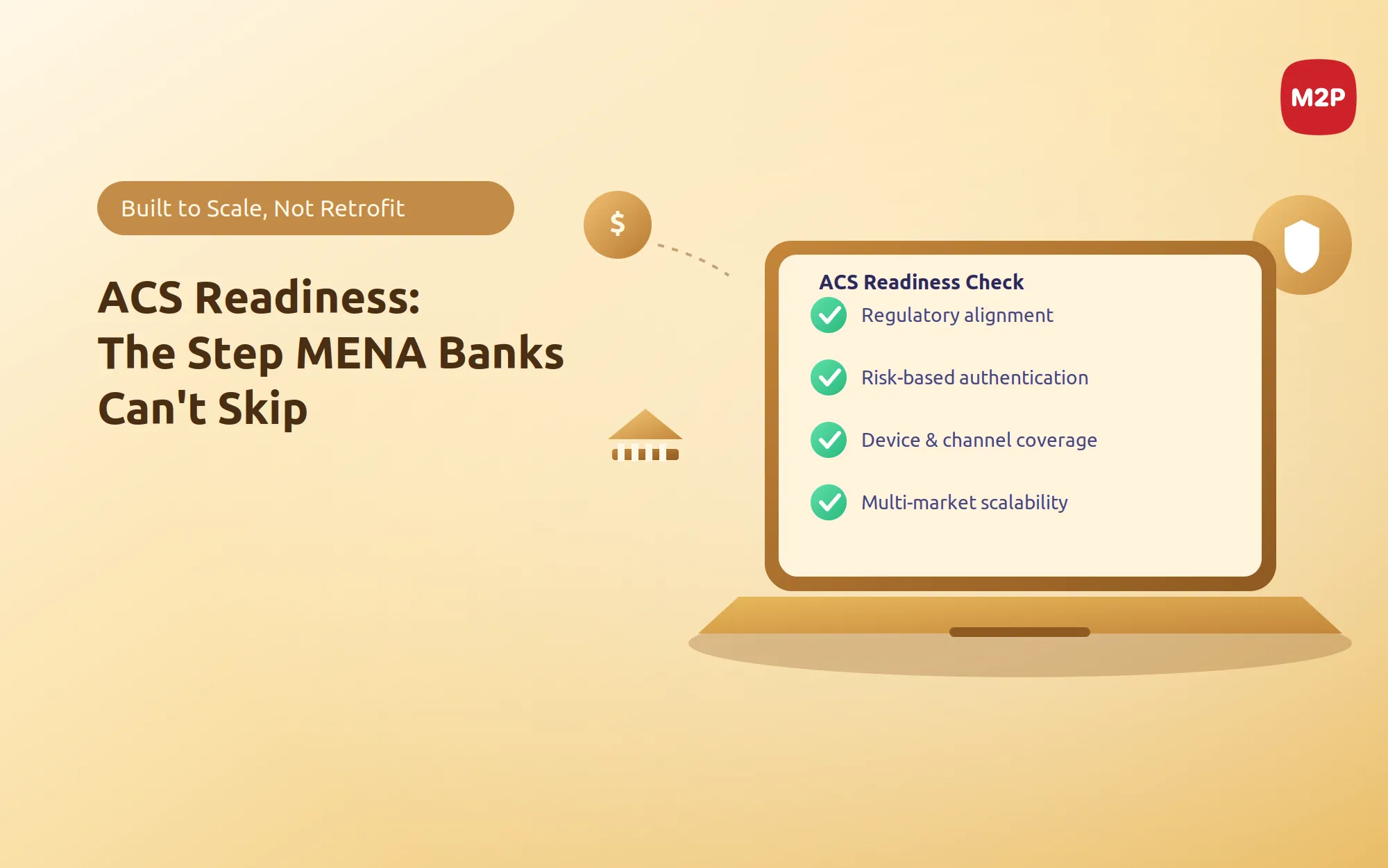
Digital card issuance across the Middle East and North Africa is accelerating, driven by a mix of national digital economy strategies, growing e-commerce volumes, and a new generation of digital-first banks and fintechs entering the market. As card portfolios scale, so does exposure to card-not-present (CNP) fraud — and with it, the importance of getting Access Control Server (ACS) infrastructure right from the outset.
Unlike markets where 3-D Secure (3DS) was added onto legacy systems over time, many MENA issuers have the opportunity to build authentication infrastructure correctly the first time. Doing that well requires a clear-eyed view of what "ACS readiness" actually means before scaling issuance volumes.
It's tempting to treat ACS as something to configure once volumes justify it. In practice, authentication infrastructure is much harder — and more expensive — to retrofit once a card program is live and processing meaningful transaction volumes. Issues with challenge flow design, scheme compliance, or risk-engine calibration surface as customer complaints, failed transactions, or chargeback disputes, not as clean engineering tickets.
For MENA banks planning to scale digital card issuance, ACS readiness is best assessed across five areas.
MENA regulators and central banks are increasingly issuing guidance on strong customer authentication, often informed by frameworks like PSD2's SCA requirements in Europe, while also reflecting local market context. Issuers need an ACS platform that:
Supports EMV 3DS 2.x specifications across all schemes the bank issues on (Visa, Mastercard, and regional/domestic schemes where applicable)
Can be configured to align with jurisdiction-specific regulatory requirements as they evolve
Provides audit trails and reporting sufficient to demonstrate compliance to regulators and card networks
A core value proposition of 3DS 2.x is the ability to authenticate low-risk transactions frictionlessly while reserving step-up challenges for higher-risk ones. This depends on a risk engine that can:
Ingest transaction, device, and behavioral data to make real-time risk decisions
Perform reasonably well even with limited historical data during early scale-up, and improve as data volume grows
Be tuned by the issuer's risk team rather than operating as a fixed black box
Banks scaling issuance quickly should ask providers directly how the risk engine behaves in the first months of a new card program, when transaction history is thin.
MENA consumers transact across a wide range of devices and channels — mobile apps, mobile web, and desktop browsers — often with varying network conditions. ACS readiness means the challenge experience:
Renders correctly and loads quickly across device types and connection speeds
Supports authentication methods relevant to the market (OTP, biometric, app-based approval) without adding unnecessary friction
Is tested against real regional usage patterns, not just reference implementations
Many MENA issuers operate — or plan to operate — across multiple countries and multiple card schemes simultaneously. An ACS platform that requires separate integration work per scheme or per market becomes a scaling bottleneck. Readiness here means confirming the platform can:
Handle multiple schemes through a consistent architecture
Extend to new markets without a ground-up re-implementation
Maintain consistent uptime and performance as issuance volume grows across regions
ACS doesn't operate in isolation. It works alongside fraud and risk management (FRM) systems, issuer processing platforms, and dispute management workflows. Before scaling, banks should confirm:
How ACS decisions feed into (and are informed by) the bank's broader FRM capability
How chargeback and liability-shift data flows back into dispute management processes
Whether the ACS provider offers this as a connected capability or requires the bank to stitch systems together independently
Issuers who scale digital card issuance without a properly readied ACS tend to encounter the same set of problems: elevated false decline rates that push customers away, inconsistent challenge experiences that frustrate mobile users, weaker footing in chargeback disputes, and compliance gaps that surface only during a regulatory review or scheme audit. Each of these is more costly to fix retroactively than to design correctly upfront.
For MENA banks planning to scale digital card issuance, ACS readiness shouldn't be an afterthought bundled into a broader card processing decision. It deserves its own evaluation — one that tests regulatory alignment, risk-engine performance, device experience, and scalability against the bank's specific growth plans, not just generic vendor claims.
Banks that treat this as a deliberate, upfront step are the ones that scale issuance smoothly, with fewer surprises as volumes grow.
M2P Fintech provides Access Control Server (ACS) infrastructure built for EMV 3DS 2.x, designed to support issuers scaling digital card programs across the Middle East and North Africa. To assess ACS readiness for your card program, get in touch with our team.
Tags

Fintech is evolving every day. That's why you need our newsletter! Get the latest fintech news, views, insights, directly to your inbox every fortnight for FREE!