

M2P Fintech
Fintech is evolving every day. That's why you need our newsletter! Get the latest fintech news, views, insights, directly to your inbox every fortnight for FREE!
Digital payments keep climbing in the Philippines. The latest full-year data shows they made up 64.7% of retail payment volume, up from 57.4% a year earlier. Customers are paying digitally more often, at more merchants and through more channels. Apple Pay’s arrival is a natural next step, and for card issuers it raises a practical question: is your card ready to be part of that everyday habit? The first weeks of the rollout show where the real work lies.
Digital payments now sit inside the national 60% to 70% target range, supported by a 69.4% rise in digital payment accounts and a 36.3% rise in merchant locations that accept them. Growth has come from several channels. QR Ph alone processed 2.47 billion transactions worth ₱1.16 trillion over the latest full year and, for the first time, exceeded debit and credit card transactions, reflecting a growing preference for interoperable, account-based payments.
Our reading: customers now have more digital ways to pay than ever. For issuers, that makes presence a priority. Cards need to be available in the places customers already pay, and for many customers that place is the phone.
Apple Pay went live on August 4, 2026 with four Philippine banks, covering eligible Visa and Mastercard cards. Customers keep earning the same rewards, and select banks let customers get an instant virtual card and add it to Apple Pay straight away. Retailers, restaurants and online platforms were live from day one, and a leading payment processor is enabling Apple Pay for more than 5,000 online merchants.
Google Pay launched in November 2025 with nine banks and financial institutions, so several issuers that were live on Google Pay were not among Apple Pay’s four launch banks.
Regulators have classified Apple Pay as a technology service provider rather than a payment system operator, so the regulatory path is clear. What remains is technical: local issuers must upgrade core systems to support card tokenization, which replaces card numbers with encrypted, device-specific tokens.
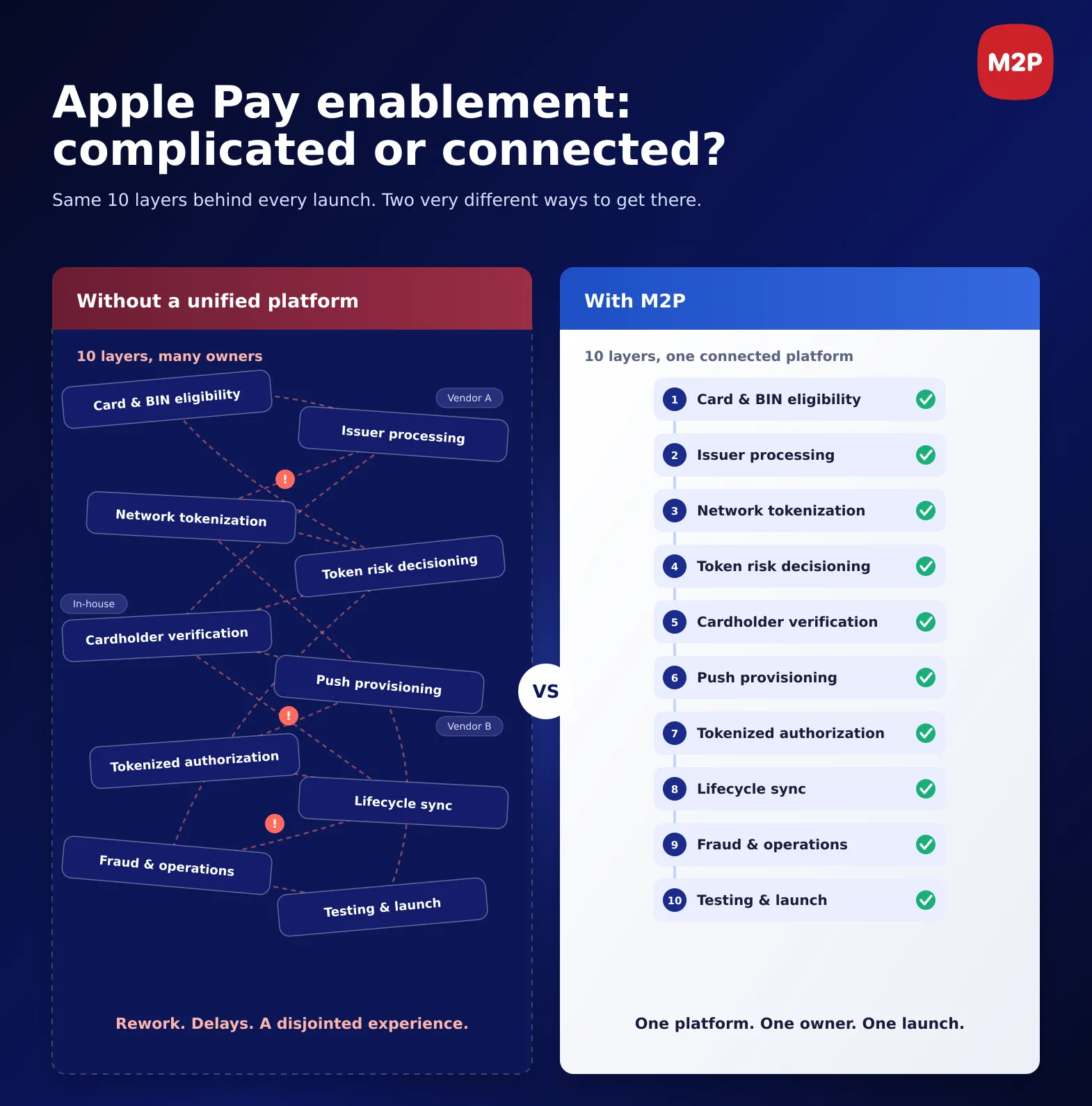
That upgrade is one layer of many. A single tap depends on ten layers, from card and BIN eligibility through issuer processing, tokenization and provisioning to fraud operations and launch testing. When different teams own different layers, the result is rework, unclear ownership and a customer experience that feels disjointed. Even at launch, Apple limits support to eligible cards, so coverage differs by bank and by card product.
Here’s how those ten layers look when they’re scattered versus connected:
Adding a card to Apple Wallet is a one-time event. Everyday use comes from habit: in-store taps, app checkouts and online purchases without retyping card details. Apple says card numbers are not stored on the device or on its servers, and that transactions stay between the customer, the merchant and their bank or card issuer, which matters for customer trust.
For issuers, the opportunity is to be the card customers choose at the top of the wallet, not one they added once and forgot. That depends on smooth provisioning, tokens that stay in sync when cards are renewed, replaced or suspended, and fraud controls that recognize tokenized transactions.
Choose the portfolio sequence - Decide which debit, credit and prepaid products and BINs go first, based on customer demand, network readiness and complexity.
Make the issuer processor token-aware - Authorization, decline logic and lifecycle events (renewal, replacement, suspension, closure) all need to recognize tokens.
Offer push provisioning in your own app - Letting an authenticated customer add a card directly keeps the bank at the center of the experience and typically improves conversion compared with wallet-led provisioning alone.
Our earlier guide walks through the full seven-step framework.
M2P brings card management, issuer processing, network tokenization and wallet enablement together on one platform, and already powers Apple Pay for card issuers across the Middle East in live portfolios. From card eligibility to launch testing, M2P supports each of the ten layers, so issuers can treat tokenization, processing and provisioning as one connected build rather than three separate projects.
Planning your Apple Pay rollout, or looking to expand eligible cards? Talk to our team today!
How do banks enable Apple Pay in the Philippines?
An issuer needs eligible BINs, a token-aware issuer processor, connectivity to the Visa and Mastercard token services, provisioning journeys (wallet-led and in-app), fraud and risk controls, and end-to-end testing. These layers work best when run as one connected programme rather than separate projects.
What is push provisioning, and why does it matter?
Push provisioning lets an authenticated customer add a card to a wallet directly from the bank’s own mobile app, instead of starting in the wallet. It keeps the bank at the center of the experience and typically improves the share of customers who complete setup.
Why does Apple Pay matter when digital payments are already growing?
Digital payments made up 64.7% of retail payment volume in the latest full year, across several channels. Apple Pay lets a bank’s cards, with their rewards, sit in the phone for tap, in-app and online payments, so issuers stay part of that everyday habit.
Fintech is evolving every day. That's why you need our newsletter! Get the latest fintech news, views, insights, directly to your inbox every fortnight for FREE!