

M2P Fintech
Fintech is evolving every day. That's why you need our newsletter! Get the latest fintech news, views, insights, directly to your inbox every fortnight for FREE!
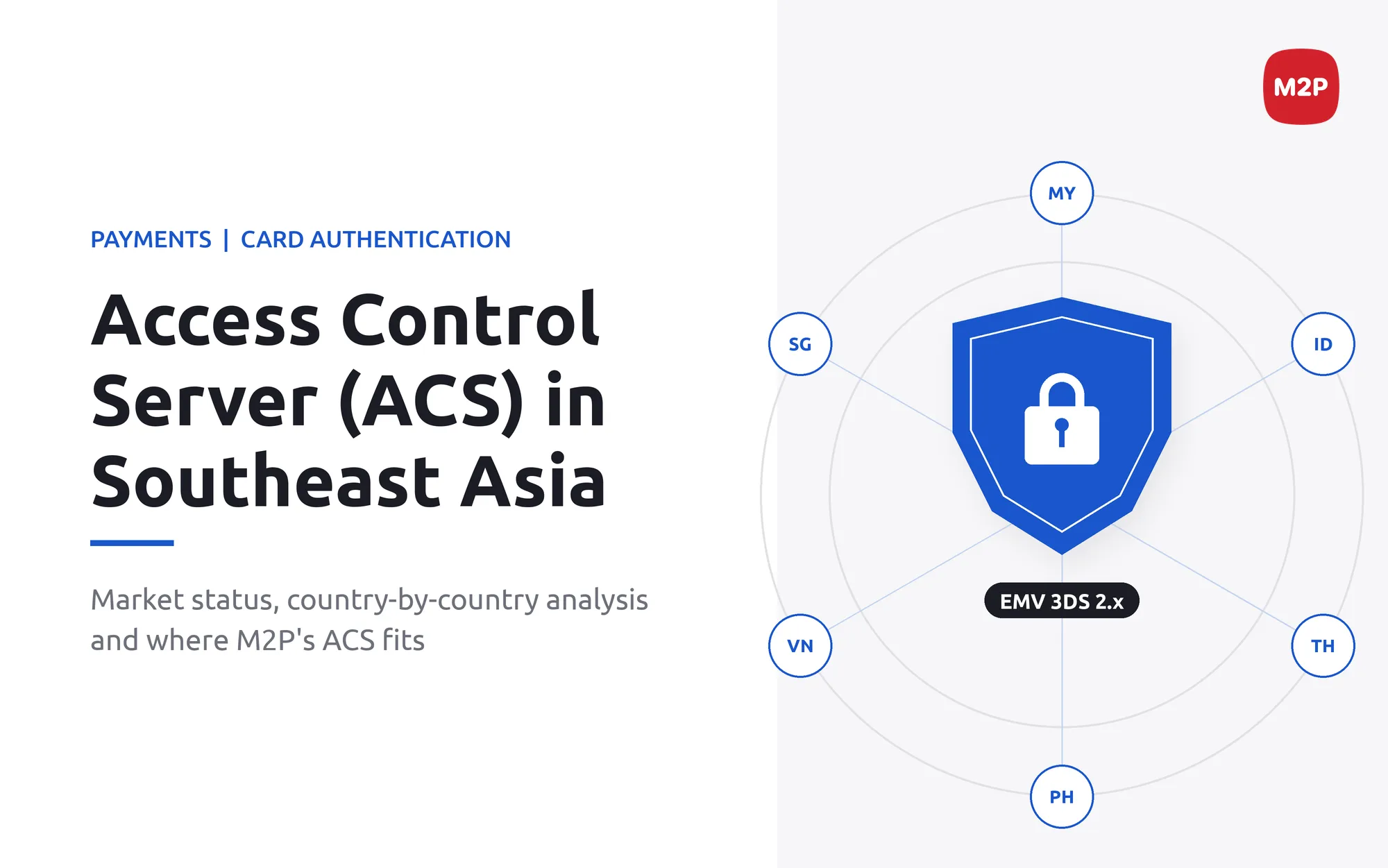
Across Southeast Asia, the Access Control Server (ACS) has moved from a back-office compliance box to a front-line system that decides how safe, and how smooth, an online card payment feels. Regulators in the region's largest card markets have spent the last three years tightening authentication rules, and most of them are pushing in the same direction: away from SMS one-time passwords (OTPs) and toward app-based, device-bound and biometric verification.
That shift lands squarely on the ACS. It is the issuer-side system that receives each 3-D Secure (3DS) request, scores its risk, and decides whether to approve it silently or challenge the cardholder. When a regulator says "no more SMS OTP," it is the ACS that must offer the replacement.
This article looks at where ACS adoption and authentication regulation stand in each major Southeast Asian market as of November 2026, and where an issuer-grade ACS such as M2P's fits each country's needs.
The ACS is the issuer's half of EMV 3-D Secure. The merchant's 3DS Server sends an authentication request through the card network's Directory Server; the ACS answers it on the issuer's behalf.
Two things make the ACS matter more today than it did under 3DS 1.0. First, 3DS 2.x carries far richer data, so a good RBA engine can approve most genuine transactions without friction. Second, the challenge step is exactly where regulators are now dictating which methods are acceptable.
Five of the six largest Southeast Asian markets now have rules or clear supervisory pressure pushing card authentication beyond SMS OTP; Indonesia is the exception, where the focus is expanding 3DS to domestic debit cards.
|
Market |
Key rule or driver |
SMS OTP for card 3DS |
Status (Nov 2026) |
Main ACS need |
|---|---|---|---|---|
|
Philippines |
BSP Circular 1213 under AFASA |
Not allowed for card payments (high risk) |
In force since 25 Jun 2026 |
OTP replacement, adaptive authentication |
|
Malaysia |
BNM 2022 directive; single secure device |
Replaced by in-app approval at major issuers |
Migration largely complete at large banks |
OOB for digital banks and e-wallet card issuers |
|
Singapore |
MAS and ABS OTP phase-out for token users |
Replaced by digital token push at major banks |
Mature; rollout continuing |
OOB and biometrics for newer issuers |
|
Thailand |
BOT draft Digital Channel Security notification |
Draft would discontinue for transaction authentication |
Consultation closed Aug 2026; final rule pending |
Readiness for card-only issuers |
|
Vietnam |
SBV Decision 2345; Circulars 50/2024 and 45/2025 |
Allowed in lower value tiers; biometrics above thresholds |
In force |
Value-tiered rules and biometric step-up |
|
Indonesia |
BI GPN policy; Jalin Verifi3d |
Still in common use |
3DS expanding to GPN debit cards |
RBA to open online debit safely |
Three themes run across the region. Regulators are favouring device-bound app approval over SMS. Liability is shifting toward issuers that keep weak controls, most explicitly in the Philippines. And domestic schemes in Indonesia, Malaysia, Vietnam and Cambodia mean an ACS strategy has to account for local networks as well as Visa and Mastercard.
Singapore has already moved most 3DS challenges from SMS OTP to in-app approval, making it the benchmark the rest of the region is measured against.
Regulatory status. In July 2023, MAS said it would set a deadline for retail banks to stop using SMS OTP as the sole authentication factor for high-risk transactions, while keeping SMS OTP available as one layer among several. In July 2024, MAS and the Association of Banks in Singapore announced that major retail banks would phase out OTPs for login by digital token users, and strengthened digital token setup to make account takeover harder.
What it means for 3DS. Banks have carried the same logic into card authentication. DBS sends a push notification to the digibank app instead of an SMS OTP. UOB has replaced SMS OTPs with Digital Token authentication for 3DS, rolling out progressively. Standard Chartered switched SC Mobile users to in-app push approval from 23 November 2025, with no SMS OTP sent to them. CIMB Singapore followed with in-app 3DS authentication from 26 June 2026.
ACS market status. Large incumbents have largely completed their migration. The opportunity sits with newer issuers: digital banks, e-money and multi-currency card programmes, and regional banks whose Singapore card books run on older ACS platforms that cannot support device-bound OOB flows.
Where M2P fits.
Malaysia has gone further than any other ASEAN market in removing SMS OTP from card authentication, and the deadline pressure has now passed from large banks to everyone else.
Regulatory status. In September 2022, Bank Negara Malaysia instructed financial institutions to migrate from SMS OTP to more secure authentication for account opening, fund transfers, payments and changes to account settings. The same package restricted customers to one mobile or secure device for authenticating online banking transactions.
What it means for 3DS. Through 2025 and 2026, the major issuers moved 3DS challenges into their apps:
|
Issuer |
3DS change |
Effective |
|---|---|---|
|
Online card transactions must be authorised via AmSecure, replacing SMS OTP |
1 Oct 2026 |
|
|
BIMB Secure replaces SMS OTP for Card-i online transactions |
15 Jul 2025 |
|
|
Mobile Banking app approval replaces SMS OTP |
21 Jun 2025 |
|
|
All CNP 3DS transactions authorised via SecureTAC on OCTO |
18 Apr 2025 |
|
|
TapSecure one-tap approval for Touch 'n Go eWallet Visa Card |
Mar 2025 |
|
|
Secure2u via MAE fully replaces SMS OTP for card online transactions |
6 Mar 2025 |
|
|
RHB Secure Plus replaces SMS OTP for debit and credit card e-commerce |
14 Feb 2025 |
ACS market status. In-app OOB authentication is now the market norm, so any issuer still sending SMS OTP for 3DS is out of step with both regulator expectations and customer habits. The TNG example shows the requirement reaches e-wallet card programmes too, not just banks. Malaysia's newer digital banks and card-issuing fintechs need an ACS that supports app-based challenges from day one.
Where M2P fits.
Indonesia's ACS story is less about replacing SMS OTP and more about extending 3DS to millions of cards that have never been used online.
Regulatory status. Bank Indonesia's National Payment Gateway (GPN) policy requires domestic debit and credit card transactions to be routed through locally licensed switching institutions. BI Regulation 4/2025 replaced the earlier payment system policy framework, and BI Regulation 10/2025, effective 31 March 2026, moved payment providers to activity-based licensing tied to transaction risk. Unlike Malaysia or Singapore, Indonesia has not issued a market-wide SMS OTP phase-out for card authentication.
What it means for 3DS. In July 2025, switching operator Jalin launched Verifi3d, an EMV 3DS-based service that lets GPN debit cards pay online using OTP and risk-based authentication. Bank Mega and BNI joined Bank Panin and CIMB Niaga as participants. Jalin notes that many banks had held back online debit usage because of fraud concerns.
ACS market status. Two separate demands are emerging. International-brand cards (Visa, Mastercard, Amex) already run 3DS, but many issuers still rely on OTP-only challenges. Domestic GPN cards are only now gaining online authentication through national infrastructure. Digital banks and card-issuing fintechs are growing fastest and need modern ACS capability without building it in-house.
Where M2P fits.
Thailand is the market to watch in 2027: a Bank of Thailand draft would end SMS OTP for transaction authentication and, for the first time, extend digital channel security rules to credit card providers.
Regulatory status. The BOT's 2024 Mobile Banking Security Notification already set minimum standards for banks and e-money providers. On 23 July 2026, the BOT released a draft Notification on Digital Channel Security for public comment, which closed on 24 August 2026. The draft would:
Separately, the BOT's Guidelines for Digital Fraud Management took effect on 17 December 2025.
What it means for 3DS. The final notification had not been published at the time of writing. Even so, the direction is clear: once card issuers are in scope and SMS OTP is ruled out for transaction authentication, any card programme still using SMS OTP as its main 3DS challenge would need an alternative. Issuers should confirm with the BOT how the final rule treats card-not-present authentication.
ACS market status. Thailand's major banks already run app-based authentication for transfers under the 2024 rules. The gap is likely to be among standalone credit card companies and non-bank credit providers, which the draft brings into scope and which may not have their own app-based authenticators.
Where M2P fits.
The Philippines now has the region's clearest legal rule on card authentication: SMS and email OTPs can no longer be used for high-risk transactions, and card payments are named as high risk.
Regulatory status. BSP Circular 1213, issued in May 2025 under the Anti-Financial Account Scamming Act (AFASA, Republic Act 12010), required covered banks and e-wallet operators to replace SMS and email OTPs from 25 June 2026 with biometric, behavioural, adaptive or passwordless methods. The rule covers institutions processing more than P75 million a month in online transactions on average: most universal and commercial banks, all digital banks, and selected thrift, rural and cooperative banks.
What it means for 3DS. The BSP lists card payments alongside digital banking enrolment, third-party transfers, online remittances and credential or device changes as high-risk transactions. Lower-risk activity, such as payments to pre-registered recipients, may still use SMS OTP. Covered institutions must also run fraud monitoring that detects rapid transfers, new recipients and unrecognised devices. Under AFASA, accountability shifts toward the institution when authentication controls are inadequate.
ACS market status. Many institutions implemented the change before the deadline, but the rule makes an OTP-only ACS a compliance and liability exposure for any covered card issuer. Smaller banks and e-wallet card programmes near the P75 million threshold are the most likely to still be upgrading.
Where M2P fits.
Vietnam has taken the most prescriptive approach in the region, tying online and card authentication to transaction value and to national biometric identity.
Regulatory status. SBV Decision 2345/QD-NHNN, issued on 18 December 2023, set security measures for online and bank card payments. From 1 July 2024, individual transactions above VND 10 million, or daily totals above VND 20 million, must use a biometric authentication measure. Circular 50/2024/TT-NHNN, in force since 1 January 2025, standardises a risk-based approach for payment and card transactions: PINs or passwords for small-value transactions, and OTP, biometric matching or e-signatures for larger ones. Its provisions on authentication forms took effect on 1 July 2026. Circular 45/2025/TT-NHNN also requires biometric matching against chip ID data when a new card is opened, effective from January 2026.
What it means for 3DS. Vietnam does not ban SMS OTP outright. Instead, the required strength of authentication rises with transaction value and type. For an ACS, that means authentication rules must reflect the SBV's value tiers, and the challenge flow must be able to step up to biometrics where required.
ACS market status. Large banks have already built biometric checks into their apps to meet Decision 2345. The ACS question is whether 3DS challenge policies are configured to apply the same tiered logic to card-not-present transactions, and whether reporting can show it. Vietnam's domestic NAPAS card scheme adds another integration consideration.
Where M2P fits.
These markets have smaller card bases and no specific SMS OTP phase-out rules for card authentication, so the ACS opportunity is about first-time or upgraded 3DS rather than compliance migration.
Cambodia is the most active of the four. Payments are led by the National Bank of Cambodia's Bakong platform, the KHQR code standard and the Cambodian Shared Switch, which clears domestic card transactions. Banks are modernising card stacks and adding 3DS as they go: BIDC, for example, cited safer e-commerce with 3D Secure as a benefit of its recent platform upgrade. Mid-sized banks issuing Visa and Mastercard cards are natural candidates for a hosted, cloud-ready ACS.
Laos, Myanmar and Brunei were not researched in depth for this article. Each has a smaller international card base, and any ACS opportunity there is likely to come through regional banking groups or processors extending services across borders. Market-specific regulation should be checked before targeting them.
Where M2P fits. For smaller issuers, the main need is a compliant 3DS 2.x ACS without heavy in-house build. M2P's cloud-ready infrastructure, 24/7 application monitoring and integration with major card schemes suit banks that want to launch or upgrade 3DS quickly.
M2P's ACS maps directly to the region's main requirement: replacing or supplementing SMS OTP with app-based, biometric and risk-based authentication, on a certified 3DS 2.x platform.
|
Southeast Asian need |
M2P ACS capability |
Most relevant markets |
|---|---|---|
|
Replace SMS OTP with app approval |
Out-of-band (OOB) authentication routed to the issuer's app |
Philippines, Malaysia, Singapore, Thailand |
|
Biometric step-up |
Inherence-based (face, fingerprint) and device-based factors |
Vietnam, Philippines, Thailand |
|
Keep genuine transactions frictionless |
Risk-based authentication combining AI/ML and issuer-defined rules |
All markets |
|
Value or risk tiers set by regulators |
Customisable issuer security policies |
Vietnam, Philippines |
|
Evidence of controls |
Reports and dashboards, embedded user management |
Philippines (AFASA liability), Vietnam |
|
Certified 3DS stack |
EMVCo-approved ACS on 3DS 2.3.1; PCI DSS and PCI 3DS compliant |
All markets |
|
Fast go-live for lean teams |
Cloud-ready infrastructure, integration with card schemes and banking systems, 24/7 monitoring |
Digital banks, e-wallet and fintech issuers |
M2P's ACS holds an EMVCo Letter of Approval for version 2.3.1, dated 7 March 2025. Its product page lists OTP, inherence, device-based and OOB factors, and support for Visa, Mastercard, Amex and RuPay, alongside PCI DSS, PCI 3DS, ISO 27001 and ISO 22301 certifications.
The platform is already in production with issuers outside India. United Bank for Africa and Zenith Bank in Nigeria use it, and Federal Bank in India reports a higher authentication success rate since migrating, with in-app authentication added alongside OTP. That experience of moving issuers off OTP-only flows is directly relevant to Malaysia, the Philippines and Thailand.
Questions to settle per market. Domestic scheme coverage (MyDebit, GPN, NAPAS, CSS) is not on M2P's published network list and should be scoped with each issuer. Data residency and hosting location also need early agreement, particularly in Indonesia and Vietnam.
Southeast Asia has moved past debating whether SMS OTP is adequate for card authentication. The Philippines has made it a legal requirement for card payments, Malaysia and Singapore have largely migrated in practice, Thailand has a draft rule that would bring card issuers into scope, and Vietnam has tied authentication strength to transaction value and biometrics.
For issuers, the ACS is where these rules are applied on every online card payment. Those still running OTP-only 3DS face growing compliance risk, liability exposure and customer friction. M2P's certified, cloud-ready ACS, with OOB, biometric and risk-based authentication, gives banks, digital banks and fintech issuers a practical way to meet these requirements without rebuilding their authentication stack.
To discuss ACS requirements for a specific Southeast Asian market, get in touch with M2P.
Regulation: MAS annual report 2024/25 · BNM directive (FMT) · BSP Circular 1213 (Daily Tribune) · BOT draft notification (Tilleke & Gibbins via Mondaq) · SBV Circular 50 (Tilleke & Gibbins) · SBV Decision 2345 (DIV) · Jalin Verifi3d


Fintech is evolving every day. That's why you need our newsletter! Get the latest fintech news, views, insights, directly to your inbox every fortnight for FREE!