

M2P Fintech
Fintech is evolving every day. That's why you need our newsletter! Get the latest fintech news, views, insights, directly to your inbox every fortnight for FREE!
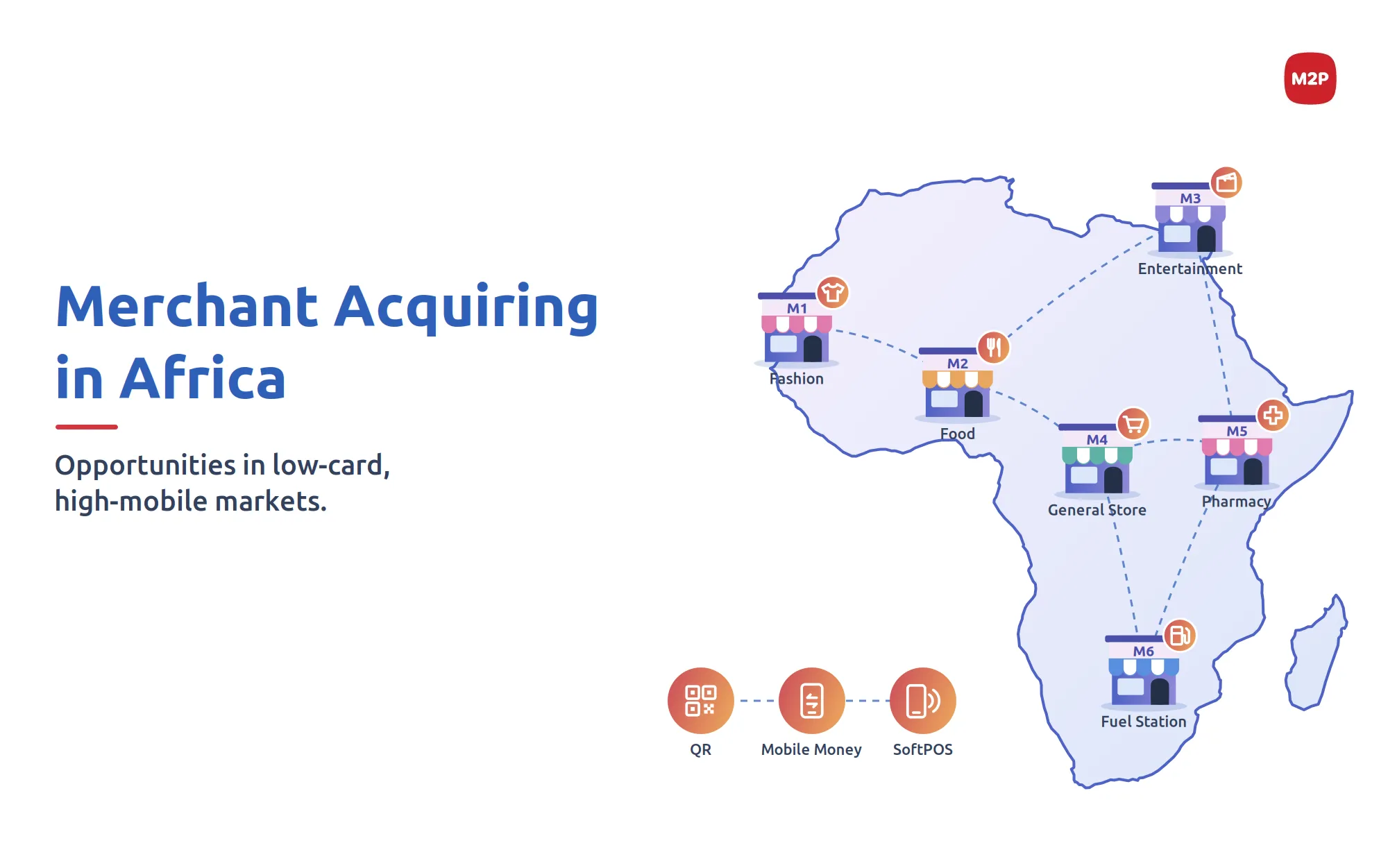
Africa is home to the world's most advanced mobile money ecosystem, yet most everyday purchases on the continent are still paid in cash. That gap between how people hold money and how merchants accept it is the single biggest opportunity in African payments today.
For banks, acquirers and payment service providers, closing it calls for a different playbook. The card-first acquiring model, built around terminals, card networks and bank-account settlement, was designed for markets where most shoppers carry a card. In much of Africa, shoppers carry a phone instead.
This blog looks at what makes merchant acquiring in Africa different, where the growth opportunities lie, and how a modular acquiring stack lets institutions serve mobile money, QR, SoftPOS and other acceptance use cases from a single platform.
The scale of mobile money in Africa is well documented. According to the GSMA State of the Industry Report on Mobile Money 2026, around $1.4 trillion moved through mobile money in Sub-Saharan Africa in 2025. That is about two-thirds of the global total. Sub-Saharan and North Africa together held 1.2 billion registered accounts, more than half of all mobile money accounts worldwide.
Account ownership is broadening too. The World Bank's Global Findex 2025 found that 40% of adults in Sub-Saharan Africa had a mobile money account in 2024, up from 27% in 2021. Overall account ownership in the region rose to 58% of adults.
Payment infrastructure is catching up as well. AfricaNenda's State of Inclusive Instant Payment Systems 2025 report counted 36 live instant payment systems across 31 African countries as of mid-2025. Together they handled about 64 billion transactions worth close to $2 trillion in 2024. Half of these systems now connect banks, mobile money operators and fintechs. Regional schemes such as PAPSS, GIMACPAY and the SADC instant payment system are extending these rails across borders.
The merchant side tells a different story. As CGAP points out, only about 20% of adults in Sub-Saharan Africa made a digital merchant payment in 2024. Across all low- and middle-income economies, that figure was 42%. Findex respondents in the region also said that cash habits and merchants who accept only cash keep them from paying digitally.
The gap is not even across the continent, either. Kenya, Ghana and Nigeria have deep digital payment adoption, while other markets are earlier on the curve. Any acquiring strategy for Africa has to work market by market.
The traditional acquiring model assumes a merchant buys or rents a terminal, a customer presents a card, and the transaction runs over card network rails. Several features of African markets weaken that model.
Shoppers pay with phones, not cards. For many consumers, a mobile money wallet is their primary or only financial account. A merchant that accepts only cards misses most of its potential digital customers.
Terminal economics don't work for small merchants. Hardware, logistics, maintenance and rental fees are hard to justify for a stall or small shop with low daily ticket sizes and thin margins.
Most merchants are informal. Many small businesses have no registered company, no formal bank account and limited paperwork. Standard KYB processes designed for registered businesses leave them out.
Connectivity and power are uneven. Terminals that depend on stable networks and charging can fail at the moment of payment, pushing merchants back to cash.
Settlement into bank accounts adds friction. Merchants who run their working capital through mobile money often want funds settled to a wallet, quickly, rather than to a bank account on a T+1 or T+2 cycle.
None of this means cards are irrelevant. Cards remain important for larger retail, travel, hospitality and online commerce, especially in markets such as South Africa, Nigeria and Egypt. The point is that card acceptance alone cannot close the merchant acceptance gap.
The most direct route to African merchants is to meet customers where their money already sits. Mobile money acceptance lets a merchant collect payments from a customer's wallet, whether through a till number, a merchant code, a USSD prompt or a QR scan.
Why it matters for acquirers: Mobile money operators already run large merchant networks in their own ecosystems. Banks and independent acquirers can grow alongside them by offering merchants something a single-operator till cannot. That means accepting payments from several wallets and bank accounts through one acceptance point, with one settlement and reconciliation view.
What the platform needs:
Integration with mobile money operators and national instant payment switches, so payments from any wallet can reach the merchant
Risk-tiered KYC and KYB, so small and informal merchants can be onboarded with lighter documentation and lower limits, then upgraded as they grow
A merchant management system that supports flexible settlement, including settlement to a merchant wallet as well as a bank account
Real-time payment notifications, because small merchants need instant proof that a payment has landed
Where it fits: Kiosks, market traders, transport operators, small retailers, utility and school fee collections, and agent networks that already handle cash-in and cash-out.
QR codes are the lowest-cost acceptance point an acquirer can deploy. A printed code costs almost nothing, needs no power or connectivity at the merchant end, and works with any smartphone app that supports the standard.
African regulators are pushing QR toward interoperability. Ghana launched its universal GhQR, which lets a merchant receive payments from bank accounts, mobile wallets and cards through a single code. The Central Bank of Kenya issued the KE-QR Code Standard 2023, based on the EMVCo QR specification, to make QR codes work across banks and payment service providers. The Central Bank of Nigeria published a QR payments framework in 2021.
Why it matters for acquirers: Once QR is interoperable, the competition shifts from who owns the code to who gives the merchant the best experience. That includes onboarding speed, settlement timing, reconciliation, reporting and the added services that sit on top of payments.
What the platform needs:
EMVCo-compliant static and dynamic QR generation, mapped to each market's national standard
Connectivity to the domestic instant payment switch for real-time credit to the merchant
Merchant management for outlet and till hierarchy, daily settlement summaries and reconciliation
Fraud and risk monitoring, because QR fraud in practice often means fake merchants or tampered codes
Where it fits: Everyday retail, food and beverage, fuel stations, pharmacies and service providers, and as a low-cost second channel for merchants who already accept cards.
Where card acceptance does matter, SoftPOS removes the biggest barrier: the terminal. SoftPOS turns an NFC-enabled Android smartphone into a contactless card terminal, so a merchant can start accepting cards by installing an app.
The model is already live in several African markets. Providers have launched SoftPOS for merchants in Nigeria and South Africa. In Egypt, the central bank has begun licensing SoftPOS providers, and AFS has rolled out a licensed service nationwide.
Why it matters for acquirers: SoftPOS cuts the cost of deploying card acceptance and shortens the time from sign-up to first transaction. It also fits mobile businesses that a fixed terminal cannot serve, such as delivery agents, field sales teams, collections agents and event vendors.
What the platform needs:
Onboarding with device binding and app-based provisioning, so a merchant can go live without a field visit
An acquiring switch for card authorisation and network connectivity
Tokenization, since SoftPOS is built around contactless and tokenised credentials
Fraud monitoring tuned for general-purpose phones, whose risk patterns differ from dedicated terminals
Solutions that meet card network and PCI security requirements, including PIN-on-mobile where higher-value transactions need it
A practical note: SoftPOS depends on merchants owning NFC-enabled Android phones and on customers carrying contactless cards or phone wallets. In many markets it works best as an add-on for card-carrying customer segments, alongside QR and mobile money for everyone else.
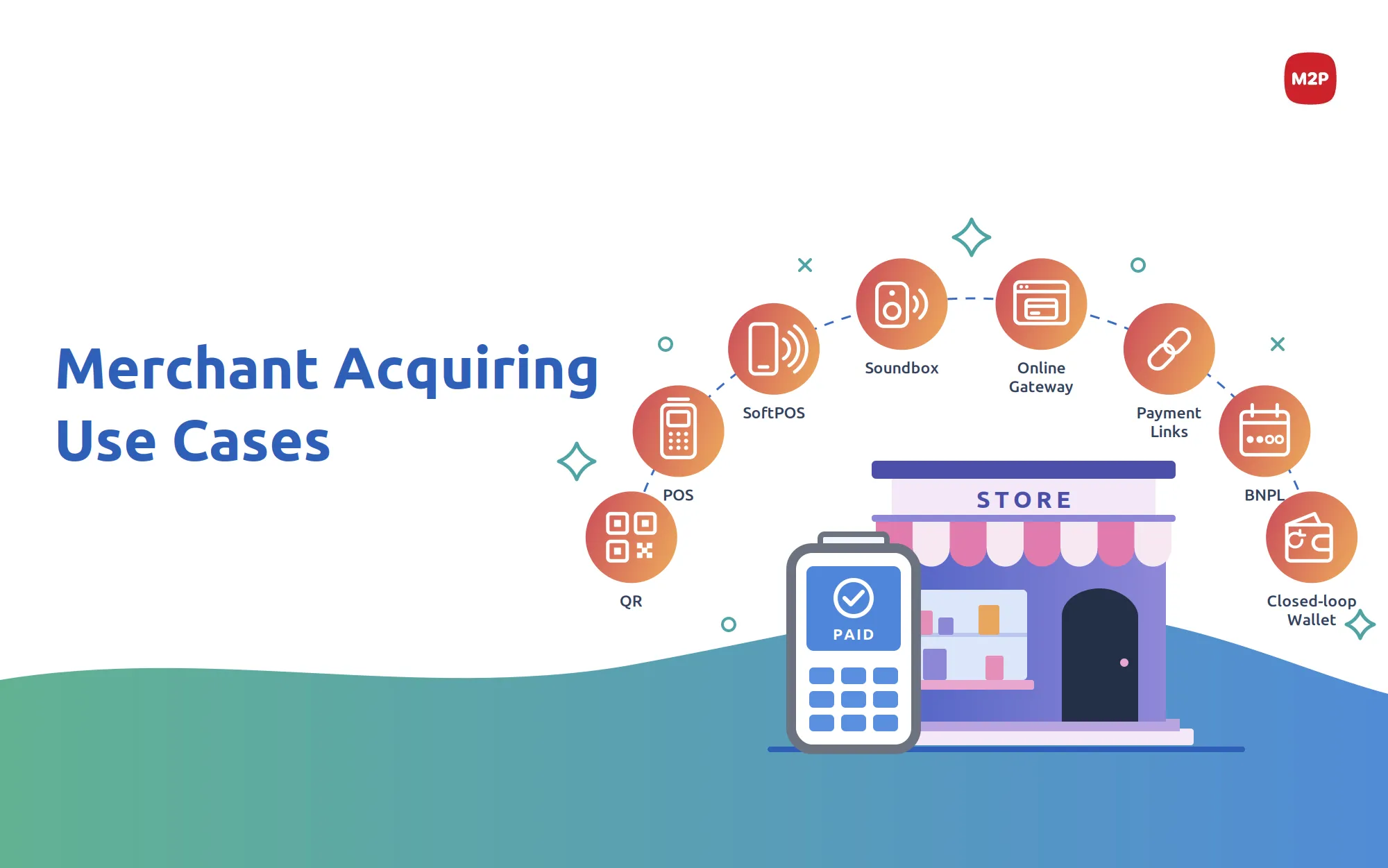
Mobile money, QR and SoftPOS are the strongest entry points, but a full acceptance strategy for Africa draws on the same set of use cases acquirers run elsewhere. Each one has a clear role in African markets.
Soundbox. A connected speaker that announces each payment out loud, paired with a merchant's QR code. For busy counters and merchants who are wary of digital payments, a spoken confirmation builds trust and cuts disputes. It also gives the acquirer a physical presence at the counter, which helps with retention.
POS terminals. Card terminals remain essential for supermarkets, fuel stations, hotels, hospitals and larger retailers. Modern Android terminals can accept cards, QR and mobile money on one device, which suits markets with mixed payment habits. In Nigeria, POS terminals also power large agent banking networks.
Online payment gateway. E-commerce, travel, education, insurance and government services all need online checkout. In Africa, a gateway has to offer mobile money and bank transfer alongside cards, and card transactions need 3-D Secure authentication.
Payment links. Many African small businesses sell through WhatsApp, Instagram and Facebook rather than websites. Payment links let them collect payment through a hosted page that offers mobile money, bank transfer and card options, without building a store.
BNPL. Point-of-sale credit for phones, appliances, solar kits, school fees and farm inputs is a growing segment. Short-term inventory credit for merchants is growing too. For acquirers, the opportunity lies in combining acceptance data with lending partners to offer instalments at checkout.
Closed-loop wallets. Universities, transport operators, estates, corporate campuses and event venues can run closed-loop wallets for payments within their own ecosystems. These are simpler to operate than open-loop instruments and keep spend data inside the ecosystem, though they still carry regulatory requirements in most markets.
These use cases look different at the counter, but they draw on the same core capabilities. KYC / KYB, onboarding and merchant management are common to all of them. The card-based channels add the acquiring switch, 3DSS and tokenization, while the mobile-first channels rely on wallet and instant payment connectivity instead.
Use case | KYC / KYB | Onboarding | Merchant mgmt system | Issued instruments | Acquiring switch | 3DSS | Tokenization | Fraud (FRM) |
|---|---|---|---|---|---|---|---|---|
Mobile money acceptance | ● | ● | ● | ○ | ○ | |||
QR payments | ● | ● | ● | ○ | ○ | |||
Soundbox | ● | ● | ● | ○ | ○ | |||
SoftPOS | ● | ● | ● | ○ | ● | ● | ○ | |
POS payments | ● | ● | ● | ○ | ● | ● | ○ | |
Online payment gateway | ● | ● | ● | ○ | ● | ● | ● | ○ |
Payment links | ● | ● | ● | ○ | ● | ● | ● | ○ |
BNPL | ● | ● | ● | ● | ○ | |||
Closed-loop wallet | ● | ● | ● | ● | ○ |
● Included · ○ Optional · blank = not required
In African markets, the mobile money, QR and soundbox rows also depend on connections to mobile money operators and national instant payment switches. Online gateways and payment links usually need the same connections to offer wallet and bank transfer options alongside cards.
The opportunity is large, but the execution challenges are real. Acquirers that plan for them early will scale faster.
Onboarding informal merchants. Many small businesses lack registration documents and formal bank accounts. Risk-tiered KYB, digital ID checks where national ID systems allow them, and limits that grow with transaction history help bring these merchants in without taking on undue risk.
Interoperability varies by market. Some countries have mature instant payment systems and national QR standards, while others are still building them. An acquiring platform needs flexible integrations to connect with mobile money operators, switches and card networks country by country.
Regulation is market-specific. Licensing for payment service providers, rules on agent networks, QR standards, data localisation and data protection all differ across African markets. A platform should be configurable per country rather than built for one regulatory model.
Fraud is rising alongside adoption. As reported from the GSMA's 2026 survey, identity fraud affected 90% of mobile money providers and social engineering affected 88%. Acquirers need real-time monitoring of both transactions and merchant behaviour, across every channel.
Connectivity and device constraints. Acceptance points must cope with patchy networks and lower-end devices. Lightweight apps, offline-tolerant flows where allowed, and instant confirmations through SMS or soundbox announcements all help.
Settlement and liquidity. Small merchants depend on quick access to their takings. Same-day or instant settlement, to a bank account or a wallet, is often a deciding factor when a merchant picks an acquirer.
M2P's merchant acquiring stack is built as a set of composable building blocks: KYC / KYB, digital onboarding, a merchant management system, issuance, an acquiring switch, a 3DS server, tokenization and fraud risk management. Banks, acquirers and payment service providers in Africa can start with the channels their market needs most and add others as acceptance matures.
In practice, that could mean:
A bank in a mobile-first market starting with QR and mobile money acceptance for small merchants, then adding SoftPOS for card-carrying customer segments
An acquirer in a card-heavy market running POS and online gateway acceptance, then extending to QR and payment links to reach smaller merchants
An ecosystem operator such as a university, transport network or corporate campus launching a closed-loop wallet with its own merchant network
Because every channel runs on the same merchant record, onboarding, settlement and reconciliation layer, adding a new acceptance channel is a matter of configuration rather than a new integration. Fraud monitoring also sees the merchant across every channel, not just one.
M2P already works with banks in Africa, including a leading Bank in Nigeria on card authentication (ACS), so it understands the regional context of compliance, scale and local partnerships.
Africa has already built the hardest part of a digital payments economy: hundreds of millions of people holding money on their phones, and a growing web of instant payment rails connecting them. The next step is merchant acceptance, and it will not be won by copying card-first models.
Acquirers that lead with mobile money, interoperable QR and hardware-light SoftPOS, and run them on a single modular platform, will be best placed to bring Africa's merchants into the digital economy.
To explore how M2P's merchant acquiring building blocks can support your Africa acceptance strategy, talk to our team.
What is merchant acquiring in Africa? It is the business of enabling African merchants to accept digital payments and settling the funds to them. Unlike card-first markets, African acquiring has to support mobile money, QR and instant bank transfers alongside cards.
Why is card acceptance alone not enough in Africa? Many consumers hold their money in mobile money wallets rather than card-linked bank accounts. A merchant that accepts only cards misses a large share of potential digital customers.
How do QR payments work with mobile money in Africa? The merchant displays a QR code and the customer scans it with a banking or mobile money app. In markets with national QR standards, such as Ghana and Kenya, one code can accept payments from several banks and wallets.
Is SoftPOS available in African markets? Yes. SoftPOS solutions are live in markets including Nigeria, South Africa and Egypt. Availability depends on local regulation and on card network certification.
How can acquirers onboard informal merchants? Risk-tiered KYB, digital ID verification where available, and transaction limits that rise with a merchant's track record let acquirers onboard small businesses safely.
Can one platform serve different African markets? Yes, if it is modular and configurable per country. Shared onboarding, merchant management and risk layers can sit on top of market-specific connections to mobile money operators, switches and card networks.
#MerchantManagementSystem #MerchantAcquiring #Payments #Africa #Nigeria #Kenya #SouthAfrica #Zimbabwe #Egypt
Fintech is evolving every day. That's why you need our newsletter! Get the latest fintech news, views, insights, directly to your inbox every fortnight for FREE!