

M2P Fintech
Fintech is evolving every day. That's why you need our newsletter! Get the latest fintech news, views, insights, directly to your inbox every fortnight for FREE!
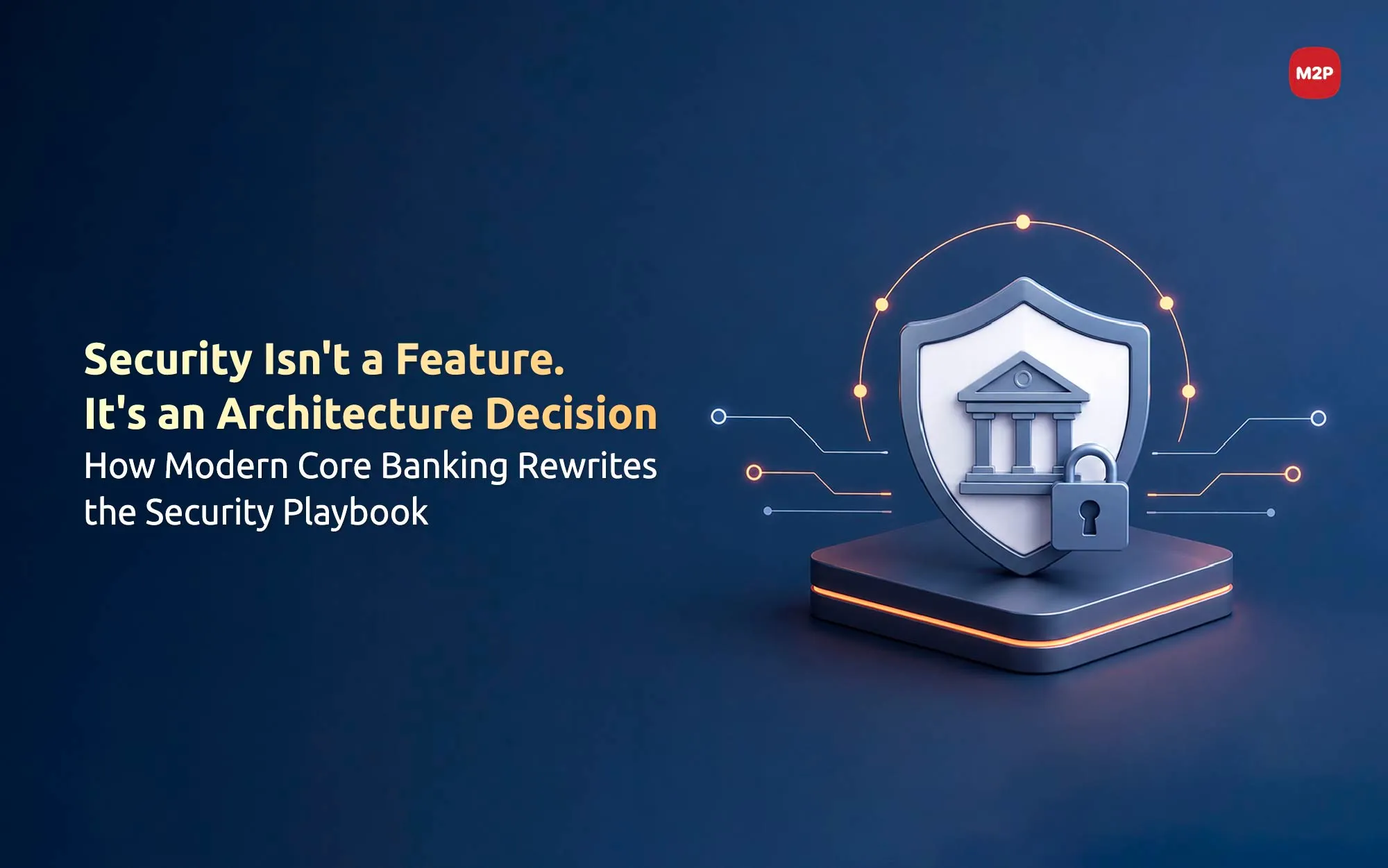
Every core banking system, no matter how old or new, exists to do one thing above all else: protect and process money and data safely. Security has always been non-negotiable in banking technology. What has changed dramatically is the nature of the threats — and, just as importantly, the architecture that either shrinks or expands the space in which those threats can operate.
For years, "secure" in core banking meant thick perimeters: firewalls, air-gapped data centers, and monolithic systems locked away behind layers of physical and network security. That model made sense when banking was a closed, on-premise world. But today's banking ecosystem is API-driven, cloud-hosted, mobile-first, and deeply interconnected with third parties — payment gateways, fintech partners, aggregators, and embedded finance players. The old perimeter-based security model doesn't just struggle to keep up with this world; in many ways, it actively works against it.
This is where the concept of attack surface becomes central to any serious conversation about core banking security. Attack surface refers to the total sum of points in a system where an unauthorized user could try to enter, extract data, or cause disruption. The bigger and more tangled the surface, the more places there are to defend — and the more places an attacker can probe for weakness.
This blog examines why legacy core banking systems tend to carry a larger, harder-to-defend attack surface, how modern, cloud-native, and composable architectures fundamentally shrink that surface, and what this means for banks, NBFCs, and fintechs choosing their next core banking partner.
In the context of a core banking system, attack surface isn't just about firewalls and passwords. It spans several dimensions:
Code surface — the total volume and complexity of code that could contain exploitable vulnerabilities. Larger, older codebases with decades of patches and extensions tend to have more of this.
Integration surface — every point where the core banking system connects to another system: payment switches, mobile banking apps, credit bureaus, regulatory reporting tools, third-party fintech APIs. Each connection point is a potential entry vector.
Access surface — every account, credential, role, and privilege that can be used to interact with the system, including administrative and vendor-support access.
Infrastructure surface — the physical and virtual infrastructure the system runs on: servers, networks, data centers, cloud regions, containers.
Human surface — the people who operate, maintain, and support the system, and the processes (or lack thereof) governing what they can access and change.
Every one of these dimensions is shaped directly by the architecture of the core banking system itself. And this is where legacy and modern platforms diverge sharply.
Many legacy core banking systems were originally built in the 1980s, 90s, or early 2000s, often on mainframe or early client-server architecture. Over the decades, as banks demanded new features — mobile banking, new payment rails, new regulatory reports — vendors layered new modules and integrations on top of the original core, rather than rearchitecting from the ground up.
The result is a codebase that has grown enormously in size and complexity, often combining multiple programming languages and generations of technology within the same system. Every additional layer of legacy code is also an additional layer of potential vulnerability — old code that may not have been written with modern security practices in mind, and that is often poorly documented decades after its original authors have moved on.
Traditional core banking systems are typically monolithic: the ledger, customer management, lending, deposits, and channel integrations are tightly coupled within a single system. This design has a serious security implication — if an attacker compromises one part of the system, especially at the infrastructure or database layer, they often gain a path toward the rest of the monolith. There are fewer internal boundaries to contain a breach.
Modern architectures, in contrast, are typically built as a set of decoupled services, each with its own scope, credentials, and boundaries. A compromise in one service doesn't automatically grant access to everything else.
Older core banking systems frequently rely on integration methods that predate modern API security standards — batch file transfers, proprietary messaging formats, or point-to-point connections that were never designed with encryption, tokenization, or granular access control in mind. Retrofitting these with modern security wrappers is possible, but it's an ongoing patchwork exercise rather than a built-in design principle.
Legacy systems, having been in production for years or decades, often accumulate a long tail of privileged accounts — vendor support access, contractor credentials, old administrative accounts that were never fully decommissioned. Every dormant or over-privileged account is a potential foothold for an attacker, and legacy environments are notorious for this kind of access sprawl simply because of how long they've been running and how many hands have touched them.
Because legacy core banking systems are often deeply customized per bank, applying a security patch isn't as simple as pushing an update. Banks frequently have to test patches extensively against their specific customizations before deployment, which can delay critical security fixes for weeks or months — a window during which known vulnerabilities remain exploitable.
While on-premise infrastructure is sometimes assumed to be inherently more secure because it's "in the bank's own hands," in practice, most banks are not infrastructure security specialists at the level that hyperscale cloud providers are. Physical data centers require significant, continuous investment in physical security, redundancy, patching, and monitoring — investment that many banks, particularly smaller ones, struggle to sustain at the same level as dedicated cloud infrastructure providers with globally distributed security operations centers.
Modern, cloud-native, and composable core banking platforms are built on fundamentally different design principles — and those principles translate directly into a smaller, more defensible attack surface.
Rather than one giant monolith, modern core banking platforms are typically composed of independent microservices — separate services for ledger management, customer onboarding, lending, payments, and so on. Each microservice has its own defined scope, its own access controls, and its own security boundary.
This has a direct security benefit: if one service is compromised, the "blast radius" of that compromise is contained. An attacker who breaches the payments service, for instance, doesn't automatically gain access to the lending engine or the core ledger. This containment principle — sometimes called the "principle of least privilege" applied at the architectural level — is one of the single biggest security advantages of modern core banking design.
Modern core banking systems are built API-first, using contemporary standards like OAuth 2.0, mutual TLS, and granular scopes for every integration point. Rather than retrofitting security onto old integration patterns, these standards are baked into the platform from day one. Every API call can be authenticated, authorized, logged, and rate-limited by design, rather than by exception.
This also makes it possible to enforce consistent security policy across every integration — third-party fintech partners, mobile apps, payment gateways — rather than relying on a patchwork of different security models for different legacy connection types.
Leading cloud infrastructure providers invest enormous, continuous resources into physical security, network security, encryption, threat detection, and compliance certifications — resources that few individual banks could replicate on their own. Cloud-native core banking platforms that are properly architected can inherit these infrastructure-level protections: encryption at rest and in transit by default, automated patching, continuous vulnerability scanning, and rapid incident response capability.
Importantly, this is not the same as simply "lifting and shifting" a legacy system onto a cloud server. True cloud-native design means the application itself is built to take advantage of cloud-native security tooling — identity and access management, secrets management, network segmentation, and automated compliance monitoring — rather than just running old code on newer hardware.
Because modern core banking platforms are built with modular, containerized services and automated deployment pipelines, security patches can be tested and rolled out far more quickly and with far less risk of breaking unrelated functionality. Continuous integration and deployment (CI/CD) pipelines, combined with automated testing, mean vulnerabilities can be identified and patched in a matter of days, not months — dramatically shrinking the window of exposure.
Modern architectures are far better suited to implementing zero trust security models, where no user, service, or device is trusted by default — every request must be continuously verified, regardless of whether it originates inside or outside the network perimeter. Combined with role-based and attribute-based access control, this allows banks to enforce precise, least-privilege access for every employee, partner, and system component, drastically reducing the risk of privileged access abuse.
Composable, cloud-native systems are typically designed with comprehensive logging, monitoring, and observability built in from the start. This makes it far easier to detect anomalous behavior in real time — unusual transaction patterns, unexpected access attempts, or API abuse — and respond before a small incident becomes a major breach. Legacy systems, by contrast, often have inconsistent or incomplete logging across their many bolted-on layers, making early threat detection significantly harder.
Modern banking doesn't happen in isolation. Banks and fintechs today operate within a dense ecosystem of partners — payment processors, lending marketplaces, embedded finance platforms, credit bureaus, and more. Every one of these relationships involves a data or system connection, and every connection is a potential attack vector if not properly secured.
This is precisely where API-first, modern core banking architecture provides a structural advantage. Rather than exposing broad, loosely governed integration points (as many legacy systems do, often via custom middleware built to bridge old systems with new demands), modern platforms can expose narrowly scoped, well-governed APIs for each specific partner use case. Each partner gets exactly the access they need — no more — and every interaction is logged, monitored, and revocable independently.
Security should never be treated as a feature to compare on a checklist alone — it needs to be evaluated as a property of the underlying architecture. When evaluating a core banking provider, institutions should ask:
Is the system built on microservices, or is it a monolith with cloud hosting bolted on? These are fundamentally different risk profiles, even if both are technically "in the cloud."
How are integrations secured — modern API standards, or legacy connection methods wrapped in newer interfaces?
How quickly can the vendor deploy security patches, and what has their historical patch cadence looked like?
What does the privileged access model look like — both for the bank's own staff and for the vendor's support teams?
What level of security certification and independent audit does the vendor maintain, and how frequently are penetration tests conducted?
How is the blast radius of a potential breach contained architecturally — is there true service isolation, or shared infrastructure with limited internal segmentation?
What visibility and control does the bank retain over third-party and partner access to core banking data?
It's worth emphasizing that no core banking architecture — legacy or modern — is inherently and permanently secure. Security is a continuous discipline that requires ongoing investment, monitoring, and adaptation as threats evolve. What modern architecture provides is not a guarantee of perfect security, but a structural foundation that makes strong security practices far easier to implement, maintain, and scale over time.
A smaller, well-segmented attack surface, built-in modern authentication standards, rapid patching capability, and strong observability don't eliminate risk — but they meaningfully reduce the probability and potential impact of a successful attack, and they make it dramatically easier for banks to demonstrate robust security posture to regulators, partners, and customers alike.
The banking industry's security challenge has fundamentally changed shape. It's no longer just about building higher walls around a fixed perimeter — it's about managing a constantly evolving web of services, APIs, partners, and data flows, each of which represents a potential point of exposure. Legacy core banking systems, built for a different era of banking, tend to carry larger, more fragmented, and harder-to-defend attack surfaces as a direct consequence of their monolithic design, accumulated complexity, and slower ability to adapt.
Modern, cloud-native, and composable core banking architecture addresses this challenge at a structural level — containing blast radius through microservices, enforcing consistent security standards through API-first design, and enabling faster, lower-risk patching and stronger observability. For banks, NBFCs, and fintechs operating in an increasingly interconnected and threat-dense environment, the architecture of their core banking system is no longer just a technology decision — it is one of the most important security decisions they will make.
Choosing a core banking partner today means choosing an architecture that treats security not as a bolt-on feature, but as a foundational design principle — one built to shrink the attack surface as the banking ecosystem around it continues to expand.
As regulators, customers, and partners demand stronger security and operational controls, financial institutions need a core banking platform that is secure by design. M2P's Turing Core Banking Platform incorporates modern architectural principles and industry-aligned security and compliance frameworks to help institutions manage risk more effectively while accelerating innovation.
Talk to M2P's experts today to see how Turing Core Banking can help your organization reduce risk, strengthen compliance, and confidently scale in a rapidly evolving financial ecosystem.
Fintech is evolving every day. That's why you need our newsletter! Get the latest fintech news, views, insights, directly to your inbox every fortnight for FREE!