

M2P Fintech
Fintech is evolving every day. That's why you need our newsletter! Get the latest fintech news, views, insights, directly to your inbox every fortnight for FREE!
Every bank, NBFC, fintech, insurer, and increasingly every government service desk in India runs on the same underlying question: is this person who they say they are? The answer used to take days and a stack of photocopies. Today, it's expected to take seconds — without compromising on compliance, fraud prevention, or customer experience.
That shift is why "KYC software" has become one of the most searched terms in Indian BFSI technology procurement. But the term hides a lot of complexity. Search for it and you'll find a dozen vendors, a dozen acronyms — CKYC, eKYC, VKYC, AUA, KUA — and very little that actually explains how these pieces fit together, what to look for before buying, or what problems still don't have great answers.
This guide is meant to be the reference point. It covers what KYC software actually is, the components that make up a complete stack, the evaluation questions most buyers don't think to ask, the compliance landscape it has to operate inside, and where the category is headed next.
KYC(Know Your Customer) is a regulatory requirement, not a product. KYC software is the technology layer that lets a regulated institution meet that requirement digitally: capturing a customer's identity, verifying it against authoritative sources, checking it for fraud or tampering, and maintaining an auditable record, all without a human being physically checking a photocopy of a PAN card.
In India, this has a specific technical shape because of two connected but distinct government identity infrastructures:
CKYC (Central KYC Registry) — a central repository (maintained by CERSAI) that stores KYC records once and lets any regulated entity retrieve them instantly, rather than re-collecting the same documents every time a customer opens a new account elsewhere.
Aadhaar-based eKYC — verification against UIDAI's Aadhaar database, accessed through licensed AUA/KUA (Authentication User Agency / KYC User Agency) integrations.
Everything else in a modern KYC software stack — video verification, document OCR, biometric matching, fraud scoring, masking — exists to make those two verification paths faster, more secure, and usable across more channels (web, app, branch, call centre, kiosk).
If you're evaluating KYC software for the first time, the acronyms are the first wall you hit. Here's what each piece actually does and when you need it — because in practice, most institutions need several of these working together, not just one.
Pulls a customer's existing KYC record using their OVD (officially valid document) number, date of birth, and mobile number. If the customer has ever completed KYC anywhere in the regulated financial system, this can complete onboarding almost instantly — no fresh document upload needed. This is usually the first check a well-designed KYC software flow should attempt, since it's the fastest and cheapest path when it hits.
When there's no CKYC record to retrieve, Aadhaar-based authentication is the next layer — verifying identity via OTP, fingerprint, face, or iris, and fetching demographic data (name, DOB, address, photograph) directly from UIDAI. This requires the vendor to hold live AUA/KUA licensing, not just claim "Aadhaar integration" — a distinction worth confirming during vendor evaluation, since sub-licensing arrangements vary in reliability and audit-readiness.
RBI's video-based customer identification process (V-CIP) allows fully remote, branch-free onboarding — a human or AI-assisted agent verifies the customer's live video, checks document authenticity, and confirms liveness, all in one session. This matters enormously for lenders and neobanks trying to acquire customers in geographies where opening a physical branch isn't viable, and for institutions that need to serve customers without reliable Aadhaar OTP access (NRIs, elderly customers, low-connectivity regions).
A lesser-known but increasingly important option: a CKYC-driven onboarding path that doesn't require Aadhaar verification at all. This exists for use cases where full KYC can be completed later (e.g., certain prepaid instruments, small-value accounts) and matters for products that need to go to market fast, in geographies or customer segments where Aadhaar-linked onboarding adds friction or isn't the ideal first step. It's rarely discussed in KYC software marketing, but it's often the fastest, cheapest onboarding path available for eligible use cases.
Beyond identity, many onboarding flows also need to check employment history, court records, and address — particularly for lending, hiring, and high-value account opening. Paperless, consent-driven background checks reduce this from a multi-day manual process to something that runs inline with digital onboarding.
A narrower but non-negotiable requirement under UIDAI rules: any entity storing or displaying Aadhaar numbers must mask the first eight digits. Good KYC software handles this automatically and extends it to custom document formats — not just standard Aadhaar cards — since institutions often need to mask Aadhaar numbers embedded in other scanned documents too.
For engineering teams building bespoke onboarding flows rather than adopting an off-the-shelf journey, granular APIs matter more than a packaged UI: liveness detection, OCR extraction, face match, GST/KYB (Know Your Business) checks, crime record checks, and AML screening as individually callable services. This is the layer that lets a product team compose their own flow instead of being boxed into a vendor's default journey.
Most KYC software comparisons stop at "does it do Aadhaar eKYC and Video KYC." That's table stakes. The questions that actually differentiate vendors — and that most vendor pages, including product pages across the industry, don't answer clearly — are these:
1. Fraud detection accuracy, not just fraud detection claims. Almost every vendor claims "AI-powered fraud detection." Few publish what that means in practice: false-positive rates, spoofed-image detection accuracy, deepfake resilience for video KYC, and how forensic checks perform against real attack patterns (photo-of-photo, screen replay, synthetic identity documents). When evaluating a KYC software vendor, ask for these numbers directly, or for reference customers who can speak to fraud outcomes post-implementation — not just onboarding-speed outcomes.
2. On-premise vs. cloud availability. Cloud-only KYC software is the default assumption in most vendor pitches, but it's a dealbreaker for public sector institutions, PSU banks, and any entity with data-residency or air-gapped infrastructure mandates. A vendor that genuinely supports both cloud and on-premise deployment — not just "can be discussed" — is solving a real, underserved requirement.
3. Total cost of ownership, beyond the per-transaction rate. Per-verification pricing is easy to compare; what's harder to see upfront is the cost of integration effort, the cost of maintaining compliance as regulations change, and the operational cost of handling verification failures and manual review queues. A lower headline rate with a higher failure/fallback rate can cost more in practice. Ask vendors for real fallback-rate and manual-review-rate data, not just headline accuracy claims.
4. Coverage beyond Aadhaar, if you operate outside India or serve NRI/foreign-national customers. Aadhaar-centric KYC software is built for the Indian resident use case. If your institution serves NRIs, foreign nationals, or operates in other markets, ask explicitly how the platform handles non-Aadhaar identity documents (passports, foreign national IDs) and whether that capability is native or requires a separate integration. This is a genuine gap across most Indian KYC software vendor pages, ours included as of today — and one worth pressing on directly in RFPs, since the answer varies a lot between vendors who've actually built for it and vendors who haven't.
5. Compliance depth: RBI Master Direction, UIDAI audit checklist, and DPDP Act. KYC software doesn't operate in a compliance vacuum. It needs to satisfy RBI's KYC Master Direction (record-keeping, risk categorization, periodic updation), UIDAI's audit checklist for any Aadhaar-linked processing, and increasingly, the Digital Personal Data Protection (DPDP) Act's consent and data-minimisation requirements. Ask any vendor how their audit trail, consent logging, and data retention policies map to all three — not just RBI.
6. Low-code/no-code configurability vs. rigid pre-built flows. Institutions with in-house product teams often want to configure onboarding journeys — reordering steps, adding conditional logic, swapping verification methods by customer segment — without a fresh engineering sprint every time. Whether a KYC software platform offers genuine no-code workflow building, or just customization via vendor professional services, materially changes how fast you can iterate post-launch.
A pattern worth naming explicitly: most institutions didn't set out to buy "a KYC suite." They bought Aadhaar eKYC from one vendor, added Video KYC from another when RBI's V-CIP norms landed, bolted on a background-verification tool for lending use cases, and built Aadhaar masking in-house or through a fourth integration.
The result, a few years in, is a fragmented identity stack: multiple vendor contracts, multiple compliance audits, multiple points of integration failure, and no single, coherent view of a customer's verification history across products.
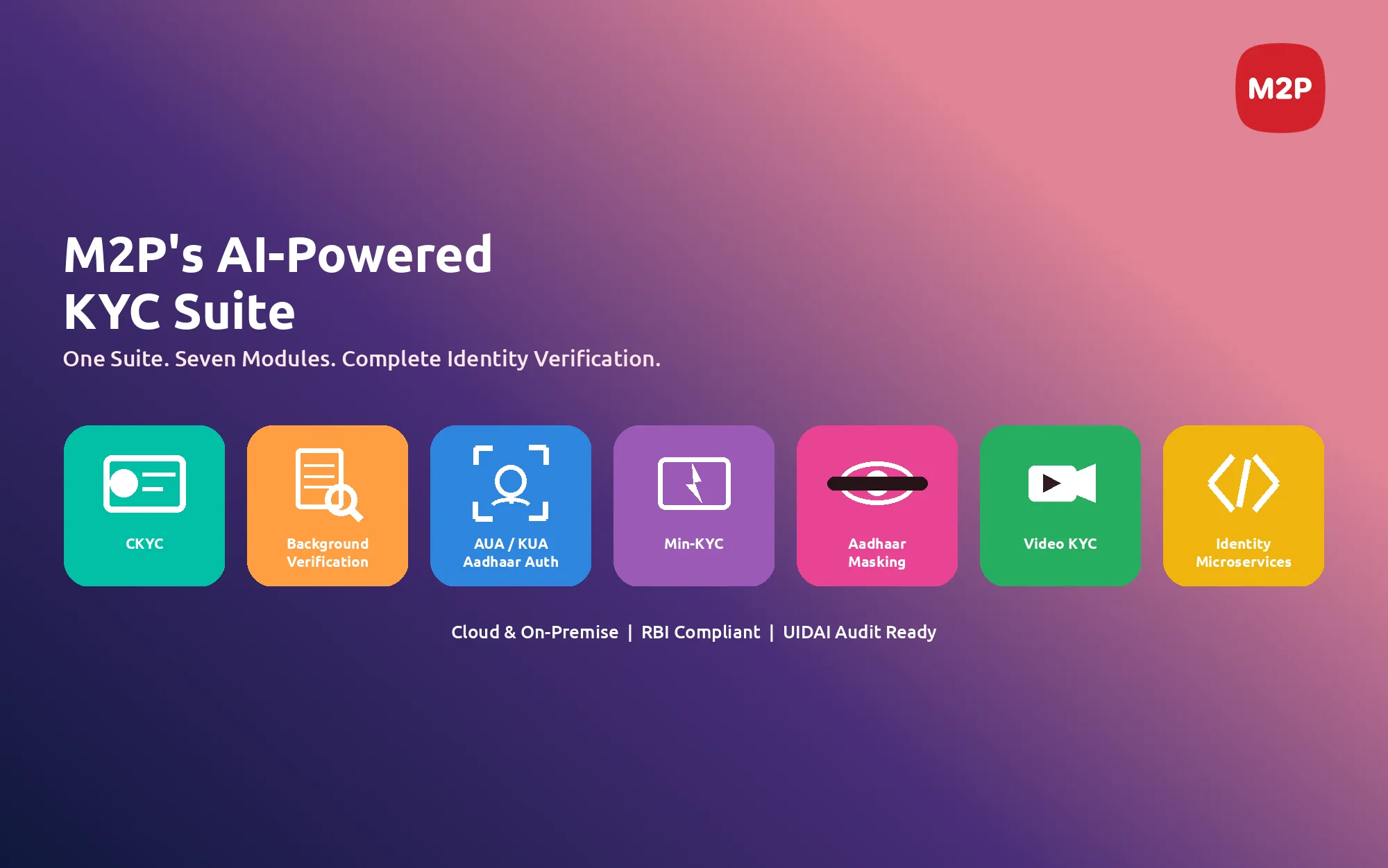
Consolidating onto a single KYC software platform — one that covers CKYC, Aadhaar eKYC, Video KYC, Min-KYC, masking, background verification, and identity microservices under one contract, one dashboard, and one audit trail — isn't just a cost play. It removes the integration overhead of maintaining multiple vendor relationships, gives compliance teams one place to pull audit records from, and lets product teams reuse the same identity infrastructure across new products (lending, cards, neobanking, merchant onboarding) instead of re-procuring for each one.
A few shifts worth watching over the next few years:
Agentic AI in verification workflows. Beyond rules-based fraud flags, AI models that can reason across a full onboarding session — cross-referencing document data, liveness signals, and behavioural patterns — are starting to move from research to production in identity verification.
Deeper video KYC automation. Fully AI-assisted VKYC sessions (reducing dependency on live human agents for routine cases, while retaining human review for edge cases) are becoming a genuine efficiency lever for high-volume onboarding.
Convergence with AML and fraud monitoring. KYC software and fraud/AML systems have historically been separate purchases; the operational logic for combining them — shared identity signals, shared risk scoring — is increasingly hard to ignore.
Government and public-sector adoption. Digital identity verification is expanding well beyond BFSI into direct citizen service delivery, welfare disbursement, and public-sector onboarding — a segment most KYC software vendors aren't built to serve at that scale or compliance bar.
M2P's KYC Suite is built around the consolidation logic described above — CKYC retrieval, Aadhaar-based AUA/KUA authentication, Video KYC (available on both cloud and on-premise), Min-KYC, Aadhaar masking, instant background verification, and identity microservices, all accessible through a single low-code/no-code platform with one audit trail.
It's currently used by 75+ BFSI institutions and 5 state governments, processing 3.8 billion digital identification transactions and 10–13 million verifications a day — a scale that reflects both consumer fintech and public-sector deployment, which is a meaningfully different bar than consumer-only KYC software vendors are built to clear.
If you're a bank, NBFC, fintech, or government body evaluating what to consolidate onto — or simply trying to move past the CKYC-vs-eKYC-vs-VKYC confusion this guide opened with — it's worth a closer look at the KYC Suite and a conversation with the team about which modules map to your actual onboarding gaps.
Tags
Fintech is evolving every day. That's why you need our newsletter! Get the latest fintech news, views, insights, directly to your inbox every fortnight for FREE!