

M2P Fintech
Fintech is evolving every day. That's why you need our newsletter! Get the latest fintech news, views, insights, directly to your inbox every fortnight for FREE!
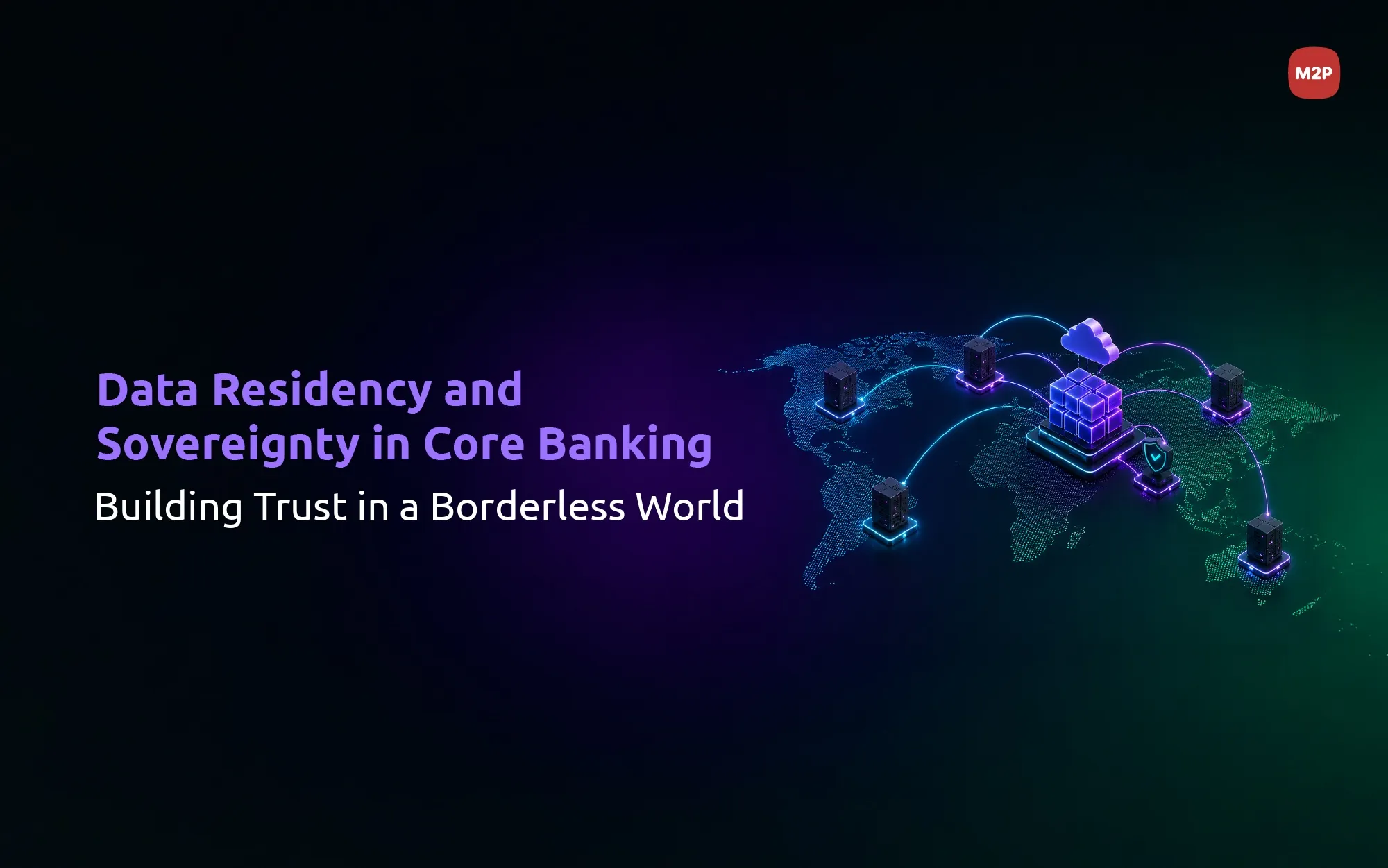
For decades, core banking systems were built around a simple assumption: data lived wherever the bank's data center happened to be. A bank in Mumbai kept its data in Mumbai. A bank in Frankfurt kept its data in Frankfurt. There was little ambiguity because there was little choice — infrastructure was physical, on-premise, and geographically fixed by default.
Cloud computing changed all of that. The same elasticity, scalability, and cost efficiency that make cloud-native core banking systems attractive also introduced a new and thorny question: where, exactly, does customer data live — and who has the right to access it?
This question has moved from a technical footnote to a boardroom and regulatory priority. Central banks, financial regulators, and data protection authorities across the world are tightening rules around where financial data can be stored, processed, and transferred. For banks, NBFCs, fintechs, and the core banking vendors that serve them, data residency and sovereignty are no longer compliance checkboxes — they are strategic considerations that shape vendor selection, cloud architecture, and market expansion plans.
In this blog, we unpack why data residency and sovereignty have become such a pressing concern, how regulators around the world are responding, what it means for core banking system (CBS) providers old and new, and how financial institutions should evaluate their core banking partners through this lens.
These three terms are often used interchangeably, but they mean distinct things — and the distinction matters when evaluating a core banking platform.
Data Residency refers to the physical or geographic location where an organization's data is stored. A bank may choose, or be required, to store its data within a specific country or region. This is often a matter of policy or contractual choice rather than law.
Data Sovereignty goes a step further. It means that data is subject to the laws and governance structures of the country in which it is collected or stored — regardless of where the company that owns the data is headquartered. This includes questions like: Can a foreign government compel disclosure of this data under its own laws? Which legal jurisdiction governs disputes over this data?
Data Localization is the regulatory mandate version of residency — a legal requirement, often written into law, that certain categories of data must be stored (and sometimes processed) within national borders, with no exceptions.
For core banking systems specifically, all three concepts collide. A CBS handles some of the most sensitive data an institution holds: customer KYC records, transaction histories, account balances, credit information, and behavioral data. Where this data sits, who can access it, and under whose legal authority it falls has direct implications for regulatory compliance, national security, and customer trust.
Several converging forces have pushed data residency and sovereignty to the top of the regulatory agenda.
Most modern core banking platforms — including cloud-native and composable systems — are built on public cloud infrastructure from hyperscalers like AWS, Microsoft Azure, and Google Cloud. These providers operate global data center networks, and by default, data can be replicated, backed up, or processed across multiple regions for redundancy and performance.
This is excellent for uptime and disaster recovery, but it creates a governance problem: a bank's core banking data might technically pass through, or be backed up in, a jurisdiction the regulator never approved. Regulators have taken notice, and many now require explicit assurances — and sometimes contractual guarantees — about where core banking data physically resides at every point in its lifecycle.
The world's approach to data governance is no longer converging — it's fragmenting. Trade tensions, national security concerns, and data protectionism have led more countries to treat financial data as a strategic national asset rather than a private commercial matter. When data can cross borders as easily as clicking "deploy," but sovereignty still runs along national lines, tension is inevitable.
This is compounded by extraterritorial laws such as the U.S. CLOUD Act, which allows U.S. authorities to compel U.S.-based cloud providers to hand over data even if it's stored outside the United States. For regulators in other countries, this raises a legitimate concern: if a bank's core banking data sits on infrastructure provided by a U.S. hyperscaler, could a foreign government access it under U.S. law, irrespective of local data protection rules?
Every major cloud outage or cross-border data breach reignites the sovereignty debate. When a global cloud region goes down and banking services in an unrelated country are disrupted, regulators start asking harder questions about concentration risk, vendor lock-in, and the wisdom of allowing critical financial infrastructure to depend entirely on infrastructure controlled by a handful of foreign companies.
Since the EU's GDPR set the template in 2018, dozens of countries have followed with their own data protection and localization frameworks — India's DPDP Act, Nigeria's NDPR, Indonesia's PDP Law, Saudi Arabia's PDPL, and many others. Each has its own rules on cross-border data transfer, consent, and — in several cases — explicit requirements that certain categories of financial and payments data be stored locally.
Financial regulators, separate from general data protection authorities, have often gone further still. Central banks frequently impose sector-specific rules on top of general data protection law, particularly for systemically important data like payment transaction records and core banking ledgers.
While approaches differ, a few clear regulatory patterns have emerged globally.
Strict localization mandates. Some regulators require that all or specific categories of financial data be stored exclusively within national borders, with no cross-border replication permitted, even for backup or disaster recovery purposes. This is common in payment systems data across several markets in Asia, the Middle East, and Africa.
Conditional cross-border transfer. Many regulators permit data to leave the country only under specific conditions — adequacy agreements, standard contractual clauses, explicit regulator approval, or evidence of equivalent data protection standards in the destination country.
Central bank oversight of outsourcing and cloud arrangements. Beyond data location, many central banks now require banks to notify or seek approval before outsourcing core banking infrastructure to third-party or cloud providers, and to maintain the ability to audit, exit, or repatriate data on demand.
Operational resilience and concentration risk rules. Regulators are increasingly concerned not just about where data sits, but about systemic risk from too many banks depending on the same handful of cloud providers. This has led to resilience testing requirements and, in some markets, explicit rules discouraging single-vendor dependency for critical banking infrastructure.
Data sovereignty as a matter of national policy. In several emerging markets, data sovereignty is tied explicitly to a broader digital sovereignty agenda — a desire to keep the economic and strategic value of financial data within the domestic economy rather than ceding it to foreign infrastructure providers.
The net effect is that a core banking vendor operating across multiple geographies today must navigate a genuinely fragmented and evolving compliance landscape — one that changes faster than most legacy CBS architectures were ever designed to accommodate.
Ironically, many of the traditional, monolithic core banking systems that predate the cloud era were architecturally "sovereign by accident" — they ran entirely on-premise, in a bank's own data center, in the bank's own country. Data residency wasn't a feature; it was simply the only option.
The challenge for legacy vendors today lies elsewhere: as they modernize and push clients toward cloud-hosted versions of their platforms, they often bolt cloud capability onto architecture that wasn't designed with multi-region data governance in mind. Retrofitting granular, jurisdiction-aware data controls onto a decades-old monolithic core is neither quick nor cheap, and it often results in rigid, one-size-fits-all deployment models that don't flex easily across different regulatory regimes.
Newer cloud-native and composable core banking platforms have an architectural advantage — but only if they're designed with data residency as a first-class concern from the outset, rather than an afterthought bolted on to satisfy a specific regulator.
Given this landscape, banks, NBFCs, and fintechs evaluating a core banking provider should go well beyond feature checklists and ask pointed questions about data governance:
Where does the data actually reside — at every stage? Not just primary storage, but backups, disaster recovery sites, logs, analytics pipelines, and any third-party sub-processors involved in the stack.
Can deployment be localized per market? A core banking provider serving multiple countries should be able to deploy region-specific instances that keep each market's data within that market's borders, rather than a single global instance with data flowing freely across regions.
What is the exit and data portability plan? Regulators increasingly require banks to demonstrate they can exit a vendor relationship and repatriate their data without excessive cost or technical lock-in. A credible core banking partner should have a documented, testable exit strategy.
Who has administrative or support access to the data, and from where? Even if data resides in-country, sovereignty can be compromised if a vendor's support or engineering teams access it remotely from another jurisdiction without appropriate controls.
How does the vendor handle sub-processors and hyperscaler dependencies? Understanding the full chain of custody — cloud provider, sub-processors, monitoring tools — is essential to understanding true sovereignty exposure.
Does the platform support jurisdiction-specific configurability? Different markets will have different rules. A rigid, single-configuration core banking system will struggle to keep pace as more countries introduce their own localization requirements.
Data residency and sovereignty concerns, while challenging, also represent a genuine differentiation opportunity for core banking providers that get this right. Institutions expanding across multiple regulatory geographies — as many digital banks, NBFCs, and fintechs are — need a core banking partner that treats in-country deployment, configurable data governance, and regulatory alignment as core product capabilities, not custom engineering projects.
A composable, API-first core banking architecture is inherently better positioned to support this than a legacy monolith. When core banking modules — ledger, customer management, lending, payments — are decoupled and independently deployable, it becomes far more feasible to deploy a fully compliant, in-region instance for each market a bank operates in, without duplicating an entire monolithic stack or compromising on functionality.
This is where the conversation around data sovereignty ultimately connects back to broader themes in core banking modernization: composability, cloud-native design, and regulatory agility aren't just abstract technology trends — they are becoming the practical foundation on which compliant, multi-market banking operations are built.
Data residency and sovereignty will only become more central to core banking strategy in the years ahead. As more countries formalize data protection and localization laws, and as geopolitical dynamics continue to shape how nations think about digital and financial infrastructure, banks will face growing pressure — from regulators, customers, and boards alike — to demonstrate precise control over where their most sensitive data lives and who can access it.
For core banking providers, this is not a problem to be solved once and forgotten. It requires an architecture and an operating model that can adapt continuously as the regulatory map keeps shifting — market by market, law by law. The providers that build this flexibility into their platforms from the ground up will be the ones best positioned to support banks and fintechs as they scale responsibly across borders, without ever losing sight of who ultimately governs their data.
Choosing a core banking partner today means choosing one that understands data residency and sovereignty are not just compliance requirements to satisfy, but a foundational part of how trust is built between banks, their regulators, and their customers.
That’s why data sovereignty and residency are becoming key considerations in every core banking decision. See how M2P is helping banks and fintechs build compliant, future-ready banking infrastructure for a rapidly changing world.

Fintech is evolving every day. That's why you need our newsletter! Get the latest fintech news, views, insights, directly to your inbox every fortnight for FREE!