

M2P Fintech
Fintech is evolving every day. That's why you need our newsletter! Get the latest fintech news, views, insights, directly to your inbox every fortnight for FREE!
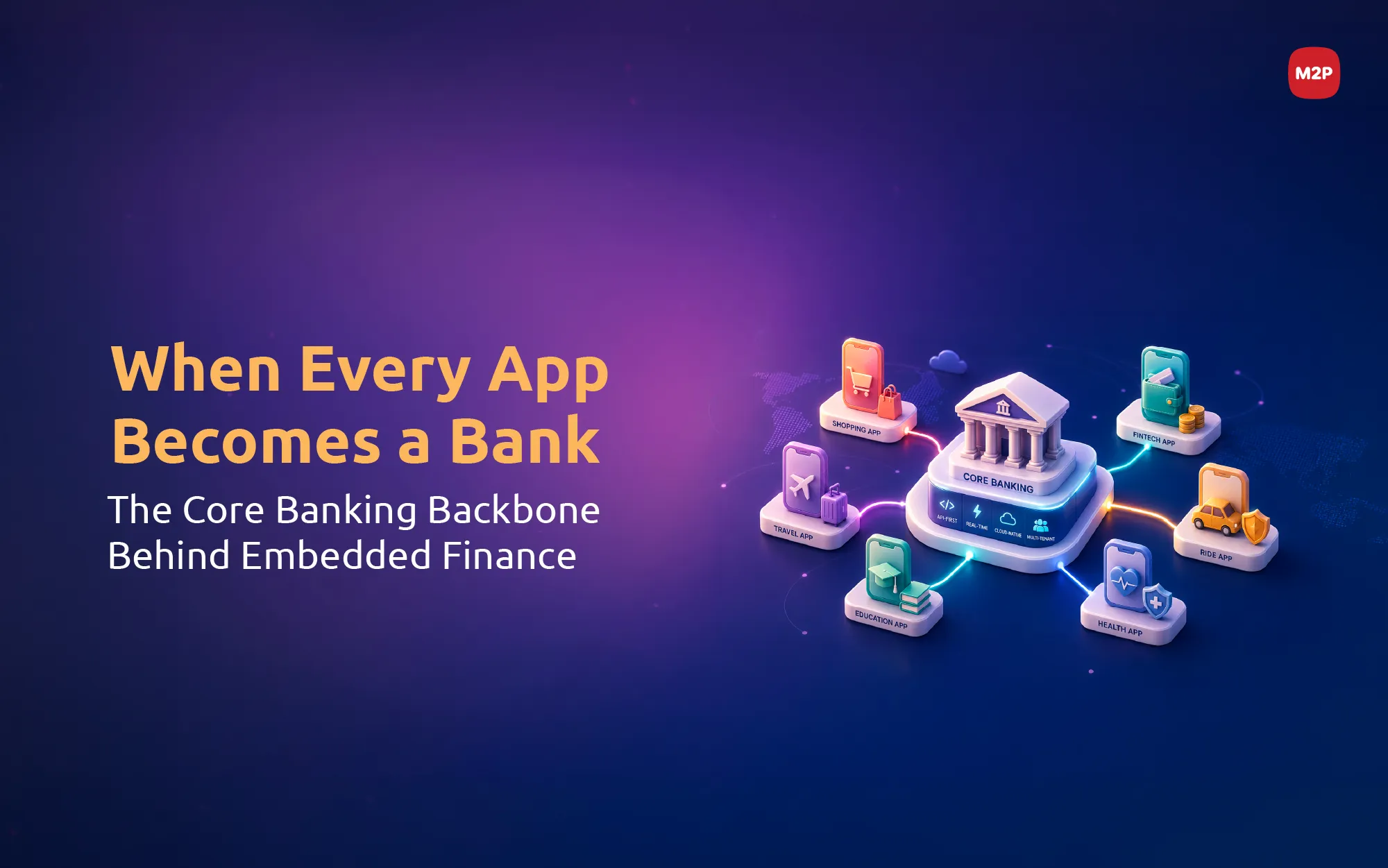
Not long ago, the boundaries in financial services were obvious. Banks provided banking. Retailers sold products. Software companies built software. Each stayed in its own lane, and a customer who wanted a loan, a savings account, or a payment method had to go to a bank to get it.
That world is disappearing fast. Today, you can get a line of credit at checkout on an e-commerce platform, open a savings wallet inside a ride-hailing app, buy insurance while booking a flight, or access working capital financing directly through your accounting software. None of these experiences require the customer to ever "go to a bank" in the traditional sense. This is embedded finance, and it is quietly rewriting the relationship between core banking systems, banks, and the non-financial companies that now sit at the front end of financial experiences.
What makes this shift so consequential is not just that financial services are appearing in new places. It's that the underlying infrastructure, the core banking system is being pulled into an entirely new role. Core banking is no longer just the back-office ledger for a licensed bank. Increasingly, it is the invisible engine powering financial products distributed by brands that have never held a banking license and never intend to.
This blog explores how embedded finance and core banking are converging, why the traditional lines between banks, fintechs, and core banking infrastructure are blurring, what this means for legacy versus modern core banking architecture, and how banks, brands, and fintechs should think about this shift strategically.
Embedded finance refers to the integration of financial products and services viz payments, lending, savings, insurance, cards etc., directly into the customer journey of a non-financial platform, at the exact moment and place the customer needs it, rather than requiring them to seek it out separately from a bank.
A ride-hailing app offering instant driver payouts. An e-commerce platform offering "buy now, pay later" at checkout. A B2B SaaS platform offering embedded business bank accounts to its SME customers. A payroll platform offering earned wage access. In every case, the financial product is not the core business of the platform rather its a value-added layer, embedded seamlessly into an existing customer relationship.
This is possible because of a broader shift in financial infrastructure: Banking-as-a-Service (BaaS). Licensed banks or regulated entities partner with technology providers to expose their banking capabilities: account creation, card issuance, payments, lending etc. via APIs that any non-bank platform can integrate. The bank provides the regulatory license and balance sheet; the technology platform provides the infrastructure and orchestration; the brand provides the customer relationship and distribution.
At the center of this entire stack sits the core banking system: the ledger, the account management engine, the transaction processing backbone that ultimately has to record, reconcile, and govern every embedded transaction, no matter which brand's app it happened inside of.
Historically, a core banking system was built to serve a single, well-defined customer journey: a bank's own customers, interacting through the bank's own branches, website, and mobile app. Embedded finance shatters that assumption. The same core banking ledger might now need to support account holders who never interact with the bank's brand at all, they experience the account entirely through a ride-hailing app, a retail platform, or a payroll system.
This means the core banking system's "customer" is no longer just the end consumer — it's also the brand and the BaaS platform sitting in between. The core banking system has to serve multiple audiences simultaneously: regulatory reporting for the licensed bank, product configuration for the BaaS orchestration layer, and seamless invisible execution for the end brand's customer experience.
In the embedded finance model, nobody outside the bank and its technology partners ever "logs into" the core banking system directly. Every interaction happens via API: account opening, balance checks, fund transfers, card issuance, loan disbursement. This has fundamentally changed what "good" core banking architecture looks like.
A core banking system built for embedded finance needs to expose comprehensive, well-documented, granular APIs for virtually every function a traditional bank branch or online banking portal used to handle. It's no longer sufficient to have a system with a good teller interface and a reasonable online banking front end, the system itself has to be built as an API-first platform from the ground up, because the "front end" could be virtually any third-party application in existence.
When a customer gets an instant loan approval at checkout, or an instant payout after a ride, there is zero tolerance for the batch-processing delays that characterized much of traditional core banking. Many legacy core banking systems still rely heavily on end-of-day batch cycles for certain types of processing, a model that is fundamentally incompatible with the real-time expectations of embedded finance experiences.
Modern core banking platforms, built around real-time transaction processing and event-driven architecture, are far better positioned to support the "invisible, instant" nature of embedded financial products.
A single BaaS platform partnering with a bank might power embedded finance programs for dozens or hundreds of different brands simultaneously. Each with its own branding, product rules, fee structures, and risk parameters, but all ultimately running on the same underlying core banking ledger. This requires a level of multi-tenancy and configurability that legacy, single-tenant core banking systems were never designed to support.
Modern, composable core banking platforms are increasingly built with native multi-tenant program management capabilities, allowing a single core banking instance to support many distinct embedded finance programs, each configured independently, without requiring a separate deployment or a heavily customized instance for every new brand partnership.
It's important to note that embedded finance does not remove the licensed bank's regulatory responsibility, in most regulatory frameworks, the bank remains fully accountable for compliance, customer protection, and financial crime controls, even when the customer experience is delivered entirely through a third-party brand.
This means the core banking system, as the ultimate system of record, has to maintain rigorous compliance capability: KYC, AML, transaction monitoring, audit trails, while simultaneously supporting the flexibility and speed embedded finance demands. Balancing these two demands is one of the more difficult architectural challenges in the embedded finance stack, and it's an area where the quality of the underlying core banking system genuinely matters.
Legacy core banking systems, largely designed decades ago for a single-institution, single-channel banking model, tend to struggle with several dimensions of embedded finance:
Limited API coverage: Many legacy systems were retrofitted with APIs years after their original design, resulting in incomplete or inconsistent API coverage across functions, forcing BaaS platforms to build workarounds or middleware layers to compensate.
Batch-oriented processing: As noted above, real-time expectations clash with legacy batch cycles, and building a truly real-time experience on top of a batch-based core often requires expensive and fragile custom engineering.
Rigid, single-tenant configuration: Supporting dozens of embedded finance programs on one legacy core often means heavy customization for each new partner: slow to build, expensive to maintain, and difficult to scale.
Slow time-to-market for new programs: Launching a new embedded finance program on a legacy core can take months of integration work, undermining one of the central value propositions of embedded finance: speed of deployment for the brand partner.
Modern, cloud-native, composable core banking platforms, by contrast, are increasingly built with embedded finance as a first-class use case rather than an afterthought. Comprehensive APIs, real-time processing, native multi-tenancy, and configurable program management designed to let new embedded finance programs launch in weeks rather than months.
Banks exploring embedded finance and BaaS as a growth strategy need to critically evaluate whether their existing core banking infrastructure can actually support this model at scale. A bank with a legacy core may find itself limited to a handful of embedded finance partnerships, each requiring significant custom integration effort, while a bank with a modern, API-first core can potentially support a much broader and more diverse portfolio of embedded finance programs with far less incremental engineering cost per partnership.
Brands looking to embed financial products into their customer experience should understand that the quality of the underlying core banking infrastructure, even though it's invisible to their end customers, directly affects what's possible. Questions about transaction speed, program flexibility, compliance robustness, and time-to-launch all trace back, in large part, to the core banking system underpinning the BaaS platform they're working with.
For technology companies building BaaS platforms that sit between banks and brands, the choice of core banking partner is arguably the single most consequential infrastructure decision they will make. It determines how quickly they can onboard new brand partners, how many distinct programs they can support without linear increases in engineering overhead, and how resilient their compliance posture is as they scale across multiple markets and licensed bank partners.
While early embedded finance use cases centered heavily on payments and buy-now-pay-later, the model is expanding rapidly into a much broader range of financial products: embedded lending for SMEs within B2B software platforms, embedded insurance within travel and retail platforms, embedded savings and investment products within consumer apps, and embedded business banking within vertical SaaS platforms serving specific industries.
Each of these use cases places different demands on the underlying core banking solutions, lending requires robust credit and collections functionality; savings and investment products require different ledger structures and interest calculation logic; business banking requires more sophisticated multi-user account management. A core banking platform built with true composability, where individual modules like lending, deposits, and cards can be adopted independently and combined flexibly, is far better positioned to support this expanding range of embedded finance use cases than a rigid, all-or-nothing legacy system.
Perhaps the most important shift to understand is this: in the embedded finance era, the core banking system's success is increasingly measured not by how good the bank's own digital banking app looks, but by how invisible and seamless it can make financial experiences delivered through someone else's app entirely.
This is a profound shift in what "good core banking" means. It's no longer primarily about the bank's direct-to-consumer digital experience, it's about the core system's capacity to be a flexible, reliable, API-driven utility that can power financial experiences across an unlimited and unpredictable range of third-party contexts, brands, and use cases, while still maintaining the compliance rigor and financial accuracy that banking has always demanded.
The lines between banking, technology, and commerce are blurring, not because banking is disappearing, but because it is becoming embedded, distributed, and largely invisible within experiences owned by other brands. This shift places enormous new demands on core banking infrastructure: real-time processing, comprehensive API coverage, native multi-tenancy, and the flexibility to support an ever-expanding range of embedded financial products across an ever-expanding range of non-bank partners.
Legacy core banking systems, built for a single-institution, single-channel world, are structurally challenged by these new demands. Modern, cloud-native, composable core banking platforms, designed with API-first principles and embedded finance as a core use case, are far better positioned to power this next chapter of financial services.
As embedded finance continues to grow, the choice of core banking infrastructure will increasingly determine not just how banks operate, but how quickly brands across every industry can bring new financial experiences to their customers, safely, compliantly, and at scale.
M2P's Core Banking System is built API-first from the ground up, designed to support the real-time processing, native multi-tenancy, and rapid program configuration that embedded finance demands. Whether you're a bank exploring Banking-as-a-Service, a brand looking to embed financial products into your customer journey, or a fintech building the orchestration layer in between, M2P gives you the composable infrastructure to launch new programs in weeks, not months, without compromising on compliance or scale.
Get in touch with our team to see how M2P's Core Banking System can become the invisible engine behind your next embedded finance play.

Fintech is evolving every day. That's why you need our newsletter! Get the latest fintech news, views, insights, directly to your inbox every fortnight for FREE!