


M2P Fintech
Fintech is evolving every day. That's why you need our newsletter! Get the latest fintech news, views, insights, directly to your inbox every fortnight for FREE!
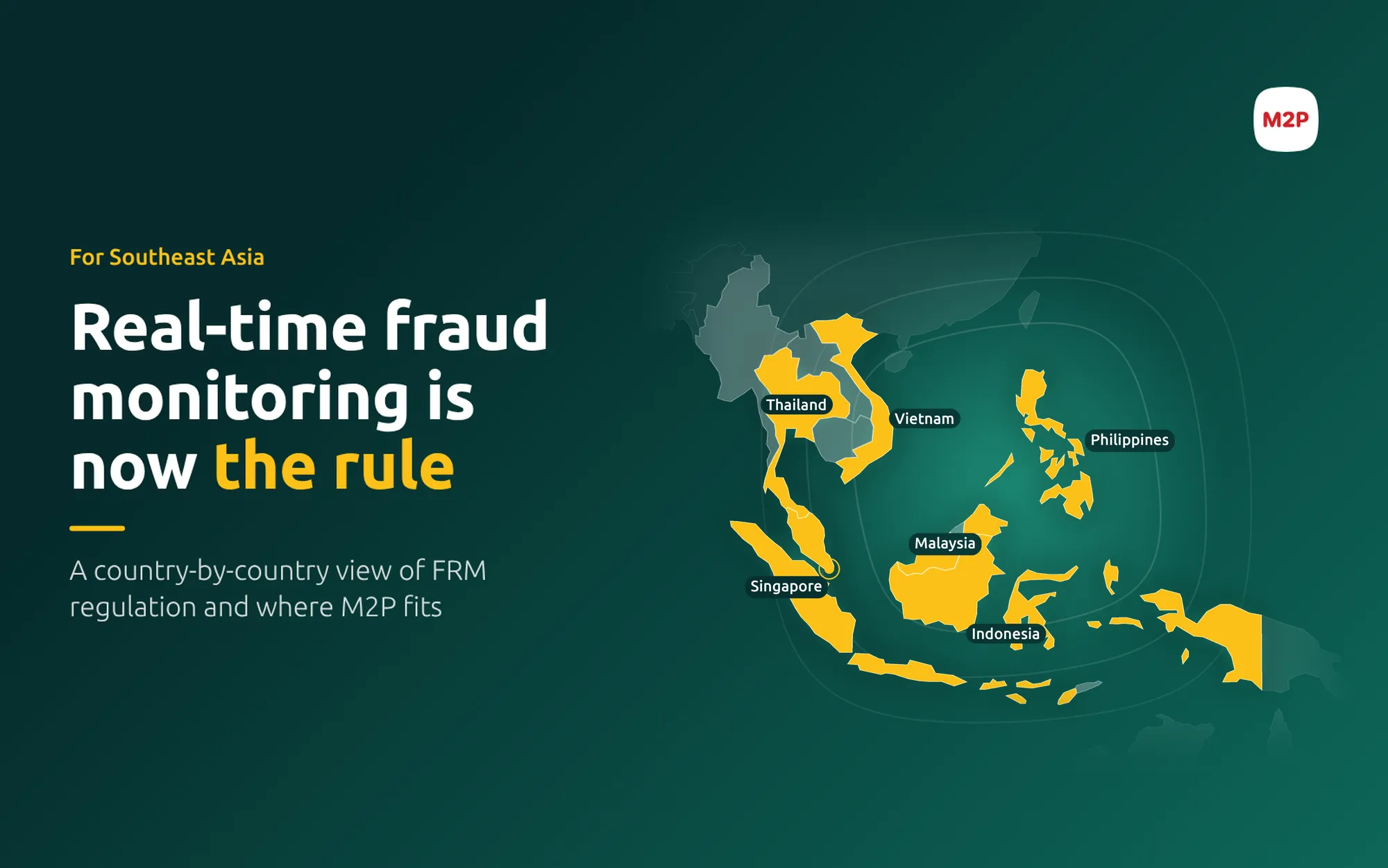
Across Southeast Asia, fraud and risk management (FRM) has moved from an internal control function to a regulated obligation, with specific requirements on what financial institutions must detect, how fast and who pays when they fail.
Two forces drive the change. Scams have shifted from stolen card details to social engineering, mule accounts and authorised push payments that look legitimate to traditional rules. And regulators have responded by mandating real-time monitoring, cooling-off periods, cross-institution data sharing and, increasingly, a share of the loss when controls fall short.
This article looks at where FRM regulation and practice stand in each major Southeast Asian market as of November 2026, and where an enterprise FRM platform such as M2P's fits each country's needs.
An FRM platform sits alongside the institution's payment, card and banking systems and scores every event for risk before, or as, it is processed.
The regulatory shift in Southeast Asia lands on almost every step. Regulators now specify which signals must be monitored, which transactions must be held or cooled off, how quickly suspicious activity must be flagged, and what evidence an institution needs to show that its controls worked.
All six major Southeast Asian markets now have binding rules or national infrastructure that require real-time fraud monitoring, and four link institutional liability to the quality of those controls.
Market | Key rule or driver | Liability link | National infrastructure | Main FRM need |
|---|---|---|---|---|
Philippines | AFASA; BSP Circulars 1213 and 1215 | Restitution if controls inadequate | Coordinated verification; 30-day fund holds | Proving FMS adequacy |
Thailand | Technology crime decree (Apr 2025); BOT Digital Fraud Management Guidelines (Dec 2025) | Joint liability unless compliant | Central Fraud Registry | Mule detection, customer risk scoring |
Singapore | Shared Responsibility Framework (Dec 2024) | Loss sharing tied to FI duties | Real-time alerts; S$25,000 hold rule | Surveillance tuning, evidence |
Malaysia | BNM RMiT (Nov 2025); fraud detection requirements | Full liability for control lapses | National Fraud Portal; planned fraud alerts | Authorised-scam and mule detection |
Indonesia | OJK Regulation 12/2024 anti-fraud strategy | Regulatory reporting and sanctions | Indonesia Anti-Scam Centre | Detection and case handling at scale |
Vietnam | SBV Circulars 17/2024, 50/2024, 77/2025 | Monthly suspicious-account reporting | SIMO suspicious-account system | SIMO integration, mule detection |
Three themes run across the region. Scams have shifted to authorised transfers and mule accounts, which rules built for stolen credentials miss. Regulators are building national data-sharing hubs that institutions must feed and act on. And liability increasingly depends on whether an institution can prove its controls worked, making reporting and case records as important as detection itself.
Singapore was the first market in the region to tie scam losses to specific FRM duties, making real-time fraud surveillance a condition for limiting an institution's liability.
Regulatory status. MAS and IMDA implemented the Shared Responsibility Framework (SRF) from 16 December 2024. Responsible FIs must send real-time alerts for high-risk activities such as new device logins, contact detail changes, limit increases and new payees, plus real-time alerts for every outgoing transaction. A fraud surveillance duty, added after consultation, requires real-time monitoring to detect phishing transactions that rapidly drain an account; FIs had six months to comply. Under it, banks must block or hold suspicious transactions above S$25,000 for 24 hours.
What it means for FRM. Liability under the SRF follows the duties. An FI that cannot show its surveillance, alerts and holds worked as required can be asked to bear the customer's loss. That makes FRM evidence, not just detection, a core requirement.
FRM market status. Large banks and major payment service providers built SRF capabilities in 2024 and 2025. Ongoing demand comes from tuning models to reduce friction on large-value transactions, extending surveillance to newer channels, and from digital banks and e-wallet issuers that need SRF-grade controls without large in-house teams.
Where M2P fits.
Malaysia has built the region's most connected anti-fraud infrastructure, and its focus is now moving from blocking unauthorised access to catching scams that customers authorise themselves.
Regulatory status. BNM sets requirements for customer due diligence, transaction monitoring, fraud detection and cybersecurity, and financial institutions bear full responsibility for unauthorised-transaction losses caused by lapses in their security controls. BNM's revised Risk Management in Technology (RMiT) policy, effective 28 November 2025, carries the fraud detection baseline, including detailed customer risk profiles for behavioural detection and rules updated as new fraud typologies emerge.
Industry infrastructure. BNM, PayNet and financial institutions launched the National Fraud Portal (NFP) on 20 August 2024 to automate scam reporting and fund tracing, alongside industry-wide procedures for reporting and handling mule accounts. Since October 2025, the NFP has piloted payment-network pattern analysis, with PayNet identifying more than 1,600 high-risk mule accounts.
What it means for FRM. The financial sector blocked about RM1.9 billion in attempted fraud in the first half of 2026, against RM1.2 billion for all of 2025. But BNM says around 95% of online fraud now involves victims manipulated into transferring their own funds. It plans to pilot an industry fraud alert capability with selected banks in the first half of 2027, prompting customers to pause and verify before a transaction completes.
FRM market status. Rules built for account takeover are no longer enough. Banks, digital banks and e-wallet operators need behavioural profiling, mule detection on inbound flows, and the ability to consume intelligence from the NFP and act on it in real time.
Where M2P fits.
Indonesia now requires every financial services institution to run a formal anti-fraud strategy, while a national scam centre handles reports and account blocking at very large scale.
Regulatory status. OJK Regulation 12/2024, effective 31 October 2024, requires all financial services institutions to implement an anti-fraud strategy built on four pillars: prevention, detection, investigation and monitoring. It covers banks, insurers and fintechs, with semi-annual reporting to OJK.
Industry infrastructure. OJK launched the Indonesia Anti-Scam Centre (IASC) on 22 November 2024, with banks and payment providers feeding victim reports into it. By June 2026, the IASC had recorded more than 608,000 fraud cases and blocked more than 557,000 accounts, securing Rp674 billion and returning almost Rp200 billion to victims. OJK says scams increasingly exploit money mule accounts, merchants and sub-merchants, digital payment systems and virtual assets. OJK is also developing a National Fraud Portal through the IASC.
What it means for FRM. POJK 12/2024 makes detection, investigation and monitoring explicit regulatory obligations with reporting attached. The IASC's volumes show the operational load: institutions must act on blocking requests quickly and detect mule activity before reports arrive.
FRM market status. Large banks have established fraud units, but the regulation reaches thousands of smaller institutions, including rural banks (BPRs), multifinance companies and P2P lenders, many of which lack real-time detection. Merchant and sub-merchant monitoring is a further gap highlighted by OJK and Bank Indonesia.
Where M2P fits.
Thailand has paired joint liability for technology crime losses with binding BOT guidelines that spell out what an end-to-end fraud management programme must include.
Regulatory status. An amendment to the Emergency Decree on technology crime, published on 12 April 2025, makes financial institutions, e-payment operators, digital asset firms, telecom providers and social media platforms jointly liable for technology crime damages unless they can prove compliance with regulatory standards. The BOT's Guidelines for Digital Fraud Management took effect on 17 December 2025, with a particular focus on mule accounts. They apply to banks, special financial institutions and e-money and e-fund transfer operators, and require:
The BOT has also capped daily digital transfers at THB 50,000 for individual customers as an anti-fraud measure.
What it means for FRM. Compliance with the BOT's standards is effectively the safe harbour under the decree. Institutions that cannot evidence their monitoring, classification and response processes face shared liability for customer losses.
FRM market status. Large banks are adapting existing systems. E-money operators and smaller institutions must meet the same baseline, scaled to risk, and many need mule-focused detection and customer risk scoring they do not yet have.
Where M2P fits.
The Philippines has written the fraud management system (FMS) directly into law, and covered institutions had until 30 June 2026 to have one in place.
Regulatory status. The Anti-Financial Account Scamming Act (AFASA, Republic Act 12010) requires institutions to protect account access through adequate controls, including multi-factor authentication and fraud management systems. It defines an FMS as automated, real-time monitoring and detection systems that identify and block disputed, suspicious or other online transactions. BSP Circular 1213 applies this to banks, non-bank financial institutions, payment service providers and clearing switch operators, and its one-year transition expired on 30 June 2026. Controls named in the associated BSP requirements include transaction-velocity checks, geolocation monitoring, behavioural anomaly detection and account enrolment and verification. Circular 1215 lets institutions temporarily hold disputed funds for up to 30 calendar days while institutions run a coordinated verification process.
What it means for FRM. AFASA ties liability directly to FRM quality. An institution the BSP finds compliant with adequate controls is not liable for losses from covered offences. One that failed to employ adequate controls can be ordered to make restitution, even without a criminal conviction. Institutions are advised to keep records of system design, alert parameters, system performance, investigations and remedial actions.
FRM market status. Large banks and the main e-wallets had systems before the deadline. The pressure now is on proving adequacy: calibrated rules, tested controls, documented alert handling, and the ability to trace and hold funds across banks and e-wallets within strict timelines.
Where M2P fits.
Vietnam's FRM model is built around SIMO, the SBV's central system for flagging suspicious accounts, combined with strict identity and transaction-security rules.
Regulatory status. Circular 17/2024/TT-NHNN, issued on 28 June 2024, requires banks to report accounts showing signs of fraud through the SBV's fraud-risk information system before the tenth of each month. Under Circulars 17/2024 and 25/2025, accounts without verified biometric data face suspension of online transactions to remove fraudulent and non-authentic accounts. Circular 50/2024 sets safety and security requirements for online banking, and Circular 77/2025 amended it, allowing banks to suspend online banking when banking apps run on devices deemed risky.
Industry infrastructure. SIMO, deployed in 2025, consolidates accounts that institutions flag as suspicious. When a customer tries to send money to a flagged account, the system warns them before the transaction completes. By mid-May 2026, SIMO had issued warnings on more than 1.3 million transactions, helping customers stop transfers worth over VND 4.5 trillion. But only 12 of nearly 50 banks had integrated the customer warning service by 25 May 2026. In October 2025, the Vietnam Banks Association also launched a joint manual for coordinating on suspicious transfers across accounts, cards and acquiring units.
What it means for FRM. Banks must both detect suspicious accounts in their own books, to report them to SIMO, and check outbound payments against SIMO's data in real time. Both require an FRM engine connected to internal and external data.
FRM market status. Biometric controls are in place at most banks. The gap is integration: most banks have not yet connected SIMO warnings to customer payment flows, and many smaller banks and e-wallets lack behavioural detection to identify mule accounts before they reach the database.
Where M2P fits.
These markets have no FRM mandates comparable to the larger economies, but Cambodia in particular faces strong pressure to move from enforcement after the fact to real-time detection.
Cambodia has taken visible action against banks linked to scam networks. On 3 August 2026, the National Bank of Cambodia revoked the licences of CCU Commercial Bank, Heng Feng (Cambodia) Bank and HH (Cambodia) Bank, its third closure episode in 2026; all three were on the US OFAC sanctions list over alleged links to cyber-fraud and trafficking networks. Commentators have called for real-time transaction monitoring and continuous, rather than one-off, KYC and AML controls. Cambodia is also working to avoid a third FATF grey list placement. For the remaining banks and payment providers, demonstrable fraud and AML monitoring is becoming a reputational and correspondent-banking necessity.
Laos, Myanmar and Brunei were not researched in depth for this article. Market-specific regulation should be checked before targeting them.
Where M2P fits. For mid-sized banks and payment providers in these markets, the need is an integrated FRM and AML platform without heavy in-house build. M2P's combination of real-time fraud detection, watchlist screening against UN and OFAC/SDN lists, and suspicious transaction alerts covers both sides of the problem in one system.
M2P's FRM maps directly to the region's common requirements: real-time, cross-channel detection, rules that change as fast as scam typologies, and the case records institutions need to prove their controls worked.
Southeast Asian need | M2P FRM capability | Most relevant markets |
|---|---|---|
Real-time detection and blocking | AI/ML models that identify suspicious behaviour and prevent fraud in real time | All markets |
Coverage beyond cards | Monitoring across internet and mobile banking, cards, wallets, real-time payments and non-financial events | Singapore, Philippines, Vietnam |
Fast response to new typologies | Configurable fraud rules tailored to specific risks, deployable by risk teams | Malaysia, Thailand |
Investigation and coordinated action | End-to-end case management with workflow automation | Philippines, Indonesia, Thailand |
Evidence for regulators and liability | Insights into rule performance, case resolution and fraud trends | Singapore, Philippines, Thailand, Indonesia |
AML alongside fraud | Integrated AML with UN, OFAC/SDN, PEP and adverse media screening and suspicious transaction alerts | Cambodia, Malaysia, Indonesia |
Security and certification | PCI DSS, ISO 27001 and ISO 22301 certifications | All markets |
These capabilities are listed on M2P's FRM and AML product page. M2P also offers pre-integrated card management, ACS and FRM, so issuers can combine strong authentication with fraud monitoring on one stack.
Southeast Asia has moved past treating fraud as a cost of doing business. Singapore, Malaysia, Thailand and the Philippines now link institutional liability to the quality of fraud controls, Indonesia mandates a formal anti-fraud strategy, and Vietnam requires banks to feed and use a central suspicious-account database.
For banks, digital banks, e-wallets and payment providers, FRM is now where those rules are met on every transaction. Institutions still relying on static rules or manual review face growing compliance risk, liability exposure and customer losses. M2P's AI-powered FRM, with configurable rules, cross-channel monitoring, case management and integrated AML, gives institutions a practical way to meet these requirements and show that their controls work.
To discuss FRM requirements for a specific Southeast Asian market, get in touch with M2P.
Regulation and infrastructure: MAS SRF announcement · BNM National Fraud Portal · BNM fraud prevention update (The Vibes) · OJK anti-scam press release · BOT Digital Fraud Management Guidelines (Tilleke & Gibbins) · BSP Circular 1213 (Nicolas & De Vega) · SBV SIMO (VietNamNet) · Cambodia bank closures (The Star)


Fintech is evolving every day. That's why you need our newsletter! Get the latest fintech news, views, insights, directly to your inbox every fortnight for FREE!