

M2P Fintech
Fintech is evolving every day. That's why you need our newsletter! Get the latest fintech news, views, insights, directly to your inbox every fortnight for FREE!
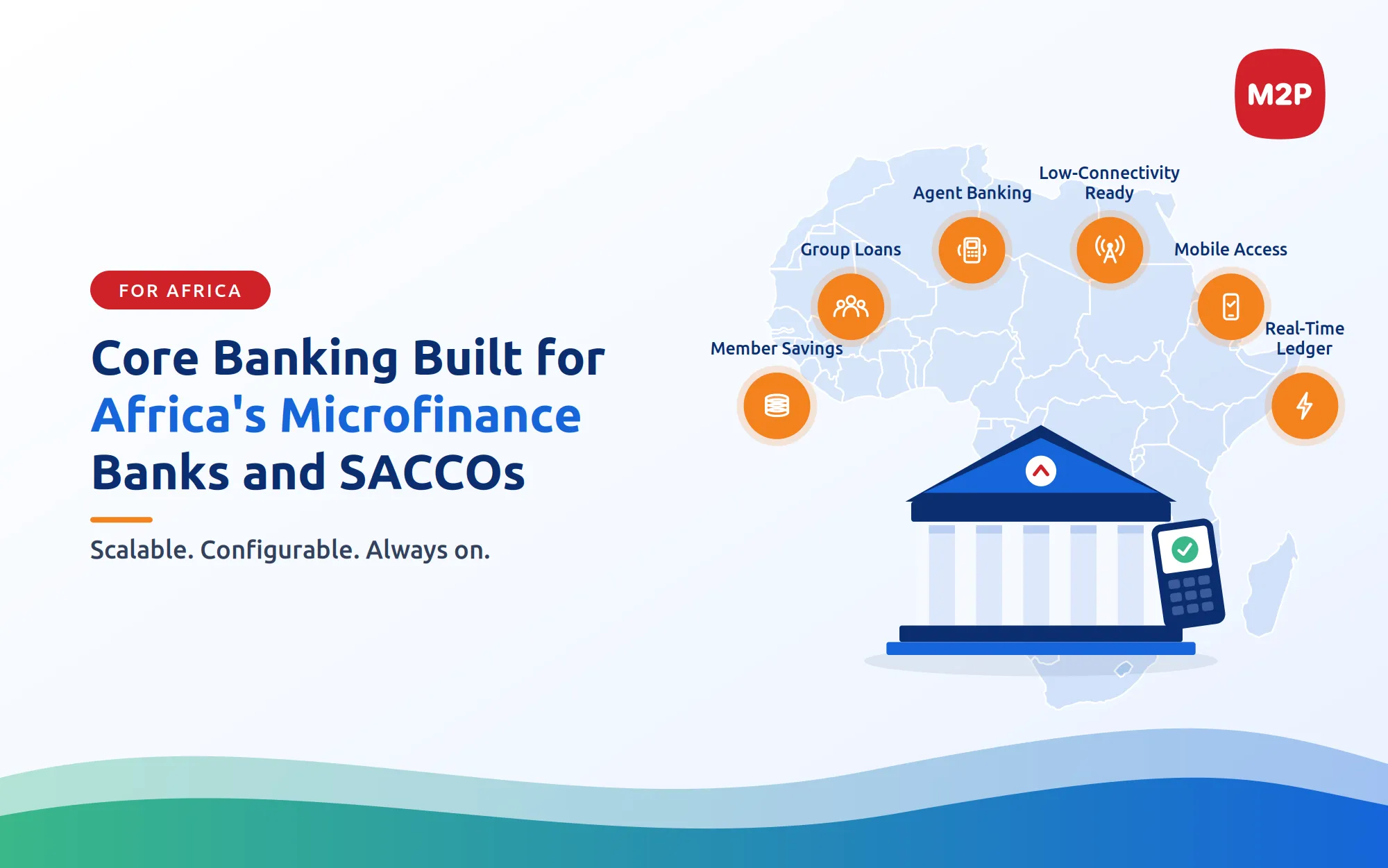
Across Africa, much of the work of financial inclusion is done by small institutions. Microfinance banks, SACCOs, cooperative banks and community lenders serve the farmer, the market trader, the teacher and the small business owner, people that large commercial banks often find too costly to reach.
These institutions are trusted locally, but most are held back by the same two problems. The first is technology that is either too expensive or too rigid for an institution of their size. The second is the network itself: branches, agents and field officers often work where connectivity is slow, patchy or missing for hours.
This blog looks at both problems together, because in practice they are one decision. Choosing a core banking system is also choosing how well the institution will serve customers at the edge of the network. It also explains how M2P's Core Banking System (CBS) addresses both, drawing on what it has already delivered for community-focused partner banks.
Small institutions carry a large share of Africa's everyday finance. Kenya shows the scale. According to the Sacco Societies Regulatory Authority (SASRA), regulated SACCOs had 7.87 million members in 2025 and total assets of about KSh 1.21 trillion. Similar roles are played by microfinance banks in Nigeria, savings and loans companies in Ghana, and microfinance institutions across East, West and North Africa.
The same SASRA data also shows the strain beneath that growth. In 2025, 61 large SACCOs held 77.62% of the industry's assets, leaving the smaller tiers to compete with far less. SASRA itself has pointed to the need to support medium and small-tier SACCOs, and Kenya's government has encouraged mergers and shared services among smaller societies. Dormant accounts in deposit-taking SACCOs also rose by 15.75% to 1.69 million in 2025, a sign that many members are not being served with products they actually use.
For most of these institutions, the core banking system sits at the centre of these pressures:
Legacy or fragmented systems: Many still run on ageing software, standalone branch databases, or a mix of spreadsheets and accounting packages. Member data is split across branches, and reconciliation is manual.
High cost of ownership: Traditional cores are priced and built for large banks. Licence fees, hardware, upgrades and specialist staff consume a budget that small institutions cannot spare.
Rigid product design: Group loans, savings schemes, share capital, dividends and seasonal agricultural credit often need custom development, which is slow and expensive.
Rising regulatory expectations: Supervisors such as SASRA in Kenya and the Central Bank of Nigeria for microfinance banks expect accurate, timely reporting, stronger controls and better risk management.
Pressure to go digital: Members expect mobile access, instant transfers and agent services, which a closed legacy core struggles to support.
The result is that many smaller institutions spend more on keeping their systems running than on serving members. A modern core needs to reverse that balance.
A core banking system for a microfinance bank or SACCO should not be a scaled-down version of a large bank's system. It should be designed around how these institutions actually work. Six capabilities matter most.
Small institutions need costs that grow with their member base and transaction volumes, not large upfront licence fees. Cloud deployment removes much of the hardware and data centre spend. Shared infrastructure, with each institution's data kept separate, spreads costs further, an approach that fits well with the shared-services model regulators are encouraging.
A SACCO's product catalogue looks very different from a commercial bank's. It may include member shares, non-withdrawable deposits, dividend payouts, guarantor-backed loans and check-off deductions from employers. A microfinance bank may need group lending, weekly repayments and seasonal agricultural loans. A modern core should let staff configure these products, interest rules, fees and limits through parameters, without waiting months for custom development.
All accounts, loans, savings and transactions should sit in one centralised, real-time ledger. This ends duplicate member records across branches, simplifies KYC and gives management a reliable picture of the portfolio at any time.
Members increasingly expect to transact through mobile apps, agents and digital payment rails. An API-first core lets an institution connect to mobile banking, card issuance, payment switches and fintech partners without rebuilding its core each time.
Regulatory reports, audit trails, maker-checker approvals and fraud monitoring should be part of the core, not separate projects. This matters even more for small institutions with lean compliance teams.
Moving years of member data out of a legacy system is the step most institutions fear. The right partner brings proven migration methods and the ability to run alongside existing systems where needed, instead of forcing a risky big-bang switch.
The second challenge is the network. According to the GSMA, almost 1 billion people in Africa, about 63% of the population, were still not using mobile internet in 2025, even though coverage is now widespread. The gap is sharpest in rural areas, where adults in sub-Saharan Africa are 48% less likely to use mobile internet than those in cities. Many who are online still rely on older 3G devices or feature phones.
This is exactly where microfinance banks and SACCOs operate. For their operations, the gap shows up in practical ways:
Branches lose their link to the core during outages, and tellers cannot post deposits or check balances.
Field officers and agents collect repayments in villages and markets with weak signal, so transactions are recorded late or on paper.
Customers cannot use self-service channels because they lack a smartphone, a data plan or both.
Reconciliation becomes a daily burden, as late-posted transactions create mismatches between agent cash, customer balances and the ledger.
For a small institution, each of these problems erodes trust, adds operational cost and limits growth beyond the branch network. A core banking strategy for Africa has to start from the assumption that connectivity will not always be reliable at the edge.
There are two broad ways to keep banking running where connectivity is weak. Both have a place, but they lead to very different outcomes for customers and agents.
In the store-and-forward model, an agent's device captures a transaction offline, stores it locally and uploads the batch when it reaches a network. The core then processes the batch, usually at end of day.
This model keeps service going, but it has real drawbacks:
Late failures: A withdrawal can be approved at the counter and declined hours later during batch processing, leading to disputes and lost trust.
Delayed settlement: Agents' funds stay tied up until reconciliation is complete, which strains their liquidity.
Security exposure: Transaction data stored on a device can be lost or compromised.
Reconciliation effort: Mismatches between offline records and the ledger have to be resolved manually.
The alternative is to keep the core always available and move the connectivity requirement to the point where it is easiest to solve. Instead of every customer needing a smartphone and data, a network of trained agents carries the connected device. Customers visit a local agent, authenticate, and complete transactions that are posted to the core instantly.
This model has clear advantages for African microfinance and SACCO networks:
No customer-side barriers: The customer needs no smartphone, data plan or app.
Instant confirmation: Balances are checked and updated in real time, so there are no late declines.
Faster agent settlement: Agent accounts are updated as each transaction is posted.
Simpler reconciliation: One real-time ledger means far fewer mismatches.
To make this work, the core must be available around the clock, handle high volumes of small transactions, and integrate easily with agent devices and authentication services. It should also give the institution full control over agent limits, commissions and monitoring.
The practical design principle is simple: keep the core always on, and reduce how much connectivity each transaction needs at the edge. The fewer steps that depend on the customer's own device and network, the more reliable the service.
M2P has already put the real-time, agent-led model into production for community-focused banks in India, a market with many of the same challenges as Africa: large rural populations, uneven connectivity and customers who are new to formal banking.
M2P's Core Banking System is a 24x7 platform built for continuous, real-time processing. Rather than relying on delayed offline batches, M2P helps partner banks reach remote customers through networks of agents who carry out authenticated transactions that are posted to the core instantly.
A cooperative bank in India migrated from its legacy system to M2P's Core Banking System. Many of its customers are senior citizens and less tech-savvy people in remote areas.
To reach them, M2P implemented a biometric, agent-led payment service integrated with the core. Customers visit a local agent, authenticate with a fingerprint, and complete their transaction in real time. They do not need a smartphone, data plan, card or PIN. On the day the service went live, the bank onboarded more than 500 agents from remote locations.
Another cooperative bank, focused on lower-income customers in rural areas, also moved to M2P's Core Banking System. The bank had built its rural strategy around mobile field agents who collect deposits in villages, along with RuPay debit cards, a mobile app with instant transfers, and biometric ATM access. A modern core gave the bank a stronger foundation for extending these services.
Scale matters as much as reach. A small finance bank in India replaced its core banking system with M2P's Core Banking System, migrating 111 branches and over 1.5 million customers.
Want to know more about these deployments? Reach out to us for detailed case studies.
The lessons from these deployments apply directly to microfinance banks and SACCOs in Africa:
Shift the connectivity burden to the agent, so customers without smartphones or data can still bank.
Keep the core always on and real-time, so every transaction is confirmed instantly and agent cash stays reconciled.
Use authentication that customers already have, such as biometrics linked to national ID, instead of relying on cards and PINs.
Scale the agent network quickly, without adding branches.
In African markets, the same model can be connected to local rails and identity systems, such as national instant payment switches and national ID databases, based on each country's infrastructure and regulations.
M2P's Core Banking System brings together the affordability, configurability and always-on design that smaller African institutions need.
Modern architecture: Built on microservices, API-first and cloud-agnostic, so institutions can deploy in the environment that suits their regulator and budget.
Low-code product configuration: New savings, deposit and loan products can be designed and launched quickly through configuration rather than custom development.
Real-time, 24x7 processing: Every transaction is posted instantly to a single ledger, supporting branches, agents and digital channels together.
Easy integration: Open APIs connect the core to mobile banking, cards, payment rails, KYC services and fintech partners.
Built-in risk controls: A pre-integrated Fraud Risk Management (FRM) engine supports secure operations from day one.
Proven migrations: M2P has moved banks from legacy systems to its Core Banking System at scale, including a small finance bank with 111 branches.
More than a core: Institutions can add lending, microfinance, cards, payments and KYC capabilities from the same infrastructure partner as they grow.
Africa's microfinance banks and SACCOs are central to financial inclusion, but many are held back by systems that cost too much, adapt too slowly and break down where the network is weak. These are not separate problems. The right core banking system can solve both.
An affordable, configurable core lets smaller institutions launch the products their members need without heavy custom development. A real-time, agent-led operating model lets them reach customers at the edge of the network without asking those customers to own a smartphone or pay for data.
M2P has already delivered this model for community-focused partner banks, with real-time agent networks reaching remote customers from day one. With a modern, API-first Core Banking System and a clear commitment to the African market, M2P is a strong option for microfinance banks and SACCOs ready to modernise.
Ready to modernise your core? Contact M2P to explore how M2P's Core Banking System can support your institution's growth across Africa.
Tags

Fintech is evolving every day. That's why you need our newsletter! Get the latest fintech news, views, insights, directly to your inbox every fortnight for FREE!