


M2P Fintech
Fintech is evolving every day. That's why you need our newsletter! Get the latest fintech news, views, insights, directly to your inbox every fortnight for FREE!
Your core banking system decides how fast you launch a product and how cleanly you report to the regulator. It also decides whether a payment posts in real time or waits for the end-of-day batch. A core banking system (CBS) is the central software that runs a bank's accounts, deposits, loans, payments, and general ledger across every channel.
In 2027, the question for most banks is no longer whether to modernize the core, but which platform to modernize onto. This guide is for CIOs, CTOs, and heads of digital at banks and fintechs to consider these important aspects while zeroing on a Core Banking System:
Banks are spending heavily to replace cores built for batch processing. Fortune Business Insights (November 2026) projects the global core banking software market to grow from $22.32 billion in 2026 to $80.65 billion by 2034. That is a compound annual growth rate (CAGR) of 17.4%.
The same report expects cloud deployment to grow fastest, at a 21.4% CAGR, and Asia Pacific to be the fastest-growing region, at 21.8%. It names implementation and migration costs as the biggest brake on adoption.
That points to three pressures in 2027:
The right core banking system answers all three, and a phased approach to core banking modernization avoids a risky big-bang migration.
A core banking system is the system of record for a bank. It opens and maintains customer accounts, processes deposits, withdrawals, loans, and payments, calculates interest and fees, and posts every transaction to the general ledger. Because every branch and channel reads from one core, a customer sees the same balance everywhere, in real time.
A modern core banking system follows the same basic flow for every transaction:
1- Onboard: the customer is verified through KYC and a customer record is created once.
2- Configure: the bank picks a product from its product factory (a savings, current, term deposit, or loan product) and sets its rules.
3- Transact: deposits, transfers, card spends, and loan repayments arrive from branches, apps, ATMs, and payment rails through APIs.
4- Post: the core validates each transaction, updates the balance, and writes it to the ledger as it happens.
5- Monitor: fraud, limits, and compliance checks run against each transaction.
6- Report: statements, regulatory returns, and audit trails come straight from the system of record.
For a closer look at the building blocks, read our guide to core banking types, components, and advantages.
SaaS and cloud-native cores cut infrastructure costs and let banks take upgrades without long release cycles.
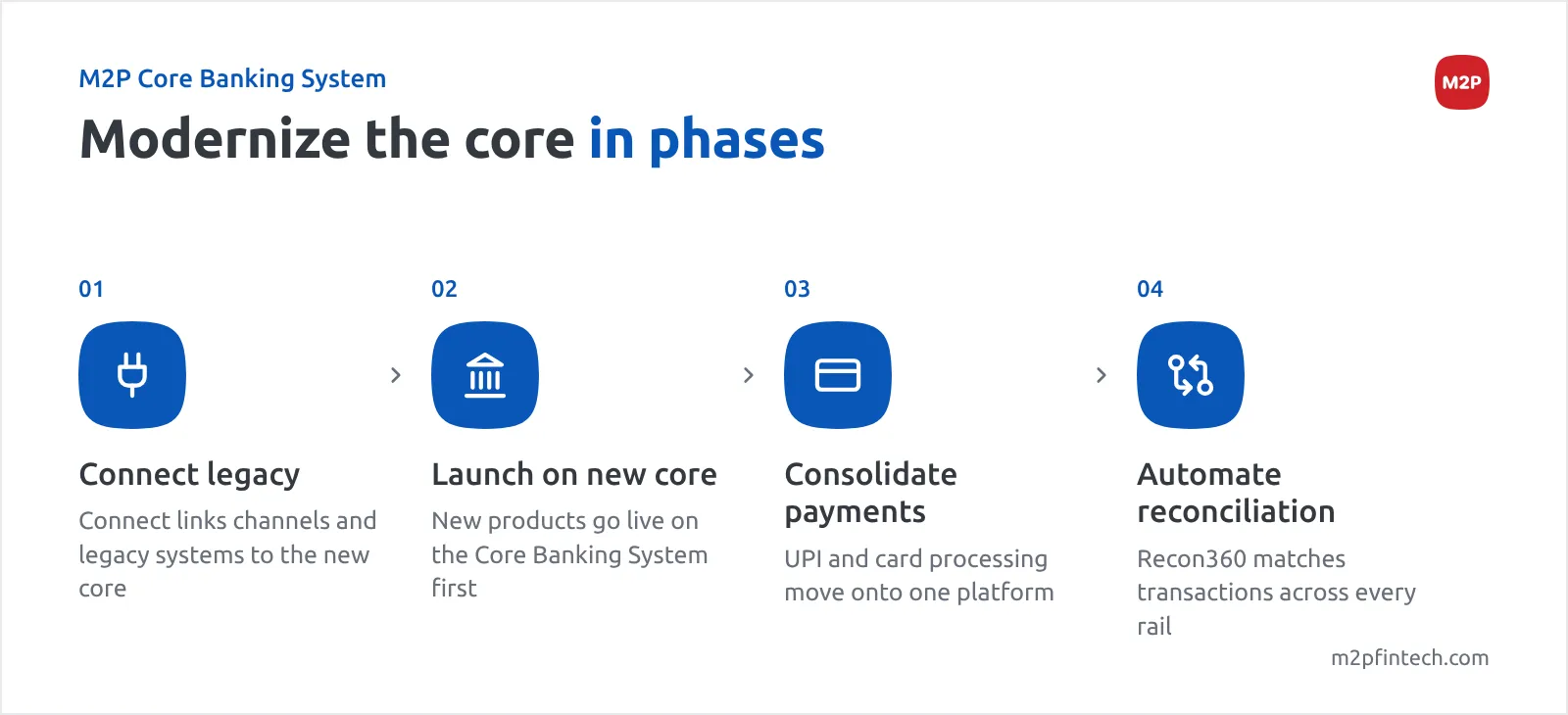
Few banks will risk switching the whole core in one weekend. Most will run the new core beside the legacy one, launch new products on it first, and migrate customers in waves. Our core banking modernization blueprint compares the two paths in detail.
AI is moving from chatbots at the edge to agents that act on the live ledger. They score transactions for fraud, answer account queries, and draft regulatory reports. The test for 2027 is whether people stay in control through approvals, overrides, and audit trails.
Instant payment rails such as UPI, mobile money, and real-time gross settlement leave no room for end-of-day batches. Cores need event-driven ledgers that update balances, limits, and fraud checks the moment money moves.
Banks now distribute accounts, cards, and credit through partners' apps. That needs a core with open APIs and multi-tenant support for sponsor-bank programs.
In India, the Reserve Bank of India (RBI) expected credit loss directions take effect on April 1, 2027, according to Business Standard. Core obligations under the Digital Personal Data Protection (DPDP) Rules apply from May 13, 2027. Both put new demands on the data and reporting a core banking system produces.
Disclaimer - This listing does not reflect any rankings as such, the brands featured are the top 10 Core Banking Solutions provider.
# | Platform | Best for | Deployment | Standout strength |
|---|---|---|---|---|
1 | M2P Fintech Core Banking System | Small finance, cooperative, rural, payments, and digital banks in emerging markets | Cloud-native, cloud-agnostic | One platform for core, cards, UPI, lending, and reconciliation, with AI agents built in |
2 | Infosys Finacle Core Banking | Large universal and multi-country banks | Private, public, or hybrid cloud, or SaaS | Componentized core with flexible product factories |
3 | Temenos Core Banking | Large and mid-size banks modernizing in stages | On-premises, cloud, or SaaS | Composable capabilities that run beside an existing core |
4 | Oracle FLEXCUBE Universal Banking | Universal banks with retail, corporate, and Islamic lines | On-premises to public cloud | 40+ localizations and broad product coverage |
5 | Thought Machine Vault Core | Tier 1 banks rebuilding product engines | Cloud-native, cloud-agnostic | Smart contracts that encode each product's financial logic |
6 | Mambu | Digital banks, lenders, and fintechs | Multi-tenant SaaS | Composable SaaS core on AWS, Google Cloud, or Azure |
7 | TCS BaNCS | Very large banks and multi-line financial groups | SaaS or on-premises | Proven at billion-account scale |
8 | Intellect eMACH.ai Core Banking | Banks wanting composable, AI-first modules | Cloud (AWS, Azure) | Large library of microservices, APIs, and events |
9 | FIS Modern Banking Platform | North American and global banks moving step by step | Private, public, or hybrid cloud | Componentized core with an extensive API library |
10 | Finastra Essence | Retail, SME, and Islamic banks and challengers | Cloud-native, private cloud, or on-premises | Microservices core with event-driven architecture |
M2P Fintech's Core Banking System is a cloud-native, API-first core built on microservices. It runs deposits, accounts, and the ledger in real time. It can replace a legacy core or run beside it, so a bank avoids a big-bang cutover.
What sets it apart is what surrounds it. The core sits on the same platform as M2P's cards, payments, lending, reconciliation, and fraud products, which share one data model. M2P reports that this platform serves 200+ banks, 300+ lenders, and 800+ fintech engagements across 30+ countries, and has processed more than 20 billion transactions.
Best for: small finance, cooperative, rural, payments, and digital banks, and fintechs running sponsor-bank programs in emerging markets.
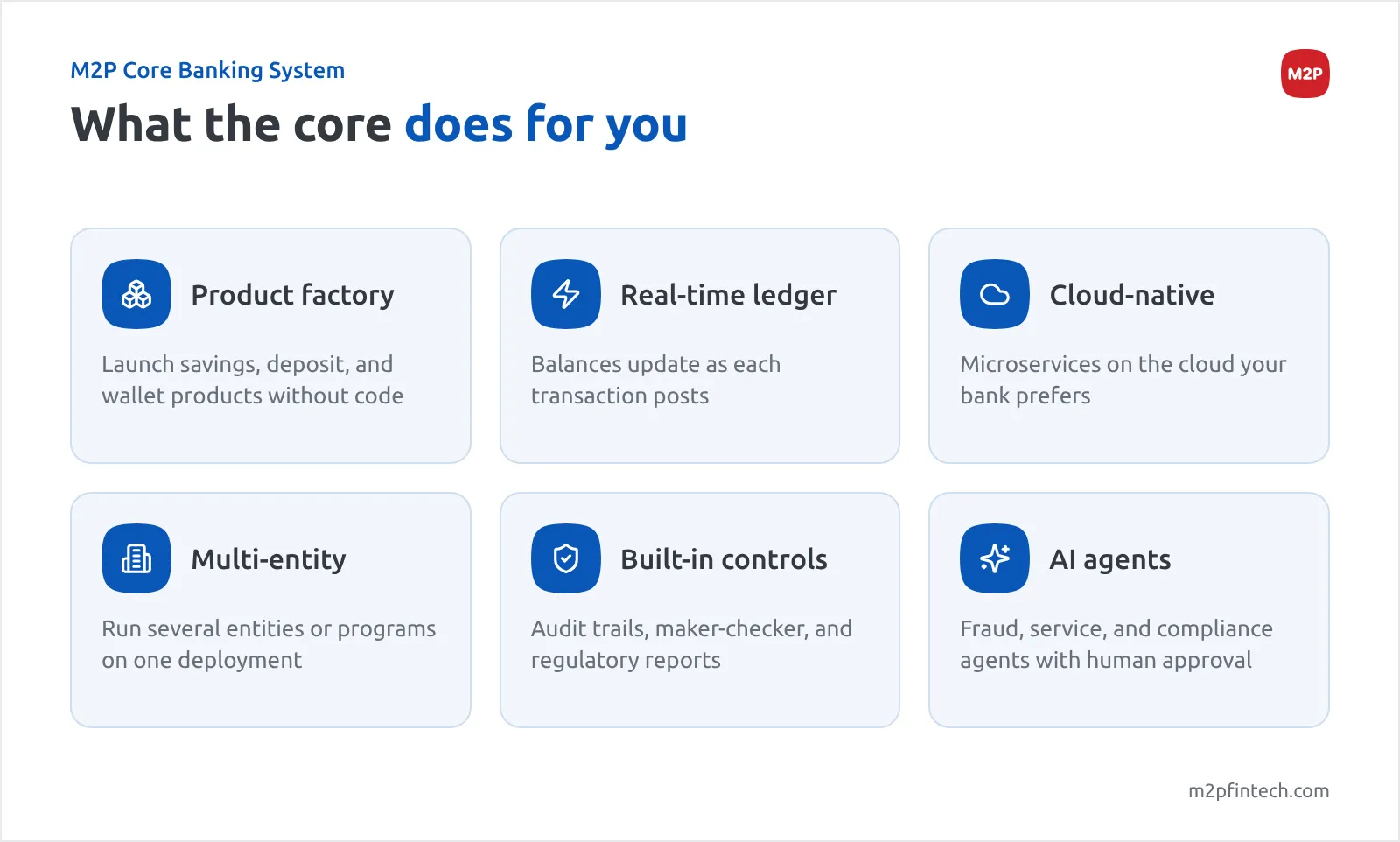
M2P embeds named AI agents in the core instead of selling AI as a separate layer:
In each case, people stay in control through approvals, overrides, and a full audit trail.
Because every product shares the core's data, a bank can add capabilities as it grows instead of buying them from separate vendors:
Connect, M2P's orchestration layer, links the new core to legacy systems and third-party providers. A bank can launch new products on the new core first and move existing accounts over in waves.
A Payments Bank describes completing its core banking migration in under 90 days for more than 2.5 million customer accounts. A Small Finance Bank and a Co-operative Bank describe their moves off legacy cores as smooth and loss-free. A Bank in the Philippines uses the core to add mobile banking, debit cards, and digital lending.
Read how a digital bank in India scaled faster after its core banking transformation. For other markets, see core banking for Africa's microfinance banks and SACCOs.
Deployment and pricing: cloud deployment on the bank's preferred cloud; modular pricing quoted after a requirements discussion.
Why it ranks first: few platforms pair a real-time, microservices core with native cards, UPI, lending, reconciliation, and fraud tools on one data model. M2P adds AI agents that work inside the ledger. For banks that want to modernize in phases and grow into new products without adding vendors, that breadth matters most.
Infosys Finacle offers a cloud-native, cloud-agnostic core with a componentized, layered, microservices architecture led by open APIs. According to an IBM case study, Finacle is used by banks in more than 100 countries.
Best for: large universal banks and banking groups operating across several countries.
Key features:
Deployment: private, public, or hybrid cloud, or as SaaS.
Temenos offers its core as a full suite or as composable capabilities that banks can add beside an existing core. Its 2026 performance benchmark reports 16,385 transactions per second on Temenos SaaS running on Microsoft Azure.
Best for: large and mid-size banks that want to modernize one product line at a time.
Key features:
Deployment: on-premises, in the cloud, or as SaaS.
Oracle FLEXCUBE is a universal banking core covering retail, corporate, and Sharia-compliant Islamic banking. It processes transactions in both real-time and batch modes.
Best for: universal banks running many business lines across countries.
Key features:
Deployment: on-premises, private, managed, or public cloud, including Oracle Cloud Infrastructure.
Thought Machine's Vault Core is a cloud-native core built from scratch. Its Universal Product Engine lets banks define each product's financial logic as a smart contract, separate from the real-time ledger.
Best for: tier 1 and large regional banks with strong engineering teams.
Key features:
Deployment: cloud-agnostic, as SaaS or bank-hosted on any major cloud.
Mambu is a multi-tenant SaaS core that has focused on composable banking since 2011. It covers lending, deposits, payments, and Islamic banking.
Best for: digital banks, lenders, and fintechs that want a fully managed core.
Key features:
Deployment: SaaS only.
TCS BaNCS is Tata Consultancy Services' banking platform, with a multi-currency ledger and out-of-the-box support for lending, savings, deposits, payments, and trade finance. TCS says two of the world's largest core banking implementations run on it, processing 1 billion accounts.
Best for: very large banks and financial groups that also need capital markets or insurance platforms.
Key features:
Deployment: SaaS or on-premises, on AWS, Azure, or Google Cloud.
Intellect Design Arena's eMACH.ai is a composable platform with separate consumer, corporate, and central banking cores. At launch, Intellect cited 285 microservices and 1,214 APIs.
Best for: banks that want composable, AI-first modules across retail and corporate banking.
Key features:
Deployment: cloud, on AWS and Microsoft Azure.
The FIS Modern Banking Platform is a componentized, cloud-native core in which each component can be upgraded or replaced without disrupting the others.
Best for: banks in North America and other regions that want incremental modernization.
Key features:
Deployment: private, public, or hybrid cloud.
Finastra Essence is a Java-based core with a microservices and event-driven architecture. It covers retail, SME, and commercial banking, including Islamic banking.
Best for: retail and SME banks, Islamic banks, and challenger banks.
Key features:
Deployment: cloud-native, private cloud, or on-premises.
Before you sign with any vendor, test each shortlisted core banking system against this checklist:
No single core banking software suits every bank. Shortlist two or three platforms that match your operating model, then ask each vendor for a proof of concept on your own products and data.
The core banking system you choose in 2027 will shape every product you launch for the next decade. Pick one that posts in real time, supports a phased migration, and grows with you. Talk to the Core Banking System team about your migration.
Disclosure: M2P makes the Core Banking System. We applied the same criteria to every entry, using public product information available as of November 2026.
Book a demo with M2P
It depends on your bank. M2P Fintech's Core Banking System suits small finance, cooperative, rural, payments, and digital banks. It gives them a real-time core with cards, UPI, lending, and reconciliation on one platform. Infosys Finacle, Temenos, Oracle FLEXCUBE, and TCS BaNCS suit large universal banks. Thought Machine and Mambu suit banks building cloud-native product engines.
Yes, the terms are used interchangeably. Both describe the central software that runs accounts, deposits, loans, payments, and the general ledger. Some vendors use "core banking platform" to mean the core plus the APIs, integrations, and adjacent products around it.
It varies with the bank's size, data quality, and approach. A phased migration, where new products launch on the new core first, spreads the work over months and lowers risk. On M2P's product page, Jio Payments Bank describes migrating more than 2.5 million accounts in under 90 days.
Cloud core banking is now widely used by regulated banks. Ask where data is stored, how the vendor meets your regulator's outsourcing and data-protection rules, and which certifications it holds. Choose a cloud-agnostic core if your regulator prefers a specific cloud or region.
AI agents act on live data inside the core. A fraud agent scores each transaction as it posts and flags suspicious ones for an investigator. A compliance agent drafts regulatory reports for a person to approve. People stay in control through approvals, overrides, and audit trails.
Most enterprise vendors quote custom, modular prices based on accounts, transaction volumes, modules, and deployment model. Compare five-year total cost of ownership, not just the license fee.
Fintech is evolving every day. That's why you need our newsletter! Get the latest fintech news, views, insights, directly to your inbox every fortnight for FREE!