

M2P Fintech
Fintech is evolving every day. That's why you need our newsletter! Get the latest fintech news, views, insights, directly to your inbox every fortnight for FREE!
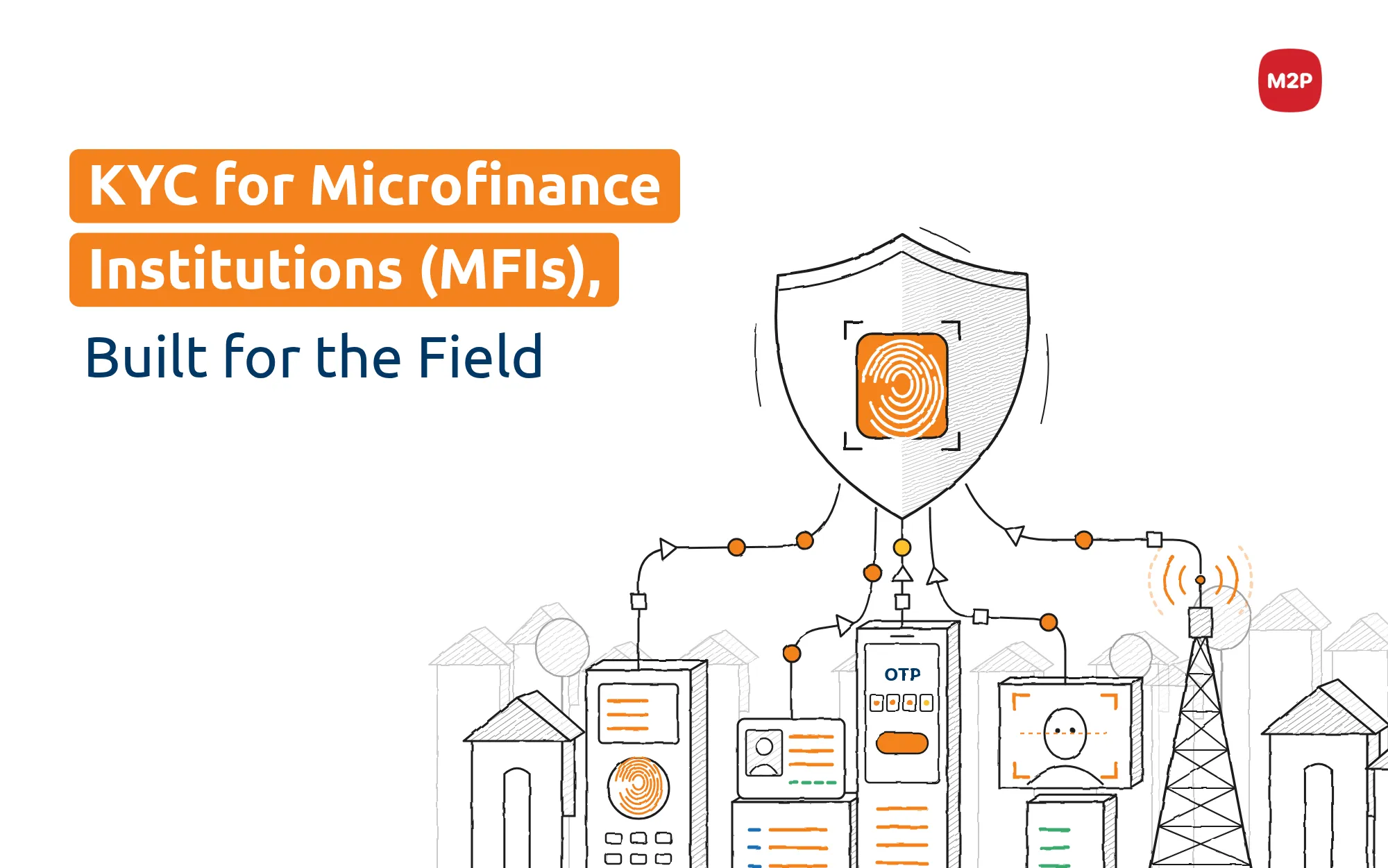
Most conversations about digital KYC assume a customer holding a smartphone, sitting on a stable 4G connection, uploading a selfie into an app. Microfinance rarely works that way.
A typical microfinance borrower is onboarded at a village centre meeting or at her doorstep, by a loan officer carrying a handheld device, often in an area where mobile signal comes and goes. She may not have a smartphone. Her mobile number may be shared with a family member, or may not be the one linked to her Aadhaar. And the institution onboarding her may be adding tens of thousands of borrowers like her every month, across hundreds of branches.
That makes KYC for microfinance a different engineering and compliance problem from KYC for a neobank or a consumer lending app. The regulatory obligations are the same. The conditions under which they have to be met are not.
This article looks at what field-led onboarding actually demands from a KYC stack: which biometric authentication modes fit which situations, how to design around patchy connectivity, how assisted onboarding changes the fraud picture, and which compliance obligations microfinance institutions (MFIs) need their KYC layer to handle. For a broader primer on the components of a KYC stack, see our complete guide to M2P's AI-powered KYC Suite.
Microfinance lending in India is built around physical presence. Most MFIs lend through joint liability groups (JLGs), where a small group of women borrowers takes individual loans and collectively vouches for repayment. Onboarding is part of a larger field process that usually includes:
Group formation and training, where a loan officer explains the product, repayment schedule, and group responsibilities over one or more centre meetings.
Household verification, including a visit to confirm residence and assess household income, since RBI's microfinance framework defines eligibility by annual household income and caps repayment obligations relative to it.
Credit bureau checks, to see existing microfinance loans and the number of lenders a borrower already has.
Identity verification (KYC), which has to be completed before disbursement and recorded in a way that stands up to audit.
KYC is one step in this chain, but it is the step that often decides how fast the rest moves. If identity verification has to be repeated, deferred until the officer is back in branch, or done on paper and digitised later, the whole loan cycle stretches. Turnaround time matters to borrowers, many of whom need funds for a specific purpose on a specific date, and it matters to the institution, since loan officer productivity is one of the biggest cost drivers in microfinance.
The practical goal, then, is simple to state: complete compliant identity verification in a single field visit, on the device the loan officer already carries, under the network conditions that actually exist on the ground.
KYC journeys designed for digital-first lending tend to make assumptions that do not hold in microfinance. Four are worth naming.
The customer owns the device. Self-serve flows assume the borrower is holding her own phone. In field onboarding, the device belongs to the institution and is operated by a loan officer. That changes everything from the user interface to who is accountable for each step.
OTP is always available. Aadhaar OTP authentication depends on the borrower having access to the mobile number linked to her Aadhaar at that moment. In rural households, that number may belong to a spouse or child who is not present, may have been changed, or may never have been updated with UIDAI. OTP works for some borrowers, but it cannot be the only path.
Connectivity is continuous. Many digital journeys make several network calls in sequence: document upload, OCR, face match, Aadhaar authentication, and record creation. Each call is a point of failure when the signal drops, and a failed journey often means starting over.
Selfies and document photos are high quality. Face match and OCR models trained on smartphone selfies in good light can struggle with photos taken outdoors, in dim interiors, or of worn physical documents. That raises rejection rates and pushes more cases into manual review.
None of this means digital KYC does not work for microfinance. It means the KYC layer has to be designed for assisted, device-based, intermittently connected onboarding from the start, rather than adapted from an app journey after the fact.
Aadhaar-based eKYC, accessed through an AUA/KUA (Authentication User Agency / KYC User Agency) integration, supports four authentication modes: OTP, fingerprint, iris, and face. Each returns the same core demographic data from UIDAI on success, including name, date of birth, gender, address, and photograph. What differs is what each mode needs in the field and where it tends to fail.
Mode | What it needs in the field | Where it fits | Common failure points |
|---|---|---|---|
Fingerprint | A UIDAI-certified registered biometric device connected to the field handset | The default for most assisted onboarding; familiar to borrowers from AePS and ration distribution | Worn or faint fingerprints, especially among agricultural and manual workers; dust and moisture on the sensor |
Iris | A certified iris scanner | A fallback when fingerprints repeatedly fail; iris patterns are less affected by manual work | Higher device cost; harder to deploy across every loan officer |
Face | A camera and UIDAI's face authentication flow with liveness checks | Borrowers with poor fingerprint quality; avoids extra hardware where supported | Lighting, camera quality, and spectacles or head coverings that affect capture |
OTP | Access to the Aadhaar-linked mobile number at the time of onboarding | Borrowers whose linked number is current and with them | Shared, changed, or unlinked numbers; SMS delays in weak network areas |
The lesson from field deployments is that no single mode covers every borrower. A KYC flow built only around fingerprint authentication will fail a meaningful share of older borrowers and manual workers. One built only around OTP will fail those whose linked numbers are not with them.
A better design treats authentication modes as a fallback sequence the loan officer can move through within the same session, without restarting the journey or re-capturing data already collected:
Attempt fingerprint authentication, with a defined number of retries and finger changes.
If fingerprint fails, move to face authentication or iris, depending on what the officer's device supports.
Use OTP where the borrower confirms access to her linked mobile number.
Where all Aadhaar-based modes fail, route to an alternate KYC path permitted under the institution's KYC policy, and flag the case for review.
The ordering can vary by region, device fleet, and borrower profile. What matters is that the flow supports it, and that every attempt and fallback is logged for audit.
It helps to be clear about one constraint first. Aadhaar authentication is an online transaction: the encrypted biometric or OTP request has to reach UIDAI and a response has to come back. There is no compliant way to complete online Aadhaar authentication without a connection at that moment.
What an MFI can control is how much of the rest of the journey depends on connectivity, and how gracefully the flow behaves when the network is weak. A few design principles make a measurable difference:
Keep the authentication call small and fast. The fewer round trips and the lighter the payload at the moment of authentication, the more likely it is to succeed on a weak signal. Heavy steps such as uploading high-resolution document images should not sit in the same critical path.
Separate capture from submission where the process allows it. Data that does not need real-time verification, such as household details, group information, and supporting documents, can be captured offline and synced when the device regains connectivity, with tamper-evident handling so nothing is altered in between.
Retry without restarting. A dropped call during authentication should allow a retry from that step, not force the officer to re-enter everything. This alone reduces repeat visits.
Use reliable switching on the back end. AUA/KUA providers route requests to UIDAI through Authentication Service Agencies (ASAs). Being able to switch between ASAs helps maintain uptime when one route is slow or unavailable, which matters most when the field side is already working with a marginal connection.
Show the officer clear status. Whether a request is pending, succeeded, or failed should be obvious on screen, so the officer knows whether to wait, retry, or move to a fallback mode while the borrower is still present.
The outcome to measure is not just authentication success rate, but first-visit completion rate: the share of borrowers whose KYC is fully complete before the loan officer leaves the village. That number reflects connectivity design, fallback design, and device readiness together.
In self-serve KYC, the main fraud risk is an outsider impersonating a customer. In assisted onboarding, there is a second risk to plan for: the process can be misused from the inside, whether through ghost borrowers, borrowers onboarded without full understanding or consent, or one person's identity used across multiple loan applications.
Biometric authentication already narrows some of these risks, since it requires the borrower to be physically present. A well-designed field KYC layer adds controls around the officer and the device as well:
Operator authentication. The loan officer logs in to the device with their own credentials, so every transaction is tied to a named employee.
Location and time stamps. Each authentication carries metadata that can be checked against the officer's assigned area and centre meeting schedule.
Pattern monitoring. A fraud monitoring layer can flag patterns that warrant review, such as unusually high onboarding volumes from one device, repeated failed attempts followed by a success, or the same biometric or phone number appearing across unrelated applications.
Consent capture. Aadhaar authentication requires informed consent from the resident. In assisted flows, the consent screen should be presented in the borrower's language, and the act of consent should be recorded as part of the transaction log.
Complete audit trails. Every attempt, including failures, retries, and fallbacks, should be logged with enough detail for internal audit and UIDAI audit to reconstruct what happened.
These controls protect borrowers as much as they protect the institution. A borrower whose identity is misused for a loan she never took faces collection pressure and a damaged credit history. Traceability at the KYC layer is one of the most effective ways to prevent that.
For institutions that want identity signals feeding directly into broader risk monitoring, KYC data can be connected to fraud and AML systems such as M2P's FRM & AML platform.
Microfinance institutions are regulated entities, and field onboarding does not reduce their KYC obligations. If anything, the volume and distributed nature of microfinance makes compliance harder to maintain consistently. The KYC layer should take care of the following without depending on each loan officer to remember them.
RBI KYC Master Direction. This covers customer identification, risk categorisation, record keeping, and periodic updation of KYC. The KYC system should store verification records in a form that maps to these requirements and makes periodic re-KYC straightforward when it falls due.
UIDAI audit requirements. Any entity performing Aadhaar authentication is subject to UIDAI's audit checklist, covering areas such as consent, data security, device standards, and logging. A KYC platform built to that checklist reduces the effort of each audit cycle.
Aadhaar masking. Aadhaar numbers stored or displayed by the institution must be masked, showing only the last four digits. In microfinance this applies not only to Aadhaar copies, but also to loan application forms, group documents, and scanned files where Aadhaar numbers often appear. Masking should happen automatically, including on the institution's own document formats.
CKYC. Regulated entities are required to upload KYC records of new customers to the Central KYC Records Registry. For repeat borrowers, or those who have completed KYC with another regulated entity, a CKYC search at the start of onboarding can retrieve an existing record and shorten the process.
Data protection. The Digital Personal Data Protection (DPDP) Act adds requirements around consent, purpose limitation, and retention of personal data. Biometric data needs particular care: it should be encrypted at the point of capture, never stored by the institution, and used only for the authentication request it was captured for.
For MFIs with strict IT policies, deployment model is part of compliance too. Some institutions require identity infrastructure to run on-premise or within their own data centre. A KYC platform that supports both cloud and on-premise deployment gives them that choice.
When an MFI evaluates a KYC platform, or reviews the one it already has, these questions separate solutions built for the field from those adapted from app journeys:
Authentication modes. Does the platform support fingerprint, iris, face, and OTP authentication through one integration, with fallback between them inside a single session?
Licensing. Does the provider hold its own AUA/KUA licences, and how does it handle routing through ASAs, including switching between them for uptime?
Device support. Does it work with the UIDAI-certified biometric devices and handhelds already in your field fleet, and how quickly does it adapt when device standards change?
Connectivity handling. How does the flow behave on a weak or dropped connection? Can officers retry from the failed step rather than starting over?
Field-friendly interface. Is the officer-facing interface clear on small screens, and are consent screens available in the regional languages your borrowers speak?
Fraud monitoring. Does the platform monitor patterns across devices, officers, and applications, and does it provide traceability for every transaction?
Audit readiness. Are audit logs complete and exportable, and is the platform built to UIDAI's audit checklist?
Masking and storage. Is Aadhaar masking automatic, including on custom document formats?
CKYC. Does onboarding start with a CKYC search, and does the platform support record upload?
Deployment. Can it run on-premise as well as on cloud, to fit your IT policies?
Scale. Has it been proven at daily volumes comparable to your peak onboarding periods, and across distributed branch networks?
An institution that can answer yes to most of these is in a good position to complete KYC in a single field visit for most borrowers, and to defend that process in an audit.
One of M2P's microfinance clients, an MFI with a large field network onboarding borrowers through assisted, biometric-led journeys, adopted M2P's Aadhaar-based eKYC to support its growth. Its requirements reflected most of the points above: a solution that could scale with rising onboarding volumes and fit within its existing infrastructure and IT policies.
The institution's CTO highlighted several outcomes:
Multiple authentication modes. OTP, face, and fingerprint authentication worked instantly and securely, giving field teams more than one way to complete KYC.
Faster KYC. UIDAI-backed eKYC shortened the KYC process within the loan journey.
Straightforward integration. The integration was developer-friendly and fast, and deployment was smooth and compliant with the institution's IT policies.
Audit readiness. Detailed audit logs were always available.
Operational efficiency. ASA switching improved efficiency by keeping authentication routes available.
Traceability. Fraud monitoring gave the institution traceability across transactions while handling high daily volumes.
"We needed a solution that could scale with our growth and adapt to our infrastructure. OTP, face, and fingerprint authentication were instant and secure. UIDAI-backed eKYC sped up our KYC process."
— CTO, a microfinance client of M2P
The common thread is that the institution did not have to choose between speed in the field and control at the centre. The same layer that made authentication faster for loan officers also gave compliance and technology teams the logs and traceability they needed.
M2P's KYC Suite brings together the capabilities a field-led MFI needs in one platform:
AUA/KUA authentication using OTP, face, fingerprint, or iris, fetching name, gender, date of birth, address, and photograph from UIDAI.
CKYC retrieval using OVD number, date of birth, and mobile number, for borrowers with an existing KYC record.
Aadhaar masking in real time, across platforms through SDKs, DLLs, and APIs, including on custom document formats.
Identity microservices such as liveness checks, OCR extraction, face match, and OVD validation, for teams building their own field journeys.
Fraud monitoring, UIDAI audit checklist compliance, and a low-code/no-code platform for configuring KYC workflows.
On-premise and cloud deployment, to fit institutional IT policies.
The platform serves 75+ BFSI clients and 5 Indian state governments, has processed 3.8 billion digital identification transactions, and handles 10 to 13 million transactions a day.
For MFIs building end-to-end digital lending, the KYC Suite works alongside M2P's Microfinance solution and Loan Origination System, so identity verification sits inside the same journey as sourcing, underwriting, and disbursement.
If your field teams are losing time to failed authentications, repeat visits, or manual audit preparation, talk to our team about which KYC Software modules fit your onboarding model.
Tags

Fintech is evolving every day. That's why you need our newsletter! Get the latest fintech news, views, insights, directly to your inbox every fortnight for FREE!