

M2P Fintech
Fintech is evolving every day. That's why you need our newsletter! Get the latest fintech news, views, insights, directly to your inbox every fortnight for FREE!
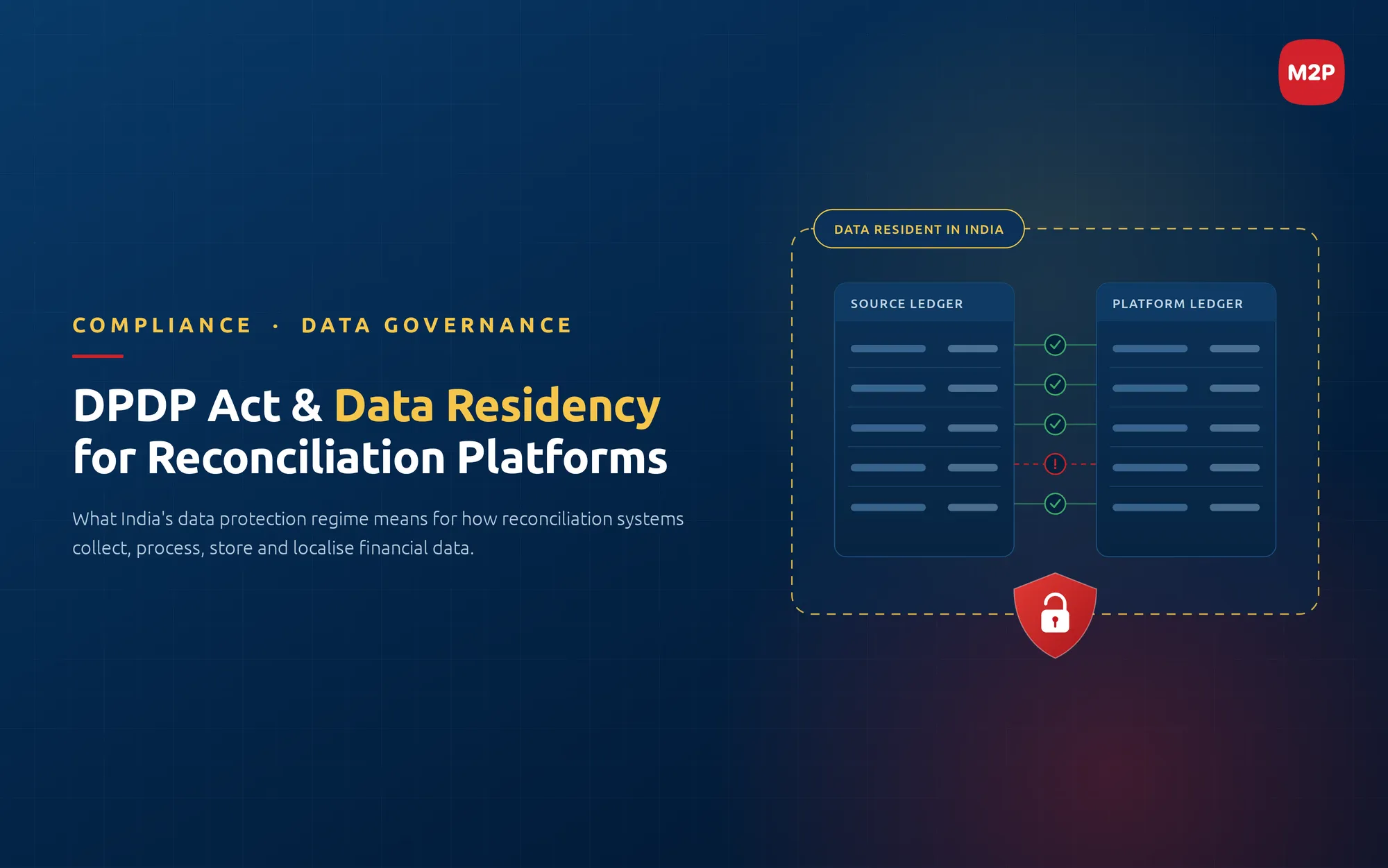
As India's data protection framework matures, this question is becoming standard across procurement and audit conversations. Any organization evaluating payment reconciliation software now needs to answer it with certainty, not assumption.
Reconciliation platforms sit at the center of this shift. They process transaction records, settlement files, and account-linked data every single day, which places them squarely within the scope of India's evolving data protection and residency requirements.
India's Digital Personal Data Protection Act (DPDP Act), 2023, governs how organizations collect, process, and store personal data of individuals in India. It applies to any reconciliation platform or payment reconciliation software that processes customer-linked transaction data, and it places clear accountability obligations on the entities that control that data, known as data fiduciaries.
The DPDP Act introduces several obligations relevant to financial institutions:
Purpose limitation: Personal data can only be processed for the purpose it was collected for.
Data fiduciary accountability: Organizations that determine how and why data is processed remain responsible for its protection, even when a third-party platform handles the processing.
Data breach notification: Fiduciaries must report breaches to the Data Protection Board of India and affected individuals.
Reasonable security safeguards: Organizations must implement measures to prevent unauthorized access, use, or disclosure.
Reconciliation systems process operational data that often includes account numbers, transaction references, payer and payee identifiers, and settlement details. Even when this data isn't traditionally classified as "sensitive personal data," it is frequently linkable to identifiable individuals, which brings it within the Act's scope. This is why banks, NBFCs, and fintechs increasingly treat reconciliation infrastructure as a data governance concern, not just an operations tool.
Data residency refers to the physical location where an organization's data is stored, while data localization is a regulatory requirement mandating that specific categories of data remain within a country's borders. For cloud-hosted reconciliation platforms, this determines where transaction records, matching logs, and audit trails physically reside, and who is legally permitted to access them.
These terms are often used interchangeably, but they carry different obligations and business implications:
Concept | Meaning | Business Impact |
|---|---|---|
Data Residency | The geographic location where data is stored, chosen for operational, contractual, or regulatory reasons | Affects hosting decisions, cloud region selection, and cross-border data flow risk |
Data Localization | A legal requirement mandating that certain data categories be stored within national borders | Limits vendor and infrastructure choices; non-compliance carries regulatory risk |
Cross-Border Data Transfer | Movement of data outside the country of origin for processing, backup, or support | Requires contractual safeguards and, in regulated sectors, may face restrictions |
Data Sovereignty | The principle that data is subject to the laws of the country in which it is stored | Determines which government or regulator has legal jurisdiction over the data |
For payments and banking data specifically, this isn't a new conversation. The Reserve Bank of India (RBI) has long required payment system data to be stored exclusively within India, independent of the DPDP Act. The DPDP Act adds a broader personal data protection layer on top of these existing sector-specific requirements, which means reconciliation platforms need to satisfy both regimes simultaneously.
The DPDP Act requires cloud-hosted reconciliation platforms to demonstrate clear accountability for how transaction data is stored, processed, accessed, and shared, regardless of whether the underlying infrastructure is owned or outsourced to a third-party cloud provider. Vendor accountability doesn't disappear simply because processing happens on external infrastructure.
This affects several operational areas:
Data storage location: Institutions must know, contractually and technically, where reconciliation data is hosted and whether it meets applicable localization requirements.
Data processing boundaries: Any processing done outside India, including by sub-processors or support teams, needs to be assessed for compliance risk.
Third-party cloud accountability: When a reconciliation platform runs on a public cloud provider, the data fiduciary remains accountable for that provider's security and data handling practices.
Audit trails: Every access, match, exception, and modification needs to be logged in a way that supports regulatory review, not reconstructed after the fact.
Security controls and access governance: Encryption, role-based access, and monitoring aren't optional extras. They're part of demonstrating "reasonable security safeguards" under the Act.
In practice, this looks different across institution types:
Banks typically require reconciliation infrastructure hosted within approved data center regions, with strict vendor due-diligence processes before onboarding any cloud-based platform.
Fintechs often move faster on cloud adoption but need contractual clarity from vendors on data location, sub-processor lists, and breach notification timelines.
Payment aggregators handle high transaction volumes across multiple bank and network partners, making consistent audit trails across all reconciliation points a compliance necessity.
NBFCs frequently reconcile across multiple lending and collection partners, which increases the number of third parties whose data handling practices come under indirect scrutiny.
Organizations evaluating a reconciliation platform should look for built-in controls that support data protection by design, including role-based access, encryption, comprehensive audit logging, and data segregation, rather than compliance measures added on as an afterthought. These features determine whether a platform can meet DPDP obligations without requiring extensive custom configuration.
Feature | Why It Matters Under DPDP | How Recon360 Supports It |
|---|---|---|
Role-based access control | Limits data exposure to only those who need it for their function | Configurable access roles across teams and entities |
Encryption (at rest and in transit) | Protects data from unauthorized access during storage and transmission | Encryption applied across data storage and transfer layers |
Audit logs | Provides the traceability regulators and auditors require | Detailed, timestamped logs across matching, exceptions, and user actions |
Data segregation | Prevents cross-contamination of data across clients or business units | Multi-entity architecture with logical data separation |
Consent-based workflows | Supports purpose limitation where personal data use requires consent | Configurable data-handling rules aligned to defined processing purposes |
Multi-tenant architecture | Ensures one client's data environment stays isolated from another's | Tenant-level isolation built into the platform design |
Monitoring and observability | Enables early detection of anomalies or unauthorized access | Real-time monitoring across reconciliation and access activity |
Recon360 is designed around the assumption that reconciliation platforms handle sensitive operational data by default, not as an exception. This shapes several aspects of how the platform is built.
Every match, exception, and manual action within Recon360 is logged with full traceability, so institutions can reconstruct the history of any transaction without relying on manual documentation. This matters as much for internal risk teams as it does for external auditors.
The platform's AI-powered matching capabilities are built with this same traceability in mind. Automated decisions are logged and explainable, rather than operating as a black box, which supports both operational trust and audit readiness.
For institutions managing multiple entities, business units, or client relationships, Recon360's multi-entity support keeps data logically segregated while still enabling consolidated reporting where appropriate. Deployment flexibility, across cloud and on-premise environments, allows institutions to align hosting decisions with their specific residency and localization obligations rather than adopting a one-size-fits-all approach.
Configurable workflows mean compliance requirements can be built into daily reconciliation processes, rather than managed as a separate, parallel effort. The result is a platform designed to reduce operational risk while supporting the accountability that regulated institutions are expected to demonstrate.
Does the DPDP Act require financial data to stay in India? The DPDP Act itself does not universally mandate that all personal data remain in India, though the government retains the ability to restrict cross-border transfers to specific countries. Separately, RBI requirements for payment system data have long required India-based storage for payments-related data, independent of the DPDP Act.
Can banks use public cloud for reconciliation? Yes, provided the cloud provider and hosting region meet applicable regulatory and localization requirements, and the bank maintains contractual accountability and audit visibility over how data is stored and processed.
What data protection controls should reconciliation systems provide? At minimum, role-based access control, encryption at rest and in transit, detailed audit logging, and data segregation across entities or clients. These form the baseline expected under "reasonable security safeguards."
How does auditability support compliance? A strong audit trail lets institutions demonstrate exactly how data was accessed, processed, and modified, which is essential for both regulatory reviews and internal risk management. Without it, compliance claims are difficult to substantiate.
What is the difference between data localization and data residency? Data residency describes where data is stored by choice or design. Data localization is a legal requirement mandating that certain data categories must be stored within a specific country's borders.
How should fintechs evaluate reconciliation vendors for compliance readiness? Fintechs should review a vendor's hosting regions, sub-processor arrangements, breach notification commitments, access control architecture, and audit logging capabilities before onboarding, rather than assuming compliance based on general vendor reputation.
Does the DPDP Act apply to B2B transaction data? The Act applies to personal data of identifiable individuals. Transaction data that includes account holder names, identifiers, or other personally linkable details can fall within scope, even in B2B payment flows.
Is on-premise deployment more compliant than cloud hosting? Not inherently. Compliance depends on the security controls, access governance, and audit capabilities in place, not solely on whether infrastructure is on-premise or cloud-hosted.

Fintech is evolving every day. That's why you need our newsletter! Get the latest fintech news, views, insights, directly to your inbox every fortnight for FREE!