

M2P Fintech
Fintech is evolving every day. That's why you need our newsletter! Get the latest fintech news, views, insights, directly to your inbox every fortnight for FREE!
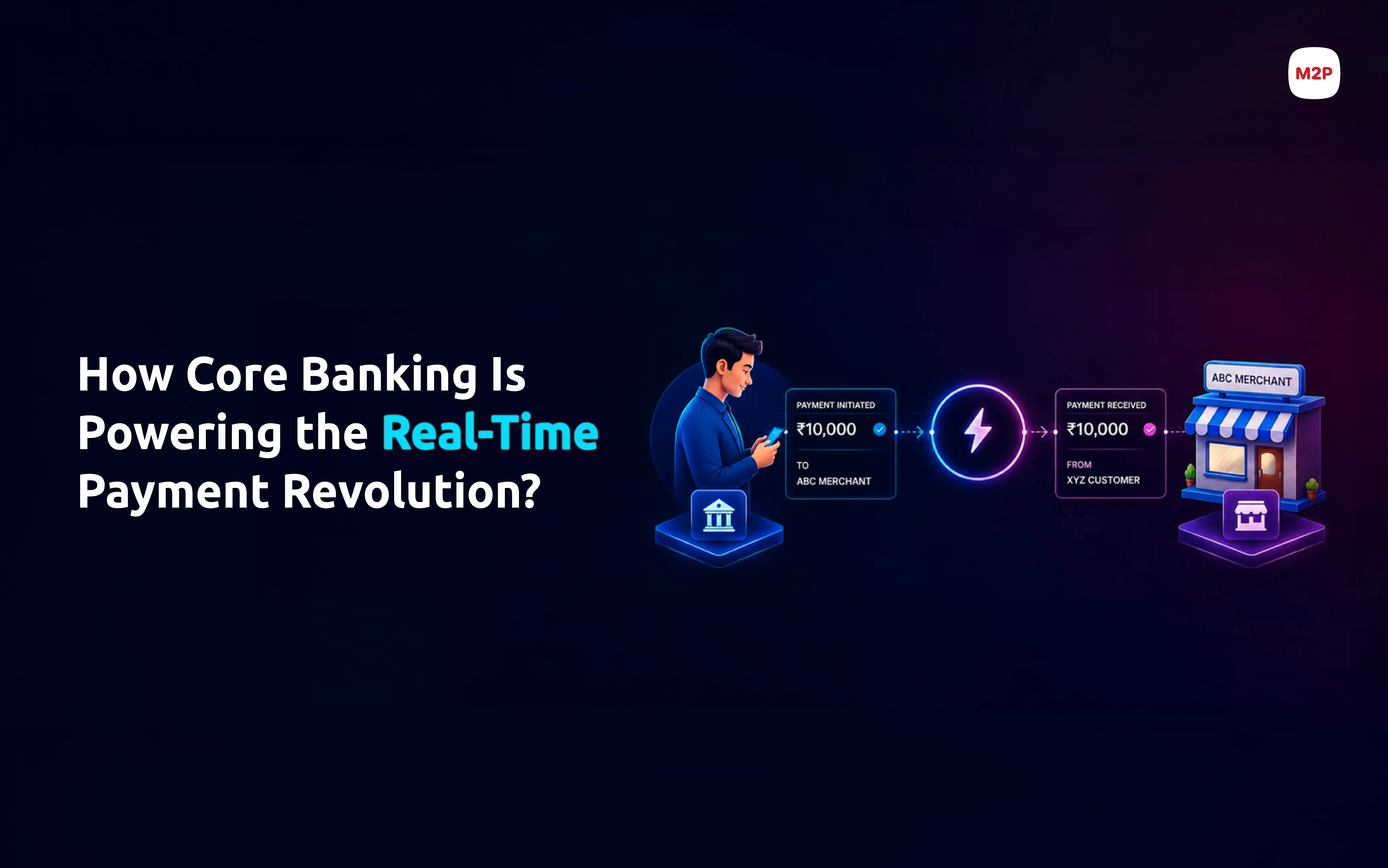
The financial world is in the midst of a revolution, one that is happening in the blink of an eye literally. The era of waiting days for payments to clear is rapidly drawing to a close, replaced by the immediacy of real-time payments. This fundamental shift is not just about speed; it's about transforming how businesses manage cash flow, how consumers interact with their finances, and how financial institutions operate at their very core. At the heart of this transformation lies the intricate relationship between Real-Time Payments (RTP) and the foundational Core Banking Systems (CBS) that power the global financial ecosystem.
This blog will delve into the dynamic interplay between these two critical components of modern finance. We will explore how Core Banking Systems are evolving to support instant payment networks like UPI and RTP, the sophisticated architecture required for this real-time processing, and the significant performance and scalability hurdles that must be overcome. We will also provide a comprehensive look at the various types of real-time payments with illustrative examples.
Before we explore their synergy, let's establish a clear understanding of each component.
Real-time payments, also known as instant payments, are electronic fund transfers that are initiated and settled in a matter of seconds, 24 hours a day, 7 days a week, 365 days a year. Unlike traditional payment methods like ACH (Automated Clearing House) or wire transfers, which often involve delays due to batch processing and banking hours, RTP networks make funds immediately available to the recipient. This immediacy provides greater transparency and certainty for both the sender and the receiver.
The global adoption of real-time payment systems has been explosive, with countries around the world launching their own networks. Some of the most prominent examples include:
Unified Payments Interface (UPI) in India: A revolutionary mobile-first system that has seen astronomical growth, processing billions of transactions monthly. It is now the world's largest real-time payment system by transaction volume
FedNow® Service in the United States: The Federal Reserve's instant payment service, designed to be accessible to financial institutions of all sizes
The Clearing House's RTP® network in the United States: The first new core payments infrastructure in the U.S. in more than 40 years
Faster Payments in the United Kingdom: A long-standing and successful real-time payment system
Pix in Brazil: A central bank-operated instant payment system that has rapidly gained widespread adoption, reaching over 80% of the adult population within a few years. It is celebrated for its innovative design and public governance model
A Core Banking System (CBS) is the back-end software platform that manages a bank's most critical operations. It is the central nervous system of a financial institution, handling everything from customer accounts, loan processing, and deposits to transaction processing and regulatory reporting. Essentially, every time a customer makes a deposit, withdraws cash from an ATM, or initiates a payment, the transaction is processed and recorded by the core banking system.
Historically, these systems were built on monolithic, legacy architectures designed for a world of paper-based transactions and end-of-day batch processing. However, the advent of digital banking and the demand for instant services have put immense pressure on these traditional systems, necessitating a fundamental modernization.
The move to real-time payments is not as simple as just connecting to a new payment rail. It requires a fundamental shift in how a bank's core systems operate. Traditional, batch-oriented CBS are simply not equipped to handle the 24/7, always-on nature of instant payments. To support systems like UPI and RTP, Core Banking Solution must evolve in several key ways:
24/7/365 Availability: Real-time payments don't adhere to banking hours. A modern CBS must be architected for continuous operation, eliminating the need for downtime for end-of-day processing or maintenance. This "always-on" capability is a foundational requirement for participating in any real-time payment network
Real-Time Transaction Processing: The core system must be able to process transactions individually and instantly as they occur. This is a stark departure from the traditional model of collecting transactions throughout the day and processing them in a large batch overnight
Instantaneous Balance Updates: When a real-time payment is made, the core banking system must be able to debit the payer's account and credit the payee's account in real-time, ensuring that account balances are always accurate and up-to-date
Seamless Integration via APIs: Modern Core Banking Solutions rely on Application Programming Interfaces (APIs) to connect with external systems, including real-time payment networks. This API-driven approach is central to Open Banking, which allows customers to securely share their financial data with third-party providers. This fosters a competitive and innovative ecosystem, as seen with UPI's open-source API framework that allows any certified bank or third-party app to connect
Enhanced Security with AI and Fraud Detection: The speed of real-time payments also presents new security challenges. A modern CBS must integrate sophisticated, real-time fraud detection and prevention tools that can identify and block fraudulent transactions in milliseconds. As traditional rule-based systems are often insufficient, modern architectures are integrating Artificial Intelligence (AI) and Machine Learning (ML). These systems analyze vast amounts of data to detect anomalies and suspicious patterns in real-time, providing a proactive approach to fraud prevention
To meet the demands of real-time payments, banks are moving away from their rigid, monolithic legacy systems and embracing a more flexible, modular, and scalable architectural approach. The key components of a modern, real-time-ready core banking architecture include:
Event-Driven Architecture (EDA) and Asynchronous Message Queues: In an EDA, actions such as a payment initiation trigger "events". These events are then processed in real-time by different services within the system. The backbone of this architecture is an asynchronous message queue like Apache Kafka, which acts as the central nervous system for the payment hub. It decouples microservices, allowing a payment initiation service to publish an event without knowing which fraud detection or settlement service will consume it. This design provides durability through replication, ensures messages aren't lost during failures, and handles the massive throughput required for RTP systems
Microservices: Instead of a single, large application, a microservices architecture breaks down core banking functions into a collection of smaller, independent services. For example, there might be separate microservices for customer management, account management, and payment processing. This modularity allows for greater flexibility, easier updates, and the ability to scale individual services as needed
API Gateway: The API gateway acts as a central point of entry for all external requests, including those from real-time payment networks. It routes requests to the appropriate microservice and plays a crucial role in security and managing traffic
Payment Hub: Many modern architectures include a dedicated "payment hub". This centralized component is responsible for orchestrating all payment-related activities, connecting to multiple payment networks (RTP, ACH, wire, etc.), managing payment routing, and ensuring compliance. India's UPI Switch, operated by NPCI, acts as a highly scalable central orchestrator or payment hub. A critical design choice is that the UPI switch is a stateless routing engine, meaning it doesn't store user data, which allows for immense horizontal scalability by simply adding more servers
In-Memory Data Grids (IMDGs): To achieve the millisecond-level responsiveness required for RTP, modern systems use IMDGs. These grids store data in RAM across a cluster of computers, providing extremely fast data access . This is essential for real-time fraud detection, where a customer's transaction history can be analyzed instantly to calculate a risk score. IMDGs also act as a high-speed cache for frequently accessed data like customer profiles, reducing the load on backend databases and improving overall system performance
Append-Only Ledgers: For ultimate data integrity and auditability, an append-only ledger is used. This data structure only allows new records to be added, preventing any alteration or deletion of past transactions. This creates a tamper-proof, immutable record of all financial movements, which is critical for regulatory compliance, forensic analysis, and maintaining a verifiable audit trail for all payment types
Auto-Scaling Cloud Infrastructure: Increasingly, banks are leveraging cloud computing to build their next-generation core banking platforms. Cloud-native architectures provide the elasticity and scalability needed to handle the fluctuating transaction volumes of real-time payments. Autoscaling dynamically adjusts computing resources to match workload demand, ensuring applications remain performant during peak loads while minimizing costs during quiet periods. This prevents system overloads and enhances resilience, which is critical for 24/7 operations
Underpinning the global move towards more efficient and interoperable payment systems is the ISO 20022 standard. It serves as a universal messaging language for financial transactions, replacing a patchwork of legacy formats that hindered communication between different systems. Its adoption is foundational for the next generation of payment systems and the innovative "overlay services" built upon them.
Data Richness and Structure: Unlike older formats, ISO 20022 messages are based on XML and can carry vast amounts of structured data. This allows for the inclusion of detailed remittance information, such as full invoice details, purchase order numbers, and tax information, directly within the payment message
Automating B2B Workflows: This rich data is instrumental in automating complex B2B workflows. It enables Straight-Through Processing (STP), where transactions are processed by machines without manual intervention. Businesses can automatically reconcile incoming payments with outstanding invoices in their Enterprise Resource Planning (ERP) systems, drastically improving efficiency and cash flow management
Enhanced Interoperability: By creating a common financial language, ISO 20022 enables seamless communication between diverse payment systems, both domestically and across borders. This is a crucial step toward linking national instant payment networks to revolutionize cross-border payments, making them cheaper and faster than the traditional correspondent banking system
Facilitating Innovative "Overlay" Services: The rich data and flexibility of ISO 20022 support the development of innovative value-added services on top of instant payment rails. A prime example is Request-to-Pay (RTP), which allows a payee to send a digital request for payment to a payer, who can then approve and execute the payment instantly. This streamlines billing and gives businesses more control over their cash flow
The transition to real-time payments is not without its challenges. The performance and scalability demands of these systems are immense, and banks must overcome several technical hurdles:
High Transaction Throughput: Real-time payment networks can experience massive transaction volumes, especially during peak times. Systems like UPI process billions of transactions monthly, so the underlying core banking systems must be able to handle this high throughput without any degradation in performance
Low Latency: The "real-time" promise means that transactions must be processed with extremely low latency—often in a matter of milliseconds. Architectural choices like stateless processing and the use of in-memory data grids can significantly speed up transaction times
24/7 Availability and Liquidity Management: These systems must be "always-on," which requires a high degree of resilience and redundancy to prevent outages. A major challenge is managing interbank liquidity outside of standard banking hours. To address this, institutions are deploying Real-Time Liquidity Management Systems that provide a unified, enterprise-wide view of cash positions. These systems use APIs for data aggregation, AI for predictive forecasting, and automation to optimize funding and reduce risk. Brazil's Pix incentivizes liquidity by remunerating the balances that participants hold in their settlement accounts, reducing the opportunity cost of pre-funding
Data Synchronization and the SAGA Pattern: In a distributed, microservices-based architecture, ensuring that data is consistent across all services is a significant challenge. A single payment might involve several services (e.g., debit account, fraud check, credit account), each with its own database. To manage this, modern systems employ the SAGA pattern. A saga is a sequence of local transactions; if any step fails, the saga executes a series of compensating transactions to undo the previous steps, ensuring the system remains in a consistent state. Sagas can be coordinated through choreography (decentralized event-driven communication) or orchestration (a central controller manages the workflow)
Security at Scale: As transaction volumes grow, so does the attack surface for fraudsters. Banks must implement security measures that can operate effectively at scale, without introducing significant latency. This involves a multi-layered approach:
Foundational Security: Protocols like device binding, end-to-end encryption, and mandatory two-factor authentication (e.g., a device PIN plus a secret UPI PIN) are essential
AI-Powered Fraud Detection: AI and ML models provide a crucial layer of defense by analyzing data in real-time. They can identify anomalies by looking at transaction patterns, amounts, and merchant details
Behavioral Analytics: These systems go beyond transaction data to analyze behavioral patterns like device usage, geolocation, and even how a user interacts with an app (behavioral biometrics) to distinguish legitimate users from fraudsters
Data-Rich Analysis: The detailed information in ISO 20022 messages provides a wealth of context for AI models, allowing them to make more accurate risk assessments and reduce the number of legitimate transactions that are mistakenly flagged (false positives)
Real-time payments can be categorized based on the parties involved in the transaction. Here's a breakdown of the most common types, with examples:
1. Person-to-Person (P2P) or Peer-to-Peer: These are transfers between individuals.
Examples:
Splitting a dinner bill with friends using a mobile banking app like PhonePe or Google Pay
Sending a monetary gift to a family member using their Virtual Payment Address (VPA)
Paying a roommate for your share of the rent, a common use case for Brazil's Pix
2. Business-to-Consumer (B2C): These are payments from a business to an individual.
Examples:
An insurance company instantly disbursing a claim payout
A gig economy platform paying a driver or delivery person immediately after a job is completed
A company issuing instant payroll to its employees
3. Consumer-to-Business (C2B): These are payments from an individual to a business.
Examples:
Paying for groceries at a store by scanning a QR code linked to a real-time payment network, a method that has seen massive adoption with UPI
Making an online purchase and paying directly from your bank account
Instantly paying a utility bill through a mobile app, a transaction type where Pix is widely used
4. Business-to-Business (B2B): These are payments between two businesses.
Examples:
A small business paying a supplier for inventory instantly to improve cash flow
A large corporation making a just-in-time payment to a logistics partner
Using a Request-to-Pay service to streamline invoicing and receive instant settlement from a client
5. Government-to-Consumer (G2C) and Consumer-to-Government (C2G): These involve transactions with government entities.
Examples:
The government instantly disbursing tax refunds or social security benefits, a use case that helped drive UPI adoption in India
A citizen making an immediate payment for taxes or a government service
6. Cross-Border Payments: The UPI-PayNow Case Study
A groundbreaking application of real-time payments is in the cross-border space, traditionally plagued by high costs and delays. The linkage between India's UPI and Singapore's PayNow is a prime example of how this is changing:
Technical Architecture: The system directly links the two domestic instant payment networks via secure APIs, bypassing traditional correspondent banking networks. A user in India can initiate a payment using the recipient's PayNow-registered mobile number in Singapore, and vice-versa using a UPI ID. The respective national payment operators (NPCI in India, BCS in Singapore) handle the cross-border communication, and designated settlement banks manage the final fund settlement
FX and Compliance: The system provides transparency by showing the sender a competitive, pre-agreed exchange rate before they confirm the transaction. The entire process is supervised by the central banks of both countries (RBI and MAS), ensuring compliance with all regulations, including AML/KYC rules and foreign exchange limits like India's Liberalised Remittance Scheme (LRS)
The rise of real-time payments represents a pivotal moment in the evolution of the financial industry. The demand for instant, 24/7 transactions is compelling banks to modernize their foundational Core Banking Systems. This transformation involves a significant architectural shift away from traditional, batch-oriented monolithic systems towards more agile, event-driven, and cloud-native platforms built on microservices principles.
To support real-time payment networks like UPI and FedNow, Core Banking Systems must be capable of continuous, real-time transaction processing, instantaneous balance updates, and seamless integration through open APIs. The architecture required for this is characterized by a sophisticated stack of modern technologies. This includes asynchronous message queues (e.g., Kafka) to decouple services and manage high throughput, in-memory data grids for low-latency processing, and append-only ledgers for immutable audit trails. A centralized, stateless payment hub often orchestrates the complexities of modern payment processing, as exemplified by India's UPI Switch. A critical enabler of this new ecosystem is the ISO 20022 messaging standard, which provides the data-rich, common language necessary for interoperability and innovation. This standard is key to automating complex B2B workflows through straight-through processing and enabling innovative overlay services like Request-to-Pay.
The journey to real-time is not just a technological upgrade; it is a strategic imperative for any financial institution that wants to remain competitive in the digital age. Navigating this complex transition from legacy systems to a modern, agile infrastructure requires a partner with a platform built specifically for the future of finance.
M2P's Turing Core Banking Platform is engineered from the ground up to meet the demands of the real-time era. With its modern, microservices-based architecture, inherent scalability, and robust, AI-driven security features, Turing empowers financial institutions to seamlessly integrate with instant payment networks like UPI and FedNow, overcome scalability challenges, and launch innovative overlay services with unparalleled speed and agility.
Don't let legacy systems dictate your future. It's time to embrace the instant. Explore how M2P's Turing Core Banking Platform can be the foundation for your real-time transformation and schedule a demo with our experts today!
Fintech is evolving every day. That's why you need our newsletter! Get the latest fintech news, views, insights, directly to your inbox every fortnight for FREE!