

M2P Fintech
Fintech is evolving every day. That's why you need our newsletter! Get the latest fintech news, views, insights, directly to your inbox every fortnight for FREE!
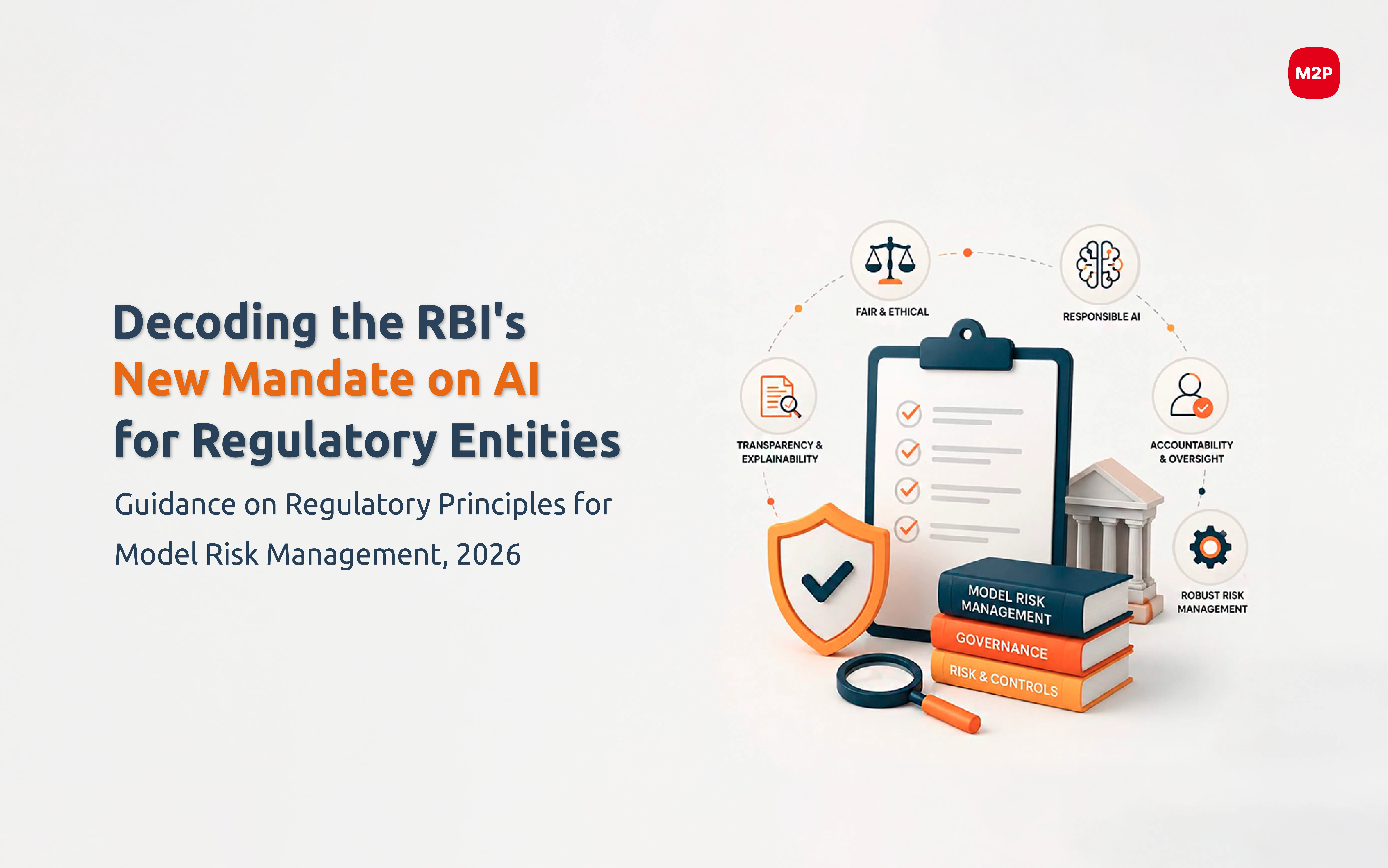
The Indian financial landscape is on the cusp of a significant transformation. On June 24, 2024, the Reserve Bank of India (RBI) released its draft 'Guidance on Regulatory Principles for Model Risk Management', stepping in to provide a structured framework for the burgeoning use of Artificial Intelligence (AI) and Machine Learning (ML) in the sector. The comprehensive framework, open for public comment until July 24, 2024, signals a pivotal shift from unbridled innovation to governed growth, ensuring that the adoption of these powerful technologies is both responsible and resilient.
This blog post will delve into the key aspects of these proposed guidelines, explaining what they mean for banks, financial institutions, and their customers.
Financial institutions, including commercial banks, NBFCs, and credit information companies, increasingly rely on complex quantitative models for everything from credit scoring and fraud detection to algorithmic trading and cybersecurity. While these models, especially those powered by AI and ML, bring immense efficiencies, they also introduce a new set of risks. The RBI warns that unmanaged model risk can lead to "inaccurate outcomes, flawed decisions, financial losses, operational disruptions, compliance failures and other adverse consequences". The "black box" nature of some complex algorithms can make it difficult to understand their decision-making process, amplifying these risks. Recognizing unique AI-related risks like "hallucinations," data bias, and new cybersecurity threats, the RBI's draft guidance is a proactive measure to mitigate these challenges and ensure the financial system remains stable, trustworthy, and fair.
To understand the new guidelines, we first need to understand the problem they aim to solve. The RBI has provided a formal definition of 'model risk’.
Model Risk is officially defined as the potential for adverse consequences—such as financial losses, flawed business decisions, operational disruptions, compliance failures, or reputational damage—arising from decisions based on incorrect or misused model outputs and reports.
The primary sources of this risk are multifaceted and include:
Model Errors: This covers a wide range of issues, including flawed assumptions or methodology, incorrect parameterization, poor-quality or inappropriate data ("garbage in, garbage out"), and implementation errors or coding defects
Misapplication: This occurs when a model is used for a purpose for which it was not designed, or when its outputs are misinterpreted
Time-Suitability Issues: Models can degrade over time as market conditions or underlying data patterns change (data drift), making their outputs less accurate or relevant
Inadequate Monitoring: This is the failure to track a model's performance over time to detect any deterioration or drift
The RBI has intentionally adopted a broad definition of a "model," encompassing any system using data and analytical techniques to produce outputs that materially influence business decisions. This means that even simpler tools like spreadsheet-based calculators could fall under these regulations if they play a significant role in key decisions.
A cornerstone of the proposed framework is the establishment of a formal, board-approved Model Risk Management Framework (MRMF) for every regulated entity. This shifts model risk from a purely technical concern to a critical board-level governance matter, representing a significant cultural shift away from viewing AI governance as a siloed IT function.
The RBI has made it clear that the ultimate responsibility for model risk governance lies with the board of directors. The Board's specific responsibilities include:
Approving the MRMF: The Board must approve a comprehensive, enterprise-wide MRMF and review it periodically to ensure its continued effectiveness
Setting Risk Appetite: The Board is responsible for defining and approving the institution's appetite and tolerance for model risk, a decision that should be informed by scenario analysis and stress testing
Overseeing Implementation: The Board, often through its Risk Management Committee (RMCB), is tasked with overseeing the implementation of the entire framework. The RMCB will have a significant oversight role, particularly in monitoring third-party and AI-based models
Approving High-Risk Models: The RMCB must review validation reports and approve the deployment of any model classified as "high-risk"
The guidelines mandate a clear governance structure based on the well-established "three lines of defense" model to ensure checks and balances and a clear segregation of duties.
First Line: Model Owners and Developers
This line consists of those with day-to-day responsibility for the model's design, implementation, and performance. Their key functions include designing, developing, documenting, and continuously monitoring the model's performance and stability
Second Line: Independent Model Risk Management and Validation
This function provides an objective assessment of model risk and must be independent of the model development process. Its primary responsibilities are to independently validate all models, challenge their conceptual soundness, and report findings to senior management and the RMCB
Third Line: Internal Audit
This is a robust and independent function that provides assurance to the Board that the overall MRMF is effective. Its key functions include independently assessing the adequacy of the first two lines of defense and ensuring compliance with all MRMF policies
The draft guidelines are comprehensive, touching upon the entire model lifecycle, from development and validation to deployment and decommissioning:
Stage | Key Requirements and Best Practices |
|---|---|
Selection and Development | Before building a model, entities must document its rationale and objectives, including a cost-benefit analysis that considers fairness, ethics, and bias. |
Independent Validation | All models are subject to independent validation initially before deployment, periodically thereafter, and whenever significant changes are made. |
Approval | A clearly defined approval structure is required, with high-risk models necessitating approval from the RMCB. For models approved with exceptions, enhanced monitoring by the RMCB is required. |
Deployment and Monitoring | Continuous monitoring is essential to track the model's performance, identify any deterioration or data drift, and determine the need for modification or replacement. |
Change Management | A formal change management process must be in place to govern any modifications or re-calibrations of existing models. |
Decommissioning | When a model is no longer in use, it must be formally decommissioned. However, records of decommissioned models must be retained in the model inventory for at least ten years to ensure a strong audit trail. |
The Comprehensive Model Inventory: A central pillar of the MRMF is the creation and maintenance of a comprehensive model inventory. This centralized register must be accurate, up-to-date, and include all models, whether they are in use, under development, or decommissioned. No model can be deployed unless it is formally recorded in this inventory
Risk-Based Model Tiering: The framework requires a methodology for model tiering, which involves classifying each model into a risk tier (e.g., high, medium, low). This classification is based on factors like the model's materiality, complexity, and potential business impact, and it dictates the intensity of validation and monitoring required
A central tenet of the draft guidance is that a regulated entity remains entirely and fully accountable for the outcomes of all models it uses, regardless of whether they are developed in-house or sourced from external vendors. Financial institutions cannot attribute flawed decisions or regulatory breaches to third-party providers. This presents a significant challenge in the validation and oversight of opaque "black box" models from vendors. To enforce this, the RBI has proposed specific obligations:
Due Diligence Processes: Before acquiring a third-party model, institutions must conduct thorough due diligence. This includes assessing the vendor's credibility, the model's methodological soundness and limitations, and the quality of its data. The goal is to identify potential risks, such as a lack of transparency in vendor-developed AI models, before integration
Contractual Requirements: Contracts with vendors must secure crucial rights for the financial institution. These include access to technical documentation sufficient for independent validation, audit rights for both the institution and the RBI, and clear arrangements for business continuity and exit strategies
Mandatory Independent Validation: The RBI mandates that all third-party models must be independently validated by the regulated entity itself before deployment and throughout their lifecycle. This is non-negotiable and required irrespective of any certification or assurance provided by the vendor
Ongoing Monitoring: All deployed third-party models must be continuously monitored to ensure their performance is as intended and to identify any need for modification or replacement
The proposed framework introduces enhanced requirements specifically for AI and ML systems to address their unique risks, such as the potential for bias and unpredictable outcomes. The guidance explicitly warns against "automation bias"—the tendency for human reviewers to place excessive trust in automated outputs:
Human Oversight and Control: Robust and meaningful human oversight for all AI-driven decisions is mandatory. This can be implemented through "human-in-the-loop" or "human-on-the-loop" arrangements to ensure a human is actively involved, especially for material decisions. Periodic human review of model outputs is also required to identify anomalies
Override Capability and the 'Kill Switch': Institutions must have the capability to override a model's decision. Taking this a step further, the RBI has mandated the implementation of a "kill switch". This mechanism allows for the immediate suspension or deactivation of a malfunctioning AI model that is producing harmful or erroneous outputs, serving as a critical safety net
Explainability and Transparency: For models with limited explainability ("black boxes"), institutions must implement compensating controls like enhanced validation, usage restrictions, and more frequent monitoring. Stricter explainability thresholds must be defined for material decisions like credit underwriting, requiring investment in "Explainable AI" (XAI) techniques
Fairness and Mitigating Bias: Regulated entities must proactively conduct fairness assessments to detect and prevent discriminatory outcomes, which is a particular challenge given India's diverse population. If bias is detected, models must be recalibrated or redesigned to mitigate it
AI-Specific Risk Mitigation: Institutions must assess and mitigate risks unique to AI, such as "hallucinations" in generative AI, spurious correlations, and data drift. Structured challenge processes like adversarial testing and "red-teaming" are required to uncover hidden weaknesses, including new cybersecurity threats like prompt injection
Transparency with Customers: For AI systems that interact directly with customers (e.g., chatbots), institutions must clearly disclose that the customer is interacting with an AI, inform them of its limitations, and provide an option to seamlessly switch to a human agent upon request
The implementation of these guidelines, once finalized, will have a profound impact on the Indian financial sector, presenting a mix of significant challenges and long-term opportunities.
Institutions face a steep learning curve and will need to navigate substantial operational, financial, and technological hurdles.
Operational Hurdles: The mandate requires a fundamental overhaul of business processes. This includes establishing the board-approved MRMF, creating a comprehensive model inventory, and implementing the "three-lines-of-defense" model. Implementing "human-in-the-loop" systems and the "kill switch" mandate will require significant procedural and technical planning. These compliance requirements could be particularly strenuous for smaller institutions, fintechs, and cooperative banks that lack established digital and analytics capabilities
Financial Implications: Compliance will necessitate significant financial investment. Analysts anticipate a notable increase in operating expenses, with some estimates suggesting a 50-100 basis point rise in IT spending as a percentage of total revenue for mid-tier banks and NBFCs over the next two years. Costs will be driven by investments in new IT infrastructure, and a surge in demand for specialists in AI governance and model validation, which will likely drive up salaries for this talent
Technological Complexities: The technological lift is substantial. Many institutions, particularly public sector banks, rely on legacy IT systems that are ill-suited for modern AI applications. Ensuring high-quality, unbiased data is a critical challenge, as is addressing the "black box" problem with investments in Explainable AI (XAI). Furthermore, there is a widely acknowledged skill gap in the Indian banking sector for AI and model risk management that will require substantial investment in training to bridge
The stringent guidelines are expected to cause a temporary deceleration in the speed of AI adoption. The focus is shifting from a "move fast and break things" approach to one of "governed growth". While this may temper the pace of deploying new models, the long-term objective is to foster a more sustainable and responsible innovation culture. The framework could, however, create a safer environment for AI experimentation through mechanisms like AI innovation sandboxes, allowing institutions to test prototypes in a controlled setting.
Despite the immediate challenges, the RBI's proactive stance is poised to create significant long-term opportunities:
Enhanced Trust and Customer Confidence: By prioritizing fairness, transparency, and accountability, the guidelines will help build greater public trust in AI-driven financial services, which is critical for long-term adoption
Improved Financial Inclusion: Well-governed AI has the potential to enhance financial inclusion by enabling more accurate credit assessments for individuals and small businesses traditionally underserved by the formal financial system
Emergence of a New RegTech Industry: The demand for expertise in AI governance and model validation is expected to spawn a new ecosystem of consulting, audit, and RegTech (Regulatory Technology) firms, creating new economic opportunities
Growth of a Homegrown AI Ecosystem: The framework could spur the development of indigenous AI solutions tailored to the Indian context, potentially supported by initiatives like a proposed "AI Kosh," a centralized repository of anonymized data for training models
More Resilient Business Models: The discipline of model risk management will lead to a deeper understanding of AI systems, resulting in more robust business models, better decision-making, and reduced operational losses
The RBI's draft guidance on model risk management is a landmark move to regulate the use of AI and ML in India's financial sector, shifting the focus from rapid innovation to governed growth. By mandating board-level accountability, a "three lines of defense" governance structure, and a comprehensive Model Risk Management Framework (MRMF), the central bank aims to balance innovation with stability. A central tenet is the full accountability of financial institutions for all models, including "black box" systems from third-party vendors, necessitating rigorous due diligence and mandatory independent validation. For AI systems, the mandate for robust human oversight, the capability to override decisions, and a "kill switch" to deactivate malfunctioning models are critical new controls.
While implementation presents significant operational, financial (e.g., a potential 50-100 bps rise in IT spending), and technological challenges, particularly for smaller institutions and those with legacy systems, the long-term opportunities are substantial. The guidelines are expected to foster greater public trust, improve financial inclusion, and spur the growth of a domestic RegTech industry and a specialized talent pool. The feedback period, open until July 24, 2024, will be critical in shaping the final contours of this regulation, which aims to ensure the future of finance in India is not only technologically advanced but also ethical, transparent, and secure.
The RBI's new mandate on AI and Model Risk Management underscores the importance of a compliance-first approach. At M2P, our commitment to regulatory adherence is at the core of everything we do. We proactively engineer our solutions to be fully compliant with all mandates given by the RBI, ensuring you can innovate with confidence and security.
Talk to M2P to build the future of finance on a foundation of trust and unwavering compliance.


Fintech is evolving every day. That's why you need our newsletter! Get the latest fintech news, views, insights, directly to your inbox every fortnight for FREE!