

M2P Fintech
Fintech is evolving every day. That's why you need our newsletter! Get the latest fintech news, views, insights, directly to your inbox every fortnight for FREE!
Financial fraud is no longer confined to traditional banking systems—it has expanded into fintech, crypto, e-commerce, and cross-border ecosystems. As fraud evolves, so do regulations. In 2026, compliance teams face a rapidly changing global regulatory environment where expectations are stricter, more technology-driven, and highly outcome-focused.
Governments and regulators are not just asking, “Do you have controls?”—they are asking, “Are your controls actually effective?” This shift is redefining how organizations approach fraud prevention, AML (Anti-Money Laundering), and risk management.
Fraud regulation globally is largely anchored in AML and KYC frameworks, guided by international standards such as the Financial Action Task Force (FATF) recommendations. These recommendations form the baseline adopted by most countries to combat money laundering and terrorist financing.
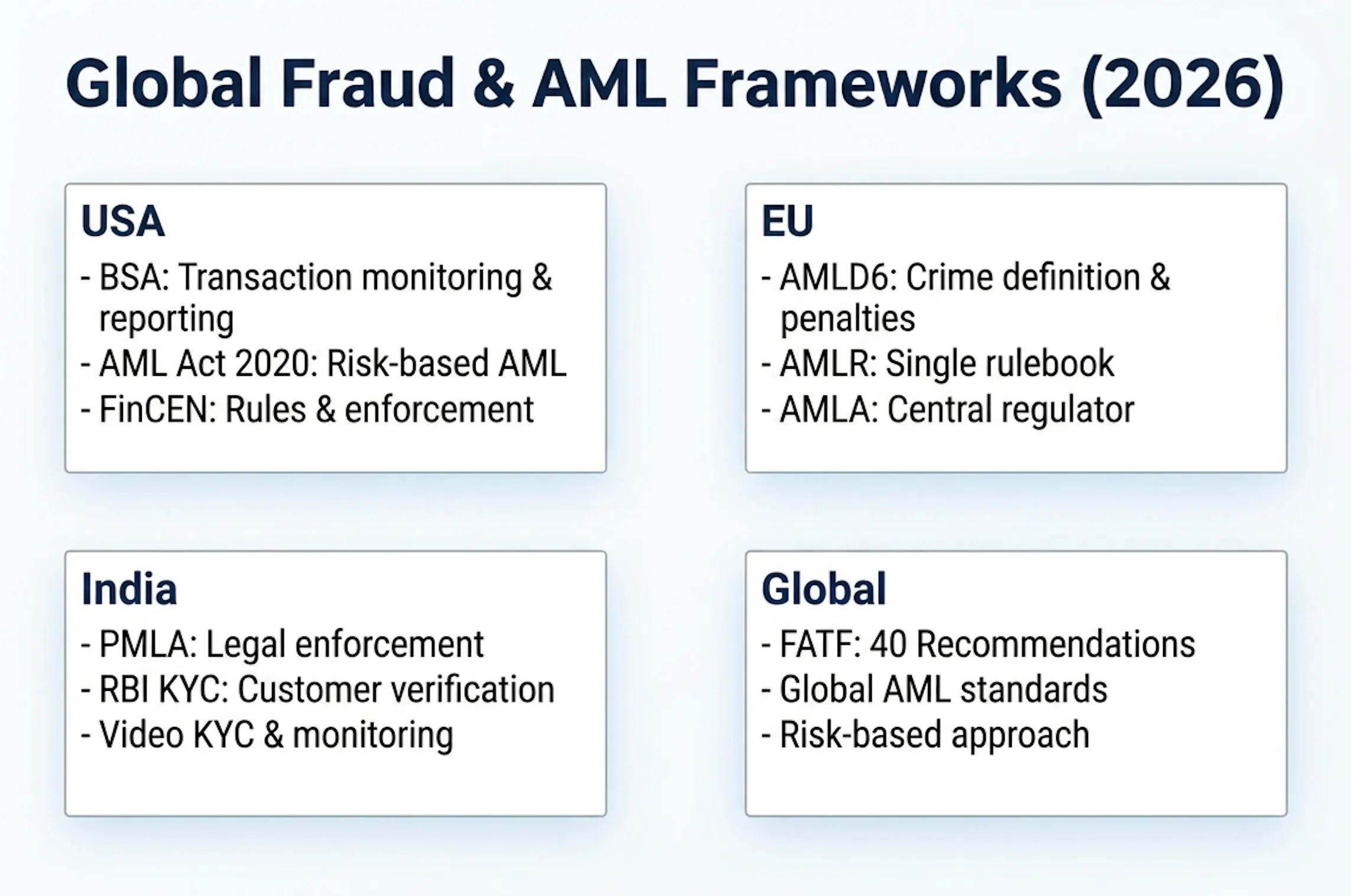
USA: Bank Secrecy Act (BSA), AML Act 2020, FinCEN rules
EU: AML Directives (AMLD6), upcoming AML Regulation (AMLR), AML Authority (AMLA)
India: PMLA, RBI KYC Master Directions
Global: FATF 40 Recommendations
Customer identity verification (KYC)
Transaction monitoring
Suspicious Activity Reporting (SAR)
Risk-based compliance programs
The BSA is the foundation of U.S. AML regulation, requiring financial institutions to:
Maintain records of financial transactions
Report suspicious activities (SARs)
Report large cash transactions (CTR)
Its core goal is to detect and prevent money laundering and fraud.
A major modernization of the BSA, this act:
Introduces a risk-based approach to AML compliance
Expands regulation to emerging sectors (e.g., crypto)
Encourages innovation (AI/analytics) in fraud detection
Focus shifts from compliance paperwork to effectiveness and risk management.
FinCEN (Financial Crimes Enforcement Network) issues detailed regulations under the BSA:
Customer Due Diligence (CDD) rules
Beneficial Ownership reporting
AML program requirements
FinCEN ensures institutions implement AML laws effectively and share intelligence with regulators.
AMLD6 is part of a series of EU directives that:
Define money laundering offenses and penalties
Expand liability to organizations and individuals
Focus is on harmonizing AML enforcement across EU member states.
AMLR will create a single rulebook across the EU:
Standardized KYC and AML requirements
Uniform compliance obligations for all countries
Removes inconsistencies between member states.
A new EU-level regulator that:
Oversees high-risk financial institutions
Coordinates cross-border AML supervision
Strengthens centralized enforcement and oversight across Europe.
India’s primary AML law that:
Criminalizes money laundering
Mandates reporting of suspicious transactions
Enables asset seizure and investigation
Focus is on legal enforcement and financial crime control.
Issued by the Reserve Bank of India, these guidelines:
Define customer identification (KYC) standards
Include Video KYC (V-CIP) and digital onboarding
Mandate ongoing monitoring of customer transactions
Ensure standardized customer verification across banks and NBFCs.
The global standard for AML/CFT (Counter Financing of Terrorism):
Sets risk-based approach principles
Covers KYC, reporting, sanctions, and monitoring
Guides national laws across countries
Countries align their regulations with FATF to avoid being grey-listed or blacklisted.
Regulators are moving away from checklist-based compliance toward performance-driven regulation.
In the U.S., FinCEN proposals emphasize how effective AML programs are, not just whether they exist
Enforcement actions increasingly focus on systemic failures, rather than minor technical lapses
Implication: Organizations must demonstrate measurable outcomes—like reduced fraud losses or improved detection rates.
Risk-based compliance is becoming a legal obligation, not just best practice.
Institutions must continuously assess and update risks based on customer profile, geography, and transaction behavior
Static, annual reviews are being replaced with dynamic, real-time risk assessments
Implication: Compliance programs must be adaptive and data-driven.
Regulators now expect organizations to adopt advanced technologies—but with accountability.
AI is being integrated into transaction monitoring, alert triage, and SAR drafting
In the EU, AI systems used in compliance are classified as high-risk, requiring strict governance and transparency
Implication: Firms must balance innovation with explainability and auditability.
Compliance obligations are no longer limited to banks.
Crypto exchanges, real estate firms, and even luxury sectors now fall under AML/KYC requirements
FATF’s Travel Rule is tightening requirements for digital asset transactions
Implication: A wider ecosystem must now comply with financial crime regulations.
Shell companies and hidden ownership structures are major fraud enablers. Regulators are addressing this by:
Expanding beneficial ownership reporting requirements
Increasing access to ownership registries
Mandating stricter due diligence
Implication: Organizations must dig deeper into who really owns and controls entities.
Fraud is borderless, and regulators are responding with cross-border cooperation.
Increased focus on information sharing between institutions
Joint enforcement actions across jurisdictions
Shared intelligence on fraud patterns
Implication: Siloed risk management approaches are no longer effective.
Different regions have overlapping and sometimes conflicting requirements, making compliance difficult for global firms.
AML compliance costs are rising significantly due to:
Technology investments
Skilled workforce needs
Reporting obligations
Traditional systems generate large volumes of alerts, many of which are false positives, reducing efficiency.
Fraudsters are leveraging:
AI-generated identities
Deepfakes
Synthetic fraud patterns
Compliance teams must constantly evolve to keep up.
Implement continuous risk scoring
Use behavioral analytics
Update models dynamically
Deploy machine learning for anomaly detection
Automate reporting workflows
Ensure explainable AI models
Use multi-source data (device, IP, behavioral signals)
Break data silos across departments
Train employees regularly
Foster a “compliance-first” mindset
Align fraud, AML, and risk teams
Maintain clear documentation
Enable audit trails for AI decisions
Align with global best practices
The regulatory environment in fraud and risk management is entering a new phase of maturity:
AI-driven compliance will become mainstream
Real-time monitoring will replace periodic reviews
Fraud and AML functions will merge into unified financial crime units
Regulators will demand proof of effectiveness, not just effort
In 2026, fraud regulation is no longer just about compliance—it is about capability, adaptability, and measurable impact. Organizations that treat compliance as a strategic function rather than a regulatory burden will be better positioned to:
Prevent financial crime
Build customer trust
Avoid penalties
Gain competitive advantage
If you want to learn more about M2P’s FRM & AML framework which is compliant and is implemented across mulitple markets and to explore how our capabilities can be tailored to your goals, we invite you to schedule a discussion with us.
Fintech is evolving every day. That's why you need our newsletter! Get the latest fintech news, views, insights, directly to your inbox every fortnight for FREE!