

M2P Fintech
Fintech is evolving every day. That's why you need our newsletter! Get the latest fintech news, views, insights, directly to your inbox every fortnight for FREE!
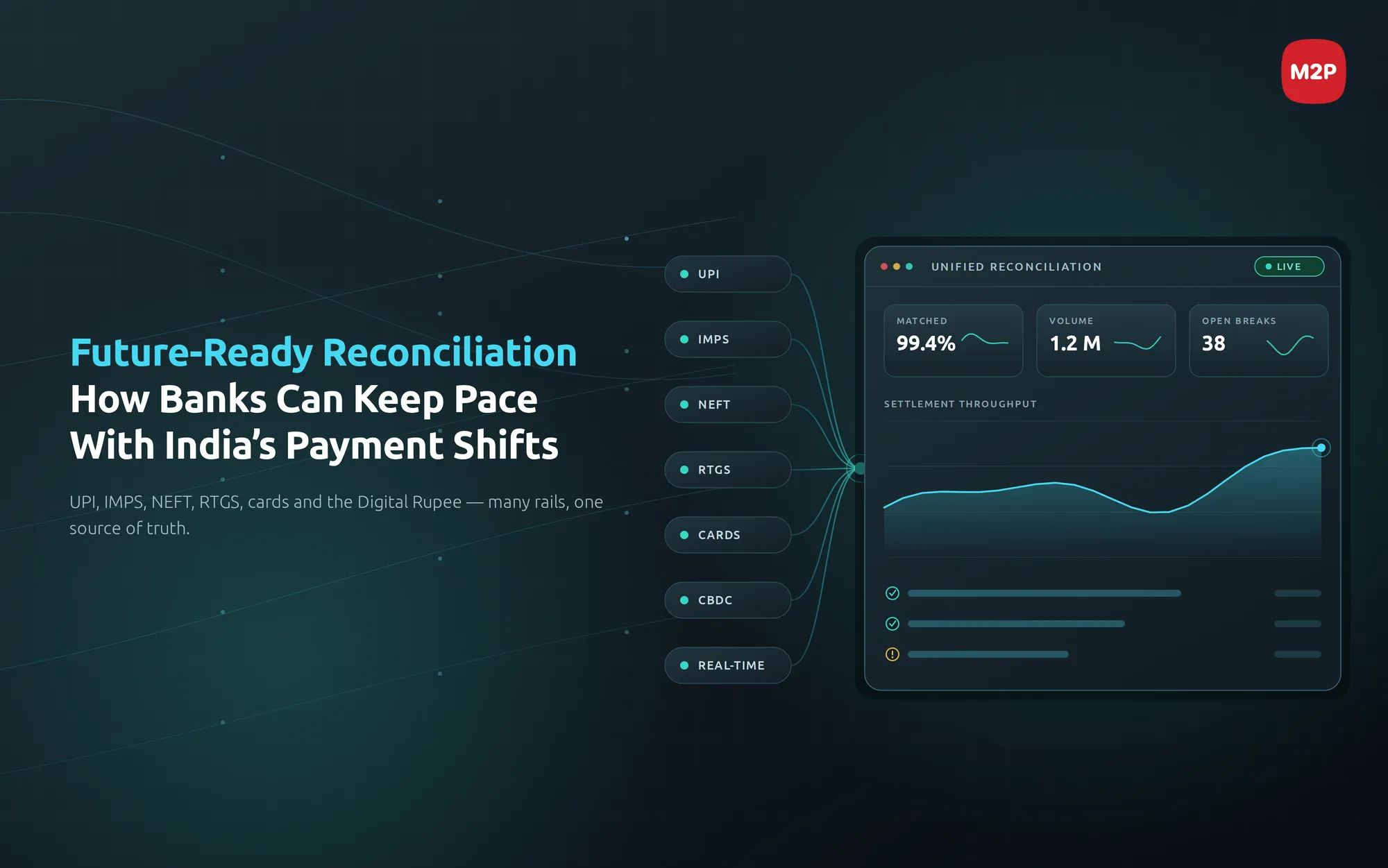
In September 2026, the Unified Payments Interface (UPI) crossed 24 billion transactions in a single month, according to National Payments Corporation of India (NPCI) data. Each transaction must be matched across banks, switches, aggregators, and ledgers, often inside a daily settlement window.
Volume is only part of the problem. New rails such as the Digital Rupee, richer ISO 20022 message data, and cross-border linkages add formats, currencies, and time zones that payment reconciliation software built for fewer rails was not designed to absorb.
Regulation adds pressure on where this work runs. Since 2018, the Reserve Bank of India (RBI) has required payment system data to be stored only in India, which shapes how reconciliation platforms are hosted.
For banks, this creates a widening gap between how fast payments change and how fast reconciliation can adapt. This guide covers eight shifts behind that gap, what each means for reconciliation, and the capabilities a future-ready platform needs.
UPI is the foundation of digital payments in India, and its feature set keeps growing. Recent and proposed enhancements, such as overdraft-linked accounts, invoice verification, and signed intent, introduce new data points that reconciliation teams must track and match.
UPI Lite's offline mode and NPCI's push to expand international merchant acceptance add more data sources and more reconciliation endpoints to an already high-volume rail.
What this means for reconciliation: Platforms must connect to multiple UPI application programming interfaces (APIs), process settlement updates in near real time, and reconcile multi-currency transactions as cross-border UPI use grows.
The RBI's Central Bank Digital Currency (CBDC) pilot covers both retail and wholesale use. CBDC transactions differ from conventional bank transfers, and settlements may need verification against a ledger that the central bank maintains.
What this means for reconciliation: Platforms will need ledger verification steps in their workflows. They must also reconcile CBDC settlements alongside traditional rails without duplicating records or losing data.
Under RBI regulation, the Account Aggregator (AA) framework lets regulated institutions share financial data securely, based on customer consent. For reconciliation, this could support transaction matching across institutions and products. A single view could bring together loan disbursements, card payments, and mutual fund redemptions across banks and fintechs.
What this means for reconciliation: Engines must ingest standardized data formats, such as Non-Banking Financial Company–Account Aggregator (NBFC-AA) specifications, and operate across product lines and regulatory requirements.
FASTag use is extending beyond highway tolls into areas such as parking and urban transit. These high-volume, low-value payments often need aggregation before settlement.
What this means for reconciliation: Systems must process large volumes of low-value transactions efficiently, so merchant settlements are not delayed.
Regulatory expectations for fraud monitoring, suspicious transaction reporting, and settlement timelines continue to tighten. Payment aggregators, for example, operate under RBI-defined settlement timelines for merchants.
What this means for reconciliation: Reconciliation should shift from end-of-day batch processing toward continuous matching. Teams can then meet compliance thresholds as transactions occur, not only report on them afterward.
The RBI has indicated plans to adopt ISO 20022 for payment messaging systems such as Real Time Gross Settlement (RTGS) and National Electronic Funds Transfer (NEFT). The standard carries richer transaction metadata, which can improve matching accuracy. It also introduces more complex data structures.
What this means for reconciliation: Platforms should be ISO 20022-ready, able to parse, match, and analyze the additional fields while maintaining processing performance.
India is connecting its payment systems with international partners, including Singapore through the PayNow–UPI linkage and the United Arab Emirates (UAE). These linkages bring more currencies, time zones, and regulatory regimes into everyday transaction flows.
What this means for reconciliation: Systems must manage foreign exchange (FX) conversions, normalize time zones, and support compliance reporting across jurisdictions.
RBI guidelines require payment system data for Indian transactions to be stored only in India. Reconciliation platforms therefore need an architecture built for local data storage, while still integrating with global systems.
India's Digital Personal Data Protection Act adds a broader data protection layer on top of these requirements. Our guide to the DPDP Act and data residency for cloud-hosted reconciliation platforms covers this in detail.
What this means for reconciliation: Cloud-native solutions must run on India-based data centers and adapt as data privacy requirements evolve.
A future-ready reconciliation platform delivers six core capabilities:
API-first, modular design: Easy integration with new payment rails, fintech platforms, and regulatory APIs
Multi-rail, multi-currency support: Dynamic matching logic that adapts to UPI, NEFT, Immediate Payment Service (IMPS), FASTag, CBDC, and future payment types through configuration rather than major code rewrites
Predictive exception handling: AI-driven detection of patterns likely to cause mismatches, such as recurring delays from specific payment service providers
Continuous reconciliation: Streaming data processing in place of batch cycles
Compliance-by-design: Automated record retention, regulatory reporting, and audit trail creation
Cloud-native, geo-compliant infrastructure: Scalability that satisfies RBI data localization requirements
Recon360, M2P Fintech's reconciliation and settlement automation platform, is designed around these principles. It helps banks, fintechs, and payment businesses automate reconciliation across rails, products, and partners from a single platform.
Capability | How Recon360 Supports It |
|---|---|
Multi-rail, multi-source reconciliation | Reconciles payment, settlement, and General Ledger (GL) data across sources, entities, and currencies in one workflow |
AI-driven matching and exception handling | Applies AI-driven matching and configurable rules, and routes breaks to assigned owners with context attached |
Continuous monitoring | Supports near-real-time transaction monitoring alongside scheduled reconciliation cycles |
Configurable workflows | Lets teams adapt rules and workflows as new payment methods and data formats arrive |
Audit readiness | Maintains a timestamped audit trail for every match, exception, and action |
Deployment flexibility | Supports cloud and on-premise deployment, so institutions can align hosting with data residency requirements |
Because these capabilities sit on one platform, a bank adding a new rail can extend existing workflows instead of building a separate reconciliation process for each one. Teams also see exceptions, settlements, and ledger positions in the same place, which shortens the path from a mismatch to its cause.
Indian financial institutions face a twofold challenge: payment innovation cycles are shortening while compliance expectations tighten. The gap between what is possible and what is mandated keeps narrowing.
Intelligent reconciliation helps institutions respond to both. It supports onboarding new payment methods in a structured way and meeting compliance requirements with less manual effort.
Institutions that delay modernizing reconciliation face growing exception backlogs, settlement delays, and audit exposure as rails multiply. Customer expectations are also rising for faster refunds, real-time account visibility, and proactive fraud prevention.
In a market where speed, accuracy, and trust shape outcomes, future-ready reconciliation is a strategic capability, not only an operational upgrade.
To see how Recon360 supports reconciliation across rails, products, and partners, connect with our team.
What is future-ready reconciliation? It is a reconciliation approach built to adapt to new payment rails, data standards, and regulations. It relies on API-first design, continuous matching, AI-driven exception handling, and built-in compliance.
How do newer UPI features affect bank reconciliation? Features such as overdraft-linked accounts, invoice verification, and signed intent add new variables. Banks must integrate multiple UPI APIs and handle near-real-time settlements and multi-currency flows.
Why does ISO 20022 matter for reconciliation? ISO 20022 carries richer transaction metadata, which can improve matching accuracy. Platforms must be able to parse these more complex structures without slowing down.
How do RBI data localization rules affect reconciliation platforms? Payment system data for Indian transactions must be stored in India. Reconciliation platforms need India-based data centers while still integrating with global systems.
How does Recon360 support future-ready reconciliation? Recon360 reconciles payment, settlement, and GL data across rails, entities, and currencies on one platform. It combines AI-driven matching, configurable exception workflows, audit trails, and cloud or on-premise deployment options.

Fintech is evolving every day. That's why you need our newsletter! Get the latest fintech news, views, insights, directly to your inbox every fortnight for FREE!