

M2P Fintech
Fintech is evolving every day. That's why you need our newsletter! Get the latest fintech news, views, insights, directly to your inbox every fortnight for FREE!
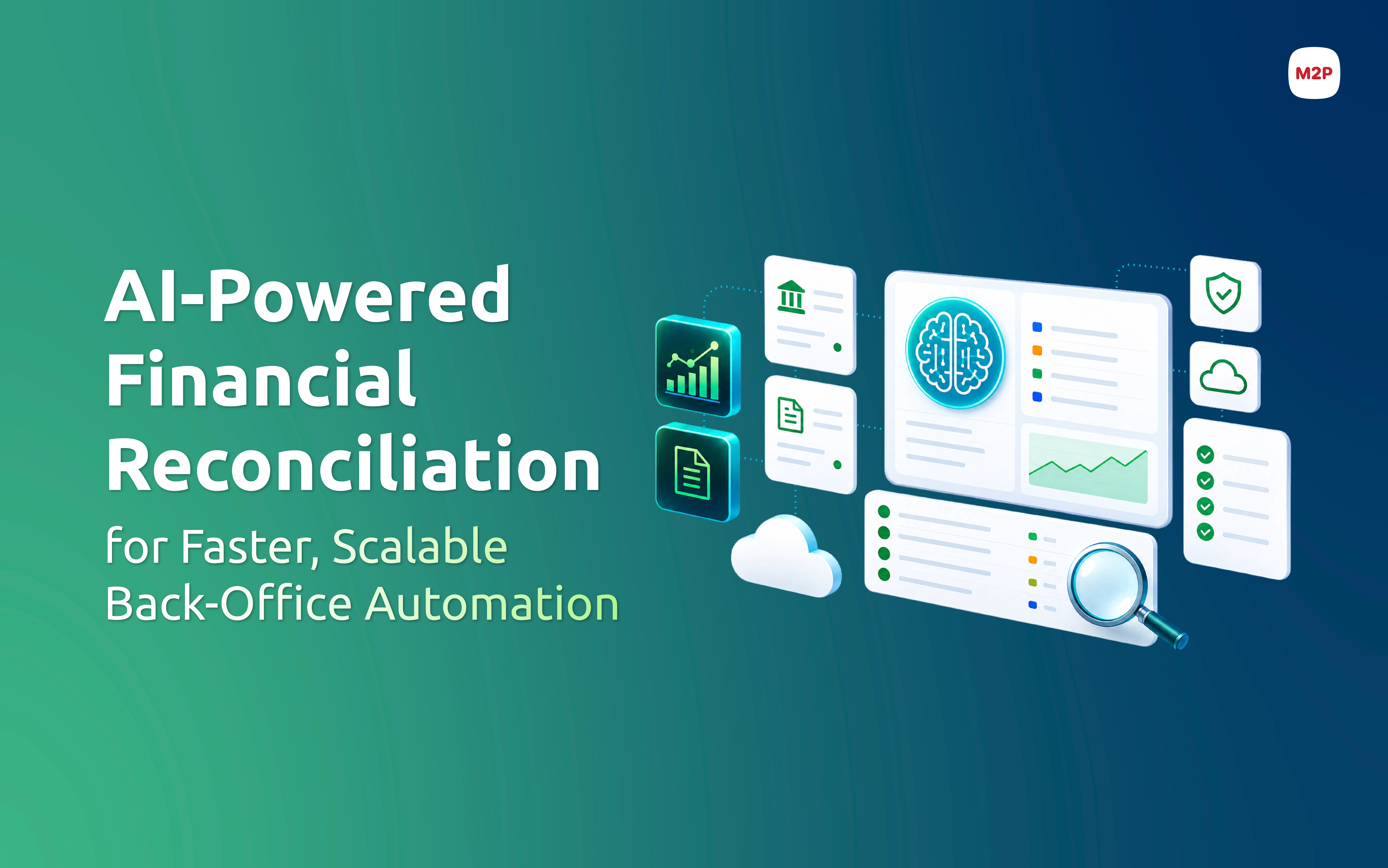
The global financial ecosystem is experiencing an unprecedented surge in transaction volume, velocity, and complexity. As financial institutions, Non-Banking Financial Companies (NBFCs), and fintechs scale their operations, the underlying infrastructure must evolve to support this growth. Unfortunately, many institutions continue to rely on legacy systems and traditional rule-based matching frameworks to manage their back-office operations. These outdated systems are inherently rigid, leading to high exception rates, delayed settlements, and significant operational bottlenecks.
To maintain compliance and drive go-to-market agility, financial organizations must move beyond static rules. The solution lies in leveraging Artificial Intelligence (AI) to orchestrate robust, enterprise-grade reconciliation. By modernizing technology stacks, organizations can streamline operations, ensure seamless interoperability, and seamlessly handle the complexities of modern financial data.
Traditional reconciliation relies on exact data matches and hard-coded if-then rules. While effective for simple, low-volume environments, this approach quickly breaks down when confronted with the diverse data formats and multi-party transactions typical of today's API-first financial ecosystem.
When legacy systems encounter unstructured data or minor discrepancies, they generate false exceptions. Operations teams are then forced to intervene manually, increasing operating expenses, elevating the risk of human error, and delaying critical settlement processes. In highly regulated environments where audit readiness and compliance are non-negotiable, these inefficiencies present severe operational risks.
The next generation of financial reconciliation replaces rigid rules with intelligent, adaptable infrastructure. Solutions like Recon360 are engineered to automate and optimize the entire back-office lifecycle through a powerful AI ingestion layer and an AI-driven matching engine.
By leveraging machine learning algorithms, modern reconciliation platforms identify complex patterns and anomalies across massive datasets. This shift from reactive exception handling to proactive risk management allows institutions to resolve discrepancies before they impact liquidity or customer experience. In practical applications, integrating predictive reconciliation models has demonstrated a 10x increase in reconciliation rates compared to traditional systems.
To truly future-proof back-office operations, enterprise platforms must deliver capabilities that extend across the entire reconciliation lifecycle:
Deploy Scalable Architecture: Poly-cloud-native, multi-tenant architectures allow institutions to serve multiple business units or legal entities from a single instance. This ensures that the platform can scale securely alongside the business.
Leverage Predictive Matching: Machine learning models process multi-way reconciliations across diverse modules—ranging from Real-Time Payments and Multi-currency to Nostro and General Ledger (GL) reconciliations—without requiring constant rule reconfiguration.
Streamline Conversational Analytics: AI-powered chatbots enable natural language search, allowing operations and finance teams to instantly fetch settlement summaries, drill down into aging breaks, and access predictive help based on historical resolution patterns.
To optimize back-office efficiency, leading financial infrastructure unifies core operational workflows into highly specialized, as-a-Service deployment models:
Reconciliation as a Service (RaaS): Automates matching and exception handling across banking, lending, and insurance systems. Pre-built connectors and domain-specific rule packs significantly accelerate time-to-market.
Settlement as a Service (SaaS): Orchestrates clearing and settlement workflows, providing real-time settlement visibility to optimize liquidity. Built-in controls ensure strict adherence to regulatory norms, including SOX, PCI DSS, and RBI guidelines.
Dispute as a Service (DaaS): Centralizes dispute management with automated workflows and Service Level Agreement (SLA) tracking. This accelerates the resolution of payment failures and chargebacks, directly improving the end-customer experience.
Upgrading your reconciliation technology stack is no longer an optional back-office enhancement; it is a strategic imperative. As business complexities grow, relying on manual interventions and legacy systems severely limits scalability and heightens operational risk. By adopting an AI-led, automated infrastructure, financial institutions can eliminate data silos, optimize liquidity, and maintain rigorous compliance. Investing in intelligent, enterprise-grade reconciliation directly empowers businesses to scale securely, reduce operational overhead, and ultimately retain high-value customers in a competitive landscape.
Ready to transform your back-office operations? Book a demo to explore how our enterprise-grade Recon360 platform can streamline your operations and future-proof your infrastructure.
Follow us on LinkedIn and Twitter for insightful fintech bytes curated for curious minds like you.
Fintech is evolving every day. That's why you need our newsletter! Get the latest fintech news, views, insights, directly to your inbox every fortnight for FREE!