

M2P Fintech
Fintech is evolving every day. That's why you need our newsletter! Get the latest fintech news, views, insights, directly to your inbox every fortnight for FREE!
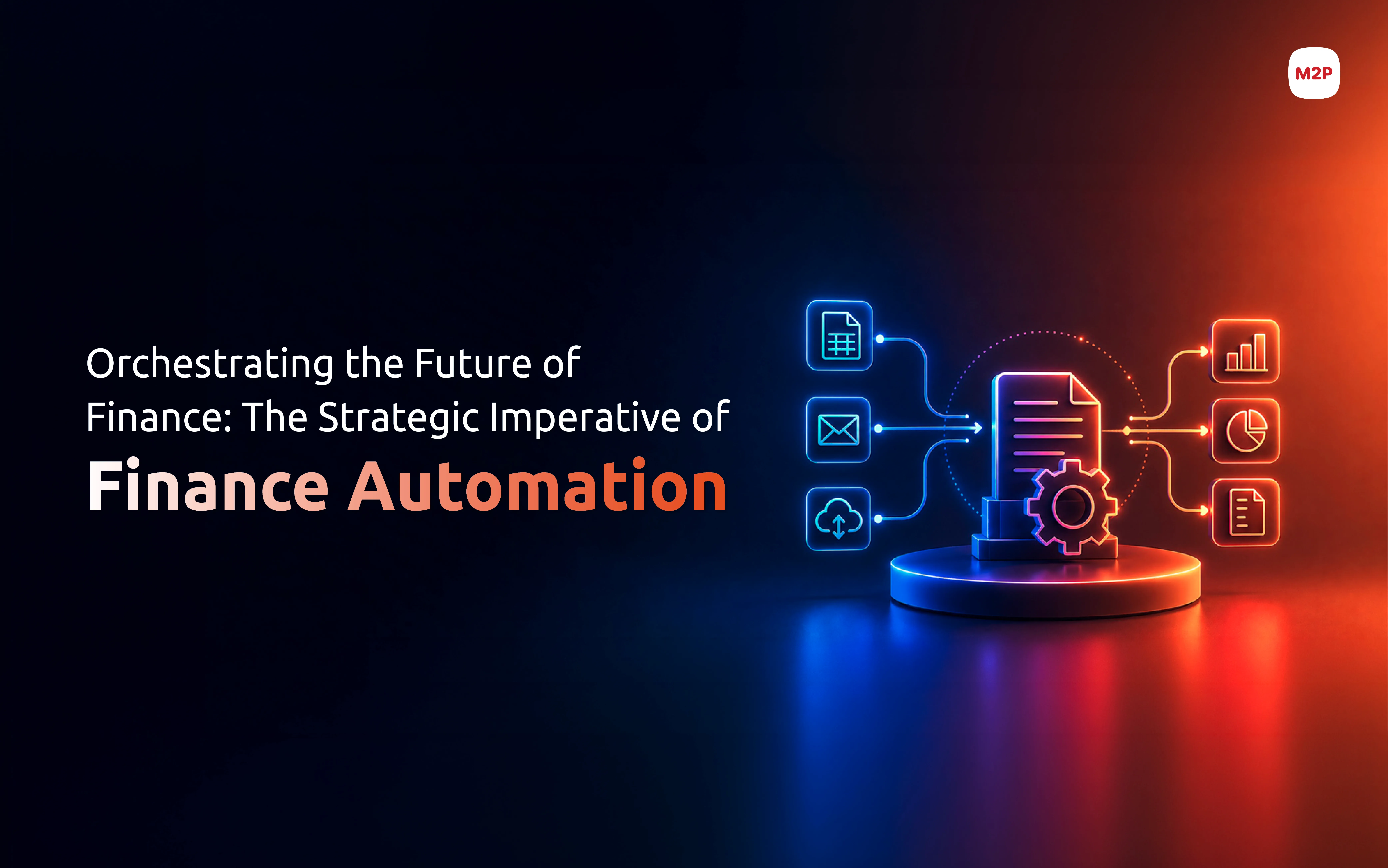
The modern financial ecosystem is defined by exponential data growth, instantaneous money movement, and evolving regulatory frameworks. Yet, as transaction velocities accelerate globally, many organizations continue to manage critical back-office functions such as reconciliation, settlement investigation, and payment cycle tracking through fragmented, manual processes. As transaction volumes scale, modernizing these legacy systems is no longer optional. Upgrading financial infrastructure is an urgent strategic requirement to maintain compliance, mitigate operational risk, and drive sustainable business growth.
Finance automation is the systematic deployment of technology to orchestrate and streamline complex financial workflows. It replaces repetitive manual data entry, disjointed file validation processes, and siloed reporting with robust, scalable infrastructure.
For enterprise finance functions, automation is not merely about cost reduction. It is a fundamental shift toward an API-first ecosystem that ensures interoperability across core banking systems, payment gateways, and enterprise resource planning (ERP) platforms. By automating the flow of financial data, organizations can shift their highly skilled finance teams away from reactive exception handling and toward proactive strategy and predictive analysis.
Organizations operating on legacy infrastructure face compounding challenges as they attempt to scale. The reliance on manual processes creates friction across several operational dimensions:
Elevated Operational Risk: High-volume manual reconciliation inherently introduces human error, leading to inaccurate financial reporting and compliance vulnerabilities.
Delayed Strategic Insights: Fragmented settlement operations prevent real-time visibility into liquidity and cash flow, delaying critical business decisions.
Inefficient Exception Handling: Identifying mismatches across disparate systems consumes countless hours, creating bottlenecks in daily verification and audit workflows.
Restricted Scalability: As institutions launch new products or enter new geographies, traditional systems lack the flexibility to support rapid go-to-market strategies.
Implementing enterprise-grade automation addresses these operational friction points directly. Transitioning from manual to automated reconciliation drastically improves data accuracy and integrity.
When financial data flows through automated validation engines, mismatch identification happens instantaneously. Automated exception handling accelerates investigation and resolution times, providing finance leaders with real-time visibility into their operational health. This streamlined approach empowers institutions to make faster, data-driven decisions while maintaining absolute control and regulatory compliance across all financial operations.
To navigate these complexities, organizations require more than a basic matching tool. Recon360 is an industry-agnostic, AI-driven reconciliation platform and comprehensive back-office automation solution. Trusted by over 200 financial institutions and 30+ banks globally, Recon360 is designed to handle the massive scale of banking and the intricate complexities of the insurance and retail sectors.
Built on a poly-cloud-native, multi-tenant architecture, Recon360 leverages advanced machine learning to ingest data, identify patterns, and match records with unparalleled precision. It provides a single, unified platform to support multiple lines of business seamlessly.
Recon360 enables comprehensive finance automation across multiple critical domains, delivering targeted solutions for enterprise operations:
Automated Reconciliation as a Service (RaaS): Recon360 orchestrates matching across General Ledger (GL), Nostro, multi-currency, and real-time payment systems. By utilizing pre-built connectors and domain-specific rule packs, it standardizes audit trails and compliance across the organization. In practical applications, the platform’s predictive capabilities have delivered a 10x increase in reconciliation rates compared to legacy systems.
Optimized Settlement as a Service (SaaS): The platform automates complex clearing and settlement workflows. By generating precise accounting entries and posting adjustments automatically, Recon360 reduces timing mismatches and provides the real-time liquidity visibility necessary for optimized cash management.
Streamlined Dispute Management (DaaS): Recon360 centralizes the management of payment failures, claim denials, and trade breaks. It establishes transparent, audit-ready lifecycles with clear reason codes, ensuring rapid resolution of disputes and improving the overall customer experience.
Deploying Recon360 fundamentally transforms the finance function, yielding clear and measurable outcomes for executive stakeholders:
Enhanced Operational Efficiency: Moving away from decentralized, manual efforts allows organizations to consolidate their reconciliation engines, reducing manual workload and accelerating daily reporting.
Maximized Cost Efficiency: The platform’s subscription-based model allows institutions to shift from heavy capital expenditure (CAPEX) to predictable operational expenditure (OPEX).
Mitigated Risk and Improved Control: Built-in controls for global regulatory standards (such as SOX, PCI DSS, and regional central bank norms) ensure permanent audit readiness and robust compliance management.
Unrestricted Scalability: The API-first design ensures easy integration with existing core banking and ERP systems, allowing businesses to onboard new entities or launch new products without overhauling infrastructure.
The future of enterprise finance is predictive, cognitive, and conversational. Advanced capabilities, such as AI-powered interfaces, are already transforming how finance teams interact with their data. By leveraging natural language search, operations managers can instantly retrieve end-of-day settlement summaries or identify aging breaks. As machine learning models continue to evolve, financial systems will not only identify historical anomalies but also recommend the next best actions to resolve disputes and optimize liquidity before bottlenecks occur.
Finance leaders must prepare for this automation-first future today. Upgrading technology stacks is no longer an IT initiative; it is a vital business strategy to retain customers, manage risk, and scale effectively. Organizations that leverage enterprise-grade infrastructure will command a decisive competitive advantage in the digital economy.
Ready to transform your reconciliation workflows? Book a demo to explore how our enterprise-grade Recon360 platform can streamline your operations and future-proof your infrastructure.
Follow us on LinkedIn and X for insightful fintech bytes curated for curious minds like you.

Fintech is evolving every day. That's why you need our newsletter! Get the latest fintech news, views, insights, directly to your inbox every fortnight for FREE!