

M2P Fintech
Fintech is evolving every day. That's why you need our newsletter! Get the latest fintech news, views, insights, directly to your inbox every fortnight for FREE!
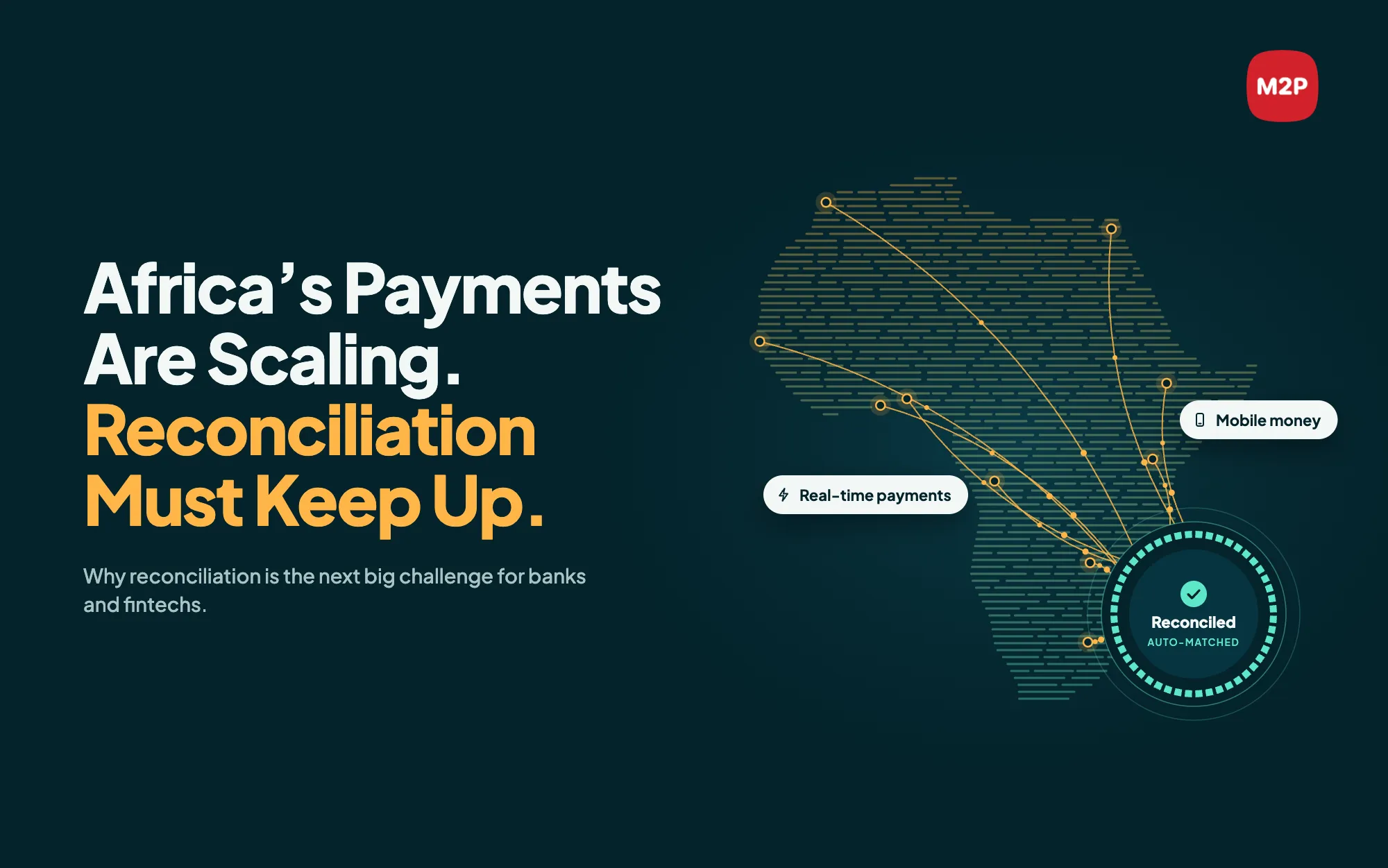
Mobile wallets, instant payment schemes, and cross-border initiatives are moving more money across Africa each year. Every one of those payments leaves a record in several systems, and every record has to agree with the others.
That is where growth meets an operational limit. Payment reconciliation software built for a handful of rails and a daily batch cycle struggles when volumes climb and settlement windows shrink. For banks and fintechs, reconciliation is becoming the point where payments growth either holds together or starts to leak.
Reconciliation is the next challenge because Africa's payment volumes are rising across mobile wallets, instant payment schemes, cards, and cross-border corridors at the same time. Each channel adds data sources, formats, and settlement cycles. Banks and fintechs must match every transaction across more systems, faster, with less room for unresolved breaks.
In many markets, adoption has moved faster than standardization. Customers use wallets and agent networks at scale, while banks, switches, and fintechs run on different technology stacks. Regional initiatives such as the Pan-African Payment and Settlement System (PAPSS) aim to connect these markets, which adds further counterparties and currencies to settlement flows.
Payments can scale quickly. Reconciliation cannot scale by adding more people.
Four pressure points appear repeatedly for institutions operating across African markets.
A single customer journey may involve a mobile wallet, an agent, a switch, a bank, and a card network. Each reports the transaction on its own schedule and in its own format, so teams must stitch together records that were never designed to align.
Cross-border flows add foreign exchange (FX) conversion, intermediary fees, and timing gaps. A payment can be valid at every step and still produce a mismatch at the end.
Reference fields get truncated, file formats change without notice, and message standards are adopted unevenly. Matching fails because of data quality, not because money is missing.
Instant payments set customer expectations for immediate answers. A break that once waited for the next business day now needs a cause and an owner within hours.
Spreadsheets cannot absorb this volume. Static matching rules help, but each new wallet partner, file format, or corridor needs another rule written and maintained. Meanwhile, the knowledge gained from resolving breaks stays with individual analysts instead of the system.
The result is a growing exception queue, a rising cost per transaction, and a close process that depends on a few experienced people.
Scalable reconciliation treats exceptions as a managed workflow, not a daily cleanup. It requires six capabilities:
Ingest data from every source, in any format
Match transactions across rails and currencies in one workflow
Resolve recurring breaks automatically
Route unresolved breaks to owners with context attached
Record every action in an audit trail
Deploy in line with local data residency requirements
Data protection and residency rules differ by country across the continent, so deployment flexibility matters as much as matching accuracy.
Recon360, M2P Fintech's reconciliation and settlement automation platform, is designed for institutions managing many rails, partners, and entities at once. It brings payment, settlement, and General Ledger (GL) reconciliation into a single workflow.
Pressure Point | How Recon360 Helps |
|---|---|
Fragmented rails and counterparties | Ingests data from multiple sources and formats, and reconciles them on one platform |
Multi-currency corridors | Supports multi-currency and multi-entity reconciliation with configurable matching rules |
Inconsistent data quality | Applies AI-driven matching to handle formatting differences and timing variances |
Shrinking resolution windows | Flags breaks at the point of mismatch, routes them to owners, and automates recurring resolutions |
Audit and governance | Maintains a timestamped audit trail for every match and action |
Data residency | Supports cloud and on-premise deployment |
Recon360 is designed to learn from how teams resolve breaks. Recurring patterns, such as a consistent fee difference from one partner, can move from manual review to automated handling. Analysts then spend their time on the breaks that need judgment.
Institutions can start before changing any platform:
Map every rail, partner, and file feed that touches a transaction
Standardize data formats at ingestion
Classify breaks by cause, value, and age
Automate the patterns that analysts resolve repeatedly
Review root-cause trends monthly with partner teams
Each step reduces the volume of breaks that reach an analyst, which matters most when payment volumes keep rising.
Africa's payments growth is a strength for banks and fintechs. Reconciliation is what keeps that growth measurable and defensible. Institutions that treat reconciliation as core infrastructure can absorb new rails and partners with less friction.
To see how Recon360 supports reconciliation across your rails, partners, and entities, connect with our team.

Fintech is evolving every day. That's why you need our newsletter! Get the latest fintech news, views, insights, directly to your inbox every fortnight for FREE!