

M2P Fintech
Fintech is evolving every day. That's why you need our newsletter! Get the latest fintech news, views, insights, directly to your inbox every fortnight for FREE!
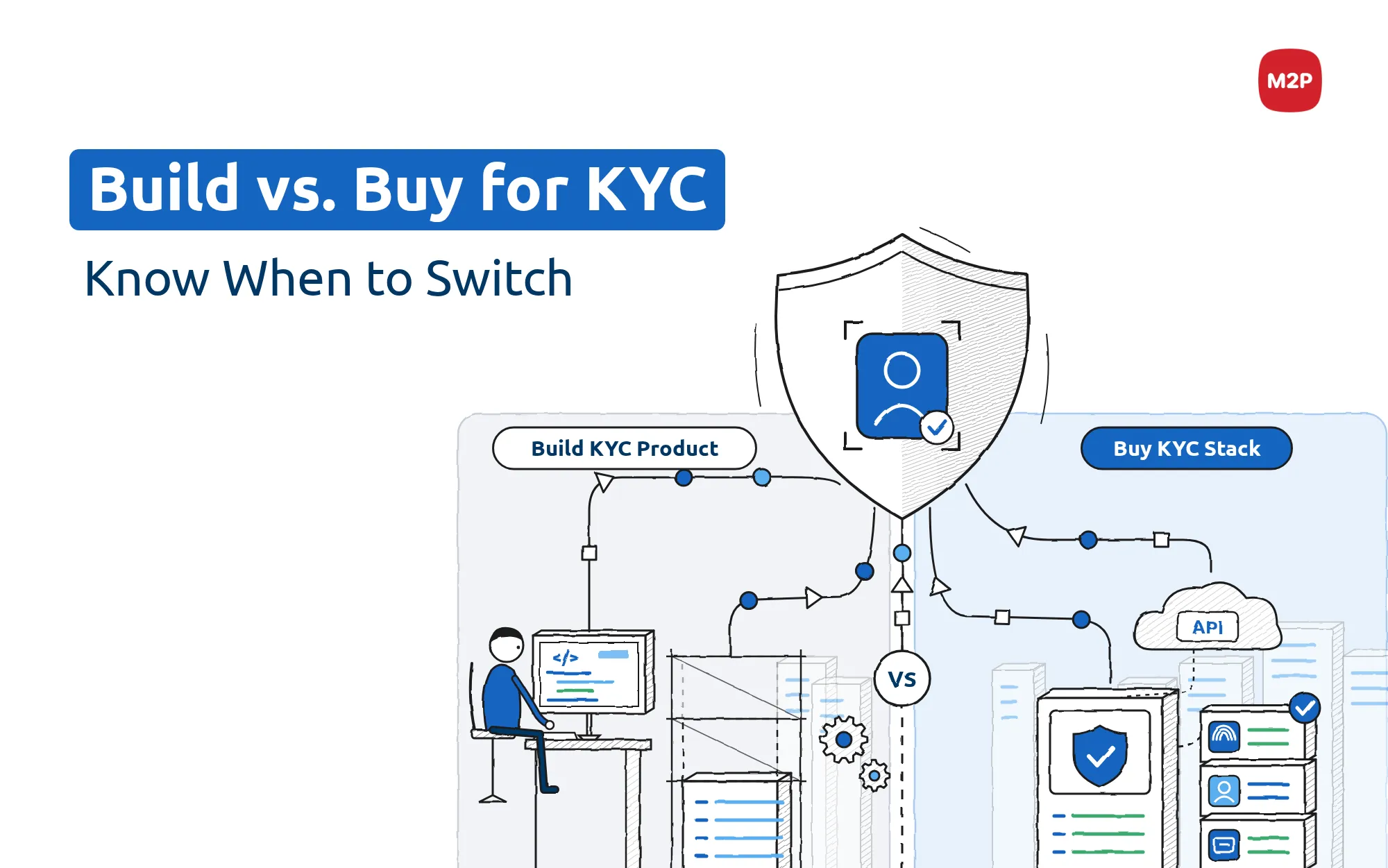
Most regulated entities start building KYC in-house for sensible reasons. Early on, onboarding volumes are modest, the journey is simple, and an engineering team can connect a few APIs (an Aadhaar OTP flow, a PAN check, a basic face match) faster than it can run a vendor evaluation. Owning the stack feels like control.
The trouble is that KYC does not stay simple. Regulators update requirements. UIDAI changes device and security standards. New products need new verification methods: Video KYC for remote accounts, Min-KYC for small-value instruments, KYB for merchants, background checks for lending. Fraud patterns shift, and deepfakes are now a real threat to face-based verification. Every one of these changes lands on the same in-house team, usually alongside their core product roadmap.
At some point, the question changes from "can we build this?" to "should we still be maintaining this?" This article walks through what building KYC in-house actually involves, the costs that tend to stay hidden until later, the situations where building still makes sense, and the signals that an in-house identity verification stack has stopped paying for itself. For an overview of the components of a modern KYC stack, see our complete guide to M2P's AI-powered KYC Suite.
A production-grade KYC stack in India is not one integration. It is a set of regulated, security-sensitive components that each carry their own obligations. A team building in-house typically needs to cover the following.
Aadhaar authentication and eKYC. To perform Aadhaar authentication directly, an entity needs to be an AUA/KUA (Authentication User Agency / KYC User Agency) with UIDAI, or work through one as a sub-AUA. Direct licensing brings onboarding requirements, connectivity through Authentication Service Agencies (ASAs), encryption and digital signing of requests, and periodic UIDAI audits. Supporting all four authentication modes (OTP, fingerprint, iris, and face) adds integration with UIDAI-certified registered biometric devices, whose standards change over time.
Aadhaar data handling. Aadhaar numbers that an entity stores must be held in an Aadhaar Data Vault with encryption and reference keys, and must be masked wherever they are displayed or stored in documents. That includes Aadhaar numbers that appear inside other files, such as application forms and scanned documents, not just Aadhaar cards.
CKYC. Regulated entities need to search and download records from the Central KYC Records Registry, and upload records of new customers. That means integrating with the registry's formats and keeping up with its changes.
Video KYC (V-CIP). RBI's Video-based Customer Identification Process sets detailed requirements: live interaction with a trained official, liveness checks, geo-tagging, secure recording and storage, and concurrent audit. Building this means a video platform, an agent interface, a scheduling and queueing layer, and the compliance controls on top.
Document and biometric intelligence. OCR for officially valid documents (OVDs), document tampering checks, face match between a selfie and an ID photo, and liveness detection that holds up against photo replays, screen replays, and increasingly, synthetic faces. Each needs models, training data, testing, and ongoing tuning.
Other verification types. Depending on the product, teams may also need Min-KYC flows, KYB for business customers, and background checks covering employment, address, and court records.
Workflow, audit, and fraud monitoring. Orchestration that routes customers to the right verification path and handles fallbacks; audit logs that satisfy RBI and UIDAI; and monitoring that spots suspicious patterns across applications.
None of these is impossible to build. The question is whether building and maintaining all of them is the best use of a regulated entity's engineering and compliance capacity.
The initial build is usually the smallest part of the total cost of in-house KYC. The larger costs tend to appear after launch.
Regulatory change is continuous. RBI's KYC Master Direction, V-CIP requirements, UIDAI circulars, CKYC changes, and data protection obligations under the Digital Personal Data Protection (DPDP) Act all evolve. Each change means reading the requirement, interpreting it, building to it, testing it, and proving compliance in the next audit. An in-house team carries this work indefinitely, and the timelines are set by regulators, not by the product roadmap.
Audits take real time. UIDAI audits, internal audits, and regulatory inspections all require evidence: logs, configurations, security controls, and process documentation. When the stack is home-grown, the team that built it is usually the only team that can produce that evidence, which pulls engineers away from product work during every audit cycle.
Fraud keeps moving. Liveness and face match models that worked well at launch can degrade as fraud techniques improve. Defending against injected video, high-quality replays, and synthetic faces requires ongoing investment in models and testing, plus access to fraud signals beyond a single institution's own data.
Uptime is your problem. Identity verification sits on the critical path of onboarding. If an ASA route is slow, a CKYC call times out, or a face match service degrades, customers drop off. Building redundancy (for example, switching between ASAs) and monitoring it around the clock is an operational cost that is easy to underestimate.
Specialist talent is scarce. Teams that understand Aadhaar security architecture, biometric device integration, computer vision, and KYC regulation are hard to hire and hard to retain. When a key engineer leaves, institutional knowledge about why the stack works the way it does often leaves too.
Opportunity cost. Every sprint spent maintaining KYC infrastructure is a sprint not spent on the products that differentiate the institution: lending journeys, card programs, customer experience, or new markets.
When these costs are added up over three to five years, the comparison is rarely "build cost vs. licence fee." It is the full cost of running a regulated identity infrastructure business inside your organisation, compared with using one that already exists.
Building is not always the wrong answer. It can be the right call when:
Identity verification is your product. If you sell identity or verification services, owning the stack is core to the business.
Your requirements are genuinely unusual. Some institutions have verification needs that no platform covers and that are central to their business model.
You already have the licences, team, and audit maturity. An institution that already operates as an AUA/KUA, has a stable specialist team, and passes audits smoothly has already paid much of the fixed cost.
Volumes are small and the product scope is narrow. A single product with simple onboarding may not justify a full platform, though this usually changes as the institution grows.
For most banks, NBFCs, MFIs, and fintechs, though, identity verification is a necessary capability rather than a differentiator. Customers expect it to be fast, secure, and invisible; they do not choose a lender because of how its KYC was engineered.
The comparison below summarises how the two approaches typically differ.
Factor | Build in-house | Buy a KYC platform |
|---|---|---|
Time to launch | Months for a full stack, longer with VKYC and biometrics | Weeks, depending on integration and configuration |
Regulatory updates | Your team interprets and implements each change | Platform provider tracks and ships updates |
UIDAI licensing and audits | Your obligation directly, or via a sub-AUA arrangement | Provider operates licensed infrastructure built to the audit checklist |
Fraud defence | Limited to your own data and models | Models tuned across many clients and use cases |
Uptime and routing | You build redundancy and monitoring | Built-in redundancy, such as ASA switching |
New verification types | Each one is a new project | Added as modules or microservices |
Control and customisation | Full control | Configurable workflows; depth varies by vendor |
Cost profile | High fixed cost plus ongoing team and compliance cost | Usage- or licence-based, more predictable |
The right answer often sits between the two extremes. Many institutions buy the regulated, infrastructure-heavy layers (Aadhaar authentication, CKYC, VKYC, masking) and keep ownership of the customer journey and orchestration on top. A platform that offers both full workflows and individual microservices makes that hybrid model straightforward.
If several of these sound familiar, it is worth reopening the build vs. buy decision.
Regulatory changes keep displacing the roadmap. Every new circular or audit finding pulls engineers off product work, and compliance deadlines keep slipping into planned releases.
Audit preparation depends on a few people. Only one or two engineers can explain how the stack meets UIDAI or RBI requirements, and audits stall when they are unavailable.
Drop-offs are rising at verification. Failed authentications, slow responses, or poor fallback handling are costing completed onboardings, and fixing them keeps getting deprioritised.
New products are waiting on KYC. A Video KYC journey, a Min-KYC product, a merchant onboarding flow, or a new lending product needs verification capabilities the current stack does not have.
Fraud losses or near-misses are increasing. Spoofing attempts, synthetic identities, or mule account patterns are getting through, and the team lacks the data or capacity to keep models current.
Uptime incidents are recurring. Onboarding stops when a single route or service has problems, because there is no redundancy built in.
The total cost is unclear. Nobody can say with confidence what in-house KYC costs each year once engineering time, compliance effort, infrastructure, and audit work are counted.
Any one of these can be managed. Several together usually mean the institution is paying a growing premium to own infrastructure that a specialised platform can provide more reliably.
If the answer is to buy, the next question is what to buy. M2P's KYC Suite is designed to take over the regulated, infrastructure-heavy parts of identity verification, while leaving institutions room to shape the customer journey their way.
One platform across verification types. The suite covers Aadhaar-based eKYC through AUA/KUA authentication (OTP, face, fingerprint, and iris), CKYC search and retrieval, Video KYC, Min-KYC, KYB, and background verification. Institutions that would otherwise integrate several vendors, or build several modules, can work with one.
Licensed, audit-ready infrastructure. M2P operates AUA/KUA infrastructure built to UIDAI's audit checklist, with detailed audit logs for every transaction. This takes much of the licensing and audit burden off the institution's own team.
Built-in Aadhaar masking. Real-time Aadhaar masking is available across platforms through SDKs, DLLs, and APIs, including on custom document formats, so masking is handled consistently wherever Aadhaar numbers appear.
Microservices for a hybrid approach. For teams that want to own orchestration, the suite offers individual identity microservices such as liveness checks, OCR extraction, face match, and OVD validation. Institutions can use the full workflow, individual services, or a mix.
Low-code workflow configuration. A low-code/no-code platform lets teams configure KYC journeys, such as which verification path a customer segment follows and which fallbacks apply, without waiting on an engineering sprint for every change.
Fraud monitoring and traceability. Fraud monitoring is built into the platform, with traceability across transactions to support investigation and audit.
Deployment that fits your IT policies. The suite can run on cloud or on-premise, which matters for banks and government bodies with strict data residency and infrastructure requirements.
Proven at scale. M2P's KYC Suite serves 75+ BFSI clients and 5 Indian state governments, has processed 3.8 billion digital identification transactions, and handles 10 to 13 million transactions a day.
Part of a wider stack. For institutions that also need lending, payments, or fraud capabilities, the KYC Suite works alongside M2P's Loan Origination System and FRM & AML platform, so identity verification connects directly to the journeys and controls that depend on it.
The result is that an institution's engineering team can focus on products and customer experience, while regulatory updates, audit readiness, uptime, and fraud defence at the KYC layer are handled by a specialised platform.
Whether you are planning a new product, reviewing an in-house KYC stack that has grown hard to maintain, or exploring a hybrid approach, M2P can help you work out which parts of identity verification to own and which to hand over.
Talk to M2P's KYC team to discuss your onboarding volumes, verification requirements, and deployment needs, and see how the KYC Suite fits your stack.
Tags
Fintech is evolving every day. That's why you need our newsletter! Get the latest fintech news, views, insights, directly to your inbox every fortnight for FREE!