

M2P Fintech
Fintech is evolving every day. That's why you need our newsletter! Get the latest fintech news, views, insights, directly to your inbox every fortnight for FREE!
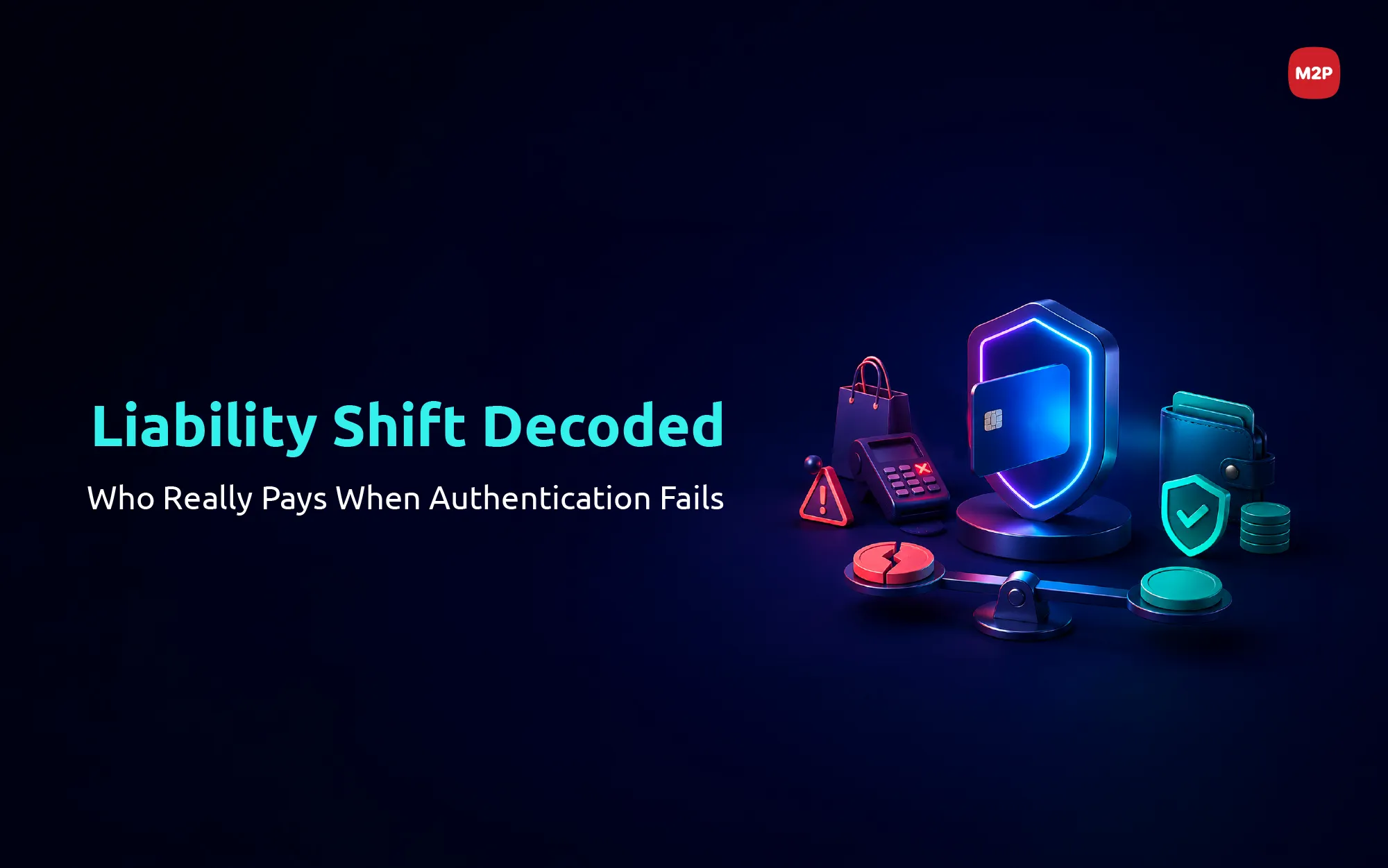
Somewhere in every card-not-present transaction, there's an invisible question being answered in milliseconds: if this turns out to be fraud, who eats the loss? The cardholder? The merchant? The issuer? The answer isn't arbitrary, it's governed by a specific set of rules called liability shift, and the outcome depends heavily on how authentication was handled at the moment of purchase.
For issuers, BaaS platforms, and fintechs, understanding liability shift isn't just a compliance nice-to-have. It directly affects the P&L. Get the authentication architecture wrong, and you can end up absorbing fraud losses that should have belonged to someone else in the chain. Get it right, and a well-placed, well-configured Access Control Server (ACS) becomes one of the most effective fraud-cost-management tools an issuer has.
This post walks through what liability shift actually means, how EMV 3-D Secure (3DS) redefined it, and, critically how the ACS and its placement in the authentication flow determines who's holding the bag when something goes wrong.
In card payments, liability shift refers to the rule set that determines which party in the transaction chain: issuer, merchant/acquirer, or in some cases the cardholder, bears financial responsibility for a fraudulent transaction.
This concept originated in the card-present world with the shift to EMV chip cards. Before EMV, if a counterfeit card was used fraudulently at a merchant, the issuer typically absorbed the loss. Once EMV chip technology became available, the schemes shifted liability to whichever party had not adopted the more secure technology. If a merchant hadn't upgraded to a chip-capable terminal and a counterfeit card was swiped instead of chipped, the merchant became liable. If the issuer hadn't issued a chip card and the merchant had a compliant terminal, the issuer stayed on the hook.
The logic was simple: liability follows the party that failed to adopt the stronger security control. That same logic carried over into the card-not-present (CNP) world through EMV 3-D Secure, except in CNP, the "control" isn't a chip, it's authentication.
Card-not-present transactions: ecommerce, in-app purchases, subscriptions don't have a physical card or terminal, so there's no chip to authenticate. Instead, 3-D Secure (3DS) provides a way for the merchant to route the transaction through the issuer for authentication before the payment is authorized.
If the merchant attempts 3DS authentication and the issuer participates (i.e., the transaction goes through the full 3DS flow with an ACS response, whether frictionless or challenge-based), liability for fraud generally shifts to the issuer — even if the transaction turns out to be fraudulent. The reasoning: the issuer had the opportunity to challenge and verify the cardholder, and either approved it or its authentication method failed to catch the fraud.
If the merchant does not attempt 3DS authentication at all, and the transaction turns out to be fraudulent, liability typically stays with the merchant/acquirer, because the merchant chose not to use the stronger authentication mechanism available to them.
If the merchant attempts 3DS but the issuer's ACS is unavailable, doesn't respond, or the issuer isn't participating in 3DS for that card range, the outcome depends on the specific scheme rules and the exemption/attempts data, but in many scheme rule sets, an "attempts" transaction (where the merchant tried 3DS but couldn't complete it due to the issuer side) still shifts liability toward the issuer, or is treated more favorably for the merchant than an unauthenticated transaction.
This is the mechanism that makes the ACS so central to an issuer's fraud economics. The ACS isn't just a UX layer that shows a challenge screen rather it's the component whose participation (or non-participation) in the 3DS flow is the deciding factor in who owns the liability.
Once you understand the mechanics above, a few things become clear:
If an issuer's ACS approves a transaction frictionlessly (no challenge shown) and it turns out to be fraud, the issuer generally bears that loss, because the issuer had the authentication opportunity and chose (via its risk engine) not to use it. This means the ACS's risk-based authentication (RBA) engine isn't just a UX nicety; it is the primary defense the issuer has against absorbing fraud losses it has explicitly signed up for by participating in 3DS.
If the RBA engine is too permissive, more fraud slips through frictionlessly and the issuer absorbs it, having already accepted liability by authenticating (or attempting to). If the RBA engine is too conservative and challenges everything, legitimate cardholders abandon transactions, hurting the issuer's card usage and the relationship with merchant partners, even though the issuer isn't "losing" money to fraud in that case, it's losing revenue and goodwill.
If an issuer's ACS is slow, times out, or is unavailable when a merchant attempts 3DS, the transaction may fall back to an unauthenticated flow or be treated as an "attempt." Depending on the scheme and region, this can change who's liable, and it can also mean lost sales if merchants or their 3DS Servers are configured to decline rather than fall back. Either way, ACS reliability has a direct, quantifiable link to liability exposure.
Regulations like PSD2 (in Europe) allow certain transactions like low-value, trusted beneficiary, transaction risk analysis (TRA)-qualified, recurring etc. to be exempted from strong customer authentication (SCA). But exemption handling has its own liability implications: if an exemption is applied and the transaction turns out to be fraud, liability rules for exempted transactions differ from fully authenticated ones. An ACS (or the broader 3DS ecosystem components around it) that mishandles exemption logic can inadvertently expose the issuer to liability it didn't need to take on, or fail to unlock exemptions the issuer was entitled to use to reduce friction.
"ACS placement" might sound like a narrow technical detail, but it materially changes liability outcomes in a few specific ways.
Whether the issuer runs its own ACS or uses a specialized provider doesn't change the liability rules themselves, those are set by the schemes and regulators. But it changes the issuer's practical ability to manage that liability well:
A managed ACS provider with a mature, cross-portfolio risk engine is generally better positioned to make accurate frictionless-vs-challenge decisions, because the model has more data to learn from. Better decisions mean less fraud slipping through frictionless approval, directly reducing the issuer's shifted-liability losses.
A managed provider typically offers stronger uptime guarantees and dedicated incident response, reducing the risk of ACS unavailability turning into unauthenticated or "attempts" transactions with unfavorable liability outcomes.
An in-house ACS that's under-resourced or slow to update its risk logic as fraud patterns evolve can quietly become a liability drain, approving transactions frictionlessly that a more sophisticated model would have challenged.
Some issuers separate their risk decisioning from their ACS execution layer, running a risk engine that feeds signals into the ACS rather than having the ACS itself own the full decision logic. This matters for liability management because:
If the risk engine and the ACS are tightly integrated and well-tuned together, the frictionless-approval decision is more likely to be accurate, directly reducing fraud losses the issuer would otherwise absorb under liability shift.
If there's a disconnect between the risk engine's signals and how the ACS interprets them (a common issue when these are built or sourced separately without careful integration), the issuer can end up either over-challenging (hurting conversion) or under-challenging (absorbing avoidable fraud), both of which are liability-adjacent costs.
Issuers operating across multiple card schemes (Visa, Mastercard, RuPay, Amex) and multiple regulatory regions (PSD2 in Europe, RBI's AFA mandate in India, and other emerging frameworks) need their ACS to correctly apply the right rules, exemptions, and challenge logic per scheme and per region, because liability shift mechanics and SCA requirements aren't identical everywhere.
Missing exemptions it was entitled to use in one region, adding unnecessary friction.
Misapplying exemption logic in a stricter regulatory region, creating unintended liability or compliance exposure.
This is where a specialized ACS provider with experience across multiple schemes and geographies has a structural advantage over a custom in-house build calibrated primarily around one region's rules.
To make this concrete, consider the same $200 online purchase running through three different authentication paths:
The transaction is processed without authentication. If it turns out to be fraud, liability generally stays with the merchant/acquirer, because the merchant didn't use the authentication tool available to it. The issuer's ACS never even entered the picture — no liability exposure for the issuer here.
The ACS's risk engine scored the transaction as low-risk and let it through without a challenge. It turns out to be a stolen card used by a fraudster who matched enough behavioral and device signals to pass. Liability shifts to the issuer. This is the scenario where ACS risk-model quality directly determines the issuer's loss exposure — a sharper model would have flagged this and triggered a challenge or decline.
Liability still generally shifts to the issuer here, but this scenario also highlights a UX and authentication-method choice: if the issuer's ACS supports stronger methods (biometric step-up, app-based push approval, FIDO2/passkeys) rather than relying solely on SMS OTP, the exposure to this specific attack vector drops. This is a case where the ACS's supported authentication methods, not just its risk scoring, affect the issuer's real-world liability exposure.
Across all three scenarios, the same underlying truth holds: the ACS's decisions and capabilities are doing the heavy lifting in determining how much fraud loss the issuer actually absorbs, given that participation in 3DS has already shifted the baseline liability toward the issuer.
Given how directly ACS decisioning ties to liability outcomes, a few practical takeaways follow:
Ask any ACS provider (or your own team, if building in-house) for real frictionless-approval rates and fraud-catch rates, not just certification status. These numbers translate directly into liability-shift losses.
An ACS outage during a peak sales period doesn't just cause failed transactions — it can shift transactions into less favorable liability categories.
SMS OTP interception, social engineering, and SIM-swap attacks are known weak points. Biometric step-up, push-based app approval, and emerging passkey/FIDO2 support all reduce the practical risk that a "successfully authenticated" transaction still turns out to be fraud.
Getting this right reduces friction where the issuer is entitled to it, without creating unintended liability gaps.
What works for a single-market card program can break down quickly for an issuer or BaaS platform expanding across geographies with different regulatory regimes.
Liability shift isn't an abstract compliance concept rather it's a direct financial mechanism, and EMV 3-D Secure made the Access Control Server(ACS) the pivot point on which it turns. The moment an issuer participates in 3DS, it accepts a baseline shift of liability toward itself in exchange for the ability to authenticate. What happens after that? How accurately the risk engine scores transactions? How reliably the ACS responds? Which authentication methods it supports?and How well it applies exemption and regional rules? determines whether that baseline liability turns into manageable, well-priced risk or a slow, invisible drain on the issuer's fraud budget.
For issuers, fintechs, and BaaS platforms, this makes ACS selection and configuration a genuinely strategic decision, not a back-office compliance task. A certified, well-tuned ACS with a mature risk engine and strong authentication method support isn't just about passing an EMVCo test, it's about making sure that when liability shifts to you, you've done everything possible to keep the losses that come with it as small as they can be.
M2P's ACS is built with this exact economics in mind, EMVCo and scheme-certified, with risk-based authentication tuned across a diverse issuer base, and support for the stronger authentication methods that reduce exposure to common attack vectors. If you're trying to understand exactly where your current authentication setup leaves you exposed, it's worth a closer look.
Curious how your current authentication flow is shaping your liability exposure? Get in touch with the M2P team to walk through it.

Fintech is evolving every day. That's why you need our newsletter! Get the latest fintech news, views, insights, directly to your inbox every fortnight for FREE!