

M2P Fintech
Fintech is evolving every day. That's why you need our newsletter! Get the latest fintech news, views, insights, directly to your inbox every fortnight for FREE!
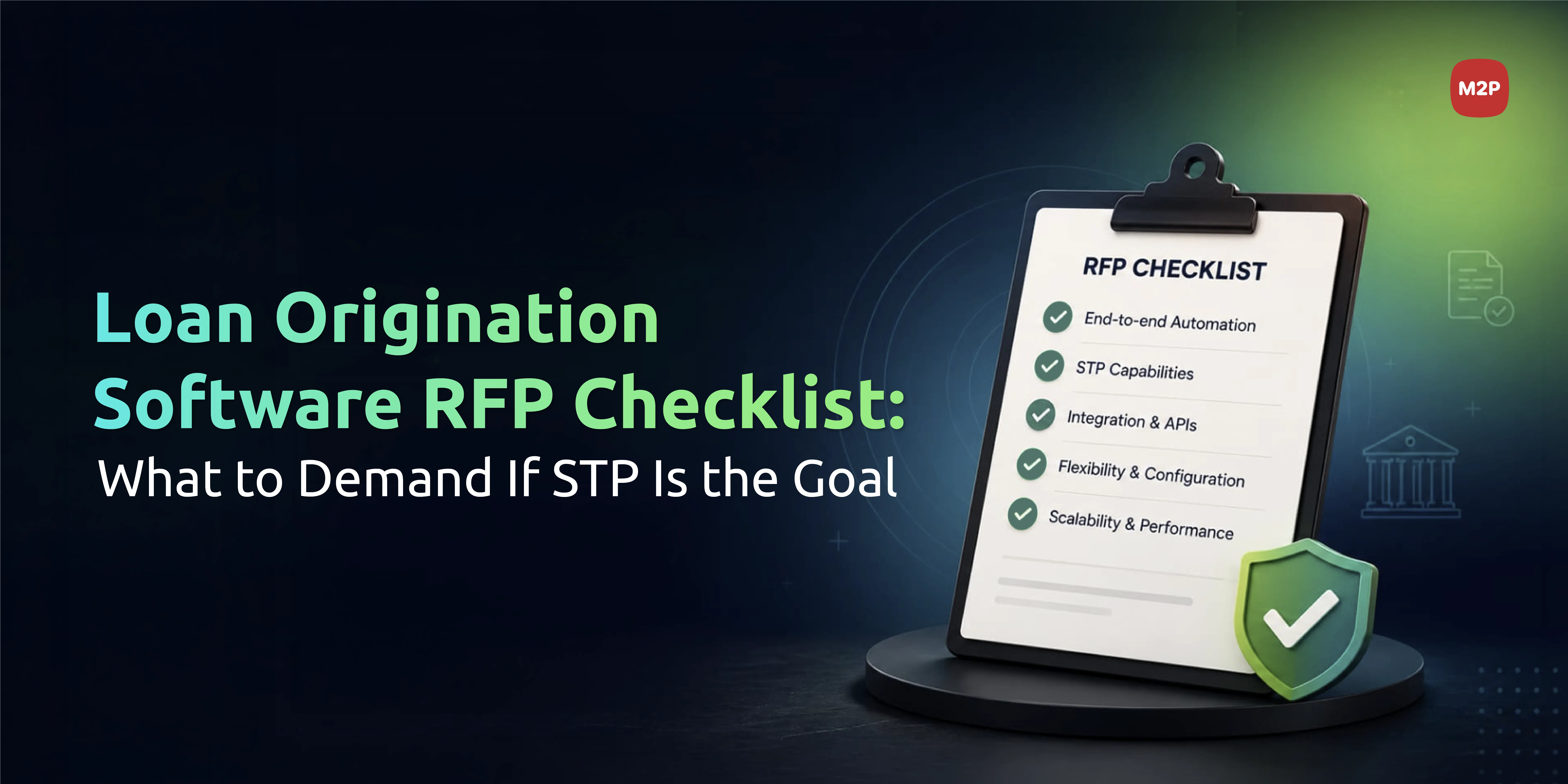
Every lender today demands higher straight-through processing (STP) in their lending operations. Faster loan approvals, reduced operational costs, improved borrower experiences, and scalable growth all depend on minimizing manual intervention across the lending journey. As competition intensifies and customer expectations continue to rise, lenders are investing heavily in modern Loan Origination Software (LOS) to drive efficiency and accelerate business outcomes.
Yet many LOS transformation initiatives fail to deliver the STP outcomes they promise. The reason is surprisingly simple: most RFPs are still designed around workflow automation rather than true end-to-end orchestration. They focus on individual features, integrations, and user interfaces, but often overlook how decisions flow across underwriting, risk, compliance, documentation, approvals, and disbursal. The result is fragmented automation where processes may be digital, but critical decisions still require manual intervention.
If the goal is genuine STP lending, lenders need to move beyond feature checklists and evaluate whether an LOS can orchestrate decisions continuously across the lending lifecycle. The future belongs to configurable, agent-driven platforms that can adapt, automate, and optimize workflows in real time.
One of the biggest barriers to STP is the inability to adapt workflows quickly. Many lending institutions discover that even minor process changes require development effort, lengthy release cycles, and dependence on engineering teams. This slows down innovation and makes it difficult to respond to changing business requirements or regulatory updates.
A modern LOS should enable business teams to build, modify, and deploy workflows themselves. No-code configuration capabilities allow lenders to launch products faster, optimize approval journeys, and continuously refine operational processes without waiting for technology teams to intervene. This flexibility is essential for maintaining agility in a competitive lending environment.
What you should demand:
DIY workflow management with no-code configuration
Ability to design STP-based workflows across products and channels
Embedded rule engines (BRE) for decision automation at every stage
M2P's Core Lending Suite enables business users to configure workflows independently, helping lenders create and manage STP-driven origination journeys without developer dependency.
RFP requirement: "Show real examples of business users configuring workflows without engineering involvement."
Many lenders assume STP means eliminating exceptions entirely. In reality, lending is inherently complex. Borrowers may fall outside policy thresholds, documentation may require additional scrutiny, or unique circumstances may warrant special approvals. The challenge is not avoiding deviations but managing them intelligently while preserving operational efficiency.
A robust LOS should provide structured mechanisms for identifying, routing, approving, and auditing exceptions. Rather than disrupting the lending process, the system should ensure that deviations are handled through predefined controls and governance frameworks. This allows lenders to balance risk management with business growth objectives.
What you need:
Policy-driven deviation rules and approvals
Intelligent flagging of out-of-policy scenarios
Real-time auditability of overrides
M2P's LOS embeds deviation management within multi-level approval workflows, ensuring governance remains intact without breaking the lending flow.
RFP requirement: "How does the system track, approve, and audit credit deviations in real time?"
As lending operations scale, compliance becomes increasingly important. Maker-checker controls help establish accountability, reduce operational risk, and ensure that critical decisions are reviewed appropriately. However, many LOS platforms treat maker-checker workflows as secondary features rather than foundational controls.
A future-ready LOS should embed authorization workflows directly into the lending journey. This creates a transparent chain of responsibility while simplifying compliance reporting and regulatory audits. Native controls also ensure consistency across products, channels, and operating teams.
A future-ready LOS should include:
Native maker-checker workflows for approvals
Role-based access and authorization
Integrated audit logs for regulatory reporting
M2P provides built-in maker-checker workflows, audit trails, and compliance reporting capabilities, ensuring governance is integrated rather than added after implementation.
RFP requirement: "Demonstrate end-to-end audit trails from application to disbursal."
Many lending operations continue to spend significant time preparing Credit Assessment Memos (CAMs), sanction letters, agreements, and other documentation. Even when underwriting decisions are automated, manual document preparation can create delays that undermine overall STP objectives.
An effective LOS should automatically generate credit summaries and documentation based on available application data. This reduces turnaround times, improves consistency, and eliminates administrative bottlenecks that often slow down approvals. Integrating e-signature capabilities further accelerates the journey and improves customer experience.
Your LOS must:
Auto-generate Credit Assessment Memos (CAM)
Provide template-based contract generation
Support e-signature workflows and document versioning
M2P includes a CAM Generation Agent and a Document Generation Agent that automate credit memos, sanction letters, agreements, and eSign-enabled documentation workflows.
RFP requirement: "Can CAMs and contracts be generated instantly with AI-driven summaries?"
Audit trails are essential for governance, compliance, and operational transparency. Yet many lending platforms provide visibility only into select stages of the process, making it difficult to reconstruct decisions during audits or investigations.
A comprehensive LOS should capture every action, decision, approval, modification, and exception throughout the lending lifecycle. Complete traceability ensures organizations can meet both internal governance requirements and external regulatory obligations while strengthening accountability.
A best-in-class LOS should offer:
Complete event-level audit logs
Visibility across underwriting, approvals, and disbursal
Support for regulatory and internal audit reporting
M2P’s Agentic Loan Origination System provides structured audit trails across workflows, user activities, approvals, and decision points, enabling full lifecycle traceability.
RFP requirement: "Provide audit logs at every decision node—not just final approvals."
Modern lending operates within a broader ecosystem that includes Loan Service Providers (LSPs), bureaus, KYC providers, payment systems, co-lending partners, and banking infrastructure. An LOS that cannot integrate seamlessly with these external entities quickly becomes an operational bottleneck.
The speed at which lenders can onboard partners often has a direct impact on business growth. Therefore, flexibility, integration readiness, and API-first architecture should be central evaluation criteria during vendor selection.
Your LOS must support:
LSP onboarding and management
Co-lending partner integrations
API-led connectivity with bureaus, KYC, banking systems, and payments
M2P’s Agentic LOS enables rapid partner onboarding through a pre-integrated ecosystem of over 50 third-party services and API-driven connectivity across external systems.
RFP requirement: "How quickly can a new partner or LSP be onboarded and go live?"
Many LOS platforms offer dashboards, but dashboards alone do not provide the visibility required to optimize lending performance. Decision-makers need granular insights into approvals, risk, operational bottlenecks, turnaround times, exceptions, and conversion rates.
Comprehensive reporting capabilities help lenders identify opportunities for improvement, monitor business performance, and make data-driven decisions. The ability to integrate with enterprise BI tools further strengthens analytical capabilities and reporting flexibility.
What you need:
100+ configurable reports
BI tool integrations
Real-time operational insights across origination journeys
M2P offers extensive reporting capabilities, customizable dashboards, BI integrations, and deep operational analytics that provide visibility across the lending lifecycle.
RFP requirement: "Show granular, drill-down reporting across approval, risk, and conversion funnels."
The future of loan origination is not defined by workflows alone. It is defined by intelligent systems that continuously interpret data, trigger actions, manage exceptions, and optimize outcomes without requiring manual intervention at every decision point.
This is where agentic orchestration changes the game. Instead of relying solely on static rule-based automation, agentic systems coordinate decisions across underwriting, compliance, documentation, fraud management, approvals, and disbursal in real time.
M2P's Core Lending Suite brings together:
AI agents for underwriting, CAM generation, fraud detection, and disbursal orchestration
Workflow orchestration agents that manage decisions and exceptions
Agentic AI Studio for self-serve configuration and customization
This enables lenders to evolve from rigid automation frameworks to intelligent STP ecosystems that continuously adapt to changing scenarios.
Most LOS fail because they focus on features instead of outcomes. A platform can have dozens of integrations and hundreds of screens, yet still fail to deliver meaningful STP if decisions remain fragmented across the lending journey.
If your RFP does not demand:
Configurable workflows
Embedded compliance controls
AI-driven decisioning
Deviation management
Full lifecycle integration
Agentic orchestration capabilities
then you are not evaluating an STP-ready LOS. You're simply buying another bottleneck.
Discover how M2P's Core Lending Suite powers agentic, end-to-end loan origination with real straight-through processing outcomes—from application to disbursal. Book a demo today to know more about our Agentic LOS.

Fintech is evolving every day. That's why you need our newsletter! Get the latest fintech news, views, insights, directly to your inbox every fortnight for FREE!