

M2P Fintech
Fintech is evolving every day. That's why you need our newsletter! Get the latest fintech news, views, insights, directly to your inbox every fortnight for FREE!
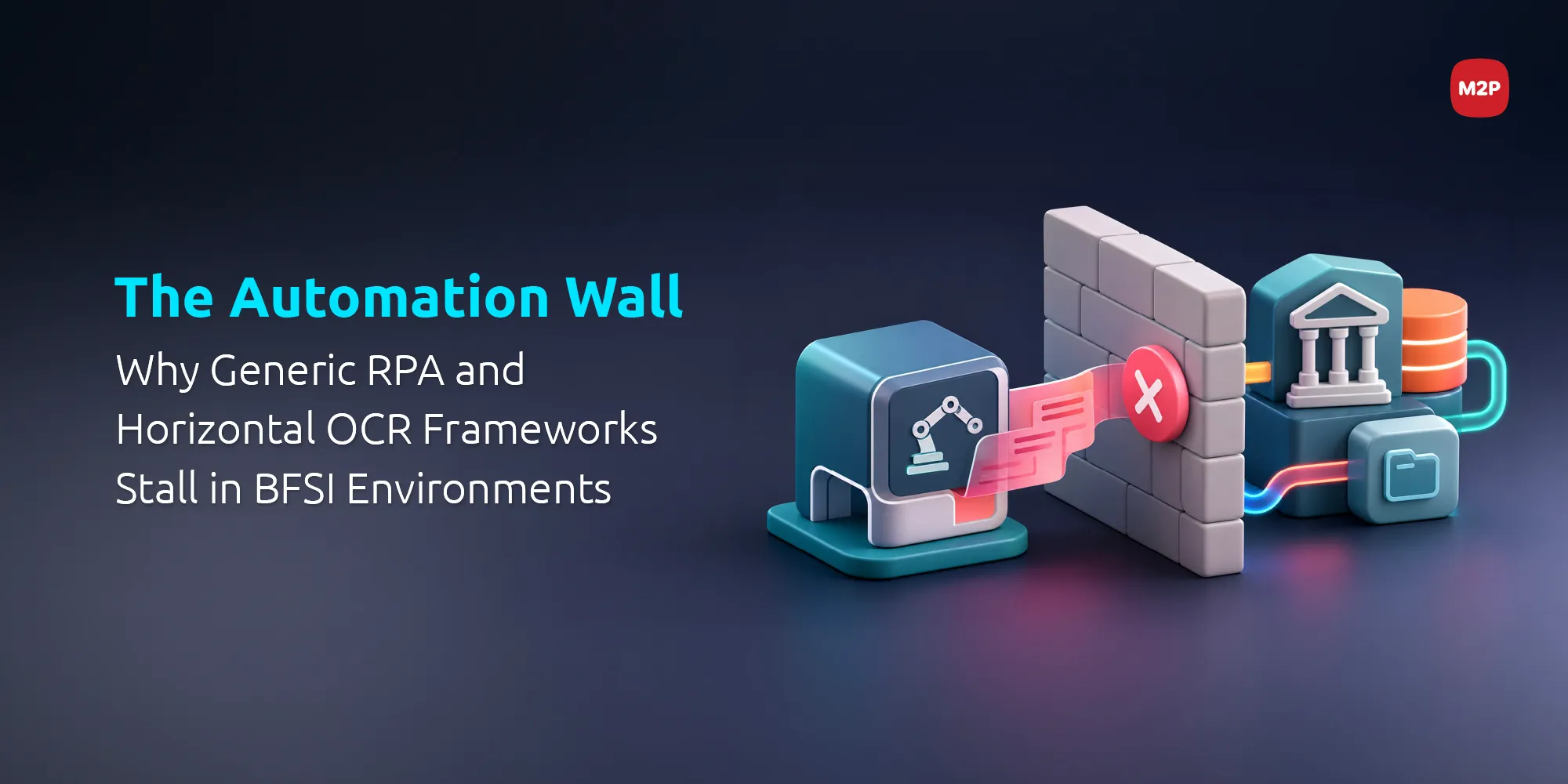
Many enterprise technology leaders share a similar experience: they invest in a leading Robotic Process Automation (RPA) suite or horizontal Intelligent Document Processing (IDP) platform, configure validation workflows, and launch the system across core operations. Initial performance on structured forms looks promising, but as soon as the platform handles real-world banking documents—such as diverse payroll slips, multi-page corporate bank ledgers, or local identity scans, exception queues begin to grow.
The system slows down, requiring continuous manual indexing and data entry by operations staff. Technology teams find themselves writing, testing, and maintaining custom parsing code and layout-specific templates to keep the automation framework running. This reveals a common industry challenge: horizontal automation tools often face performance limits when confronted with the structural complexity of financial documents.
Horizontal automation suites and generic character engines process text at a basic syntactic layer. They see letters and numeric blocks within specific page coordinates, but they lack a semantic understanding of financial document structures. If a regional bank changes its statement formatting, or an employer updates their payroll stub layout, a coordinate-dependent system can misinterpret the data fields. The result is an exception flag, pushing the file out of the automated stream and back into a manual verification queue.
Vue by M2P addresses this challenge by embedding financial taxonomy models directly into the extraction pipeline. Rather than treating incoming text as isolated, generic strings, the platform evaluates information through a pre-trained data layer optimized for banking, compliance, and lending document variations.
Context-Aware Semantic Extraction: The platform identifies data fields based on context rather than fixed page location. It can accurately distinguish between total, gross, net, and base compensation fields across varying document designs, reducing the need for constant template updates.
Unified Processing Pipelines: Instead of piecing together separate OCR modules, custom rules engines, and external exception routing code, Vue by M2P handles classification, extraction, validation, and business logic routing inside a single, unified orchestration layer.
Native Platform Integration: The system connects directly with broader core banking components, card issuing rails, payment modernizations, and custom modules inside the Agentic AI Studio (such as the KYC Agent and Loan Scrutiny Agent) via the M2P platform ecosystem. This integration ensures that verified data transfers smoothly into downstream transaction ledgers and backend accounting frameworks without requiring complex custom middleware.
When evaluating automation investments, long-term maintenance costs are a critical factor. Systems that require continuous manual fine-tuning for every layout change can create significant technical debt and divert engineering resources from core strategic projects. Transitioning to an intelligent processing framework built specifically for financial taxonomies helps minimize maintenance overhead, lower overall total cost of ownership, and ensure reliable processing performance as transaction volumes scale. Click here to book a demo with our technology deployment specialists.


Fintech is evolving every day. That's why you need our newsletter! Get the latest fintech news, views, insights, directly to your inbox every fortnight for FREE!