

M2P Fintech
Fintech is evolving every day. That's why you need our newsletter! Get the latest fintech news, views, insights, directly to your inbox every fortnight for FREE!
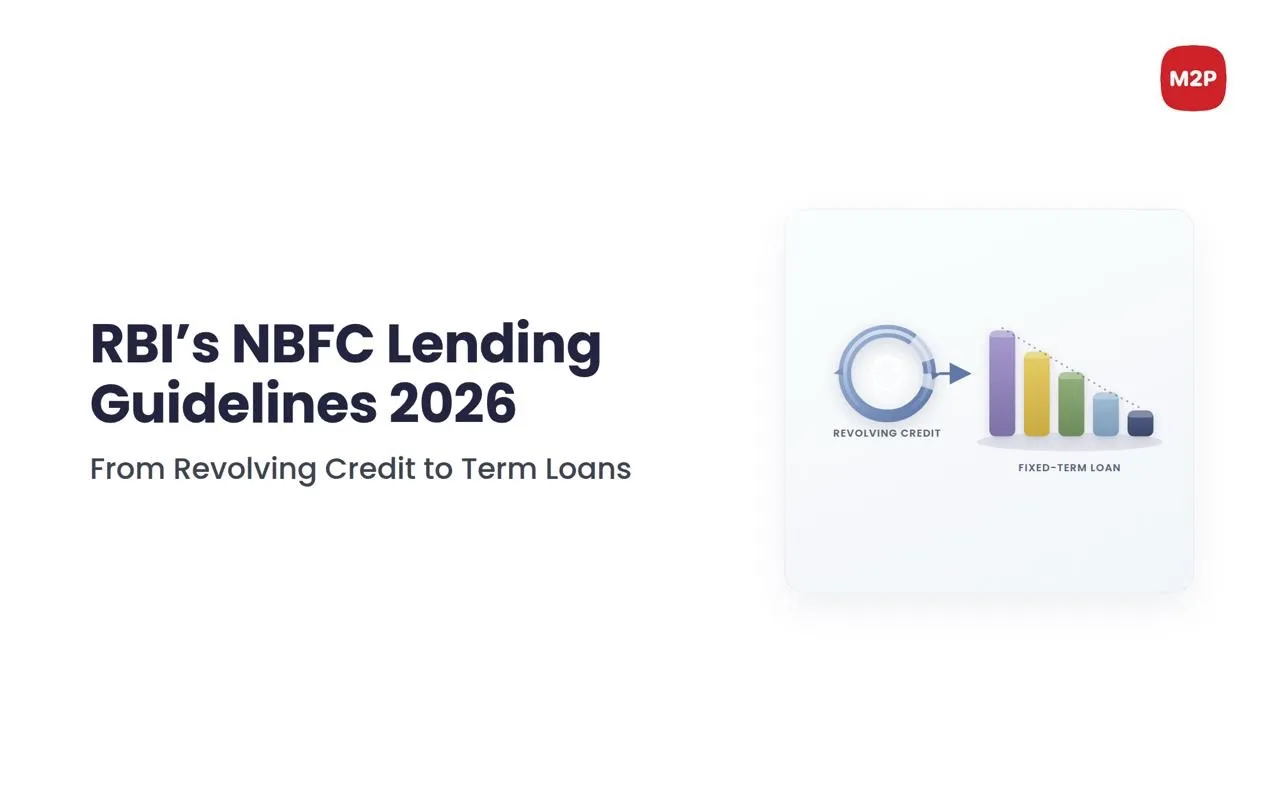
For decades, formal credit in India moved almost entirely through banks. That began to change as digitalisation, new-age NBFCs, and fintechs widened access. Borrower groups once treated as edge cases, whether new-to-credit, underserved, or unserved, turned into real business lines. Flexi loans, digital credit lines, overdraft-style products, and app-based limits let millions of people draw, repay, and draw again.
Now the regulator wants to rein that flexibility in.
The RBI has proposed draft amendments to its NBFC Credit Facilities Directions, 2025. If they go through, most NBFCs would be allowed to offer only term-loan products, and revolving credit would be prohibited outright.
Here is what the draft changes, why the RBI is doing it, and how lenders can respond without stalling their business.
The draft is short, but the impact is structural:
Term loans only. An NBFC would be permitted to offer only credit products that are in the nature of term loans. Revolving credit products would be prohibited.
One exemption. NBFCs specifically authorised by the RBI to issue credit cards can continue offering revolving credit through their card programs.
First-time definitions. For the first time, the framework formally defines both constructs. A term loan is a fund-based facility with a fixed sanctioned amount, disbursed as a lump sum or in tranches, and repaid on a predetermined schedule. Once repaid, the limit cannot be restored or reused. Anything that does not meet this definition counts as revolving credit.
No transition runway. The amendments are proposed to come into force immediately upon notification. There is no phase-in period in the draft.
The proposal replaces the existing Demand/Call Loans chapter with a new section titled "Restrictions on Revolving Credit Facilities." The wording suggests the RBI sees this as a permanent boundary rather than a temporary tightening.
The move has been building for a while. The regulator has flagged concerns about perpetual credit lines before: when borrowers can keep drawing and only service interest, repayment visibility drops and evergreening becomes easier, with fresh drawdowns quietly clearing old dues. Revolving structures also look a lot like cash-credit facilities, which belong to the banking perimeter rather than the NBFC one.
Set against the RBI's wider caution on unsecured retail credit, the message is consistent. Credit should carry a defined amount, a defined schedule, and a defined end.
If the draft is finalised as written, it lands on some of the sector's fastest-growing products:
Flexi loans and hybrid limits where repaid principal replenishes the drawable amount
Digital lines of credit embedded in consumer and fintech partnership journeys
Overdraft-style products for salaried and self-employed borrowers
Working-capital and supply-chain limits where MSMEs draw repeatedly against a sanctioned cap
Every NBFC outside the credit card exemption then faces four tasks:
Map the book. Identify every live facility where a repaid limit can be redrawn. Those cannot continue in their current form once the norms are notified.
Redesign the products. Rebuild flexi and line-based offerings as term loans, including tranche-based disbursals, which the draft definition explicitly allows.
Re-underwrite the borrower. A line customer becomes a term-loan customer, which changes cash-flow assessment, tenor design, and pricing.
Re-paper and re-report. New documentation, new KFS and sanction letters, revised schedules, and clean bureau and accounting trails, all at portfolio scale.
Because the draft takes effect the moment it is notified, the binding constraint is speed, not intent. Lenders running rigid, hard-coded stacks may need full engineering sprints just to retire one product variant and stand up its compliant replacement.
M2P's Core Lending Suite (CLS) is a unified, AI-native platform that covers origination, decisioning, servicing, collateral, collections, and accounting on a single stack. It was built for exactly this kind of moment, when a regulatory change reshapes the product line faster than legacy systems can adapt.
Here is how CLS lines up against each of those tasks.
Our Core Lending Suite is configurable without code, so business teams can define new term-loan products, amortisation structures, repayment strategies, and charge structures without waiting on engineering. Converting a flexi loan product into a compliant, tranche-disbursed term product becomes a configuration exercise rather than a rebuild.
The draft definition allows term loans to be disbursed in one or more tranches against a fixed sanction, and our Loan Origination System supports precisely that. It offers configurable, product-aware journeys across digital, branch, LSP-partnered, and embedded intake models, with multi-level approvals, deviation management, and full STP support. Supply-chain and working-capital needs can be met as distinct, schedule-bound term loans instead of open-ended limits.
The underserved borrowers that revolving products reached do not disappear. They now need better-underwritten term loans. The CLS Credit Assessment layer brings a configurable Business Rules Engine with a full audit trail and version control, supported by AI agents: a Bank Statement Analyzer covering 50+ banks, a Financial Analysis Agent that extracts 50+ ratios, and an ML-powered Credit Scoring Agent that blends multi-bureau and alternative data with explainable outputs. Every policy change made in response to the final norms stays versioned and auditable.
Our Loan Management System manages the full post-disbursal lifecycle across 15+ loan product types, covering rescheduling, restructuring, part-payments, pre-closures, waivers, and write-offs, with automated journal-entry posting and reversals, NPA and asset classification, and bureau reporting built in. Moving non-conforming facilities to compliant structures happens with the accounting and regulatory trail intact.
CAM and KFS builders with automated contract generation take much of the documentation load out of a portfolio-wide product migration.
Product transitions can unsettle repayment behaviour. Our Collections module uses dynamic DPD segmentation together with configurable recovery strategies and multi-channel workflows to keep delinquency in check through the changeover.
Our Core Lending Suite today powers 15M+ borrowers, 27M+ active loan accounts, and a $6.5B total loan portfolio. It ships with 150+ pre-integrated third-party services across KYC, bureaus, and payment rails, along with a compliant co-lending platform for NBFCs partnering with banks on the new term-loan books.
Draft norms invite comments, but final norms tend to arrive with little warning, and this one takes effect the day it is notified. The NBFCs that handle it best will not be the ones that pushed hardest for exemptions. They will be the ones whose lending stack can re-express its product strategy through configuration rather than code.
For NBFCs that hold credit card authorisation, the one route where revolving credit survives, M2P's full-stack credit card issuing and processing platform brings the same AI-native architecture to the card side of the business.
The rules are redefining the product itself, so it is worth checking that your platform can keep pace.
Most lending platforms solve one part of the problem well. CLS covers the entire lifecycle, with AI built in at each stage, across five modules on one unified platform:
Loan Origination System (LOS): a configurable origination engine handling every intake model (digital, branch, assisted, LSP-partnered, embedded), with product-aware dynamic journeys, full STP support, and AI agents for document intelligence (95%+ OCR accuracy, 100+ document types), GST data extraction, and field operations.
Credit Assessment: a configurable Business Rules Engine (BRE) embedded across LOS, LMS, and collections, with AI-assisted inputs from bank statement analysis, financial assessment, and fraud detection, including synthetic-identity and document-tampering checks.
Loan Management System (LMS): complete post-disbursal lifecycle management, covering EMI scheduling, repayment allocation, restructuring, NPA and asset classification, settlements, and accounting across 15+ loan product types.
Collateral Management (SMS): end-to-end asset tracking, charge creation, LTV configuration, and automated revaluation alerts for secured lending.
Collections: delinquency monitoring, strategy automation, and multi-channel recovery from early warning to post-NPA.
Because these modules run as one system, with data moving between them without integration overhead, a change made at the product level flows cleanly through origination, decisioning, servicing, accounting, and reporting. That is exactly the property this amendment puts to the test.
Book a demo to see how M2P's Core Lending Suite can help you map, redesign, and migrate your lending portfolio before the final norms land.

Fintech is evolving every day. That's why you need our newsletter! Get the latest fintech news, views, insights, directly to your inbox every fortnight for FREE!