

M2P Fintech
Fintech is evolving every day. That's why you need our newsletter! Get the latest fintech news, views, insights, directly to your inbox every fortnight for FREE!
In the modern credit landscape, processing speed represents a significant competitive lever. When an institution takes hours or days to verify documents and approve a loan, client acquisition costs climb, application drop-off rates rise, and operational resources become stretched. For many banks and Non-Banking Financial Companies (NBFCs), the obstacle to achieving higher processing speed isn't their capital allocation or credit scoring models—it is the manual administrative effort required to process incoming documentation.
The traditional 'Maker-Checker' operational model was designed to safeguard data integrity and ensure policy compliance. In this model, one operator manually enters and verifies document data (the Maker), while a secondary operator reviews the file to confirm accuracy (the Checker). While secure, this structure is highly labor-intensive and difficult to scale during peak application periods. As application volumes grow, adding more manual staff increases operational expenses without solving the underlying processing bottleneck.
Lending applications are rarely uniform. A single loan file often contains a mix of diverse document types: bank statements with varying column layouts, salary stubs from different employers, regional identification cards with varied scanning quality, and unstructured tax filings. Standard Optical Character Recognition (OCR) tools often struggle with this level of structural variation. Because they rely on rigid template rules, minor layout shifts can cause data extraction errors, flagging exceptions that require manual human review and slowing down the process.
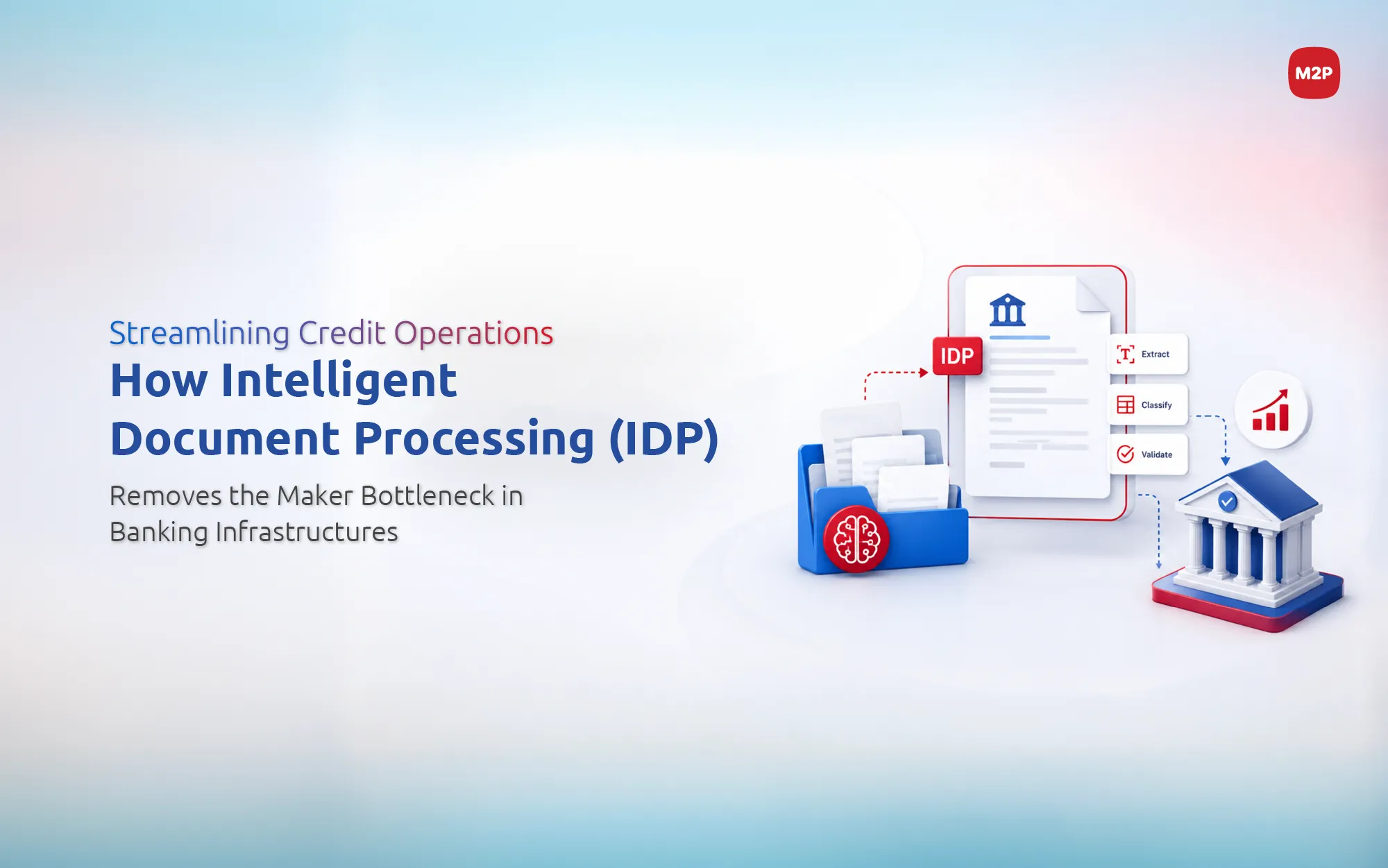
Vue by M2P addresses these limitations by introducing an Intelligent Document Processing (IDP) platform that combines machine learning classification with domain-trained extraction models. Rather than relying on simple text pattern matching, the platform processes incoming documents through an integrated financial data taxonomy framework.
Machine-Learning Multi-Class Classification: As files enter the system, they are automatically parsed, cropped, and routed across 70+ separate document variations without requiring manual sorting or pre-separation by operators.
Contextual Taxonomy Extraction: The extraction engine uses specialized financial dictionaries to accurately identify and capture key data fields from 16+ core document categories, ensuring reliable processing despite layout changes.
Automated Policy and Validation Engine: The platform runs ~200 validation checks simultaneously. This includes processing-level checks like automated blur detection to flag unreadable files early, alongside programmatic data verification to cross-check extracted text fields directly against core backend databases.
Centralized Operational Workspace: Processed applications are organized into a unified interface. Clean files that pass all automated criteria flow straight into the core Loan Management System (LMS), while applications with verified anomalies are routed to senior risk officers for targeted review.
Quantifiable Production Outcomes
This automated framework has been active in high-throughput enterprise banking environments for over 3 consecutive years, delivering stable performance metrics at scale:
Scrutiny Turnaround Time (TAT) was compressed from a 24-hour cycle to less than 2 minutes per contract, accelerating the time to disbursement.
Straight-Through Processing (STP) rates increased by more than 10x, enabling higher application capacity without adding manual administrative staff.
Manual verification requirements dropped by over 60%, allowing the institution to eliminate the entry-level maker role and refocus team members on complex exception management and risk mitigation.
By moving away from manual document sorting and transcription, modern financial institutions can transform their operational efficiency. Implementing an intelligent data layer allows automated lending workflows to run smoothly, driving higher processing capacity, faster response times, and consistent policy compliance across the entire enterprise stack. To know more about our products, book a demo here.

Fintech is evolving every day. That's why you need our newsletter! Get the latest fintech news, views, insights, directly to your inbox every fortnight for FREE!