

M2P Fintech
Fintech is evolving every day. That's why you need our newsletter! Get the latest fintech news, views, insights, directly to your inbox every fortnight for FREE!
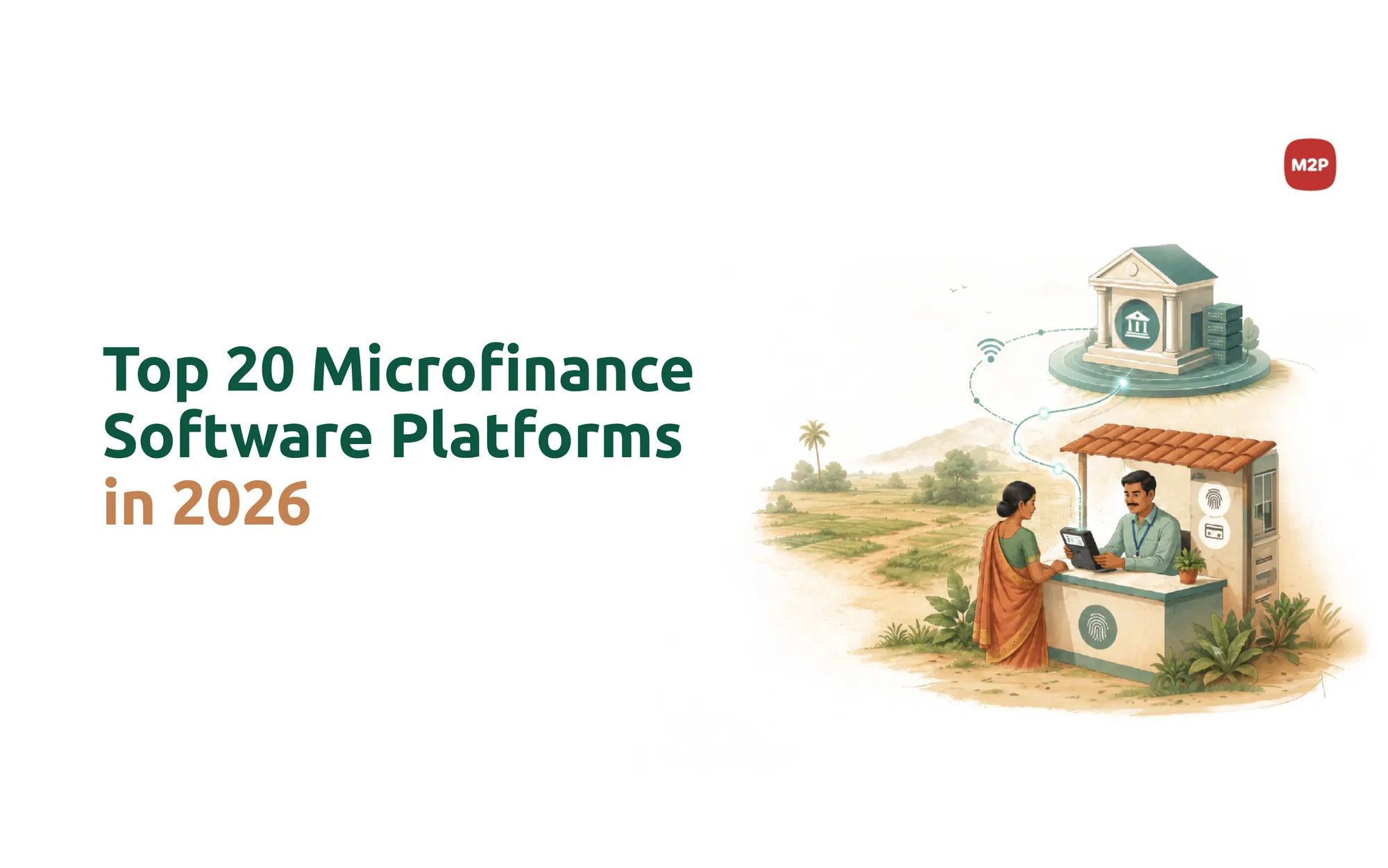
Microfinance institutions (MFIs), NBFCs, and banks running joint-liability-group (JLG) and self-help-group (SHG) lending are under more pressure than ever: regulators want tighter compliance, borrowers expect mobile-first journeys, and field officers still need systems that work offline in low-connectivity villages. The software you pick determines whether you can meet all three demands at once.
This guide ranks and reviews the 20 best microfinance software platforms in 2026 — starting with M2P Fintech's Microfinance Lending Suite, followed by Nucleus Software's FinnOne Neo mFin, Finastra, FinBox, and 16 other proven platforms — so you can shortlist the right technology partner in minutes, not weeks.
Microfinance remains one of the fastest-growing corners of inclusive finance. The global microfinance market was valued at roughly $290–310 billion in 2025 and is on track to cross $320–345 billion in 2026, expanding at a compound annual growth rate of 10–12% through the early 2030s, according to multiple industry research firms including DataM Intelligence and Precedence Research. Asia-Pacific — led by India — remains the largest and fastest-growing regional market, followed by Africa and Latin America.
That growth is happening against a stubborn backdrop: the World Bank's Global Findex still counts more than 1.4 billion adults worldwide as unbanked, and MFIs collectively serve upward of 150 million active borrowers. Closing that gap profitably — while keeping non-performing loans and operating costs low — is no longer possible with spreadsheets, paper ledgers, or legacy on-premise core banking. It requires purpose-built microfinance software that can:
Digitize group and individual loan origination, including JLG/SHG center meetings
Automate credit decisioning with bureau and alternative data
Run doorstep collections in cash, UPI, and mobile money — even offline
Enforce regulatory, KYC, and AML compliance automatically
Plug into core banking, payments, and credit bureaus via APIs
The rest of this guide breaks down the platforms best positioned to deliver on that in 2026.
Microfinance software is a purpose-built loan management and origination system that helps MFIs, NBFCs, cooperatives, and banks originate, disburse, service, and collect small-ticket loans — often without collateral — for underserved individuals, groups, and micro-entrepreneurs.
At a functional level, most platforms cover the same core loan lifecycle:
Sourcing & onboarding — field officers or business correspondents capture borrower KYC, household income, and group/center data, often via a mobile app that works offline.
Credit assessment — the system scores the applicant using credit bureau data, alternative data (utility bills, mobile usage), and a configurable business rules engine.
Disbursement — funds move to the borrower via bank transfer, prepaid card, mobile wallet, or cash, based on the loan product configuration.
Servicing & collections — repayment schedules, reminders, doorstep collections, and delinquency workflows run automatically across digital and cash channels.
Compliance & reporting — the platform generates regulator-ready MIS reports, tracks portfolio-at-risk (PAR), and flags AML/KYC exceptions.
Modern platforms differ mainly in how configurable, AI-native, and mobile/offline-capable each layer is — which is exactly what we evaluate below.
With smartphone penetration exceeding 70% across most emerging markets, MFIs increasingly demand field-officer apps that work with zero or intermittent connectivity — critical for rural JLG/SHG lending — and sync automatically once back online.
Micro-lending is being embedded directly into e-commerce, agri-marketplace, and gig-economy apps through APIs, letting non-bank platforms offer credit at the point of need without becoming a licensed lender themselves.
Alternative data — mobile usage, utility payments, transaction history — combined with AI scoring engines is expanding approval rates for borrowers with little or no formal credit history, a segment most traditional bureau-only models miss entirely.
As banks and NBFCs partner more frequently to originate microfinance loans, platforms now need native support for co-lending splits, first-loss default guarantee (FLDG) tracking, and multi-lender reconciliation.
Central banks across Africa, Asia, and Latin America are enforcing stricter digital compliance, capital-adequacy, and data-protection rules for MFIs, pushing platforms to build compliance and audit trails in by default rather than as an add-on.
Cash is still king in rural microfinance, but digital rails — UPI, dynamic QR, BBPS, mobile money — are rapidly supplementing it, with real-time receipts replacing manual collection sheets.
# | Platform | Best For | Deployment | Standout Feature |
|---|---|---|---|---|
1 | M2P Fintech | Banks, NBFCs & MFIs running JLG/SHG lending at scale | Cloud-native, API-first | Powered by AI agents, offline field-officer app + doorstep digital collections |
2 | Nucleus Software (FinnOne Neo mFin) | Large MFIs and banks with high transaction volumes | Cloud & on-premise | 480+ APIs, 200+ FIs across 50 countries |
3 | Finastra | Retail, community & credit-union lenders | Cloud, API-driven | Broad core-banking + lending ecosystem |
4 | FinBox | Embedded and MSME-focused digital lenders | API/SDK, cloud | AI-native Sentinel decisioning engine |
5 | HES FinTech | MFIs to multinational banks needing modular LOS/LMS | Cloud & on-premise | Highly configurable admin interface |
6 | TurnKey Lender | Non-bank and embedded lenders | Cloud, SaaS | Proprietary AI credit scoring |
7 | Craft Silicon | African & Asian MFIs and mobile network operators | Cloud & on-premise | Core banking + agency banking bundle |
8 | CloudBankin | Small-to-mid MFIs wanting fast deployment | Cloud, SaaS | Guided, low-code workflow builder |
9 | LoanPro | Fintechs and B2B lenders needing deep API control | API-first, cloud | Real-time data access via REST APIs |
10 | Mambu | Digital banks and fintechs building composable lending | Cloud-native, SaaS | Product Factory for configurable loan products |
11 | Musoni System | MFIs and SACCOs in Africa & Asia | Cloud, MifosX-based | Deep mobile-money (M-PESA) integration |
12 | Vexil Infotech | Indian NBFCs and MFIs | Cloud & on-premise | Biometric + geo-tagging borrower verification |
13 | Panamax | Telecom-linked micro-lending programs | Cloud & on-premise | Blockchain & social-scoring modules |
14 | ABLE Platform | Startups launching microloan products fast | Cloud, SaaS | Ready-made borrower portal + landing page |
15 | Fiserv | Banks needing origination across multiple loan types | Cloud & on-premise | 25+ years in origination automation |
16 | ScoreMe Solutions | Lenders needing document/bank-statement analytics | Cloud, API | Unstructured data & bank-statement parsing |
17 | Nelito (FinCraft) | Microfinance arms of established banks | Cloud & on-premise | Android mobility layer for field agents |
18 | Pennant Technologies | Banks scaling loan origination & servicing | Cloud & on-premise | 100M+ loan transactions processed annually |
19 | Software Group | Multi-country MFIs & development organizations | Cloud, API | Centralized multi-tenant, multi-country management |
20 | Newgen | Banks needing omni-channel origination | Cloud & on-premise | Smart underwriting with customizable rules |
Below, we go deeper on the top platforms — starting with the four institutions leading the pack in 2026.
Website: m2pfintech.com
M2P Fintech's Microfinance Lending Suite, is an AI-native, purpose-built platform for banks, NBFCs, and MFIs running JLG/SHG microfinance at scale. M2P powers infrastructure for over 300 banks, 100+ NBFCs, and 800+ fintechs across 20+ markets, processing tens of billions of transactions — giving its microfinance suite the backing of a genuinely enterprise-grade, API-first technology stack rather than a standalone point solution.
M2P’s Microfinance Software is an AI-native architecture that unifies LOS, LMS, and Collections on a single data model instead of stitching together separate systems. A credit decision made at origination flows instantly into the LMS for scheduling and into Collections for risk segmentation, with no manual handoffs or reconciliation in between. Purpose-built AI agents are embedded at every stage of this lifecycle: a Document Intelligence Agent classifies and extracts data from KYC documents and income proofs at onboarding, a Scrutiny Agent automates underwriting review and policy checks, an Early Warning Agent monitors live repayment behavior to flag delinquency risk before a payment is even missed, and a Collections AI Co-Pilot drives sentiment scoring, next-best-action recommendations, and settlement strategies for overdue accounts. For microfinance specifically, this means field officers, credit teams, and collections agents are all working off the same AI-informed, real-time view of a borrower or group — rather than three disconnected systems.
What sets M2P apart is that microfinance isn't bolted on as an afterthought — the AI-powered MFI suite is engineered specifically for field-officer-led, low-connectivity lending, which is where most microfinance software falls short.
Key features:
Group and center management — end-to-end JLG/SHG creation, center meeting scheduling, and attendance tracking
Offline-first field app (LoanBook) — onboarding, KYC, household income assessment, and disbursement continue even without connectivity, syncing automatically once back online
Doorstep digital collections — cash, UPI QR, BBPS, payment gateway, and self-service repayment through a borrower app, with instant digital receipts
Configurable business rules engine (BRE) — a UI-based BRE lets institutions adjust lending policies and eligibility criteria without code changes
Bureau and alt-data integrations — plugs directly into credit bureaus and alternative data sources for fast, accurate risk scoring
Savings products — voluntary and mandatory savings, recurring/fixed deposits, with auto-closure tied to loan closure
Co-lending and FLDG-style tracking — native support for multi-lender partnership structures, a growing requirement in 2026's co-lending environment
Full loan lifecycle automation — origination through closure, plus real-time portfolio-health monitoring and early-warning signals
Why it ranks #1: Few platforms combine enterprise scale, true offline field operations, and native co-lending/compliance tooling in one modular suite. For MFIs balancing rapid growth with regulatory scrutiny, M2P's Microfinance Lending Suite offers the broadest single-platform coverage of the loan lifecycle available in 2026.
Website: nucleussoftware.com
Nucleus Software is one of the most established names in lending technology, supporting 200+ financial institutions across 50 countries, processing over 26 million transactions daily against a combined loan portfolio exceeding $500 billion. Its microfinance-specific product, FinnOne Neo mFin, brings that scale down to a mobility-first solution purpose-built for micro-lenders.
Key features:
Paperless sourcing with pre-populated application data
Real-time application submission and instant verification
Seamless credit bureau integration for group lending
Geo-tagging and image capture/upload for field verification
Role-based dashboards for field officers, branch managers, and credit teams
480+ APIs supporting integration with third-party systems
Cloud and on-premise deployment flexibility
Best for: Established MFIs and banks with a microfinance arm that need enterprise-grade reliability, deep credit-bureau connectivity, and a vendor with decades of lending-domain expertise.
Website: finastra.com
Finastra is a leading cloud-based, API-driven core banking and lending platform serving retail, commercial, community, and credit-union institutions worldwide. While not exclusively a microfinance vendor, Finastra's lending portfolio covers consumer, syndicated, commercial, and mortgage lending, and its open, API-first architecture makes it a common choice for banks layering microfinance products onto an existing core.
Key features:
Loan origination across multiple lending verticals
Credit risk assessment tooling
Full loan management and servicing
Deep integration and customization options
Analytics and regulatory reporting
Best for: Banks and credit unions that need microfinance or small-ticket lending capability integrated into a broader, already-deployed core banking environment.
Website: finbox.in
FinBox is an AI-native, API-first credit infrastructure platform built for embedded and MSME-focused digital lending. Backed by a $40M Series B round led by WestBridge Capital, FinBox powers loan origination and risk decisioning for major institutions including HDFC Bank, Kotak Mahindra Bank, and Poonawalla Fincorp, making it one of the fastest-scaling lending-infrastructure players in the market.
Key features:
BankConnect — bank-statement analysis for faster, more accurate underwriting
Sentinel AI — real-time, AI-driven credit decisioning engine
DeviceConnect — alternative-data underwriting using device and behavioral signals
Multi-bureau analytics and a configurable loan origination system (LOS)
"Embed" product for launching in-app lending journeys without becoming a licensed lender
Best for: Fintechs, NBFCs, and platform businesses that want to embed microcredit and MSME lending directly into an existing app or marketplace, with AI-first underwriting.
A London-headquartered lending-software vendor serving everyone from small MFIs to multinational banks, with a modular architecture covering the full lending journey — from application to debt recovery. Notable for AI-powered application scoring and a highly configurable admin interface that reduces dependency on the vendor for minor changes.
A comprehensive lending-automation platform using proprietary AI for credit scoring, serving non-bank lenders, embedded lenders, and traditional financial institutions alike. Automates origination, underwriting, servicing, debt collection, and reporting in one system.
Nairobi-headquartered with operations across Africa, India, and the UAE, Craft Silicon combines core banking, mobile banking, digital payments, and agency banking — a strong fit for MFIs that need microfinance lending bundled with broader digital-banking infrastructure.
A cloud-based, guided-workflow platform purpose-built for MFIs of all sizes, with automated loan lifecycle processing, strong analytical reporting, and secure, user-controlled data permissions — popular for institutions prioritizing fast, low-friction deployment.
An API-based lending platform known for scalability and integration depth, used by banks, fintechs, B2B lenders, and traditional institutions. Offers dedicated suites for servicing, payments, collections, and CRM, with loans categorized by status and portfolio for operational clarity.
A pioneer of composable, cloud-native core banking, Mambu got its start serving microfinance providers (100+ MFIs across 26 countries within its first two years) before expanding into mainstream digital banking. Its "Product Factory" lets institutions configure and launch loan and deposit products without custom code — a strong option for fintechs building a modern lending stack from scratch.
A cloud-based core banking system purpose-built for MFIs and SACCOs, now used across 19 countries. Musoni is best known for deep mobile-money integration (M-PESA, Airtel Money), SMS-based repayment reminders, and a digital field application for paperless loan processing in low-infrastructure markets.
An India-focused developer of microfinance and NBFC software, whose flagship IMS (Integrated Microfinance Solutions) product includes biometric registration, geo-tagging, and housing-index credit checks — tailored to Indian regulatory and field-verification requirements.
A fintech solutions provider founded in 2001, serving 60+ countries with a Microcredit solution that blends online lending, blockchain, social-network scoring, and mobile data analytics for underbanked and small-business borrowers.
A lending solution built for startups and small lenders needing a fast, reliable launch. Bundles a borrower-facing landing page, self-service borrower portal, back office, and credit scoring/decisioning into one out-of-the-box package.
A long-standing core banking and origination platform with 25+ years of experience streamlining mortgage, consumer, and business loan processes — offering comprehensive origination support, automated underwriting, and paper-free processing across channels.
An India-based fintech specializing in paperless credit and analytics, helping lenders process unstructured data — bank statements, tax returns, GST filings — for faster, more transparent lending decisions, alongside built-in KYC checks.
Nelito's FinCraft core lending solution automates microfinance business processes on a scalable platform, with an Android-based mobility layer, multi-partner compatibility, and strong regulatory/MIS reporting — often chosen by the microfinance arms of established banks.
A fast-growing lending-technology company trusted across Asia, having managed over 14 million loans and 100 million+ loan transactions annually through its award-winning origination, servicing, and collections platform.
Operating in 70+ countries, Software Group provides digitalization tools for remote customer onboarding, group lending, savings, and loan origination — with centralized management across multiple countries and tenants, a strong fit for multi-market MFI networks and development organizations.
A digital-transformation vendor whose loan origination system simplifies disbursement for personal loans, credit cards, and high-touch products like HELOCs, with smart underwriting, customizable rules, and omni-channel application support.
Before signing with any vendor on this list, weigh the platform against these criteria:
Offline and low-connectivity support — can field officers onboard, verify, and collect without a live connection, and does data sync reliably afterward?
API-first architecture — can you integrate credit bureaus, payment rails, and mobile money without a lengthy custom-build cycle?
Group and individual lending support — does it natively handle JLG/SHG structures, not just individual retail loans?
Compliance and audit readiness — are KYC, AML, and regulator-specific MIS reports built in, or will you need to build them?
Co-lending and partnership tracking — as co-lending and FLDG structures grow more common, does the platform track multi-lender splits natively?
Deployment flexibility — cloud, on-premise, or hybrid, depending on your regulatory environment and IT footprint
Total cost of ownership — licensing, implementation, and ongoing support costs relative to your loan book size and growth trajectory
There is no single "best" platform for every institution — a fast-growing MFI running JLG lending across rural, low-connectivity branches has very different needs from a bank layering microloans onto an existing digital-banking stack. Shortlist two or three vendors above whose strengths match your operating model, and request a proof-of-concept against your actual loan products before committing.
There is no one-size-fits-all answer, but M2P Fintech's Microfinance Lending Suite stands out for institutions running JLG/SHG group lending at scale, thanks to its offline-capable field app, doorstep digital collections, and native co-lending support. Nucleus Software's FinnOne Neo mFin and Finastra are strong alternatives for large, established institutions, while FinBox leads for embedded, AI-driven MSME lending.
At minimum: digital loan origination, credit/bureau scoring, KYC/AML compliance automation, group and individual lending support, collections management, and API connectivity to payments and third-party data sources. Platforms like M2P, Nucleus Software, and Musoni combine all of these into a single configurable suite.
Pricing varies widely by vendor, deployment model, and scale — most enterprise platforms (M2P, Nucleus Software, Finastra) use custom, modular pricing based on user count, loan volume, and selected modules, while smaller platforms (CloudBankin, ABLE Platform) often offer more standardized SaaS pricing. Expect a formal quote after a requirements discovery call.
Yes — platforms built for rural and low-connectivity lending, such as M2P's Microfinance Lending Suite, Nucleus Software's FinnOne Neo mFin, and Musoni System, include offline-capable mobile apps that let field officers onboard, verify, and collect data without a live connection, syncing automatically once connectivity resumes.
An LMS typically handles loan servicing after disbursement — repayments, accounting, and collections — for any lending vertical. Dedicated microfinance software goes further, natively supporting group/center-based JLG and SHG lending structures, field-officer workflows, and doorstep collections designed specifically for underserved, often rural, borrower segments.
AI-driven credit scoring uses alternative data — mobile usage, utility payments, transaction history — to assess borrowers with thin or no formal credit files, improving approval accuracy for populations that traditional bureau-only models often reject. Platforms like FinBox (Sentinel AI) and TurnKey Lender build this directly into their underwriting engines.
Cloud-based deployment (offered by nearly every platform on this list) is now the default for most MFIs because it lowers upfront IT costs, scales faster, and enables quicker product launches. On-premise or hybrid deployment remains relevant for institutions with strict data-residency or regulatory requirements — several vendors above, including Nucleus Software, Finastra, and Craft Silicon, support both.
Embedded microfinance is the practice of integrating micro-lending directly into third-party apps — e-commerce platforms, agricultural marketplaces, gig-economy apps — via APIs, AI agents, so borrowers can access credit at the exact point of need rather than through a separate lending app.
Tags

Fintech is evolving every day. That's why you need our newsletter! Get the latest fintech news, views, insights, directly to your inbox every fortnight for FREE!