

M2P Fintech
Fintech is evolving every day. That's why you need our newsletter! Get the latest fintech news, views, insights, directly to your inbox every fortnight for FREE!
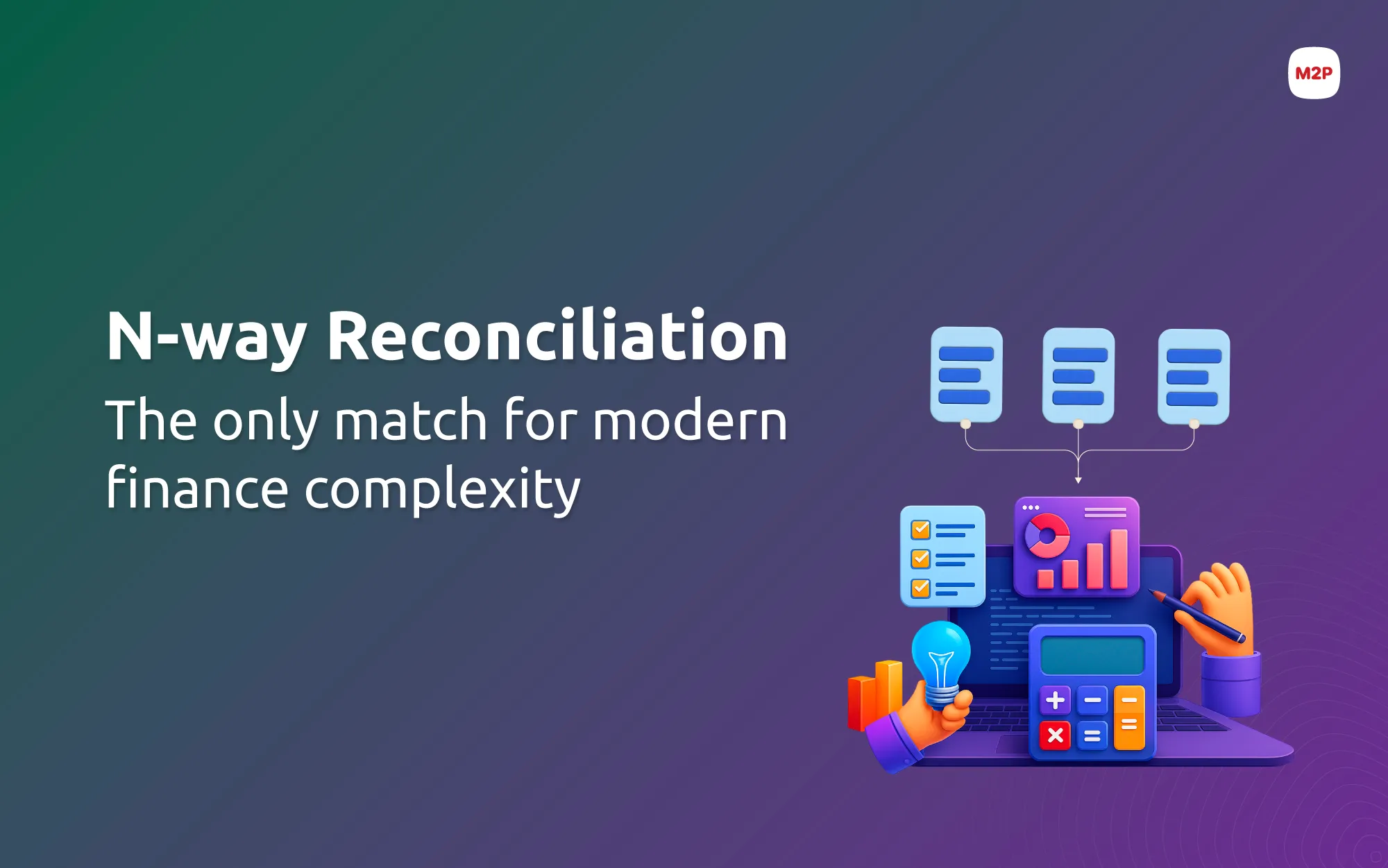
Most finance teams are familiar with the basics of reconciliation: compare your internal ledger against the bank statement, resolve the gaps, move on. It sounds manageable until you're operating at scale, across multiple payment processors, ERPs, subsidiaries, and data sources, all generating transactions simultaneously.
That's where traditional two- or three-way reconciliation breaks down. And that's precisely where N-way reconciliation begins.
Two-way reconciliation comparing two data sources, say a bank statement against an internal ledger has been the standard for decades. Three-way reconciliation adds a third dimension, such as a client sub-ledger or a broker report. These methods serve simple, contained environments well.
But modern finance is anything but contained. According to the Institute of Finance & Management (IOFM), 39% of invoices contain errors from overbilling to duplicate charges and industry auditors report that around 60% of recoverable cash identified in AP audits comes from statement reconciliation findings. Meanwhile, reconciliation errors cost companies an average of $150,000 annually, a figure that climbs steeply as transaction volumes grow.
When you're reconciling data across banks, payment gateways, custodians, brokers, and internal sub-systems simultaneously, a two-way comparison doesn't catch what falls through the cracks between sources. Errors compound. Detection lags.
N-way reconciliation also called multi-way reconciliation is the simultaneous comparison of data across any number of sources, not just two or three. Rather than comparing pairs of records sequentially, it assembles a complete data pool: general ledgers, transaction logs, bank feeds, payment processor reports, custodian data, broker statements, and any other relevant stream. It then matches every record against every other record in a single, unified pass.
The "N" is the key insight: the number of sources isn't fixed. It scales to however complex your financial infrastructure is.
This approach fundamentally changes what you can detect. A discrepancy that looks clean on a two-way comparison because the error is distributed symmetrically across two sources becomes visible the moment a third, fourth, or fifth source is added to the picture.
Getting N-way reconciliation right requires more than just pulling in more data. It depends on four capabilities working together:
1. Unified data ingestion: All sources regardless of format, schema, or update frequency must be normalized into a common structure before matching can begin. This is where most legacy tools fail: they're built for two specific data types, not arbitrary combinations.
2. Intelligent matching logic: N-way matching can't rely on exact-match rules alone. Variations in transaction IDs, date offsets, currency rounding, and terminology across counterparties require fuzzy matching, configurable tolerance thresholds, and rule hierarchies.
3. Exception surfacing, not just exception flagging: The value isn't in catching discrepancies it's in explaining them. Effective N-way systems contextualize exceptions: which sources agree, which disagree, by how much, and what the likely cause is.
4. Auditability: Every matched record, exception, and resolution must be traceable. Regulators and auditors require a complete chain of evidence, not just a final reconciled balance.
Recon360 was built from the ground up for multi-source, high-volume financial environments. Here's how it operationalizes each pillar:
Adaptive data connectors ingest data from banks, ERPs, payment processors, custodians, and custom sources in any format and normalize them into a unified transaction layer. There's no manual reformatting. Data flows in; Recon360 handles the translation.
Configurable matching engine allows finance teams to define matching rules by source combination, transaction type, and tolerance. A payment settled T+1 across a gateway and a bank doesn't need to fail matching it needs a rule that accounts for settlement lag. Recon360 makes that rule explicit and auditable, not buried in a spreadsheet macro.
Contextual exception management presents discrepancies with full source visibility: you see not just that a transaction mismatched, but where in the N-source chain the disagreement originated. This cuts investigation time dramatically teams using automated reconciliation tools report up to 85% faster reconciliation compared to manual methods.
Immutable audit trails log every matching decision, every exception, and every resolution with timestamps and user attribution giving finance leaders and external auditors the confidence of a complete, tamper-evident record.
The reconciliation software market reached $2.53 billion in 2024 and is projected to hit $7.54 billion by 2033, growing at 13.1% CAGR. The growth is being driven by one thing above all else: the cost and complexity of getting reconciliation wrong at scale.
As financial operations span more channels, geographies, and counterparties, the gap between what two-way reconciliation can catch and what actually needs to be caught keeps widening. N-way reconciliation isn't a luxury upgrade it's the architecture that modern finance requires.
Recon360 exists to make that architecture accessible: not as a months-long implementation project, but as a platform your team can configure, operate, and trust from day one.
Ready to see how Recon360 can transform your reconciliation process? Schedule a demo today
Follow us on LinkedIn and Twitter for insightful fintech bytes curated for curious minds like you.
Fintech is evolving every day. That's why you need our newsletter! Get the latest fintech news, views, insights, directly to your inbox every fortnight for FREE!