

M2P Fintech
Fintech is evolving every day. That's why you need our newsletter! Get the latest fintech news, views, insights, directly to your inbox every fortnight for FREE!
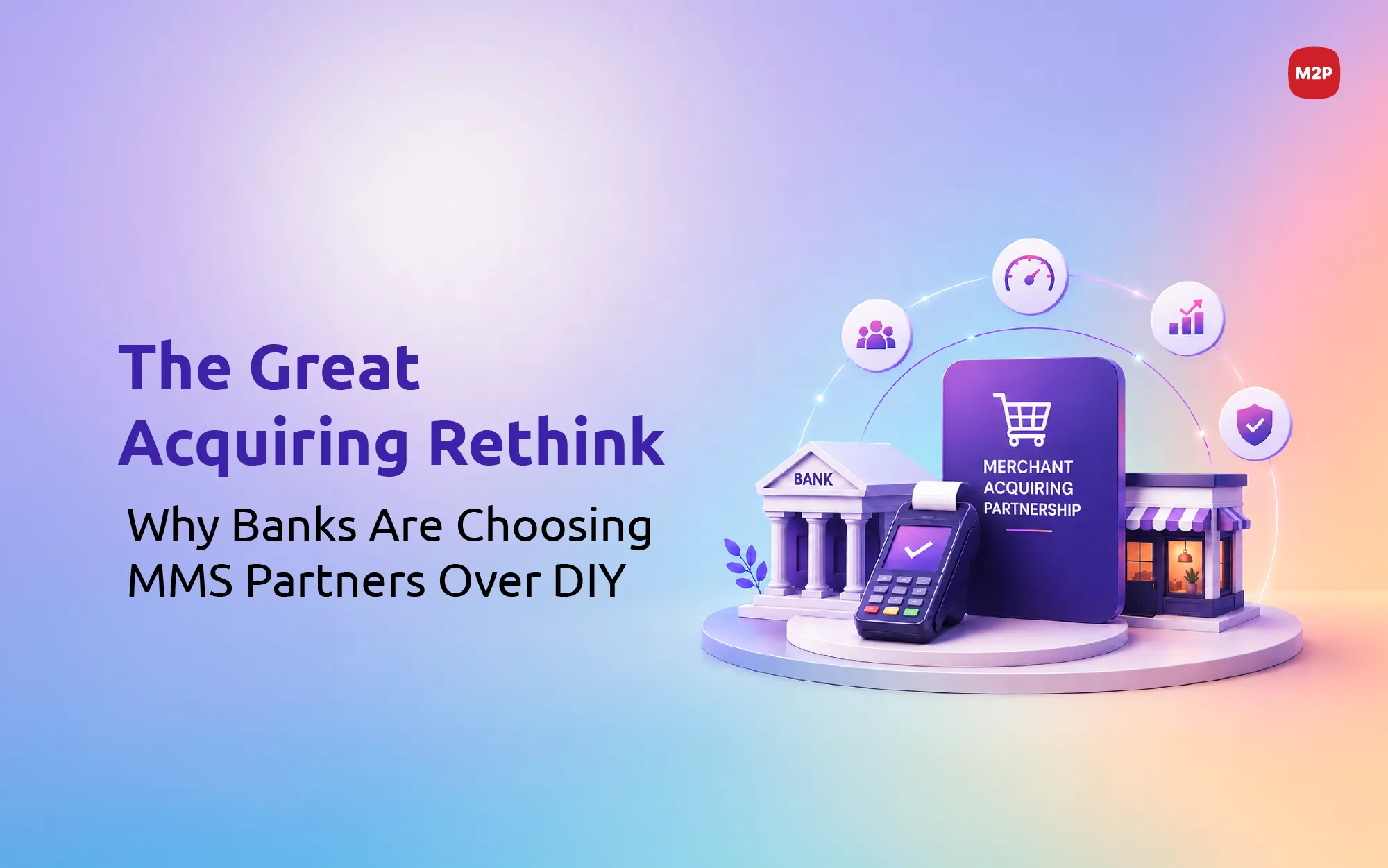
For decades, Merchant Acquiring was one of those businesses banks simply assumed they had to own end-to-end. The logic seemed sound: acquiring touches core banking relationships, settlement accounts, and merchant credit risk, so why would a bank hand any of that over to a third party?
That logic is now being tested — and increasingly, it's losing. Across markets, banks and NBFCs are quietly (and sometimes not so quietly) stepping back from running their own Merchant Acquiring and Merchant Management System (MMS) stacks in-house, and instead partnering with specialist MMS providers to power that business. Global acquirers built their scale over the last twenty years partly by absorbing exactly this kind of outsourced infrastructure demand. Newer entrants built platform-native acquiring stacks that banks now benchmark themselves against. And in high-growth markets like India, the Middle East, and Southeast Asia, players have shown just how fast a modern, API-first acquiring stack can move compared to a legacy one.
So what's actually driving this shift? Let's unpack the real reasons banks are rethinking their in-house Merchant Acquiring stacks — and why "partner with an MMS provider" has gone from a fallback option to a strategic first choice.
Most in-house Merchant Acquiring stacks at banks were built 10, 15, even 20 years ago. They were designed for a world of physical POS terminals, batch settlement, and a relatively small, stable base of large-format merchants. That world doesn't exist anymore.
Today, a bank's merchant base includes everything from a single QR code at a roadside kiosk to an omnichannel retail chain processing in-store, online, and app-based payments simultaneously. Supporting that diversity on a legacy stack means one of two things: expensive custom development bolted onto an aging core, or simply not supporting large segments of the merchant market at all.
The total cost of ownership (TCO) math has quietly flipped. A decade ago, building in-house was often cheaper than the licensing fees of third-party platforms. Today, the opposite is frequently true, once you account for:
Maintenance and technical debt on systems that were never designed for cloud-native, API-first operations
Specialized talent needed to keep old acquiring cores running — a shrinking and increasingly expensive pool of engineers
Opportunity cost of engineering teams spent on "keeping the lights on" rather than building differentiated merchant products
Compliance re-certification costs every time a legacy system needs to be brought up to the latest PCI-DSS or card network mandate
MMS providers spread these costs across many client banks, meaning the same infrastructure investment that would bankrupt a single bank's IT budget becomes a shared, amortized cost across a partner's entire portfolio. This is precisely the "SaaS logic" that made Adyen and Stripe so disruptive to the acquiring business — and banks are now applying that logic inward.
In-house acquiring stacks are notoriously slow to change. Adding a new payment method, supporting a new merchant category, or launching a value-added service like dynamic currency conversion or tap-to-phone acceptance can take a legacy team six months to a year — by which point a fintech competitor has already captured the merchant relationship.
Contrast that with what modern MMS platforms enable. Companies like M2P have built their entire value proposition around turning POS deployment and merchant onboarding into a same-day or same-week activity in India. M2P’s Merchant Acquiring architecture lets enterprise merchants go live across markets in weeks, not quarters. Even in cross-border e-commerce acquiring, players have pushed the industry toward configuration-based go-lives rather than custom-coded integrations.
Banks that still run in-house stacks are watching their addressable merchant segments — particularly SMEs and MSMEs who won't wait months for onboarding — get captured by fintechs and payment aggregators who partner with agile MMS providers. The realization setting in across the industry is simple: owning the infrastructure is no longer synonymous with owning the merchant relationship. A bank can retain the merchant relationship, the settlement account, the brand, and the risk book, while letting a specialist MMS partner run the acquiring engine underneath it.
Merchants today expect same-day settlement, real-time dashboards, self-service onboarding, embedded lending offers, and omnichannel acceptance across QR, cards, wallets, and BNPL — often in a single unified merchant portal. These are baseline expectations shaped by what merchants have experienced and what the industry had already built and not luxury features.
Legacy in-house acquiring stacks, built around batch-mode settlement cycles and static reporting, simply cannot deliver this experience without a ground-up rebuild. And a ground-up rebuild inside a regulated bank's technology environment is a multi-year, multi-million-dollar undertaking with real execution risk.
Modern MMS providers, by contrast, have already solved these problems — because merchant experience is their core product, refined across hundreds of client banks and thousands of merchants. Partnering means a bank can offer a merchant experience competitive with Adyen or Stripe on day one, without having to become a product engineering organization first.
Merchant Acquiring sits at the intersection of some of the most demanding compliance regimes in financial services: PCI-DSS, card network mandates (Visa/Mastercard/RuPay/local schemes), AML/KYB requirements for merchant onboarding, data localization rules, and — in markets like India and the GCC — an evolving regulatory posture from central banks and payment regulators on interoperability, MDR caps, and merchant categorization.
Each of these requires continuous, specialized investment to stay compliant. A bank running its own stack has to independently track, interpret, and implement every regulatory change across every market it operates in. An MMS provider serving multiple banks does this once, centrally, and pushes the update across its entire client base — turning a recurring compliance burden into a shared, managed service.
This matters even more for banks operating across multiple geographies, where regulatory divergence (say, between RBI guidelines in India and central bank requirements in the UAE or Saudi Arabia) can otherwise mean maintaining parallel, market-specific compliance teams for the same underlying acquiring function.
It's tempting to frame the build-vs-partner decision purely as a cost question. But conversations with bank technology leaders increasingly point to a deeper issue: it's genuinely hard to hire and retain engineering talent that wants to work on legacy acquiring cores.
The best payments engineers want to work on modern, API-first, cloud-native systems — the kind of stacks that MMS providers and fintech-native acquirers have built. Banks competing for this talent against major players and well-funded MMS providers are fighting an uphill battle when the job on offer is maintaining a fifteen-year-old COBOL-adjacent settlement engine.
Partnering with an MMS provider effectively lets a bank access modern engineering capability without having to win the talent war itself. The provider's roadmap, informed by serving dozens of banks and millions of merchant transactions, becomes the bank's roadmap too — without the bank needing to staff a payments engineering org from scratch.
Perhaps the most structural shift is this: acquiring is no longer just a bank-to-merchant relationship. Marketplaces, SaaS platforms, and vertical fintechs increasingly want to embed acquiring directly into their own products — think a POS software company that wants to offer payment acceptance natively, or a B2B marketplace that wants to settle its sellers directly.
This is the "embedded acquiring" or "acquiring-as-a-service" wave, and it fundamentally changes the economics of building in-house. A bank now competes not just with other banks and traditional acquirers, but with software platforms that white-label acquiring capability from an MMS provider and go to market faster than any bank's internal roadmap would allow.
For banks, the strategic response has been to flip the model: instead of trying to out-build these platforms, banks are partnering with MMS providers to power their own acquiring-as-a-service offering — becoming the licensed, regulated backbone for fintechs and platforms, while the MMS provider handles the technology layer.
A common objection banks raise is risk: "If we don't run the stack ourselves, how do we control merchant risk?" In practice, the opposite tends to be true with a mature MMS partner.
Modern MMS platforms come with built-in, continuously updated risk and underwriting engines — AI-driven merchant risk scoring, transaction monitoring, fraud and risk management, chargeback and dispute automation, and portfolio-level anomaly detection — refined across a much larger and more diverse merchant dataset than any single bank's portfolio alone could provide. Banks retain the decision-making authority and the credit relationship, but the underlying risk tooling is sharper because it's built on a broader base of merchant behavior data across industries and geographies.
This is a meaningful shift from the earlier assumption that risk control requires infrastructure control. Increasingly, risk control requires the best infrastructure — and that's rarely the one a single bank can build and maintain alone.
It's worth stating plainly: banks aren't just competing with other banks anymore. They're competing with M2P’s MMS, Adyen, Stripe, Pine Labs, Razorpay, Cashfree, PayU, BillDesk, Checkout, Network International, Geidea, and a long list of well-capitalized, technology-first acquirers and PSPs — many of whom can onboard a merchant in minutes and settle funds same-day.
A bank running a legacy in-house stack isn't just accepting higher operating costs; it's accepting a permanently inferior product compared to what fintech-native competitors offer. In a merchant acquiring market where switching costs for merchants are falling (thanks to easier onboarding elsewhere), that product gap translates directly into portfolio attrition.
Partnering with a modern MMS provider like M2P is, in this light, less about outsourcing and more about competitive parity — it's how a bank ensures its merchant acquiring business can actually compete for the next decade, not just maintain the one it inherited from the last.
Rethinking the stack doesn't mean a bank exits merchant acquiring or hands over its merchant relationships wholesale. In practice, the shift toward MMS partnerships tends to preserve what banks value most — the merchant relationship, the balance sheet, the brand, and regulatory ownership — while transferring the technology burden to a specialist. That typically includes:
Merchant onboarding and lifecycle management — automated KYB, risk-based underwriting, and self-service merchant portals
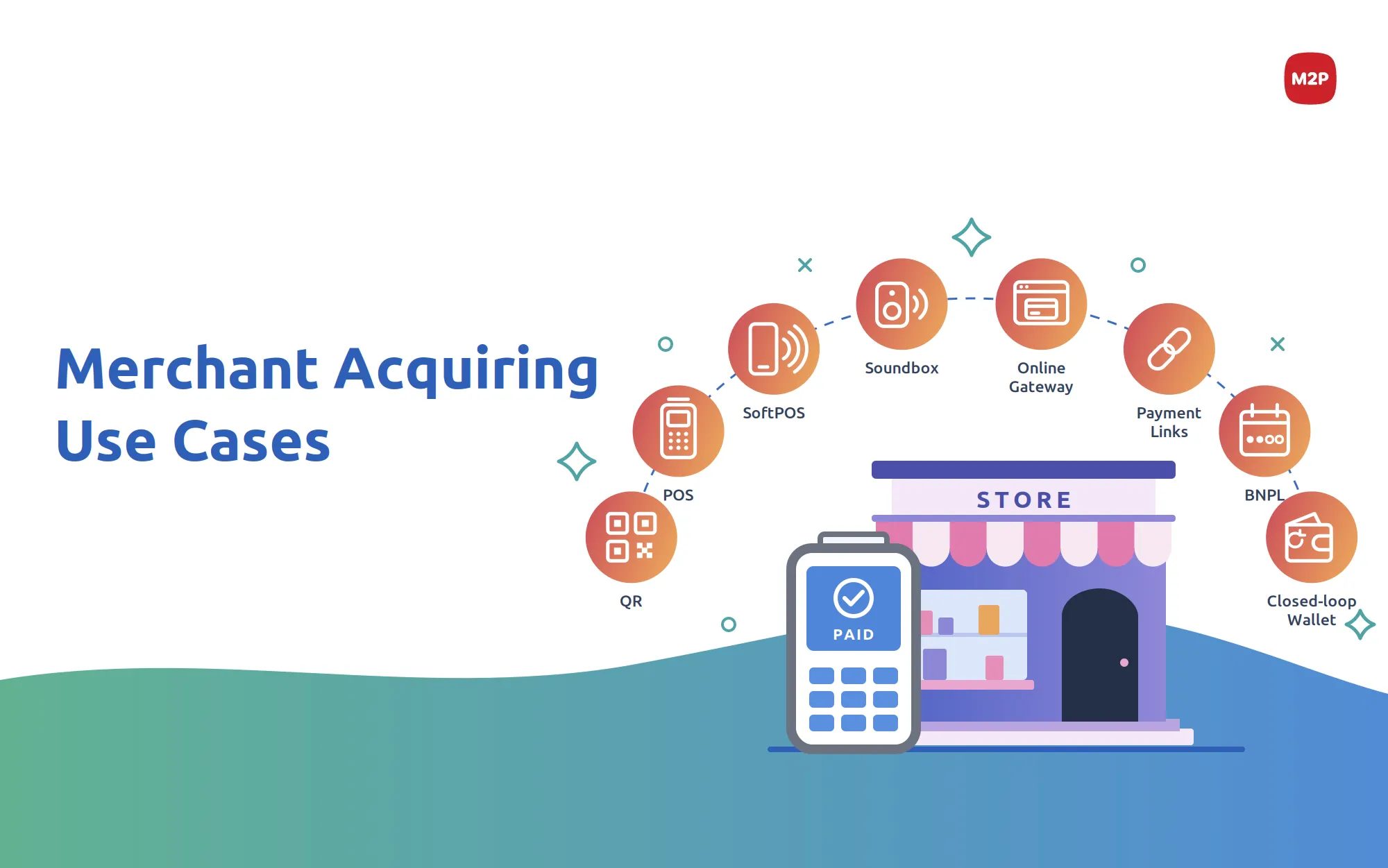
Multi-rail acceptance — cards, QR, wallets, BNPL, and SoftPOS/Tap-to-Phone under one merchant experience
Settlement and reconciliation — real-time or near-real-time settlement engines with automated reconciliation
Risk and dispute management — AI-driven monitoring, chargeback workflows, and portfolio risk dashboards
Value-added services — the analytics, lending, and loyalty layers that turn a payments relationship into a broader merchant banking relationship
The bank stays the bank. The MMS provider becomes the engine room.
The shift away from in-house Merchant Acquiring stacks isn't a story about banks giving up on payments. It's a story about banks recognizing that the infrastructure layer of acquiring has become a specialized, fast-moving, capital-intensive discipline of its own — one best run by partners who do nothing else, all day, across dozens of clients and millions of merchants.
The banks winning in merchant acquiring today aren't the ones with the biggest internal engineering teams. They're the ones who've figured out how to combine their trust, balance sheet, and merchant relationships with a modern MMS provider's technology, speed, and compliance depth, and get the best of both.
This is exactly the space M2P's Merchant Acquiring stack is built for: modular, API-first infrastructure that lets banks and NBFCs launch or modernize their acquiring business without the multi-year rebuild, so they can compete with the Adyens and Pine Labs of the world on the merchant experience that matters most.

Looking to modernize your bank's Merchant Acquiring stack without the multi-year rebuild? Talk to M2P about how our Merchant Acquiring and MMS infrastructure can get you there faster.
Fintech is evolving every day. That's why you need our newsletter! Get the latest fintech news, views, insights, directly to your inbox every fortnight for FREE!