

M2P Fintech
Fintech is evolving every day. That's why you need our newsletter! Get the latest fintech news, views, insights, directly to your inbox every fortnight for FREE!
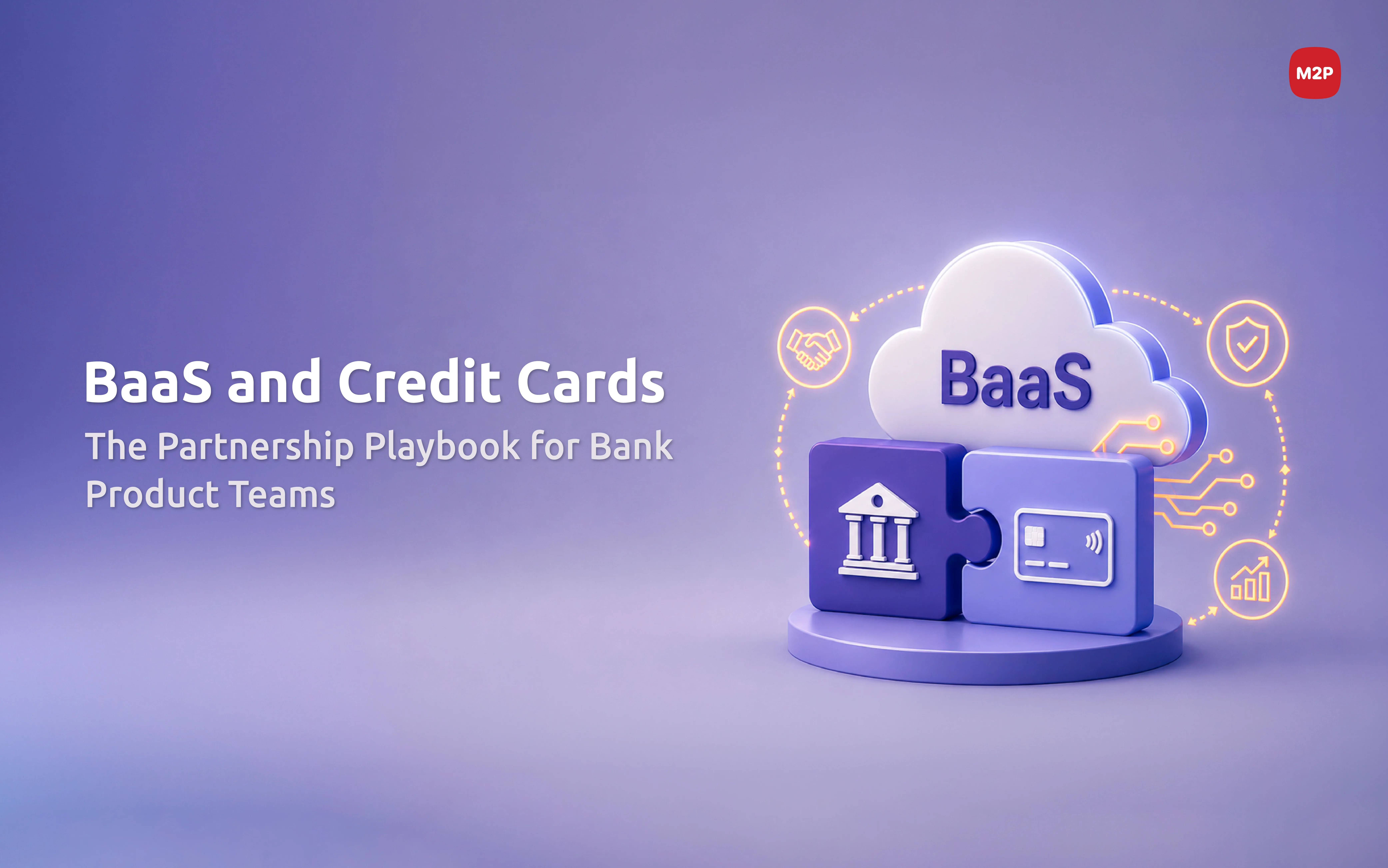
Every few months, a new brand - an airline, a fintech app, an e-commerce platform - launches a co-branded credit card. Somewhere behind that card is a bank or NBFC, and increasingly, a Banking-as-a-Service (BaaS) partner sitting in between.
If you're on a bank's product team and you've been asked to evaluate a BaaS partnership for a card program, this piece is meant to save you a few uncomfortable surprises six months into the contract.
In the context of credit cards, is simple: a technology and operations layer that lets your bank issue cards through a partner's rails - APIs for card issuance, KYC, transaction processing, and often the customer-facing app - instead of building all of it in-house.
Your bank still holds the license, still carries the regulatory responsibility, and still owns the customer relationship on paper. The BaaS partner handles the plumbing.
That last point is where most confusion starts. Plumbing doesn't mean irrelevant - it means invisible until something breaks, and when it breaks, the bank is still the one RBI calls.
Three things are pushing more banks toward BaaS-style credit card partnerships:
Speed. Building card issuance infrastructure from scratch takes time most banks don't want to spend when a competitor's co-branded card is already live.
Non-bank brands want in. Airlines, D2C brands, and fintech apps want a credit card product, but they're not licensed to issue one. They need a bank, and increasingly, that bank needs a BaaS layer to make the partnership operationally workable.
Regulatory scrutiny has increased. [VERIFY: cite specific RBI circular/guideline on co-branded cards and outsourcing of financial services, latest version] has made banks more cautious about who they partner with and how responsibilities are split — which ironically has made well-structured BaaS partnerships more attractive, not less.
1. Direct issuance - the bank builds and owns the entire stack, from card issuance to servicing.
2. BaaS partnership - the bank owns the license and compliance responsibility; a BaaS provider handles issuance infrastructure, processing, and often the co-brand integration.
3. Full outsourcing to a program manager - the bank plays a more limited role, and a third party manages most of the day-to-day program operations under the bank's licence.
Most large co-branded card programs in India today sit somewhere between models 2 and 3, with the exact split depending on the bank's risk appetite and the BaaS provider's capabilities.
This is the section that gets glossed over during the sales pitch and becomes a headache during an audit.
The bank is accountable to the regulator, full stop. A BaaS partner's failure is still the bank's compliance failure in the eyes of RBI.
The BaaS/program management partner typically owns the technology stack, uptime, fraud monitoring tooling, and often first-line customer support.
The brand partner (in co-branded programs) owns marketing, customer acquisition, and the reward/loyalty construct - but has no regulatory standing of its own.
Before signing anything, a bank's product team should have clear, written answers to:
Who is liable if a fraud incident goes undetected - the bank, the BaaS partner, or both, and in what proportion?
Who owns the customer data, and where is it hosted? Does this comply with (VERIFY: current RBI data localization requirements)?
What SLAs exist for card issuance turnaround, dispute resolution, and system uptime - and what are the penalties if they're missed?
Can the bank audit the BaaS partner's systems and processes on demand, or only on a scheduled basis?
What happens to the program (and the customer base) if the bank wants to exit the partnership?
Treating the BaaS partner as a vendor instead of an extension of the bank's compliance perimeter. Regulators don't make that distinction, and neither should you.
Underestimating the integration effort. "API-first" doesn't mean zero effort on the bank's side - core banking integration, KYC alignment, and reconciliation processes still need real engineering time.
Not stress-testing the exit clause. Many banks only read the exit terms after they've decided they want out - by then, negotiating leverage is gone.
Assuming BaaS means less compliance work. It shifts where the compliance work happens, not whether it happens.
Embedded finance is only going to push more non-bank brands toward wanting credit products, and BaaS is the structural bridge that makes that possible without every brand becoming a bank. For product teams at banks and NBFCs, the winning position isn't avoiding these partnerships - it's going into them with a clear map of who owns what, backed by contracts that hold up under regulatory scrutiny, not just commercial negotiation.
Getting the technology, compliance, and program management pieces right on day one is usually the difference between a BaaS partnership that scales smoothly and one that turns into a firefighting exercise. If you're evaluating partners for a credit card program, M2P's Credit Card Management System is built to handle exactly this split - issuance, compliance workflows, and program operations - so your product and compliance teams aren't left reverse-engineering responsibility after something goes wrong. Talk to us about how a program like this gets structured.
Frequently Asked Questions:
1. What is BaaS in the context of credit cards?
Banking-as-a-Service (BaaS) for credit cards is a technology and operations layer that lets a bank issue and manage credit cards through a partner's infrastructure — covering card issuance APIs, KYC, transaction processing, and often the customer-facing app — instead of building this stack in-house. The bank retains the banking license and regulatory accountability; the BaaS partner handles the underlying plumbing.
2. Who is legally responsible if something goes wrong in a BaaS credit card partnership?
The bank or NBFC holding the license is always accountable to the regulator, regardless of which partner caused the failure. A BaaS partner's system failure, fraud gap, or compliance lapse is still treated as the bank's compliance failure by RBI. This is why banks should treat BaaS partners as an extension of their compliance perimeter, not as an ordinary vendor.
3. What's the difference between a BaaS partnership and a program manager model for credit cards?
In a BaaS partnership, the bank owns the license and compliance responsibility while the BaaS provider handles issuance infrastructure and processing. In a full program manager model, the bank plays a more limited role and the third party manages most day-to-day program operations under the bank's license. Most large co-branded card programs today sit somewhere between these two models.
4. Does using a BaaS partner reduce a bank's compliance workload?
No. BaaS shifts where compliance work happens - from the bank's internal teams to a shared or partner-managed workflow - but it does not eliminate the compliance obligation itself. Banks that assume BaaS means less compliance oversight are the ones most likely to face issues during an audit.
5. What should a bank's product team confirm before signing a BaaS credit card partnership?
Before signing, a bank should have written clarity on: fraud liability and its proportional split, customer data ownership and hosting location, SLAs for issuance turnaround and dispute resolution (with penalties for misses), audit rights over the BaaS partner's systems, and a clearly defined exit process for the program and customer base.
6. Why is the exit clause in a BaaS contract so important?
Because negotiating leverage is highest before the contract is signed and lowest once a bank has already decided to leave. Many banks only scrutinize exit terms after they want out, by which point the BaaS partner has little incentive to offer favorable terms.
7. Why are more non-bank brands launching credit cards through BaaS partners?
Non-bank brands like airlines, D2C companies, and fintech apps aren't licensed to issue credit directly. BaaS gives them a structural bridge to launch co-branded card products through a licensed bank without either party having to build the entire stack from scratch.
Fintech is evolving every day. That's why you need our newsletter! Get the latest fintech news, views, insights, directly to your inbox every fortnight for FREE!