

M2P Fintech
Fintech is evolving every day. That's why you need our newsletter! Get the latest fintech news, views, insights, directly to your inbox every fortnight for FREE!
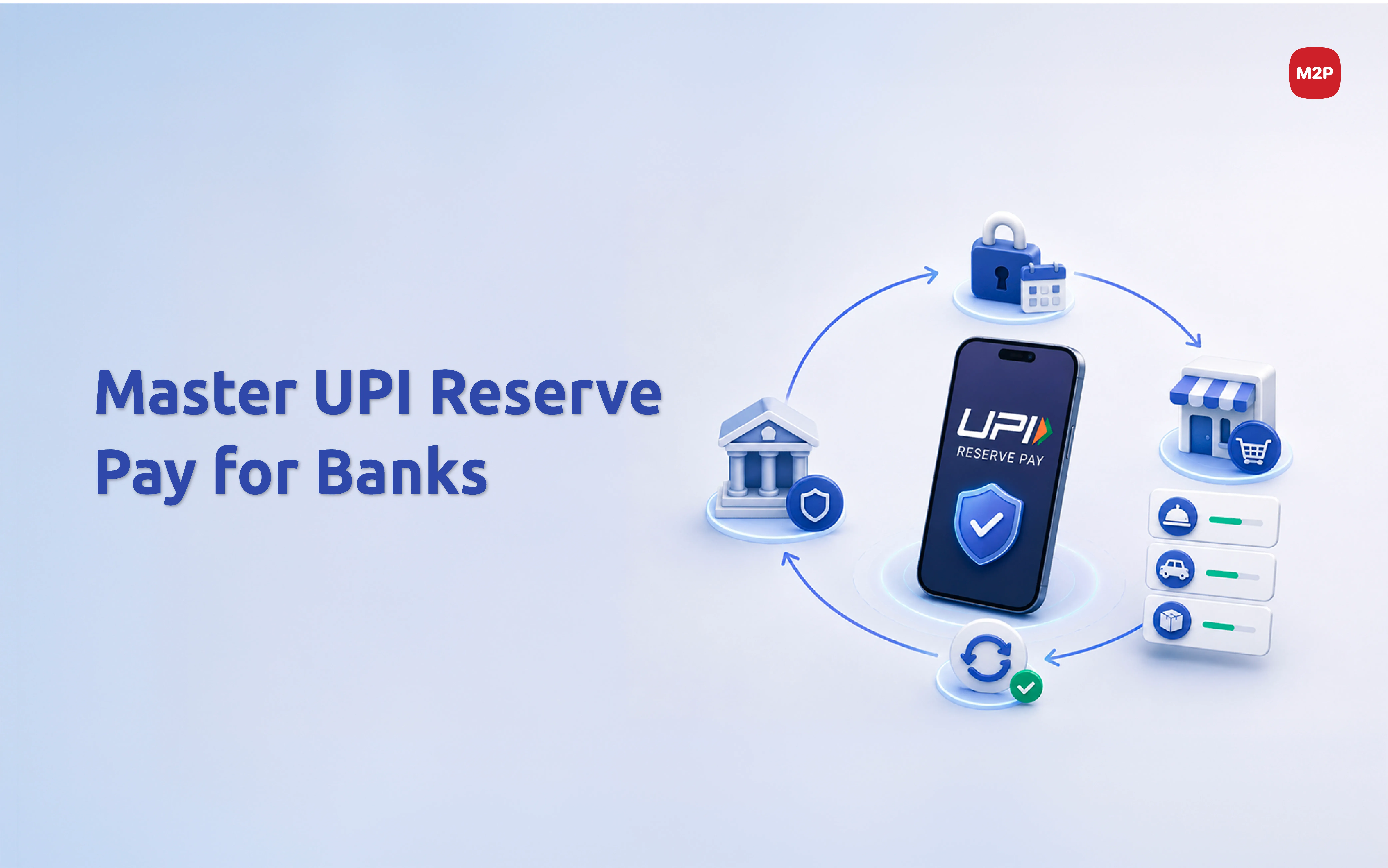
The digital payments landscape in India is evolving at a breathtaking pace. With the Unified Payments Interface (UPI) processing billions of transactions every month, the network has become the undisputed backbone of the country's financial ecosystem. However, as adoption reaches unprecedented levels, the mandate for financial institutions is shifting. It is no longer just about facilitating standard peer-to-peer or peer-to-merchant transfers. The focus is now on supporting advanced, specialized use cases that drive the next wave of digital commerce.
For banks, staying competitive means rapidly adopting new functionalities introduced by the National Payments Corporation of India (NPCI). One of the most transformative additions to this growing list of capabilities is UPI Reserve Pay. As a Technology Service Provider (TSP), we understand the intense pressure banks face to roll out these features quickly. Implementing UPI Reserve Pay is a strategic imperative for banks looking to modernize their payment offerings, capture high-frequency transaction volumes, and provide superior value to their corporate merchant clients.
To appreciate the value of UPI Reserve Pay, banks must look at the mechanical shift it introduces to standard payment processing. Traditionally, every single UPI transaction, regardless of its size, requires full authentication. The user initiates a payment, enters their UPI PIN, the bank’s systems validate the request, the core banking system is hit, and the transaction is settled. This linear process works perfectly for standard purchases but becomes highly inefficient for rapid, low-value, or recurring digital services.
UPI Reserve Pay fundamentally changes this architecture by introducing a block-and-debit mechanism. It allows a user to mandate their issuing bank to reserve or block a specific amount of funds in their bank account or linked credit line. Once this initial block is authorized with a single PIN entry, the user can execute multiple subsequent transactions against that reserved amount without needing to re-authenticate with a PIN every time. This creates a highly secure, frictionless payment corridor between the user and a specific merchant, managed entirely by the bank’s underlying switch infrastructure.
From an infrastructural standpoint, high-volume, low-ticket transactions are a massive operational challenge for financial institutions. Quick commerce, mobility platforms, and digital gaming drive millions of micro-transactions daily. When each of these micro-transactions requires an individual authorization hit, the load on a bank's Core Banking System (CBS) becomes immense. This heavy traffic can lead to system slowdowns, increased timeout rates, and overall network degradation during peak hours.
UPI Reserve Pay acts as a critical pressure release valve for the CBS. Because the system only requires the core banking infrastructure to authenticate and block the funds once, subsequent debits against that reserved amount are processed much faster. The bank's payment switch handles the logic of deducting the micro-amounts from the reserved block, drastically reducing the number of direct hits to the CBS. This operational efficiency is vital for banks looking to scale their digital payment processing without constantly overhauling their legacy core systems. For institutions looking to further modernize their foundational infrastructure, integrating this with a modern Core Banking Solution ensures unparalleled stability.
For acquiring banks, offering the most advanced payment solutions is the key to winning and retaining large corporate clients. Merchants operating in the gig economy, mobility, and e-commerce sectors are desperate to reduce checkout friction. Every extra step in a payment journey - like waiting for an OTP or entering a PIN - increases the risk of cart abandonment and lost revenue. These corporate clients are actively seeking banking partners who can provide APIs that enable seamless, one-click-like checkout experiences.
By enabling UPI Reserve Pay, banks can offer these highly sought-after capabilities directly to their merchant network. It allows merchants to offer their users a way to preload a trusted digital buffer, ensuring that subsequent rides, food orders, or in-app purchases are executed instantly. When a bank can provide the technological foundation that helps a merchant increase their conversion rates and customer lifetime value, the bank solidifies its position as an indispensable financial partner. This competitive edge is crucial for growing the bank's merchant acquiring portfolio and driving higher transaction revenues.
While the business case for UPI Reserve Pay is clear, the technical reality of implementation is often daunting. Legacy UPI switches were built for simple, stateless, one-to-one money transfers. Reserve Pay, however, requires complex state management. The switch must accurately track the blocked amount, monitor the expiration timeline of the reserve, handle real-time modifications or revocations by the user, and precisely manage the multiple debit requests without error.
For banks relying on outdated monolithic payment switches, building and certifying this complex logic can take months of development time and significant capital expenditure. Furthermore, layering complex new features on top of rigid legacy architecture often introduces new points of failure. When a user attempts to modify a reserve and the system times out due to architectural bottlenecks, the bank's reputation suffers. To deploy these features reliably, financial institutions require an agile, highly intelligent, and scalable technological foundation.
This is exactly where partnering with the right Technology Service Provider becomes a game-changer. As a trusted TSP for leading financial institutions, M2P Fintech removes the technical friction of adopting new NPCI mandates. Our cloud-native, full-stack UPI platform enables banks to deploy complex features like UPI Reserve Pay with speed, security, and absolute certainty. We handle the heavy lifting of backend integration, complex state management, and strict regulatory compliance, allowing the bank to focus on market strategy.
The M2P UPI Switch acts as an intelligent, automated traffic controller tailored specifically for the rigorous demands of modern banking. It dynamically monitors the nature of incoming requests - intelligently separating informational queries, reserve block initializations, and actual financial debits. By actively routing traffic and dynamically allocating computing resources, our switch ensures that critical money movements are processed instantly, without being bottlenecked by non-financial network noise.
Performance and reliability are non-negotiable when dealing with national payment networks. The M2P UPI switch is engineered to deliver exceptional speed, even during the most demanding traffic spikes. In real-world deployments with prominent financial institutions, our modernized switch has demonstrated the capability to execute UPI transactions in under 10 milliseconds. This blazing-fast processing speed is the foundation required to support multi-stage features like Reserve Pay seamlessly.
Whether your institution is looking to upgrade its issuing capabilities or leverage our comprehensive UPI Stack for merchant acquisition, our platform provides the resilience you need. Furthermore, managing the inherent risks of new payment models is integrated directly into our offering. Banks can secure their users' transactions by leveraging our advanced Fraud Risk Management capabilities, ensuring that convenience never comes at the cost of security.
To stay at the forefront of the digital payments revolution, financial institutions require infrastructure that is built for the future. Here is how the M2P UPI Switch empowers your bank:
Limitless Scalability - Elastically handle massive peaks and troughs in transaction volumes with our modern, cloud-native, microservices architecture.
Dynamic Routing - Intelligently splits and routes traffic based on transaction types and network health, maximizing processing speed and eliminating timeout errors.
Accelerated Time-to-Market - Leverage our comprehensive API coverage and pre-certified NPCI integrations to launch new UPI features in a fraction of the traditional development time.
Economical TCO - Drastically reduce your Total Cost of Ownership through a flexible, pay-as-you-go platform that eliminates the need for expensive multi-vendor integrations.
Comprehensive Fraud Prevention - Protect your bank and your customers with an integrated, real-time electronic Fraud Risk Management (eFRM) system designed specifically for the nuances of digital payments.
The trajectory of digital finance clearly favors institutions that are agile enough to adopt and deploy advanced payment functionalities early. Features like UPI Reserve Pay are not just passing trends; they represent the new baseline expectation for corporate clients and end-consumers alike. By upgrading your underlying switch infrastructure, your bank can transform operational challenges into powerful new revenue streams.
Embracing the right TSP partner ensures that your institution is equipped to handle the complexities of modern digital commerce without compromising on stability or security. Do not let outdated legacy systems dictate your market position or hinder your ability to attract top-tier merchant clients. Upgrade your infrastructure, reduce the strain on your core systems, and lead the market with cutting-edge payment capabilities.
Your corporate clients are already demanding the next generation of frictionless payments. Do not let your infrastructure fall behind the curve - talk to us today and future-proof your bank's digital payment ecosystem.
What is UPI Reserve Pay?
UPI Reserve Pay is an NPCI-enabled UPI capability that lets a user authorize their bank to block, or "reserve," a set amount of funds against a single PIN entry. Once reserved, subsequent transactions against that amount can be processed without repeated PIN authentication, reducing friction for high-frequency, low-value payments.
How is UPI Reserve Pay different from UPI Autopay?
UPI Autopay is built for fixed, recurring payments like subscriptions or EMIs on a set schedule. UPI Reserve Pay is designed for variable, on-demand micro-transactions, such as rides or in-app purchases, where the amount and timing of each debit isn't fixed in advance but draws from a pre-authorized pool.
Does adopting UPI Reserve Pay require banks to rebuild their entire UPI switch?
Not necessarily. Banks with modern, cloud-native switches can typically extend existing infrastructure to support the added state management Reserve Pay requires. Banks on legacy, monolithic switches often face longer development and certification cycles, which is where partnering with a TSP can shorten time-to-market.
What happens to a reserved amount if it isn't fully used?
The mechanics of expiry, partial-use handling, and revocation are governed by the reserve mandate the user sets up with their issuing bank, in line with NPCI's specifications. Banks should confirm current rules directly with NPCI documentation, as these parameters can be refined over time.
Does UPI Reserve Pay reduce load on a bank's Core Banking System (CBS)?
Yes. Because only the initial fund block requires a full CBS authentication hit, the payment switch can handle subsequent micro-debits against that reserved amount independently. This reduces the number of direct CBS calls during high-volume periods, easing strain during peak transaction windows.
Which merchant categories benefit most from UPI Reserve Pay?
Sectors with high-frequency, variable-value transactions see the clearest gains, including quick commerce, ride-hailing and mobility platforms, food delivery, and digital gaming or in-app purchases, where removing repeated PIN entry meaningfully reduces checkout friction and cart abandonment.
Can banks offer UPI Reserve Pay without building it in-house?
Yes. Banks can partner with a Technology Service Provider (TSP) that has pre-certified NPCI integrations and existing switch infrastructure, which typically shortens deployment timelines compared to building and certifying the state-management logic in-house.



Fintech is evolving every day. That's why you need our newsletter! Get the latest fintech news, views, insights, directly to your inbox every fortnight for FREE!