

M2P Fintech
Fintech is evolving every day. That's why you need our newsletter! Get the latest fintech news, views, insights, directly to your inbox every fortnight for FREE!
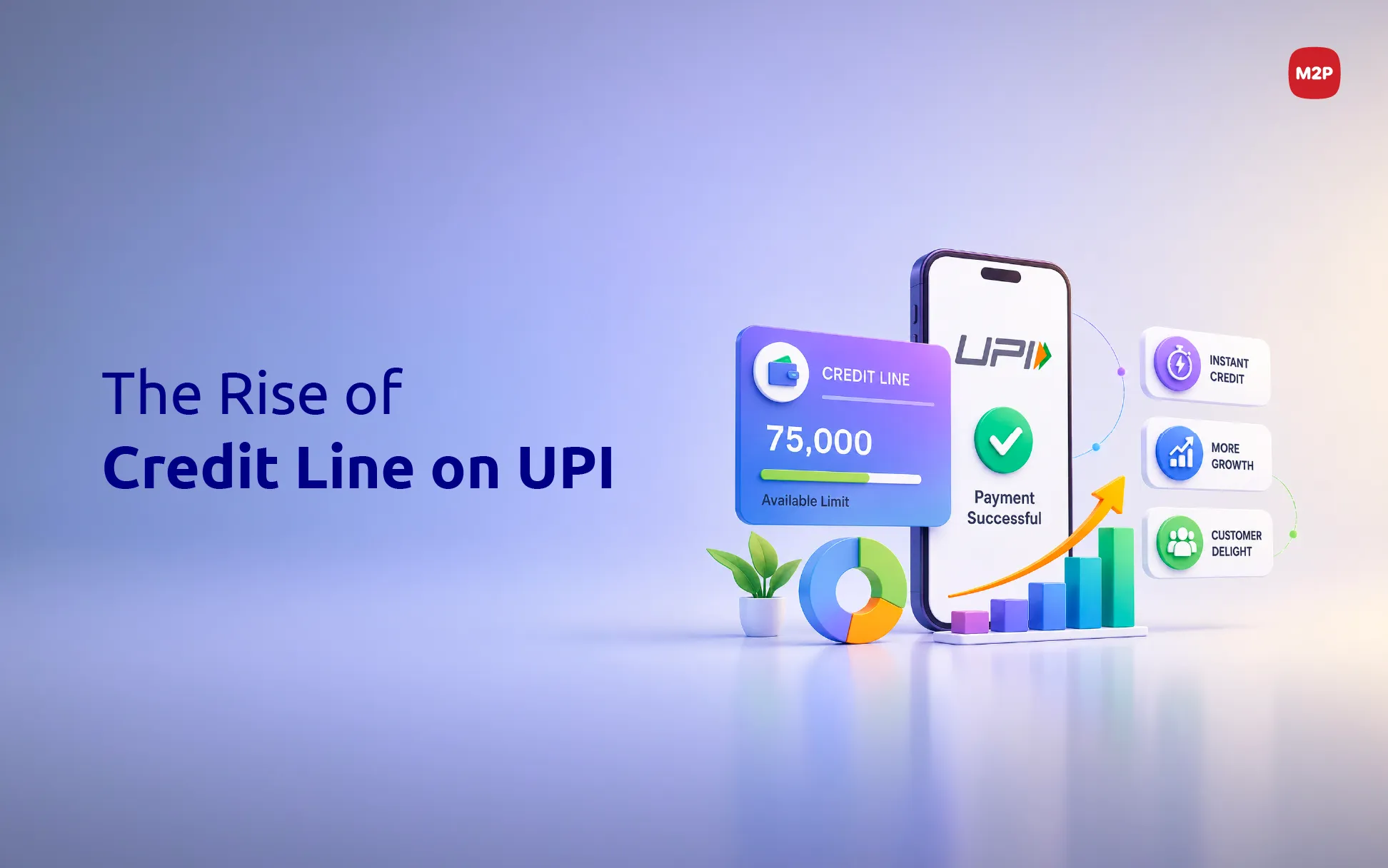
The Unified Payments Interface has radically transformed the way we handle money. It has moved from simple peer-to-peer transfers to becoming the undisputed backbone of retail payments. Now, the introduction of the Credit Line on UPI is setting the stage for the next major leap in financial services. It seamlessly combines the convenience of everyday digital payments with the purchasing power of instant credit, creating an entirely new ecosystem for growth.
A credit line on UPI allows banks to offer pre-approved, revolving credit to customers directly through their favorite UPI applications. Instead of carrying a physical credit card, waiting days for a loan approval, or navigating complex banking portals, users can simply link their approved credit line to a UPI interface. The onboarding process is typically digital-first, allowing users to apply, receive approval based on their creditworthiness, and activate their limit in a matter of minutes.
When making a purchase, they scan a merchant QR code or initiate an online payment and choose the credit line as their payment source, just as they would select a savings or current account.
This eliminates the traditional barriers to borrowing. It provides a frictionless experience that feels exactly like a standard bank account debit. For customers, it means enhanced financial flexibility and the ability to manage cash flows efficiently. For banks and lenders, it represents a massive opportunity to distribute credit products securely, efficiently, and exactly at the point of sale where the customer needs it most.
The adoption of digital payments has been nothing short of revolutionary. We are seeing a steady shift in consumer behavior, moving away from physical cash toward seamless digital interactions. In February 2026, the UPI transaction volume stood at an impressive 20.39 billion, reflecting massive user adoption across the country. With the daily transaction value regularly crossing ₹26 lakh crore, the infrastructure has proven its reliability, security, and immense scale.
As digital literacy improves and smartphone penetration deepens, these numbers are only projected to climb.
As ticket sizes grow and more users embrace digital checkout flows, adding a seamless credit option is a logical evolution. The current payment ecosystem caters to millions of customers who prefer the simplicity of scanning a QR code or using on-device biometric authentication over entering long card details or dealing with one-time passwords.
By embedding credit directly into this existing, highly trusted user flow, financial providers are effectively removing the friction that historically plagued loan disbursements.
Historically, accessing a line of credit was a cumbersome process marked by lengthy paperwork, manual verification, and prolonged waiting periods. Customers had to visit physical branches, submit physical documentation, and wait days or even weeks for an approval decision. This traditional approach created significant friction, often discouraging potential borrowers who needed immediate financial flexibility.
However, the advent of digital-first banking and the proliferation of smartphone adoption have completely rewritten the rules of engagement. Modern consumers expect financial services to be instantaneous, transparent, and embedded within the applications they already use daily. By shifting from legacy lending models to an API-driven, digital-first approach, banks can leverage alternative data and automated underwriting to issue credit limits in real-time. This evolution not only dramatically reduces customer acquisition costs but also aligns perfectly with the fast-paced, on-demand nature of the modern economy. Credit Line on UPI is the ultimate manifestation of this shift, seamlessly bridging the gap between immediate spending needs and responsible borrowing.
For merchants and financial institutions, ignoring the rise of instant credit is a missed opportunity. Integrating a credit line capability directly addresses common friction points like cart abandonment and actively drives higher average order values. When consumers know they have an accessible line of credit ready to be deployed instantly, they are more confident in making larger purchases. It gives them the purchasing power they desire, exactly when they are ready to transact.
Furthermore, it opens up entirely new revenue streams for everyone involved
Financial institutions can earn through interest and interchange fees while deepening their relationship with the customer. It democratizes credit access, reaching a wider demographic that might not possess traditional credit cards but has a solid financial history. By offering intuitive and accessible lending products, banks can foster long-term loyalty and dramatically increase the lifetime value of their user base.
Delivering a flawless credit experience requires a robust backend architecture that is both agile and resilient. When a user initiates a credit transaction, the system must securely route the request, verify the available credit limit in real time, and process the payment in milliseconds.
This is where the core infrastructure becomes the critical differentiator between a successful deployment and a disjointed user experience.
Banks and financial institutions need a modern technology stack that can handle high volumes without latency or downtime. Relying on legacy systems often leads to capacity caps, transaction failures, delayed regulatory reporting, and ultimately, a poor customer experience.
A modern orchestration layer is essential to connect the credit origination systems, the central UPI network, and the core banking ledgers seamlessly. This infrastructure must be capable of processing millions of data points simultaneously while maintaining strict adherence to compliance, fraud prevention, and security protocols.
To stay ahead in the highly competitive digital finance landscape, you need an infrastructure partner that provides resilience, modularity, and the ability to scale on demand. The M2P UPI Switch stack is precisely engineered to do the heavy lifting for your business
As a cloud-native, full-stack platform, our solution abstracts away the complexity of continuous integration and regulatory compliance.
Whether you are looking to launch a dedicated Credit Line on UPI offering or upgrade your existing payment routing, we empower banks to deliver a superior experience. By partnering with a modern technology service provider, you can eliminate the operational hurdles associated with building and maintaining complex payment rails in-house.
Limitless Scalability: Built on a cloud-native, microservices architecture designed to handle massive peaks in transaction volume effortlessly without compromising speed.
Accelerated Time-to-Market: With comprehensive API coverage and low-code enablement, you can launch your credit and UPI products in a fraction of the time it would take to build from scratch
High Transaction Success Rates: Our platform features sophisticated multi-bank routing and automatic fallback logic to minimize payment failures and protect your revenue streams.
Unified Platform Control: Benefit from centralized product configuration, issuer processing, reconciliation, and fraud controls managed through a single pane of glass
Seamless Integration: M2P’s architecture is designed to easily connect with our wider Core Lending Suite, enabling you to cross-sell products and scale efficiently.
The integration of credit lines into the UPI ecosystem is fundamentally reshaping how consumers access and utilize credit in their daily lives. It brings unprecedented convenience, speed, and transparency to the end-user while providing financial institutions with an efficient, secure, and highly scalable channel to grow their lending portfolios. As the line between payments and credit continues to blur, staying competitive requires agility and robust technological foundations. Building on a modern, future-ready infrastructure is no longer optional; it is the fundamental requirement for sustained growth and success in the new open finance era.
The digital lending landscape is evolving rapidly, and early adopters are already capturing the lion's share of the market. Don't let outdated infrastructure limit your growth potential or cost you valuable customer relationships. Reach out and talk to us today to unlock new revenue streams and future-proof your payment offerings.
Fintech is evolving every day. That's why you need our newsletter! Get the latest fintech news, views, insights, directly to your inbox every fortnight for FREE!