

M2P Fintech
Fintech is evolving every day. That's why you need our newsletter! Get the latest fintech news, views, insights, directly to your inbox every fortnight for FREE!
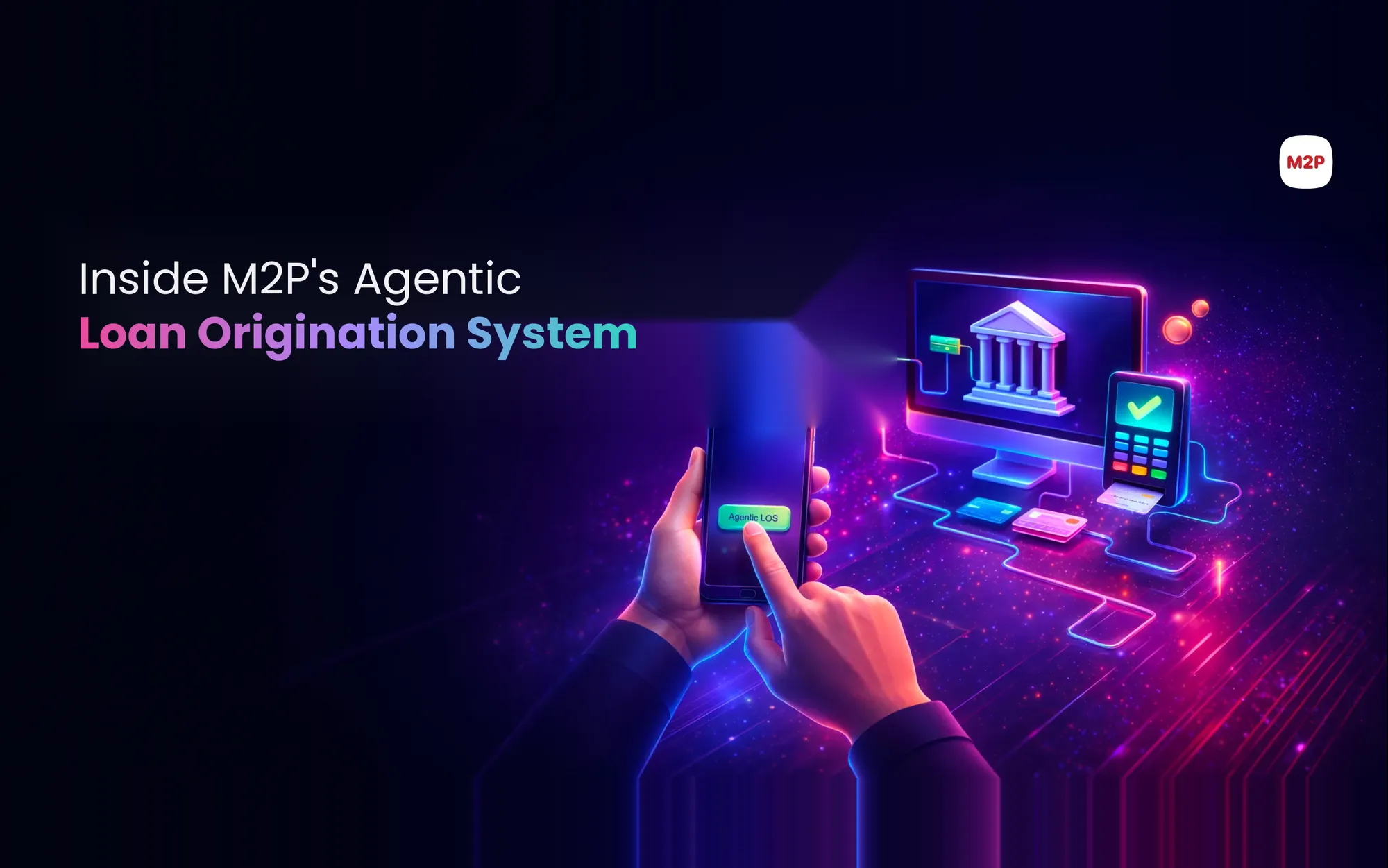
Loan origination has always been one of the most critical stages in lending. It is where customer intent becomes an application, an application becomes a credit decision, and a credit decision becomes a disbursal.
But for many lenders, origination is still not a single journey. It is a chain of disconnected systems.
One tool captures leads. Another collects documents. A separate engine assesses credit. A different workflow manages approval. Yet another dashboard tracks performance. Each system may do its job, but the lender is left managing the gaps between them.
Those gaps create friction.
Applications slow down. Data gets duplicated. Credit teams lose context. Operations teams chase missing documents. Risk teams struggle to trace why a decision was made. Business leaders see dashboards, but not always the full journey behind the numbers.
M2P's AI-Orchestrated Loan Origination System is built for a different model. It speeds up decisions with AI-driven, policy-based processing across digital, branch, embedded, and partner channels — with a seamless handoff to the LMS at the other end. From lead to disbursal, the platform helps lenders move faster, reduce manual effort, and retain complete control over every decision.
Most lenders have digitised parts of origination. But digitised does not always mean connected.
A customer may begin through a branch, partner, website, mobile app, or embedded journey. Their documents may be collected through one system, identity checks may run through another, and credit assessment may depend on yet another workflow.
The result is often a stitched stack.
At first, this may seem workable. But as volumes grow, product lines expand, and risk policies become more complex, the cracks become visible.
Teams spend time reconciling data instead of acting on it. Exceptions pile up. Manual follow-ups increase. Policy changes take longer to implement. Audit trails become harder to reconstruct. Decisioning depends not only on risk logic, but also on whether the right data reached the right system at the right time.
In lending, that is a real business problem. Origination needs speed, but it also needs control. It needs automation, but it cannot become a black box. It needs intelligence, but the final decision must remain with the lender.
That is the principle behind M2P's Agentic LOS: AI assists, the lender decides.
M2P's Agentic LOS brings together five core capabilities across the origination chain — each one powered by domain-trained AI agents working on a shared data layer, not bolted-on point solutions.
Applications may come from multiple channels: direct digital journeys, assisted sales, branches, merchants, partners, or embedded finance touchpoints. The sourcing layer captures leads and applications consistently, regardless of channel, so the journey begins with structured, usable data instead of fragmented inputs.
In practice, this covers omnichannel intake across branch, assisted, digital, partner, and embedded flows; configurable intake forms with pre-screening and field-level validations; STP-enabled workflows with multi-level approvals and deviation management; co-applicant, guarantor, and multi-borrower onboarding; and LSP management for partner onboarding, journey customization, and access control.
A dedicated Field Agent extends this to the ground — a mobile platform for document collection, case assignment, route optimisation, and real-time visit logging for field-based origination.
Document-heavy onboarding can slow down even the best lending journeys. This layer classifies documents, extracts relevant fields, validates information, and routes exceptions before they become operational bottlenecks — reducing manual review effort and helping clean applications move faster.
The platform pre-integrates 75+ APIs across KYC, banking, bureau, documents, payments, and fraud services, including individual and business KYC with identity verification, OCR, Aadhaar vault and account-aggregator connectivity, bank account verification, income validation, e-signing and e-stamping, and multi-bureau credit checks with soft-pull support for pre-qualification.
This is where the depth of the agentic layer really shows, with specialized agents including:
Document Intelligence Agent — auto-classification, field extraction, and tamper detection at 95%+ OCR accuracy across 100+ document types
Bank Statement Analyser Agent — multi-format parsing, average bank balance computation, cash-flow categorisation, and bounce detection across 50+ banks
Financial Analysis Agent — P&L, balance sheet, and cash-flow extraction with 50+ ratios, multi-year trend analysis, and industry benchmarking
Fraud Detection Agent — document tampering checks, velocity checks, and synthetic-ID and duplicate detection, with risk signals fused directly into decisioning
GST Analytics Agent (for SME lending) — GSTR-1 vs 3B reconciliation, compliance scoring, and sector/anchor risk mapping
Income Verification Agent (for retail lending) — salary credit identification, Form 16 extraction, EPFO/ESI verification, and affordability assessment
The document intelligence engine doesn't just extract data — it can determine which documents are actually required under policy for a given case, and support a straight-through path with zero human review where the case qualifies.
Credit teams need more than a score. They need decisioning that reflects lender policy, risk appetite, product rules, and borrower context. Credit policies are operationalised through a configurable Business Rules Engine (BRE) supporting boolean, financial, gating, and weightage-based rule operators, with versioning, auditability, and controlled policy enforcement.
This layer supports risk-based pricing, custom scorecards, and explainable decision outputs; property and collateral evaluation using Automated Valuation Models, geospatial risk indicators, and title/encumbrance checks; and CAM generation with structured templates, plus rule back-testing against historical portfolio data.
The agents behind this stage:
Credit Scoring Agent — ML-powered scoring, multi-bureau aggregation, alternative data, custom scorecards, and explainable AI
Policy Compliance Agent — internal credit-policy validation, deviation flagging, and negative-list checks with auditable outcomes
Property Valuation Agent (for SME/secured lending) — AVM with 85%+ accuracy, title deed extraction, encumbrance analysis, and geospatial risk
CAM Generation Agent — automated Credit Assessment Memo generation with financial-analysis summaries and multi-format export
By drawing on historical context and the performance of similar loans, the engine can automate approve/reject/refer decisions directly — cutting turnaround time considerably on standard cases while routing genuinely borderline ones to a human reviewer.
A credit approval is not the end of origination. Funds still need to move correctly, compliance steps must be completed, conditions must be checked, and downstream systems must be updated.
This stage covers pre-disbursal checklists with configurable validation gates, multi-tranche disbursals, payment gateway integration, account opening automation, mandate setup, and — critically — a native handoff to the LMS for servicing setup, NACH/UPI AutoPay, and reconciliation. For co-lending arrangements, it manages dynamic split rules, partner exposure, and automated settlement.
Supporting agents include a Document Generation Agent (sanction letters, loan agreements, e-signature workflows, legal clause libraries, version control, and regional-language support), a Disbursal Orchestration Agent managing the end-to-end workflow, and — for working-capital lending — a Drawing Power Agent that computes drawing power in real time from stock statements and book-debt ageing.
Origination leaders need to know where applications are coming from, where they are dropping off, how decisions are performing, which channels are converting, and where operations are slowing down.
Role-based dashboards give CXOs, risk, ops, sales, and finance teams real-time visibility into applications, decisions, disbursements, and TATs; analytics on BRE outcomes, approvals, deviations, and policy performance; SLA adherence, queue ageing, and productivity tracking; portfolio, utilization, and repeat-borrowing insights; and 100+ configurable MIS reports with BI-tool integration.
Individually, each of these five stages solves a real problem. Together, on one shared data layer, they form a connected origination platform rather than five disconnected tools wearing the same login.
The real strength of Agentic LOS isn't that it offers multiple modules — it's that these capabilities work on a shared data foundation.
That matters because origination is a context-heavy process. The document agent should know what was captured during sourcing. The credit decisioning agent should use verified data from document intelligence. The disbursal agent should know the approved conditions. The analytics layer should see the full journey, not isolated snapshots.
When these functions operate on one data layer, lenders get continuity. They can trace the journey from application to decision. They can understand which inputs influenced credit assessment. They can monitor exceptions. They can improve policies based on real application behaviour. They can reduce duplicate data handling and minimise operational leakage.
A stitched stack gives lenders tools. A connected platform gives them control.
In lending, automation cannot come at the cost of accountability.
M2P's Agentic Loan Origination System is designed around explainable, auditable, and policy-controlled decisioning. AI can assist with extraction, validation, scoring, routing, recommendations, and monitoring — but lender policies define the rules of engagement.
This distinction matters because a lender must be able to answer key questions at any point:
Why was this application approved?
Why was this case referred?
Which data sources were used?
Which policy rule was triggered?
Who reviewed the exception?
What changed between application and disbursal?
Our Agentic LOS supports this need by creating decision trails across the origination lifecycle, so risk, compliance, business, and operations teams work from the same source of truth. Case managers get centralized handling of exceptions and non-STP workflows, with configurable allocation logic, multi-level approvals, SLA/TAT monitoring, and full audit trails on every deviation.
For lenders, the benefit is clear: end-to-end origination on one platform, not a stitched stack.
The platform already underpins origination and servicing for 15M+ borrowers and 27M+ active loan accounts, moving a total loan portfolio of $6.5 billion at a peak capacity of 3,000 transactions per second — across 15+ secured, unsecured, and microfinance loan types, from loan-against-property and MSME loans to BNPL, education loans, and JLG/SHG group lending.
That scale translates into concrete outcomes for lenders adopting the platform:
Go-live velocity — new institutions can launch 15+ products in weeks, with migration acceleration of up to 40% and near-zero downtime
Decision speed — faster turnaround on standard cases, with straight-through processing where policy allows
Fraud prevention — earlier detection of fraudulent attempts through velocity checks and anomaly detection
Approval lift — a higher rate of qualified approvals using alternative data scoring and pre-qualification
Case manager efficiency — centralized exception handling instead of manual chasing across systems
Actionable visibility — role-based dashboards giving leadership real-time insight into pipeline health, decisions, bottlenecks, and performance
In competitive lending markets, origination speed matters. But speed alone is not enough. The future of origination belongs to lenders that can combine speed, intelligence, explainability, and control.
M2P's Agentic LOS helps make that possible — from lead to disbursal, across five orchestrated stages, on one origination platform. To know more about our Agentic LOS, book a demo with us here.
Fintech is evolving every day. That's why you need our newsletter! Get the latest fintech news, views, insights, directly to your inbox every fortnight for FREE!