

M2P Fintech
Fintech is evolving every day. That's why you need our newsletter! Get the latest fintech news, views, insights, directly to your inbox every fortnight for FREE!
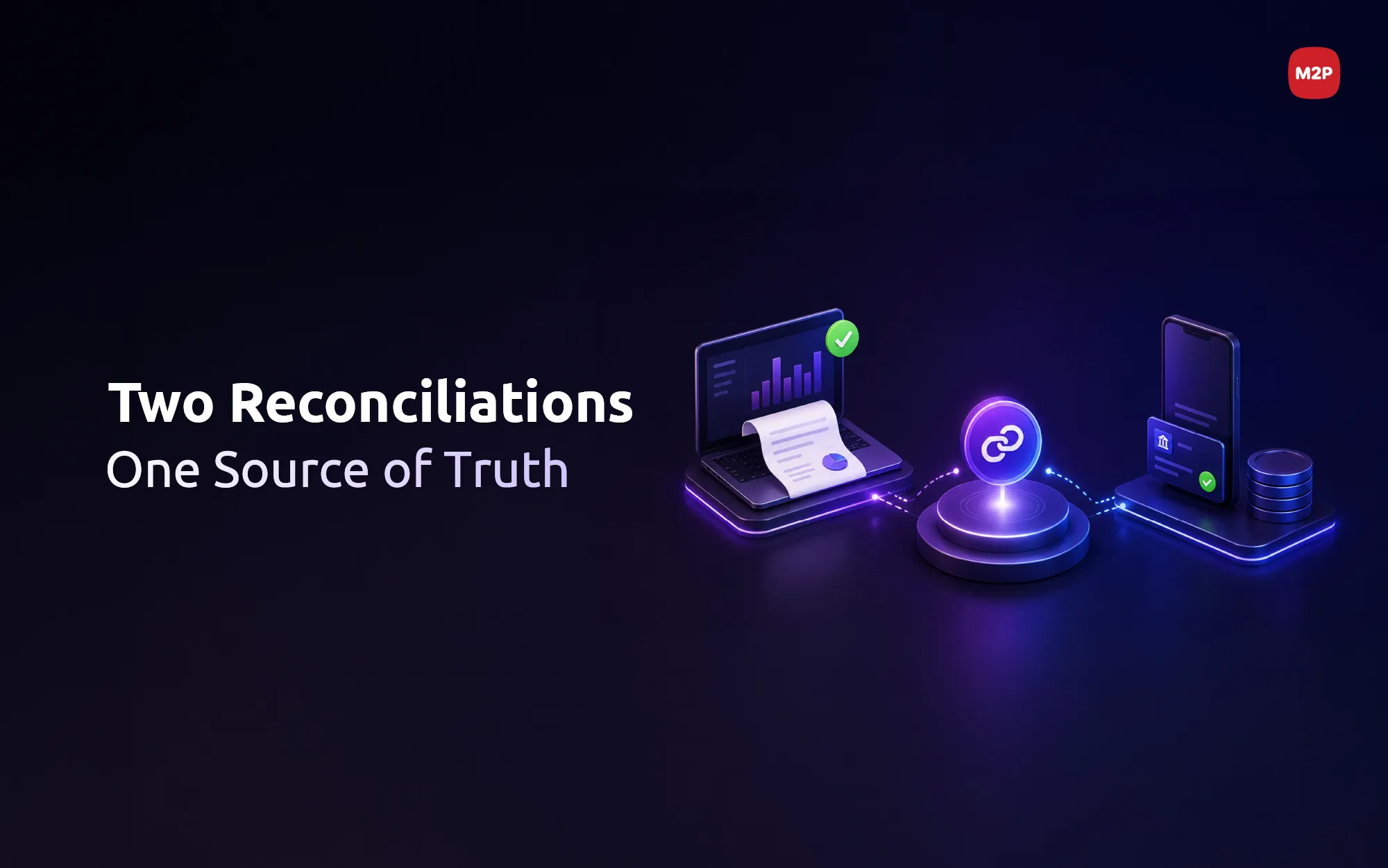
Finance teams often treat reconciliation as a single, monolithic task. In reality, it encompasses at least two distinct disciplines and conflating them is where costly errors hide.
GL reconciliation and payment reconciliation each serve a different purpose, operate on different data sources, and catch different categories of risk. If you're only running one, you're operating with a blind spot. Here's what you need to know and how modern platforms like Recon360 close the gap.
General ledger reconciliation is the process of verifying that the balances recorded in your GL accurately reflect your company's true financial position by comparing them against supporting documentation: bank statements, sub-ledgers, invoices, and external records.
As Sage describes it, GL reconciliation confirms "what should have happened (on your books) with what actually happened (independent source documents).
It covers accounts across the full balance sheet and P&L cash, accounts receivable, accounts payable, payroll, fixed assets, and equity. Most companies reconcile core accounts monthly, targeting around 70% of GL accounts during routine close cycles (Numeric, 2024).
• Duplicate or missing journal entries
• Timing differences between sub-ledgers and control accounts
• Errors that distort balance sheets or income statements
• Compliance gaps ahead of audits
Payment reconciliation operates at the transaction level. It matches individual incoming or outgoing payments ACH transfers, wire transactions, card settlements, cheques against open invoices or expected positions in the GL.
Per HighRadius, payment reconciliation "connects customer payments with open invoices in the general ledger" and is critical for reducing unapplied cash, accelerating revenue recognition, and giving CFOs real-time visibility into collections.
Where GL reconciliation validates the structure of your books, payment reconciliation validates the flow ensuring every rupee in and out is matched, applied, and accounted for.
• Unapplied or misapplied payments
• Duplicate settlement entries from payment gateways
• Discrepancies between bank receipts and invoiced amounts
• Chargeback and refund mismatches
The critical insight: these two reconciliations are complementary, not interchangeable.
GL reconciliation can confirm your accounts payable balance is ₹98,000 — but it won't tell you whether a specific vendor payment was misapplied to Invoice #4421 instead of #4521. Only payment-level matching surfaces that. Conversely, payment reconciliation can clear every transaction in your bank feed while your GL still carries a timing error from a misposted journal entry — invisible until period-end close.
Industry data underscores the stakes:
• Businesses lose an estimated 1–5% of annual revenue to GL reconciliation errors alone (HighRadius, 2024)
• Manual reconciliations contribute to up to **30% misstatement rates in GL balances
• 45% of accounting professionals cite finding and fixing errors as the single hardest part of revenue work (Leapfin State of Accounting Automation Report)
Operating without both is not a resource trade-off it's a risk accumulation strategy.
Recon360 by M2P Fintech is built to eliminate the gap between GL and payment reconciliation handling both within a unified, automated workflow.
For GL reconciliation, Recon360 ingests data from your ERP and sub-ledgers, applies intelligent matching logic, and surfaces exceptions that require human review reducing reconciliation time dramatically versus manual processes.
For payment reconciliation, Recon360 matches transaction-level data from payment gateways, banks, and AR/AP systems against open invoices in real time flagging unapplied cash, duplicate entries, and settlement mismatches before they compound.
The result: a single audit trail, a faster close cycle, and financial data your CFO can act on not investigate.
GL reconciliation ensures your financial statements are trustworthy. Payment reconciliation ensures your cash position is accurate. Neither is sufficient alone and the organisations that treat them as a unified function, powered by automation, are the ones closing books faster and entering audits with confidence.
Ready to run both with one platform? Explore Recon360
Follow us on LinkedIn and Twitter for insightful fintech bytes curated for curious minds like you.

Fintech is evolving every day. That's why you need our newsletter! Get the latest fintech news, views, insights, directly to your inbox every fortnight for FREE!