

M2P Fintech
Fintech is evolving every day. That's why you need our newsletter! Get the latest fintech news, views, insights, directly to your inbox every fortnight for FREE!
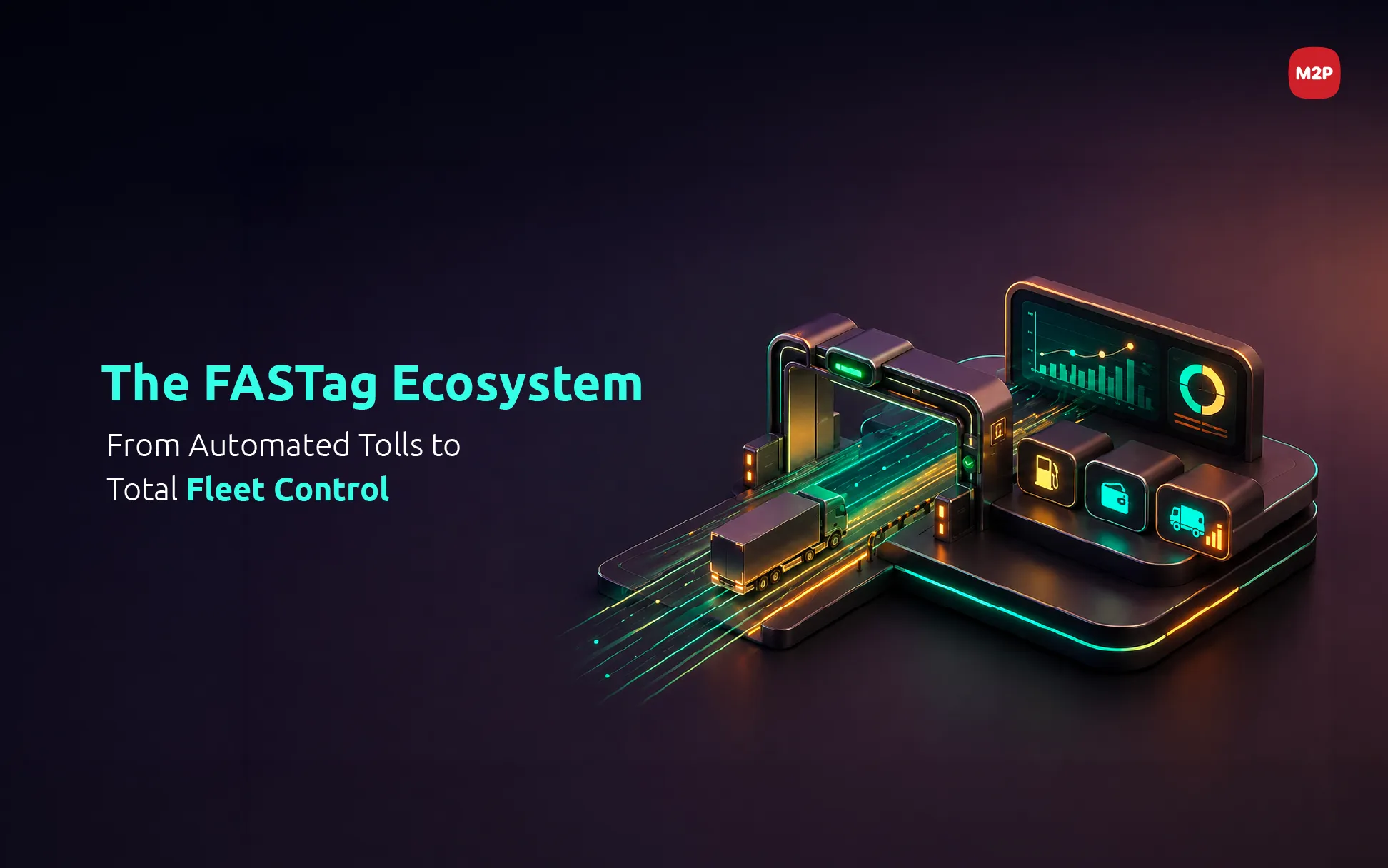
In the fast-paced world of logistics and transportation, efficiency is the name of the game. For fleet operators, managing a multitude of vehicles, drivers, and on-the-road expenses can be a complex and costly endeavor . However, the digital revolution has brought forth powerful tools to streamline these operations. At the heart of this transformation is the modern Fleet Management System, a comprehensive solution that goes far beyond simple vehicle tracking. This blog post delves into the core components of a sophisticated Fleet Management System, with a special focus on the pivotal role of FASTag Management, and how it serves as the foundation for integrated Fuel and Expense Management solutions that deliver measurable financial returns.
A contemporary Fleet Management System is a multi-faceted platform designed to give fleet owners complete visibility and control over their operations. While features can vary, the most effective systems are built around three critical pillars:
FASTag Management System: The backbone of the modern fleet management ecosystem, this component automates toll payments, eliminating the need for cash transactions and reducing transit times
Fuel Management System: Often integrated through a prepaid wallet or card program, this system allows for the efficient monitoring and control of one of the largest variable costs for any fleet: fuel
Expense Management System: This provides a holistic view of all trip-related expenditures, from driver allowances to maintenance costs, ensuring transparency and simplifying accounting
What makes these systems truly powerful is their integration, which breaks down the data silos that typically trap information in separate, uncorrelated systems. At the center of this integration is the FASTag, which has evolved from a simple toll payment method into the cornerstone of a comprehensive payment and expense management ecosystem for fleets.
The introduction of the National Electronic Toll Collection (NETC) program, with FASTag at its forefront, has been a game-changer for Indian highways. For commercial fleets, the benefits of automated, non-stop toll payments are immense, leading to significant savings in fuel and time. However, the FASTag ecosystem is complex, involving multiple players and a specific regulatory framework that presents significant challenges for financial institutions wishing to participate.
The key players in this ecosystem are:
FASTag Issuers: These are typically banks authorized by the National Payments Corporation of India (NPCI) to issue FASTags. They are responsible for linking the tags to a payment instrument, which is a form of Prepaid Payment Instrument (PPI) regulated by the Reserve Bank of India (RBI)
FASTag Acquirers: These are the banks that partner with toll plaza operators to process the payments collected through FASTags. They ensure that the toll amount is correctly calculated and routed through the NPCI network for clearing and settlement
Third-Party Service Providers (TSPs): These are technology companies that provide the essential infrastructure and software for the issuance and management of FASTags E.g. M2P’s Fleet and FASTag Management System
To understand why TSPs are so critical, it's helpful to look at the technical complexity of a single toll transaction, which unfolds in two distinct stages.
Real-Time Authorization: As a vehicle passes a toll plaza, an overhead RFID reader captures the unique Tag ID (TID). The Acquirer Bank's system sends this TID to the NPCI's central switch, which queries the NETC Mapper—a central database linking the tag to the vehicle and the Issuer Bank. The NPCI switch then sends a real-time authorization request to the Issuer Bank's system. The Issuer must instantly check for sufficient funds, place a hold on the amount, and send an approval back through the NPCI to the Acquirer, which then signals the boom barrier to lift. This entire high-speed exchange must happen in seconds.
Batch Clearing and Settlement: While the vehicle passes immediately, the actual transfer of funds happens later. At the end of predefined cycles, all Acquirer Banks submit consolidated transaction files to NPCI's Electronic Toll Collection Global Clearing and Settlement (EGCS) system. The EGCS nets the amounts owed between all Issuer and Acquirer banks and facilitates the final fund transfer via the RBI's RTGS system.
For many traditional banks that act as issuers, building and maintaining the complex technology required for this seamless process is a significant challenge. This is where TSPs play a crucial role. Attempting to manage a commercial FASTag program in-house exposes a financial institution to a host of technical, operational, and regulatory hurdles.
Technical Challenges: Banks' legacy systems are often ill-equipped to handle the high volume of real-time API requests from the NETC ecosystem, which can use modern RESTful APIs or traditional financial messaging standards like ISO 8583. A robust in-house solution requires complex integration with the NPCI, the bank's own core banking system, and various third-party services, all while ensuring scalability and data security. Most national highway plazas now operate on the advanced ICD 2.5 protocol, which demands near real-time transaction processing capabilities
Operational Challenges: The operational burden is immense. It includes the logistics of tag issuance and lifecycle management (e.g., blacklisting lost tags) and the monumental task of transaction reconciliation through the EGCS, which can account for 30-40% of back-office labor costs. Managing disputes and chargebacks through the NPCI's framework is another major task requiring dedicated resources
Regulatory Challenges: Issuers are subject to stringent regulations from the NPCI and RBI. FASTag wallets are a special-purpose PPI, and their operation is governed by the RBI's Master Directions on Prepaid Payment Instruments, which dictate KYC, Know Your Vehicle (KYV), and Anti-Money Laundering (AML) rules. Ensuring continuous compliance is a constant, resource-intensive effort
This is why the FASTag management system is the core product that a TSP provides to an issuer. TSPs offer "white-label" solutions—ready-made, compliant, and tested platforms that banks can brand as their own. This allows banks to offer FASTag services quickly and cost-effectively, converting a large capital expenditure into a manageable operational expense, while avoiding the significant technical and operational risks.
A prime example of a TSP empowering banks and fleet operators is M2P Fintech. M2P's "Fleet Drive" is a comprehensive fleet management platform that showcases the power of an integrated system built on an API-driven architecture. M2P provides the technological rails for banks to issue and manage not just FASTags, but a whole suite of fleet-related financial products. M2P’s Fleet solution provides a centralized digital repository for all fleet data, enabling real-time access to transaction data from a single dashboard, effectively solving the challenges of in-house development.
With a robust FASTag management system as the foundation, TSPs like M2P build additional layers of value-added services, with Fuel and Expense Management being the most critical for fleet operators.
Fuel is a major expenditure for any fleet, and managing it effectively is key to profitability. While regulatory frameworks for PPIs have often led to separate wallets for tolls and fuel, modern fleet management systems overcome this by creating a powerful abstraction layer.
The "Unified" Wallet Illusion: The platform provides a centralized dashboard that allows a fleet operator to manage what are often technically separate FASTag and fuel wallets from a single interface. This is not a single, technically unified wallet, but a sophisticated orchestration layer that provides a unified user experience
Navigating Different Transaction Flows: Using a FASTag wallet for fuel requires partnerships with Oil Marketing Companies (OMCs) and adherence to specific RBI guidelines. Unlike the automated, drive-through toll process, a fuel payment is often a manual transaction. It may require the driver to use a specific mobile app (like HP Pay) and verify the purchase with an OTP, after which an attendant might use a handheld RFID device to complete the payment. A TSP's platform hides this complexity from the fleet manager, presenting it as just another line item on a unified dashboard
Enhanced Control and Visibility: Through this integrated dashboard, fleet managers can set granular spending limits, track fuel consumption in real-time, and receive detailed reports, helping to prevent fraud and optimize fuel efficiency
Beyond tolls and fuel, a fleet incurs various other expenses, such as driver allowances and maintenance. An integrated Expense Management System, built on top of the FASTag and fuel management platform, provides a 360-degree view of all these expenditures. M2P's Fleet Drive, for example, allows for the issuance of customized prepaid cards for a range of expenses. These cards can be configured with granular controls, such as restricting purchases to specific Merchant Category Codes (MCCs) to ensure funds are used only for approved expenses like fuel or maintenance. This gives operators complete visibility and authority over all on-trip spending through a single dashboard.
The true power of these integrated platforms lies in their ability to ingest raw data from disparate sources—FASTag tolls, fuel card payments, and vehicle telematics (GPS)—and transform it into actionable intelligence that delivers a measurable return on investment. This is achieved by breaking down data silos and correlating information in ways that are impossible when services are managed separately.
Data Enrichment and Correlation Methods
Automatic Data Synchronization: The platform uses APIs to automatically pull in toll transactions, fuel purchase data, and real-time vehicle data like location, speed, and engine status from telematics devices
Timestamp and Location Matching: The system's core logic involves matching these disparate data points based on timestamps and geographical location. For example, a toll transaction is automatically linked to the vehicle that passed the plaza and the specific trip it was on, verifying its authenticity
Unified Dashboard: All this enriched and correlated data is presented on a centralized dashboard, giving fleet managers a single source of truth for all financial and operational information
This integrated approach unlocks significant financial benefits that are unachievable with non-integrated systems.
By correlating a fuel card transaction with the vehicle's GPS data, the system can instantly flag fraud if the vehicle was not physically present at the fuel station when the card was used. Similarly, if a FASTag transaction occurs at a location far from the vehicle's reported position, it signals potential tag misuse
Measurable Impact: This helps plug financial leakages, which can account for up to 22% of total fleet spend
The platform combines FASTag toll expenses and real-time fuel consumption data to calculate the total cost for different routes. An algorithm can then recommend the most cost-effective route, factoring in not just distance but also toll charges and fuel efficiency. It can also identify fuel wastage from excessive idling, which can consume up to 2 liters of fuel per hour
Measurable Impact: This level of optimization can lead to fuel cost reductions of up to 30%
Reliable, timestamped FASTag data can serve as a backup for GPS tracking, validate trip progress, and improve the accuracy of Estimated Times of Arrival (ETAs). Automated data categorization also eliminates error-prone manual data entry and helps prevent issues like double toll payments
KPIs to Track: Trip Turnaround Time (TAT), vehicle utilization rate, and idle time
Telematics data identifies unsafe driving behaviors like harsh braking or speeding. This data can be used to create driver scorecards for targeted training, which can reduce accident rates and lower insurance premiums
KPIs to Track: Harsh event incidents and driver safety scores
The evolution of the FASTag from a simple toll payment device to the core of a comprehensive fleet management ecosystem is a testament to the power of fintech innovation. The integration of FASTag, fuel, and expense management into a single, unified platform is enabling fleet operators to streamline their operations, reduce costs, and gain a competitive edge. As technology continues to advance and payment instruments become more interoperable, we can expect to see even more value-added services being built on this foundation, further revolutionizing the logistics and transportation industry.
The modern Fleet Management System has evolved into a sophisticated, integrated platform crucial for the efficiency and profitability of logistics companies. This report details the key components of such a system, emphasizing the central role of the FASTag Management System as the foundational core upon which other services are built.
We have explored the intricate ecosystem of FASTag, defining the roles of Issuers, Acquirers, and, most importantly, Third-Party Service Providers (TSPs). TSPs, exemplified by companies like M2P Fintech, provide the essential "white-label" technology that enables banks to become FASTag issuers without succumbing to the significant technical, operational, and regulatory challenges of an in-house build. The complexity of the FASTag transaction—involving real-time authorization via the NPCI Mapper and deferred batch settlement through the EGCS—underscores the value of these TSP solutions. For these issuers, the FASTag management solution is the core product offering, designed to navigate the specific requirements of FASTag as a special-purpose Prepaid Payment Instrument (PPI).
Building upon this core, TSPs integrate critical value-added services like Fuel and Expense Management. While regulatory frameworks and differing transaction flows (e.g., manual OTP verification for fuel vs. automated toll scans) have historically led to separate wallets, modern platforms act as a powerful abstraction layer. They use an API-driven architecture to provide a single dashboard for managing these technically separate wallets. This integration allows for the correlation of disparate data from tolls, fuel cards, and vehicle telematics.
This data enrichment unlocks measurable financial benefits for fleet operators that are otherwise unattainable. By correlating transaction data with GPS location, these systems can detect and prevent fraud, which can account for up to 22% of fleet spend. By combining toll and fuel data, they can optimize routes to reduce fuel costs by as much as 30%. In essence, the journey of a modern fleet is powered by a digital engine where FASTag is the ignition. The integrated management of fuel and other expenses, unified through a sophisticated technology platform, ensures a smooth, efficient, and cost-effective ride.
Whether you are a bank looking to launch a comprehensive, white-label Fleet Management System, a large or small fleet owner in need of a robust FASTag Management System, or you simply want to optimize costs by exploring our dedicated Fuel and Expense Management modules—we have the right solution for you.
Reach out to us today for a quick demo and discover how M2P's integrated platform can drive your efficiency and profitability forward!
Fintech is evolving every day. That's why you need our newsletter! Get the latest fintech news, views, insights, directly to your inbox every fortnight for FREE!