

M2P Fintech
Fintech is evolving every day. That's why you need our newsletter! Get the latest fintech news, views, insights, directly to your inbox every fortnight for FREE!
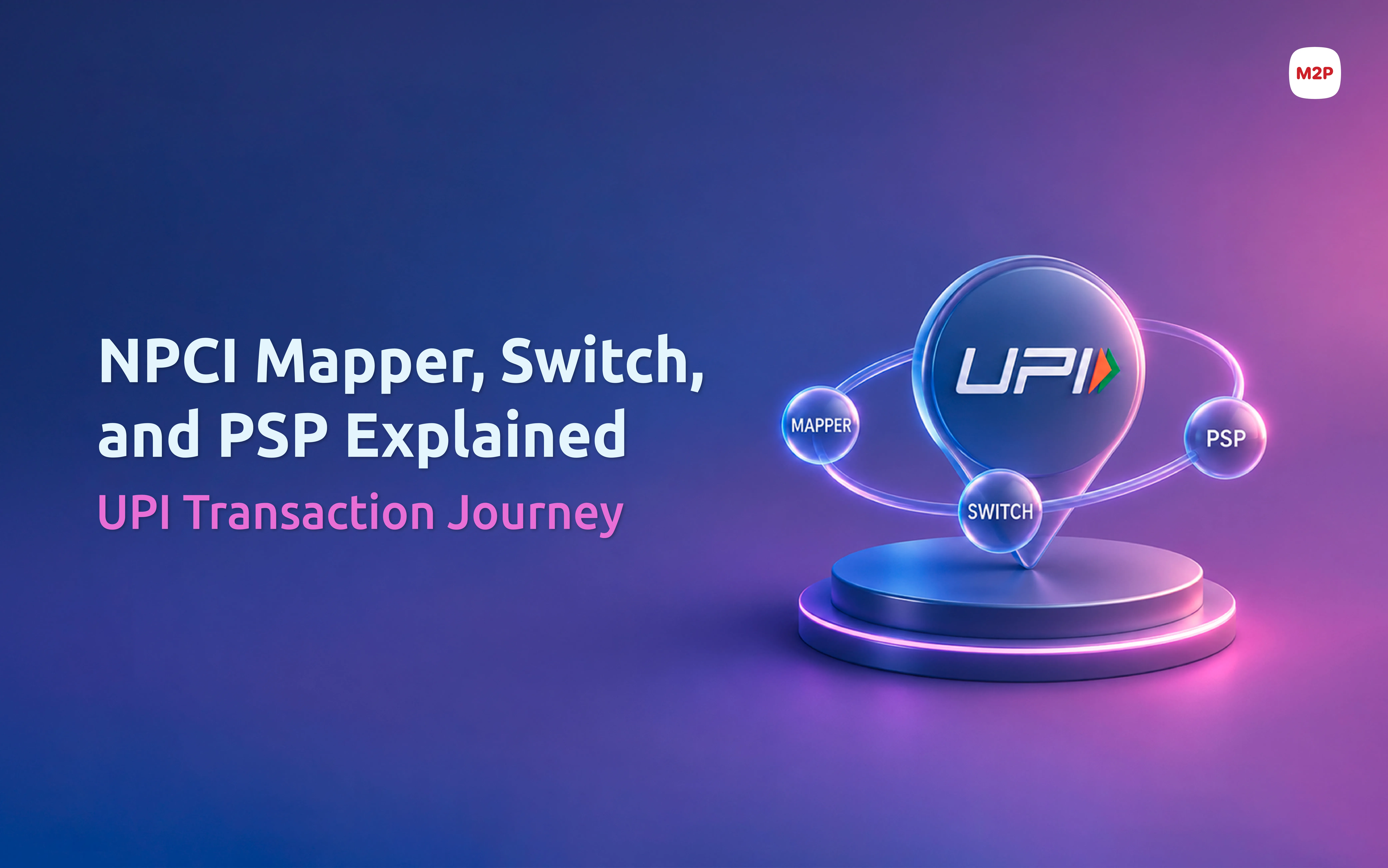
Every time someone taps Pay on a UPI app, a lot happens in the two or three seconds before the screen shows Payment Successful. A UPI payment isn't a single hop from one bank account to another - it's a relay race across at least three distinct systems, each with a specific job, each bound by strict timing rules set by NPCI.
Most explainers stop at UPI is fast and free. Very few actually open up the pipes and show what's moving inside them. This one does.
If you work in banking technology, payments product, or fintech operations, understanding this journey isn't academic - it's the difference between reading an incident report and actually understanding why a transaction failed, or why your team is evaluating a new UPI payment platform in the first place.
Before we walk through the flow step-by-step, it helps to meet the three main players. Each one solves a different problem, and each is a potential point of friction if not built or maintained well.
1. PSP (Payment Service Provider)
The PSP in UPI is the app layer - the interface the payer or payee actually touches. Google Pay, PhonePe, Paytm, and every bank's own UPI app are all PSPs. A PSP's job is narrow but critical: capture the payment intent (amount, VPA, PIN), present it in a usable interface, and pass it downstream. A PSP doesn't know how to actually move money - it simply hands off the request into the UPI ecosystem, expecting the other layers to do the heavy lifting of routing, validation, and settlement.
2. NPCI Mapper
Think of the Mapper as UPI's directory service - the "phonebook" that translates a Virtual Payment Address (VPA, like name@bank) into the actual account number and IIN (Issuer Identification Number) it's linked to. Without the Mapper, a UPI app would have no idea which bank, which branch, or which account a VPA actually points to. This lookup happens almost instantly, but it's a mandatory hop in the chain - every single UPI transaction touches the Mapper at least once.
3. Payment Switch
This is the layer most people outside payments engineering have never had to think about, and it's arguably the most important one operationally. A payment switch - sometimes called a payment gateway switch - sits between the PSP / NPCI layer and each bank's core banking system (CBS). Its job is to:
- Route the transaction request to the correct destination bank
- Translate message formats between NPCI's protocol and the bank's internal systems
- Validate the transaction against business rules and fraud checks
- Manage retries, timeouts, and status reconciliation
- Ensure the entire round trip completes within NPCI's mandated Turnaround Time (TAT)
If the PSP is the storefront and the Mapper is the directory, the switch is the logistics network - invisible when it works, and the first thing that breaks when transaction volumes spike.
4. Issuer and Acquirer Bank Systems (CBS)
At the very end of the chain sit the actual banks - the issuer (payer's bank) and the acquirer (payee's bank). Their Core Banking Systems execute the real debit and credit. Everything before this point is essentially routing and validation; this is where the money actually moves.
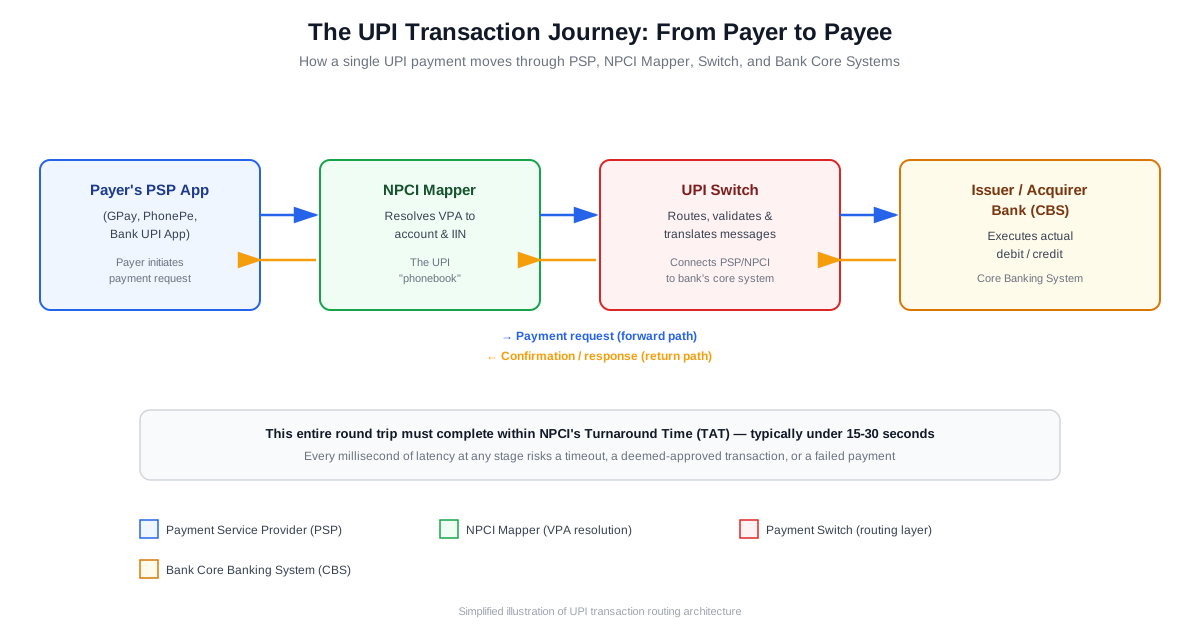 Walking through it step by step:
1. Initiation - The payer opens their PSP app and enters a VPA, amount, and UPI PIN. The PSP packages this as a payment request.
2. VPA Resolution - The request reaches NPCI, which queries the Mapper to resolve the payee's VPA to their actual account and IIN.
3. Routing via the Switch - NPCI forwards the request to the payment switch connected to the payer's issuing bank. The switch validates the request format, checks it against the bank's rules, and forwards it into the bank's CBS.
4. Debit at the Issuer - The issuing bank's CBS checks balance and account status, then executes the debit, sending a confirmation back through the switch.
5. Credit at the Acquirer - NPCI relays the transaction to the payee's bank via their own switch, which passes it to their CBS for the credit.
6. Confirmation Loop - Success or failure status flows back up the same chain - CBS → switch → NPCI → PSP - and the payer and payee both see the result on their respective apps.
All of this - six distinct hops across potentially four different organizations - is expected to complete within NPCI's TAT window, typically under 15–30 seconds depending on the transaction type. This is why UPI transaction processing at scale is such a demanding engineering problem: it isn't just about handling volume, it's about handling volume fast, correctly, every single time.
The PSP app is what users see. The Mapper mostly runs invisibly and reliably in the background, maintained centrally by NPCI. But the payment switch architecture each bank or PSP operates is where most real-world friction originates, for a few reasons:
It has to handle enormous, unpredictable load - Salary days, festival sales, IPO subscription windows - UPI volume can spike 3-4x within hours. A switch that isn't built for elastic scaling becomes the bottleneck, causing timeouts that show up to users as "payment failed" even though money may have moved.
It's where compliance actually gets enforced - NPCI's TAT rules, retry logic, and message format standards aren't self-enforcing - the switch is the component responsible for adhering to them. A poorly built switch can silently violate TAT norms, exposing the bank to penalties and reconciliation headaches down the line.
It's the translation layer between two very different worlds - NPCI speaks a standardized protocol; every bank's CBS speaks its own internal format, often decades old. The switch has to bridge these without introducing errors, and this translation logic gets more complex as banks add new products - UPI Lite, Credit Line on UPI, international UPI acceptance - each with its own message variations.
It's where fraud checks need to happen in real time - Since the switch sees every transaction before it hits the CBS, it's a natural chokepoint for velocity checks, risk scoring, and anomaly detection - but only if it's designed to do this without adding latency that blows the TAT budget.
This is why so many banks, especially mid-sized and regional players, find that building and maintaining switch infrastructure in-house is a far bigger undertaking than it first appears. It's not a one-time build - it's an ongoing commitment to keep pace with every NPCI circular, every new UPI feature, and every traffic spike.
It's common for the terms UPI payment gateway and payment switch to get used interchangeably, but they solve different problems. A payment gateway typically sits on the merchant side, helping a business accept payments across multiple methods (UPI, cards, wallets) through a single integration - it's focused on UPI API integration for acceptance. A payment switch, by contrast, operates at the infrastructure level between PSPs, NPCI, and bank systems - it's concerned with routing, translation, and compliance at the network layer, not merchant-facing checkout experiences.
To put it in simple words: a gateway helps a merchant accept a payment. A switch helps that payment actually travel correctly through the banking network to get there.
The journey above describes a push transaction - the payer initiating a payment. But UPI also supports pull flows, most commonly through the UPI collect API, where a payee requests money from a payer (used heavily in bill payments, loan EMI collection, and merchant checkouts). A collect request follows a similar path through the Mapper and switch, but in reverse initiation - the payee's PSP raises the request, which is routed to the payer's bank for approval before the debit occurs.
Similarly, a UPI QR payment solution simply changes how the VPA and amount are captured at the front end - a QR code encodes the payee's VPA so the payer's app can scan rather than type it - but once initiated, the transaction flows through the exact same Mapper-Switch-CBS journey described above. The QR code changes the input method, not the underlying UPI acquiring solution infrastructure that processes the transaction.
- For banks evaluating vendors: knowing what a switch actually does helps you ask the right questions when comparing UPI payment software providers - uptime SLAs, TAT adherence rates, reconciliation automation, and scalability under peak load all matter far more than surface-level feature lists.
- For product and ops teams: when a transaction fails, knowing which layer likely caused it (Mapper resolution issue vs. switch timeout vs. CBS rejection) massively speeds up root-cause analysis and customer communication.
- For anyone building on UPI: whether you're integrating a UPI payment gateway for merchant acceptance or building a UPI payment platform from scratch, understanding where the switch sits in the chain clarifies exactly which parts of the stack you need to build versus rely on partners for.
A UPI transaction that completes in under three seconds hides an enormous amount of coordinated engineering - VPA resolution through the Mapper, message routing and validation through the switch, and the actual ledger movement inside each bank's core system. The PSP is the part everyone sees. The switch is the part that determines whether the experience actually works.
This is exactly the layer that specialized UPI switch infrastructure is built to handle - absorbing the complexity of NPCI compliance, peak-load routing, real-time fraud checks, and reconciliation, so banks and PSPs don't have to build and maintain this machinery from scratch.
M2P's UPI Switch is purpose-built for precisely this layer of the journey - if you're evaluating how your current switch infrastructure holds up against scale, compliance, and reliability demands. Talk to us today!
What is the difference between NPCI Mapper and a payment switch?
The Mapper is a lookup service that resolves a VPA to an account and IIN. A payment switch is the routing and translation layer that carries the actual transaction request between NPCI, PSPs, and bank core systems, enforcing compliance and handling scale.
Is a PSP the same as a UPI payment gateway?
Not quite. A PSP is the app-layer provider consumers interact with (like GPay or a bank's UPI app). A UPI payment gateway is typically merchant-facing infrastructure that helps businesses accept UPI (and other) payments through a single integration.
Why do UPI transactions sometimes fail even when money is debited?
This usually happens when the confirmation message is delayed or lost somewhere in the Mapper-Switch-CBS return path, often due to timeouts under high load. The debit occurs, but the success confirmation doesn't reach the PSP in time, resulting in a "deemed approved" or later-reversed transaction.
Fintech is evolving every day. That's why you need our newsletter! Get the latest fintech news, views, insights, directly to your inbox every fortnight for FREE!