

M2P Fintech
Fintech is evolving every day. That's why you need our newsletter! Get the latest fintech news, views, insights, directly to your inbox every fortnight for FREE!
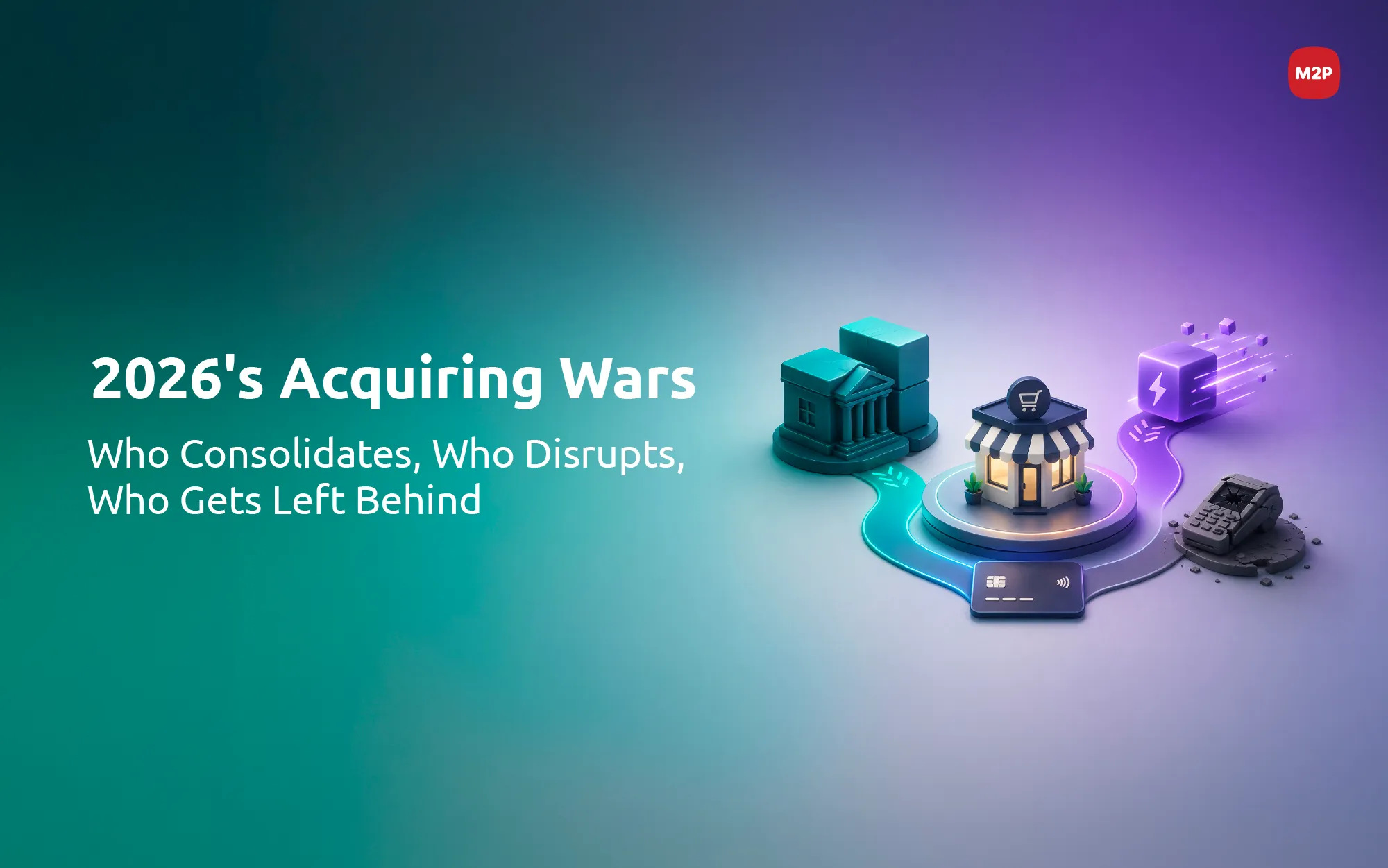
Merchant Acquiring in 2026 looks almost nothing like it did a decade ago, and arguably, less like it did even three years ago. What was once a relatively stable, bank-dominated business defined by processing volumes and interchange economics has become one of the most contested, fast-moving segments in financial services. Three forces are reshaping it simultaneously: consolidation among the traditional acquiring giants, relentless fintech disruption from platform-native players, and a bank response that is still very much being written.
Understanding where the industry stands today, and where the pressure points lie, matters for anyone with a stake in merchant acquiring: banks, NBFCs, PSPs, and the infrastructure providers powering them all.
The last several years have seen an unmistakable pattern among the traditional acquiring giants viz Fiserv, FIS, Global Payments, M2P Fintech, Nexi, Worldline, each of them navigating mergers, divestitures, and restructuring at a pace rarely seen in payments before. Global Payments' acquisition of Worldpay, M2P’s acquisition of Finflux(Lending) and Madstreet Den(AI capabilities), FIS's parallel moves to reshape its merchant business, and Worldline's continued portfolio rationalization across Europe are not isolated events. They reflect a single, shared realization across the legacy acquiring industry: scale is no longer optional.
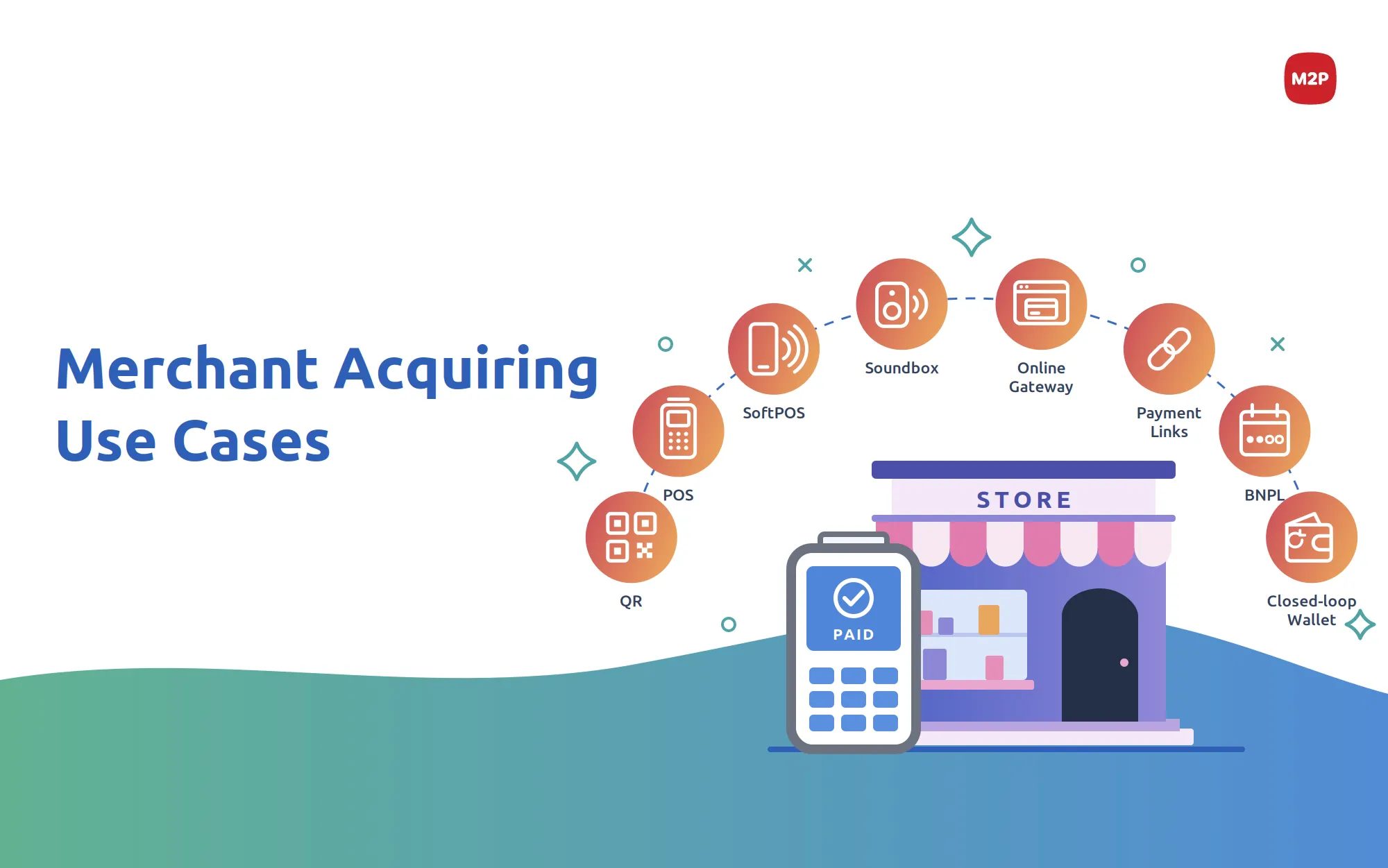
Building and maintaining a modern, omnichannel, API-first acquiring platform, one that supports cards, QR, wallets, BNPL, SoftPOS, and real-time settlement across multiple geographies requires sustained capital investment that only the largest players, or the most tightly focused specialists, can justify. Consolidation lets legacy acquirers pool R&D spend across a larger merchant and transaction base.
As regulators in market after market, from the EU's interchange fee caps to India's zero-MDR debit card/UPI policies to various price-cap discussions across the Middle East, squeeze the economics of card acceptance, acquirers need volume to make unit economics work. Smaller, sub-scale acquirers are increasingly unable to compete on price while maintaining margin, making them natural acquisition targets.
As e-commerce merchants expand across markets, they increasingly prefer a single acquiring/PSP relationship that can operate across geographies rather than stitching together local acquirers market by market. This has driven consolidation not just for cost reasons, but to build the geographic breadth merchants are demanding.
Much of the consolidation activity in acquiring and payments processing over the past few years has been PE-driven, rolling up regional processors, ISOs (independent sales organizations), and payment facilitators into larger platforms that can then be sold, merged, or taken public at a premium. This financial engineering layer has added velocity to a consolidation trend that was already structurally inevitable.
The result: by 2026, a handful of scaled global acquirers control an outsized share of processing volume, while the long tail of regional and niche acquirers faces a stark choice, either to get acquired, or specialize deeply into a defensible niche, or partner into a larger platform's infrastructure to stay relevant.
While the legacy acquiring industry consolidates around scale, an entirely different competitive logic has been playing out at the other end of the market, and it's the one reshaping merchant expectations everywhere.
Adyen, Stripe, and Checkout built their businesses not around processing volume alone, but around a fundamentally different architecture: single-platform, API-first, globally consistent acquiring that treats every merchant, from a two-person e-commerce startup to a multinational retailer, as a product user rather than a processing account. This platform model has three characteristics that continue to disrupt the traditional acquiring business in 2026:
Merchants no longer think of "online payments" and "in-store payments" as separate systems needing separate integrations. Adyen's unified commerce platform and Stripe's expansion into Terminal and Tap to Pay have made omnichannel acceptance table stakes. Acquirers still selling online and offline as separate products are increasingly at a disadvantage.
Software platforms, marketplaces, and vertical SaaS companies, from POS software providers to logistics platforms to B2B marketplaces, increasingly want to embed payment acceptance directly into their own product, monetizing payments as a feature rather than routing merchants to a separate acquirer relationship. Stripe Connect, Adyen for Platforms, and a growing ecosystem of embedded acquiring infrastructure providers have made this a mainstream go-to-market model rather than a niche one. This directly threatens the traditional acquirer-merchant sales relationship, because the software platform, not the bank or acquirer, now owns the merchant relationship.
In India, Pine Labs, Razorpay, Cashfree, PayU, and Innoviti have moved well beyond payment gateways into full acquiring and merchant management propositions, same-day settlement, integrated lending, and value-added services bundled directly into the merchant dashboard. In the Middle East, Geidea, PayTabs, Telr, and Network International have driven a similar shift, often moving faster than the banks they were originally meant to complement. These regional players increasingly compete directly with banks for SME and MSME acquiring relationships, a segment banks have historically underserved and fintechs have aggressively targeted.
The net effect of fintech disruption isn't just competitive pressure on pricing, it's a redefinition of what "good" looks like in merchant acquiring. Same-day settlement, real-time dashboards, self-service onboarding, and API-first integration are no longer differentiators; they're baseline expectations set by fintech-native acquirers, and every bank and legacy acquirer is now measured against that baseline whether they like it or not.
The genuinely difficult position in 2026 belongs to the players caught between these two forces, regional banks and mid-sized acquirers who are too small to achieve the scale economics of a Fiserv or Global Payments, but too structurally slow to match the product velocity of a Stripe or a Razorpay.
This "squeezed middle" faces a familiar set of symptoms: merchant attrition to fintech competitors on price and experience, margin compression from interchange regulation, rising technology maintenance costs on aging infrastructure, and increasing difficulty attracting the engineering talent needed to modernize. For many of these players, the strategic question isn't whether to change, it's how fast they can change before the gap becomes unrecoverable.
Banks are not standing still in the face of this pressure, but their responses in 2026 are diverging into a few distinct strategic postures.
The most common and pragmatic response has been for banks to partner with modern Merchant Management System (MMS) providers to modernize their acquiring stack without undertaking a multi-year, high-risk internal rebuild. This lets banks retain the merchant relationship, the settlement account, and regulatory ownership, while offloading the technology burden viz onboarding automation, omnichannel acceptance, real-time settlement, risk and dispute management to a specialist partner. This is, in effect, banks borrowing the platform economics that made Adyen and Stripe disruptive in the first place, and applying them inside a bank-owned, regulated wrapper.
A second, more ambitious strategy sees banks flip the disruption narrative on its head: rather than simply modernizing their own merchant book, some banks are positioning themselves as the licensed, regulated infrastructure layer for fintechs, PSPs, and software platforms that want to offer embedded acquiring but don't want to become a bank themselves. In this model, the bank becomes a wholesale acquiring partner, powering other companies' merchant acquiring propositions under the hood, often through the same modern MMS infrastructure that powers its direct merchant business. This turns embedded acquiring from a threat into a growth channel.
A third response has been strategic focus, rather than trying to compete everywhere, some banks are concentrating on merchant segments where trust, credit relationships, and regulatory standing matter more than pure technology velocity: larger enterprise merchants with complex settlement needs, regulated industries, or markets where local banking relationships remain a genuine advantage over global fintech platforms. This is a narrower strategy, but a defensible one, particularly for banks that can pair it with a modernized technology layer via an MMS partner rather than trying to out-build fintech competitors head-on.
What's notable is that these three responses aren't mutually exclusive, many banks are pursuing a blend of all three simultaneously, using a modern MMS partnership as the common technology foundation underneath each strategy.
India continues to be a bellwether for where global acquiring is headed, given the sheer pace of digital payments adoption, UPI's dominance in transaction volume, and the maturity of players like Pine Labs, Razorpay, and Cashfree in merchant-facing innovation. Regulatory shifts around MDR, tokenization mandates, and interoperability continue to reshape acquirer economics faster than in most other markets, making India a useful preview of pressures that eventually surface elsewhere.
The Middle East (UAE, Saudi Arabia, Egypt) has seen a wave of acquiring modernization driven by national digital payment strategies, with Network International, Geidea, and PayTabs expanding aggressively, often in partnership with, rather than in competition against, regional banks that see the value of a modern acquiring layer without owning the full technology stack.
Europe remains shaped by regulatory complexity (interchange caps, PSD2/3 evolution, and strong customer authentication requirements) that continues to favor scaled acquirers like Nexi and Worldline who can absorb compliance costs across a large merchant base, while also creating openings for API-first challengers like Adyen and Checkout to win share from banks slower to adapt.
North America continues to be defined by the aftershocks of the Global Payments–Worldpay consolidation and Fiserv's ongoing platform integration efforts, alongside steady share gains by Stripe and Square (Block) in the SME and platform-embedded acquiring space.
Three things seem clear as the global acquiring landscape continues to evolve through 2026 and beyond:
Acquirers and banks need to either achieve genuine scale advantages or build defensible specialization (by segment, geography, or use case). Being merely "adequate" across the board is an increasingly untenable position.
Same-day settlement, unified omnichannel acceptance, self-service onboarding, and embedded value-added services aren't premium features anymore, they're the baseline every acquirer, bank, and MMS provider is measured against, everywhere.
The single biggest lever available to banks and regional acquirers who want to compete with global platforms, without the years-long rebuild or the capital intensity of true in-house platform development, is partnering with a modern MMS provider that has already solved the hard technology problems at scale across multiple markets and client banks.
This is precisely the gap M2P's Merchant Acquiring infrastructure is built to close. As consolidation reshapes who owns global acquiring volume, and fintech platforms continue to redefine merchant expectations, banks and NBFCs need a way to modernize fast, compete credibly, and increasingly become acquiring infrastructure providers themselves for the fintechs and platforms building on top of them. M2P's modular, API-first Merchant Acquiring stack is designed to let banks do exactly that: modernize the technology layer, retain the merchant and regulatory relationship, and move at a pace that keeps them relevant in a landscape being reshaped in real time.
The global acquiring industry in 2026 isn't converging toward a single winning model — it's fragmenting into scaled giants, disruptive platforms, and banks that have learned to borrow the best of both through the right infrastructure partner. The players who understand that distinction early will be the ones setting the pace for the next decade of merchant acquiring, rather than reacting to it.
Want to see how M2P's Merchant Acquiring infrastructure can help your bank or fintech compete in this fast-consolidating, fintech-disrupted landscape? Get in touch with M2P to learn more. ti

Fintech is evolving every day. That's why you need our newsletter! Get the latest fintech news, views, insights, directly to your inbox every fortnight for FREE!