

M2P Fintech
Fintech is evolving every day. That's why you need our newsletter! Get the latest fintech news, views, insights, directly to your inbox every fortnight for FREE!
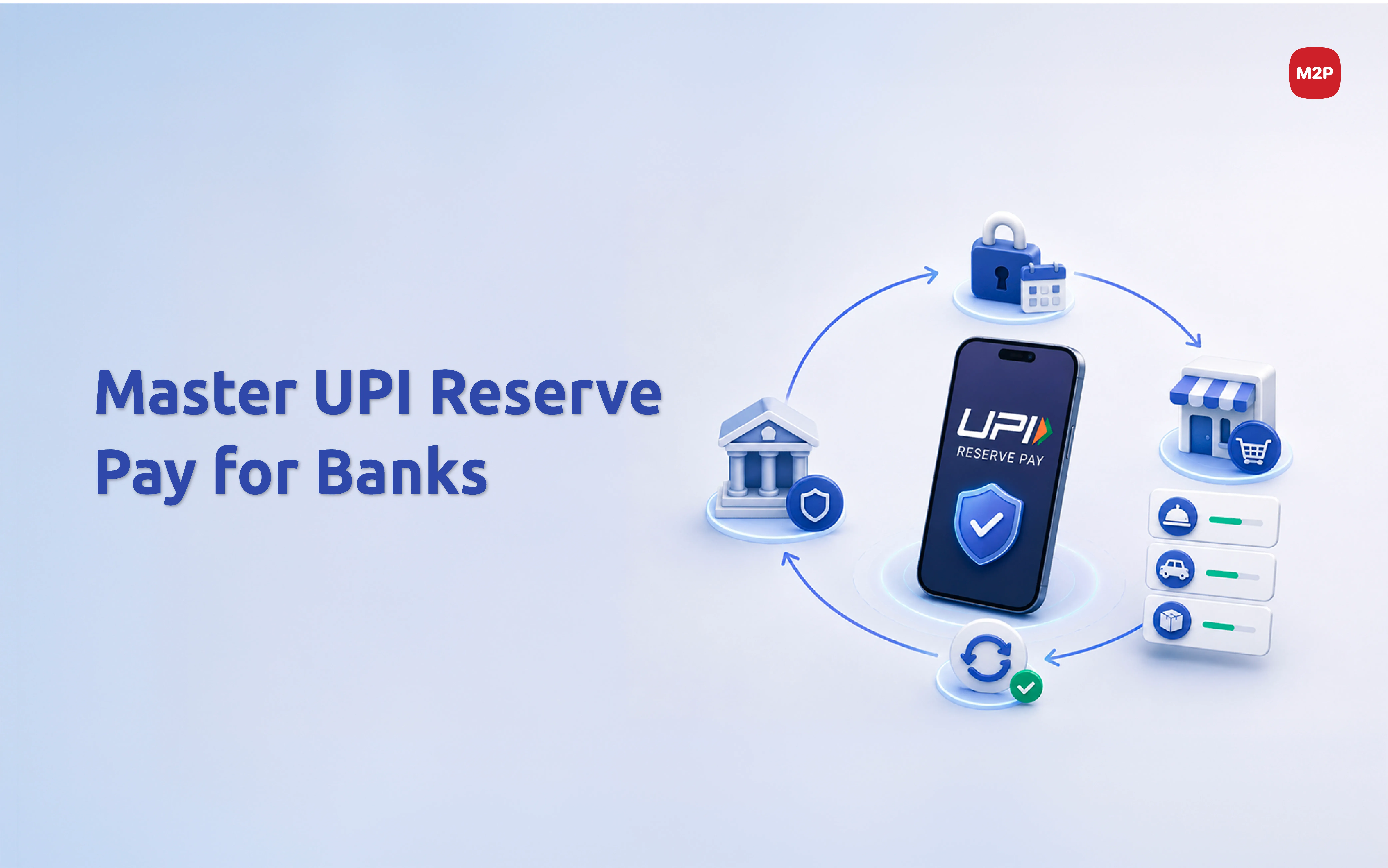
UPI Reserve Pay is an NPCI-enabled UPI capability that lets a user block, or reserve, a set amount of funds against a single PIN authorization - after which multiple subsequent payments can be debited from that reserved amount without repeated authentication. It's built for high-frequency, variable-value use cases like ride-hailing, quick commerce, and in-app spending, where asking for a PIN on every single transaction creates more friction than the transaction itself is worth.
For banks, this isn't just another item on NPCI's feature list. UPI's monthly transaction volumes have moved well past the point where every payment can reasonably demand full authentication without straining core systems. The institutions that adopt specialized capabilities like Reserve Pay early are the ones best positioned to win high-value corporate and merchant relationships - the ones that lose the most from checkout friction and are actively shopping for banking partners who've already solved for it.
Traditional UPI payments are stateless: every transaction - regardless of size - requires the user to enter their UPI PIN, the issuing bank to authenticate the request, and the core banking system to process the debit end to end. That's fine for a single, planned purchase. It's inefficient for a ride that racks up five small fare adjustments, or a gaming app processing dozens of micro-purchases a session.
Reserve Pay changes the sequence:
Mandate setup. The user authorizes their bank to reserve a specific amount against their account or linked credit line, confirmed with one PIN entry.
Fund block. The bank places a hold on that amount — it's set aside, not yet spent.
Subsequent debits. As the user transacts with the merchant, the payment switch deducts from the reserved block directly, without a fresh PIN prompt each time.
Reconciliation. Each debit is logged and reconciled against the original mandate for audit and settlement purposes.
Expiry or revocation. The reserve has a defined validity window and can be modified or cancelled by the user; any unused balance is released back to the account.
The result is a single authenticated entry point followed by a fast, low-friction corridor between the user and a specific merchant - with the heavy lifting of tracking, timing, and modification handled by the bank's switch infrastructure rather than the core banking system on every transaction.
Banks and merchants often ask how Reserve Pay differs from mechanisms that sound similar. Here's the comparison:
Feature | UPI Reserve Pay | UPI Autopay | Standing Instruction | UPI Lite |
|---|---|---|---|---|
Best for | Variable, on-demand micro-transactions | Fixed, scheduled recurring payments | Fixed-amount recurring transfers | Small-value offline-capable payments |
Amount per transaction | Variable, drawn from a reserved pool | Fixed, pre-set amount | Fixed, pre-set amount | Small-value, capped per transaction |
Authentication frequency | Once, at mandate setup | Once, at mandate setup | Once, at setup | No PIN needed per transaction (within limits) |
Typical use case | Rides, quick commerce, in-app/gaming spend | Subscriptions, SIPs, EMIs | Recurring bill payments | Small retail, transit, low-connectivity payments |
Funds status before use | Blocked/reserved, released on expiry | Not blocked; debited on schedule | Not blocked; debited on schedule | Pre-loaded balance on device |
The distinction that matters most for banks: Autopay and Standing Instructions solve for predictable recurring debits. Reserve Pay solves for unpredictable, frequent ones - which is exactly the segment growing fastest across quick commerce, mobility, and digital gaming.
High-volume, low-ticket transactions are an operational strain point for most banks. Quick commerce, mobility, and gaming platforms generate millions of micro-transactions daily, and when each one requires an individual authorization hit, the load on a bank's Core Banking System (CBS) climbs fast - showing up as slower response times, higher timeout rates, and degraded network performance during peak hours.
Reserve Pay acts as a pressure release valve here. Because the CBS only needs to authenticate and block funds once per mandate, the payment switch handles all subsequent micro-debits against that reserved amount independently. That's a meaningful drop in direct CBS hits, and it's the kind of operational efficiency that lets banks scale digital payment volumes without a constant cycle of core-system overhauls. Pairing this with a modern Core Banking Solution compounds the benefit further.
Banks - get a way to reduce authentication overhead at scale while offering a feature their most valuable merchant clients are actively requesting.
Merchants - particularly in the gig economy, mobility, and e-commerce - get to remove one of the biggest sources of checkout friction and cart abandonment: the repeated OTP or PIN prompt. A trusted, pre-authorized buffer means the next ride, order, or in-app purchase completes instantly.
Consumers - get a smoother experience for the kind of frequent, small-value spending they already do daily, without sacrificing the control of setting their own reserve limit and revoking it at any time.
The business case is straightforward. The engineering reality is not. Legacy UPI switches were built for simple, stateless, one-to-one transfers. Reserve Pay requires real state management - accurately tracking the blocked amount, monitoring the reserve's expiry window, handling real-time modifications or revocations, and precisely managing multiple debit requests against a single mandate without error.
For banks running on monolithic, outdated switches, building and certifying that logic in-house can take months and significant capital expenditure - and layering complex new state logic onto rigid legacy architecture tends to introduce new failure points. A timeout when a user tries to modify their reserve is a reputational cost, not just a technical one.
As a Technology Service Provider (TSP), this is the layer M2P works on. The M2P UPI Switch is a cloud-native, full-stack platform built to help banks deploy features like Reserve Pay without re-engineering core infrastructure from scratch - handling the backend integration, state management, and regulatory compliance so banks can focus on go-to-market strategy rather than backend plumbing.
What that looks like in practice:
Limitless scalability - a cloud-native, microservices architecture that elastically absorbs transaction peaks and troughs.
Dynamic routing - intelligently separates informational queries, reserve initializations, and financial debits, so critical money movement isn't bottlenecked by non-financial traffic.
Accelerated time-to-market - pre-certified NPCI integrations and comprehensive API coverage cut deployment time significantly versus building in-house.
Economical TCO - a pay-as-you-go model that avoids the cost of stitching together multiple vendors.
Integrated fraud prevention - a real-time eFRM system built for the specific risk patterns of block-and-debit flows.
In production deployments, the switch has demonstrated sub-10 millisecond transaction execution - the kind of headroom multi-stage features like Reserve Pay need to run reliably at scale.
Features like Reserve Pay are quickly becoming the baseline expectation for corporate clients, not a differentiator that fades. Banks that treat their switch infrastructure as a strategic asset rather than a maintenance burden are the ones positioned to capture that shift first.
Talk to us to see how the M2P UPI Switch fits into your infrastructure roadmap.
What is UPI Reserve Pay? UPI Reserve Pay is an NPCI-enabled UPI capability that lets a user authorize their bank to block, or "reserve," a set amount of funds against a single PIN entry. Once reserved, subsequent transactions against that amount can be processed without repeated PIN authentication, reducing friction for high-frequency, low-value payments.
How is UPI Reserve Pay different from UPI Autopay? UPI Autopay is built for fixed, recurring payments like subscriptions or EMIs on a set schedule. UPI Reserve Pay is designed for variable, on-demand micro-transactions, such as rides or in-app purchases, where the amount and timing of each debit isn't fixed in advance but draws from a pre-authorized pool.
How is UPI Reserve Pay different from UPI Lite? UPI Lite is designed for small-value payments that can process without a PIN and even with limited connectivity, using a pre-loaded on-device balance. Reserve Pay instead reserves funds directly against a bank account or credit line and is built around a mandate-and-debit relationship with a specific merchant, rather than a general-purpose small-value wallet.
Does adopting UPI Reserve Pay require banks to rebuild their entire UPI switch? Not necessarily. Banks with modern, cloud-native switches can typically extend existing infrastructure to support the added state management Reserve Pay requires. Banks on legacy, monolithic switches often face longer development and certification cycles, which is where partnering with a TSP can shorten time-to-market.
Does UPI Reserve Pay reduce load on a bank's Core Banking System (CBS)? Yes. Because only the initial fund block requires a full CBS authentication hit, the payment switch can handle subsequent micro-debits against that reserved amount independently. This reduces the number of direct CBS calls during high-volume periods, easing strain during peak transaction windows.
Can banks offer UPI Reserve Pay without building it in-house? Yes. Banks can partner with a Technology Service Provider (TSP) that has pre-certified NPCI integrations and existing switch infrastructure, which typically shortens deployment timelines compared to building and certifying the state-management logic in-house.

Fintech is evolving every day. That's why you need our newsletter! Get the latest fintech news, views, insights, directly to your inbox every fortnight for FREE!