

M2P Fintech
Fintech is evolving every day. That's why you need our newsletter! Get the latest fintech news, views, insights, directly to your inbox every fortnight for FREE!
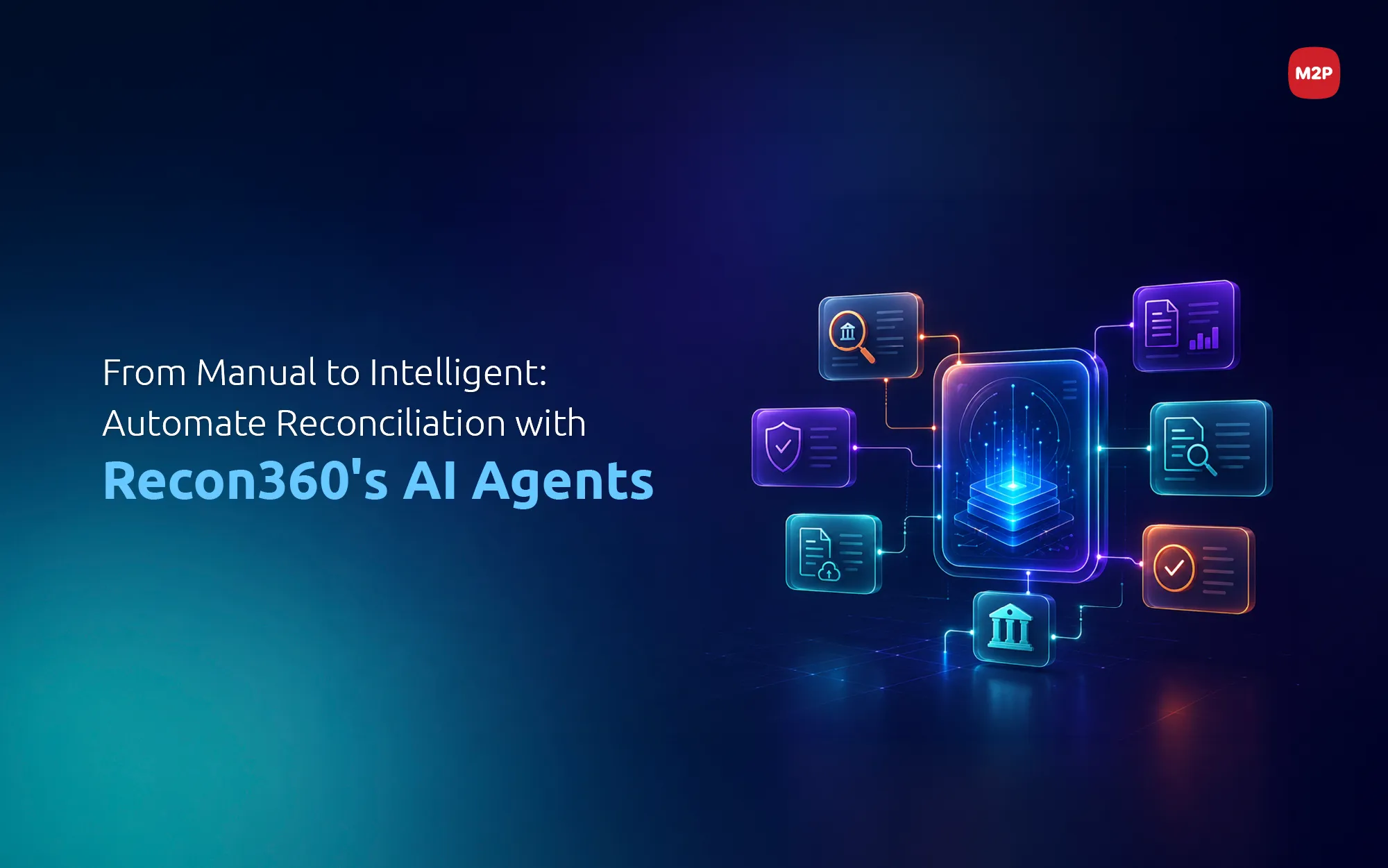
Smart back-office teams have long accepted manual reconciliation as an unavoidable cost of doing business. The reality is grimmer than most leaders acknowledge: research shows that approximately 10% of manually reconciled transactions contain errors, and a single spreadsheet formula error has been found to cost back-office operations close to $3 million a year before detection. Meanwhile, teams are spending 4–6 hours daily on reconciliation tasks that add no strategic value.
The global account reconciliation software market is responding to this pain projected to reach USD 9.4 billion by 2034, driven by an accelerating shift toward AI and automation. By 2025, over 40% of organisations were already piloting or actively using Generative AI in financial reporting. The direction is clear. The question for finance and operations leaders is no longer whether to automate reconciliation but how comprehensively to do it.
Recon360, M2P Fintech's AI-powered reconciliation platform, answers that question with a purpose-built suite of intelligent agents designed for the full operational lifecycle of reconciliation: from settlement investigation and file processing to dispute resolution, report generation, and document analysis.
Most reconciliation tools automate the easy part matching clean, structured transaction data against a single source. But enterprise operations are messier.
Settlement files arrive in inconsistent formats. Disputes pile up without clear ownership. Analysts waste hours hunting for the right report configuration. Auditors need complete, traceable financial histories at short notice.
Recon360 addresses this with specialised AI agents, each trained on a discrete domain of reconciliation work. Pattern recognition within datasets enables item-level reconciliation rates of 90–100% at scale consistent with benchmarks reported across AI-driven platforms in the sector. More importantly, these agents are not passive tools. They interpret queries in natural language, surface insights proactively, and hand off context across workflows.
For settlement operations teams and file processing specialists, Recon360's agents handle the daily verification cycle that smart back-office controllers depend on. The platform effortlessly manages high-volume demands, processing over 200 daily settlement vouchers for banks while validating both successful matches and settlement mismatches across major card networks.
Additionally, it breaks down settlement amounts by cycle and account, and tracks file processing status across date ranges identifying files that have failed processing before they escalate.
File validation happens before reprocessing, catching format errors early and preventing downstream disruption. When a process fails, error diagnosis agents surface root causes and can trigger reprocessing directly, compressing resolution timelines that typically stretch across shifts.
This matters operationally: manual workflows without real-time processing leave decision-makers waiting for reliable data long after it should be available. Operation teams using AI automation have cut reconciliation time by up to 50% and reduced manual journal entries by 65%.
Dispute resolution is a high-friction, high-volume workflow for customer support and compliance teams. Recon360's dispute agent handles the full lifecycle: creating cases, updating statuses, escalating where required, and resolving disputes with all actions logged to a traceable audit trail.
Beyond case management, the agent delivers analytics: dispute trends by partner, top dispute reasons by quarter, SLA resolution rates by month. These are the operational insights that allow compliance officers to identify systemic issues before they compound shifting dispute management from reactive firefighting to evidence-based process improvement.
At the core of any reconciliation platform is the ability to find things fast. Recon360's transaction search agents allow analysts to query unreconciled items, filter by account, amount threshold, or reconciliation failure status, and pull complete financial histories for audit purposes.
Crucially, Recon360 also serves analysts who need to understand the logic behind what they're seeing. The platform can explain reconciliation rules for specific processes, surface matching criteria, and retrieve historical configuration snapshots capabilities that are particularly valuable for new analyst onboarding and audit compliance, where clear documentation is non-negotiable.
One of the most persistent bottlenecks in enterprise is the gap between what decision-makers need and what IT can build on time. Recon360's report query agent closes this gap by allowing Business Intelligence analysts and finance controllers to self-serve: browsing available report configurations, querying table and column metadata, generating custom settlement or dispute reports by date range or partner, and exporting data without raising a ticket.
The practical implication is significant. When back-office teams can access trusted, real-time data without engineering dependency, strategic analysis replaces operational waiting.
Back-office operations don't exist in clean data environments. Bank statements, partner invoices, settlement PDFs, and scanned receipts arrive constantly and critical information is locked inside unstructured documents.
Recon360's document intelligence agent uses Vision AI to extract transaction data from uploaded PDFs and images, classify document types, and search content for specific reference numbers or settlement data. For customer support and operations teams processing high volumes of inbound documentation, this transforms a manual, error-prone process into an automated, auditable workflow.
Regulatory compliance and internal audit requirements demand complete, verifiable records. Recon360's financial history and audit trail capabilities let auditors trace settlement flows for individual transactions, retrieve all actions taken on dispute cases, and generate full audit trails for file processing activity by date, by process, or by account.
The 2025 ACFE benchmarking report found that US public companies lost a median 1.06% of annual revenue to known fraud losses, with weak reconciliation controls contributing to both occurrence and delayed detection. Recon360's architecture with every action logged, every decision traceable is designed to close that gap.
The business case for platforms like Recon360 goes beyond cost reduction. AI-driven reconciliation gives back-office teams trusted, real-time data that flows downstream into treasury operations, FinOps decisions, and strategic planning. It enables specialised teams settlement operations, dispute resolution, compliance, business intelligence to work within a single intelligence layer rather than across siloed spreadsheets and email chains.
As IBM's 2025 banking outlook noted, 60% of banking CEOs now acknowledge the necessity of accepting calculated risks to leverage automation benefits. The organisations moving first are not just saving hours they are building reconciliation as a strategic capability.
Recon360 is built for that ambition.
To learn how Recon360's AI agent suite can be configured for your reconciliation workflows, contact the M2P Fintech team.
Follow us on LinkedIn and Twitter for insightful fintech bytes curated for curious minds like you.
Fintech is evolving every day. That's why you need our newsletter! Get the latest fintech news, views, insights, directly to your inbox every fortnight for FREE!