

M2P Fintech
Fintech is evolving every day. That's why you need our newsletter! Get the latest fintech news, views, insights, directly to your inbox every fortnight for FREE!
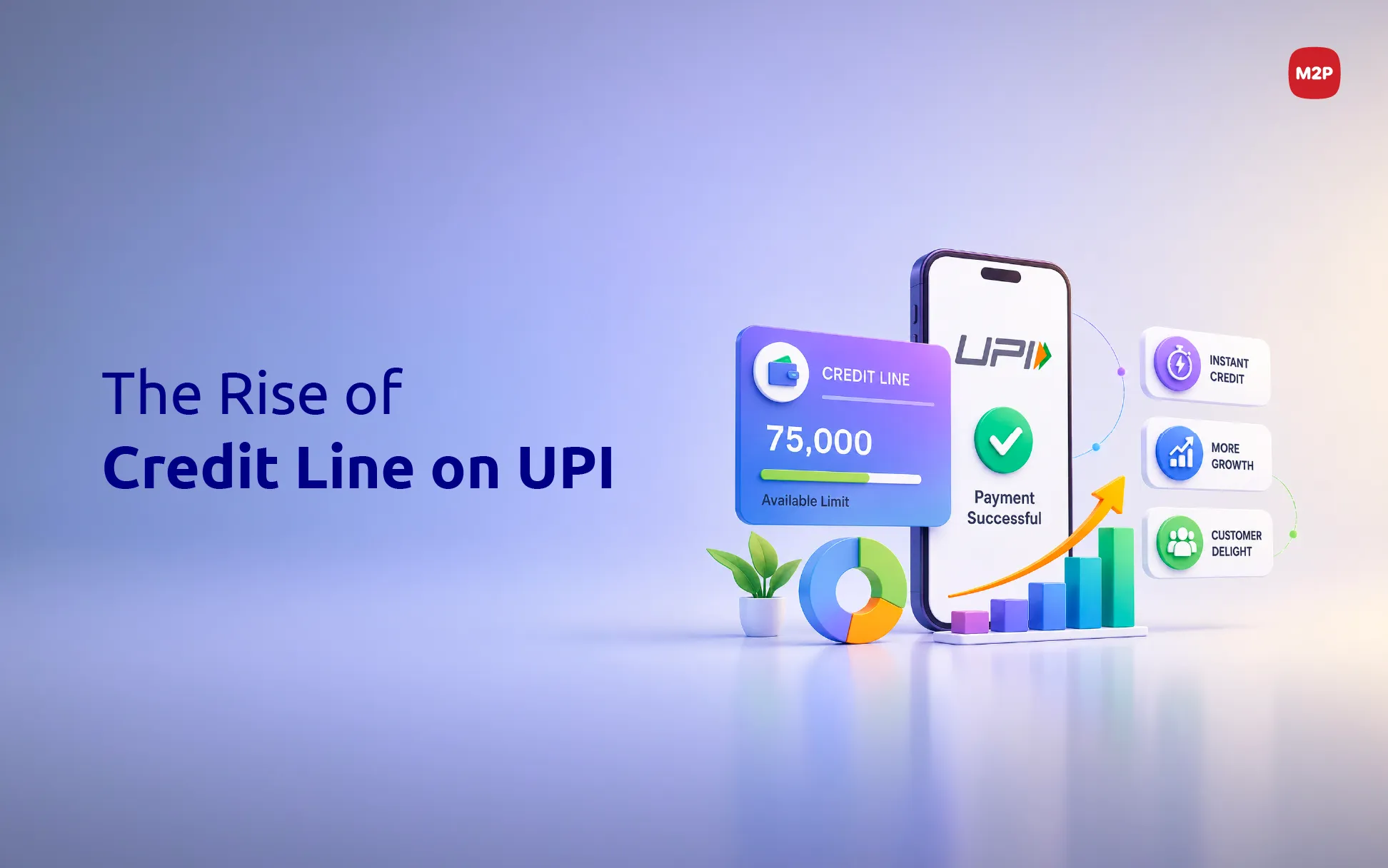
The Unified Payments Interface has already transformed how India handles money - moving from simple peer-to-peer transfers to becoming the backbone of retail payments. Now, Credit Line on UPI is setting up the next shift: combining the convenience of everyday digital payments with the purchasing power of instant, pre-approved credit.
A Credit Line on UPI allows banks to offer pre-approved, revolving credit to customers directly through their UPI app. Instead of carrying a physical credit card or waiting days for loan approval, users link an approved credit line to their UPI ID. Onboarding is digital-first: apply, get approved based on creditworthiness, and activate a limit in minutes.
At checkout, the flow feels exactly like using a UPI-linked bank account - scan a QR code or pay online, then select the credit line as the payment source instead of a savings account. No separate app, no physical card, no manual entry.
For customers, this means flexibility to manage cash flow without applying for a new product from scratch each time. For banks, it's a way to distribute credit at the exact point of sale, where the customer's intent to spend is highest.
UPI's scale gives this shift real weight. In February 2026, UPI processed 20.39 billion transactions, with daily transaction value regularly crossing ₹26 lakh crore (NPCI data). As smartphone penetration and digital literacy continue to grow, these numbers are expected to climb further.
That scale matters for credit specifically: it means the infrastructure already carries the trust and habitual use that lending products have historically struggled to build from zero. Embedding credit into an existing, high-frequency behavior - rather than asking users to adopt a new one - removes a major source of friction in loan disbursement.
For most users, the natural question is how this compares to products they already know.
Credit Line on UPI | Credit Card | Personal Loan | |
|---|---|---|---|
Approval time | Minutes, often instant | Days to weeks | Days to weeks |
Access point | Existing UPI app | Physical card / card app | Separate loan app or branch |
Repayment structure | Revolving, flexible | Revolving, flexible | Fixed EMI |
Best for | Small, frequent purchases | Larger purchases, rewards | Lump-sum, planned expenses |
Onboarding | Fully digital, alternative data | Physical/digital, traditional bureau data | Physical/digital, traditional bureau data |
It's worth pausing on how much this changes the lending process itself. Historically, accessing a credit line meant a branch visit, physical documentation, manual verification, and a wait of days or weeks. That friction didn't just inconvenience customers - it discouraged people who needed credit precisely at the moment they needed it, and it capped how many customers a bank could realistically serve.
Digital-first banking rewrites that. With API-driven infrastructure, banks can pull alternative data and run automated underwriting to issue a credit decision in real time, at a fraction of the acquisition cost of a traditional product. Credit Line on UPI is the clearest expression of that shift - bridging the gap between a spending decision and the credit to support it, without a multi-day gap in between.
For merchants and lenders, the upside is concrete: fewer abandoned carts, higher average order values when customers know credit is available at checkout, and a way to reach borrowers who have a solid financial history but no traditional credit card. It also opens new revenue lines - interest and interchange, while deepening the customer relationship.
None of this works, though, if the infrastructure underneath it can't keep up. When a user chooses their credit line at checkout, several things have to happen in the space of a few hundred milliseconds:
The available credit limit has to be verified in real time
The transaction has to be routed securely across the credit origination system, the UPI network, and the core banking ledger
Fraud checks have to run without adding latency
The transaction has to be reconciled and reported in line with regulatory requirements
Legacy banking systems weren't built for this kind of concurrent, real-time load. Relying on them tends to show up as capacity caps at peak volume, transaction failures, delayed regulatory reporting, and ultimately customers who abandon the credit line option because it's slower or less reliable than just tapping their card.
This is the infrastructure challenge banks and fintechs are now facing as they move to offer Credit Line on UPI. Some are building the orchestration layer in-house; others are partnering with providers who've already solved for scale, compliance, and reliability at this level. Here's what that looks like in practice.
M2P's UPI Switch stack is built specifically to handle the problems above, at the scale UPI already operates at:
Limitless scalability - a cloud-native, microservices architecture built to absorb transaction peaks without slowing down, addressing the capacity-cap problem legacy systems run into
Accelerated time-to-market - comprehensive API coverage and low-code enablement mean banks can launch a Credit Line on UPI product in a fraction of the time it would take to build the orchestration layer from scratch
High transaction success rates - multi-bank routing and automatic fallback logic reduce the payment failures that directly hurt customer trust in the product
Unified platform control - centralized product configuration, issuer processing, reconciliation, and fraud controls in a single pane of glass, closing the compliance and reporting gaps legacy systems struggle with
Seamless integration - connects with M2P's wider Core Lending Suite, so banks can cross-sell related credit products without re-building infrastructure each time
As payments and credit continue to converge, the institutions that move first on infrastructure that's actually built for this scale - will be the ones capturing the lending relationships that matter most over the next few years.
Ready to launch Credit Line on UPI without building the infrastructure from scratch? Talk to our team today!
Is Credit Line on UPI the same as a credit card? Functionally similar (revolving credit, interest on unpaid balances) but distributed differently through the UPI rails rather than card networks, with faster onboarding and no physical card required.
Who is eligible? Eligibility is bank-specific and typically based on a mix of traditional credit bureau data and alternative signals (transaction history, income patterns), which is why approval can happen in minutes rather than days.
Is it safe? It runs on the same UPI infrastructure including two-factor authentication and NPCI's security protocols - that already secures billions of transactions monthly. The credit itself carries the same regulatory obligations (interest disclosure, RBI guidelines on digital lending) as any other lending product.
What does it cost? Interest rates and fees are set by the issuing bank, within RBI's digital lending guidelines, and disclosed at the time of activation, the same regulatory framework that governs credit cards and personal loans.
Fintech is evolving every day. That's why you need our newsletter! Get the latest fintech news, views, insights, directly to your inbox every fortnight for FREE!