

M2P Fintech
Fintech is evolving every day. That's why you need our newsletter! Get the latest fintech news, views, insights, directly to your inbox every fortnight for FREE!
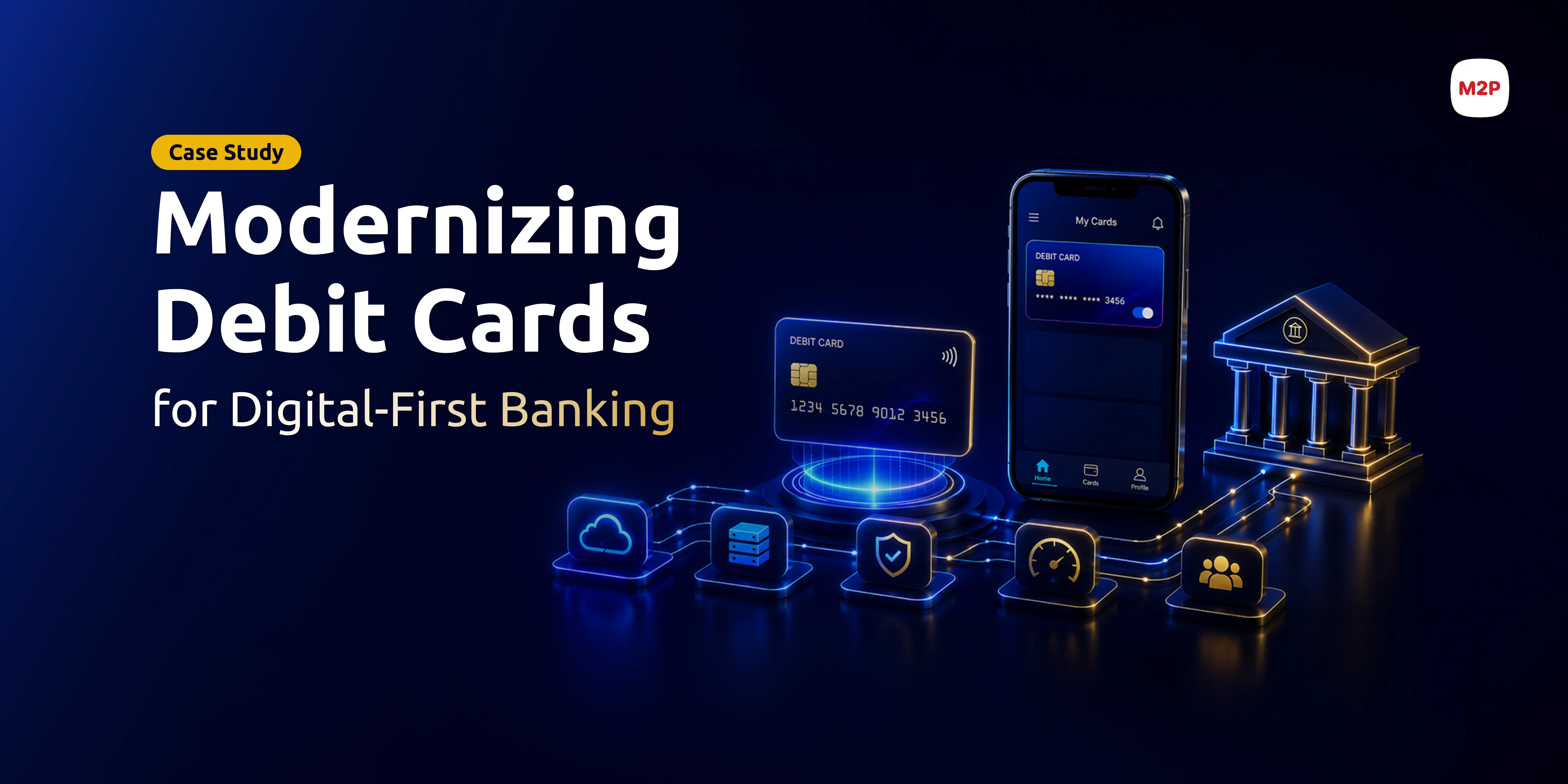
A leading small finance bank in India, known for its focus on financial inclusion and digital banking, was looking to modernize its debit card program for a fast-changing payments environment.
As customer expectations evolved, debit cards were no longer just basic access instruments. They had become an important part of the everyday banking experience enabling ATM access, POS payments, online transactions, contactless payments, and emerging ecosystem-led use cases.
However, the bank’s legacy debit card infrastructure was becoming difficult to scale. High operating costs, limited flexibility, and dependency-heavy workflows were slowing down its ability to deliver faster and more personalized card experiences.
To address these challenges, the bank partnered with M2P Fintech and migrated from its legacy card management system to M2P’s Debit Card Management System.
For a bank operating in a rapidly evolving digital payments landscape, the existing debit card system presented several operational and technology challenges.
The legacy setup involved recurring technology, maintenance, and operational expenses. As the debit card portfolio scaled, the bank needed a more cost-efficient platform that could support growth without proportionally increasing infrastructure and support costs.
The bank wanted greater control over its debit card program — from product configuration and card controls to new feature rollouts. The existing infrastructure limited the speed at which changes could be introduced.
Launching new debit card features required multiple dependencies, extended coordination cycles, and additional operational effort. This made it difficult for the bank to respond quickly to customer and market needs.
Managing reconciliation, controls, support processes, and day-to-day program operations across fragmented systems created avoidable complexity for internal teams.
The bank was also preparing for emerging use cases such as contactless transit payments and micro-ATM acquiring. This required a more modular, scalable, and integration-friendly debit card stack.
The bank chose M2P Fintech to modernize its debit card infrastructure through a cloud-first, modular Debit Card Management System.
M2P’s platform was designed to simplify debit card operations, support faster migration, and enable the bank to configure and scale its card program with greater agility.
The bank needed to migrate a large active debit card portfolio without disrupting business-as-usual operations.
M2P enabled the migration of over 5 lakh accounts within a short implementation window, helping the bank maintain continuity across customer-facing services while transitioning to a modern platform.
The migration was supported by M2P’s in-house capabilities, reducing dependency on multiple external systems and enabling tighter control over execution timelines.
M2P implemented a cloud-first deployment model that helped the bank simplify infrastructure management and reduce ongoing maintenance effort.
This enabled the bank to move away from a heavy legacy operating model and adopt a more scalable architecture designed for availability, flexibility, and faster product evolution.
The cloud-first approach also helped internal teams focus less on system upkeep and more on delivering improved debit card experiences to customers.
M2P’s modular debit card stack allowed the bank to configure different components of its card program without reworking the entire system.
This plug-and-play approach helped simplify product changes, improve rollout speed, and support future enhancements with lower implementation effort.
From card controls and program-level configurations to integration readiness for new payment use cases, the modular architecture gave the bank greater flexibility to evolve its debit card offering over time.
With M2P, the bank was able to bring multiple card management functions into a more unified environment.
Capabilities such as reconciliation support, access control, program management, and operational workflows were streamlined through a single platform-led approach.
This helped internal teams reduce manual dependencies, improve visibility, and manage day-to-day debit card operations more efficiently.
Beyond core debit card modernization, M2P also worked with the bank on future-facing capabilities, including:
National Common Mobility Card readiness for contactless payments across transit and retail use cases
Micro-ATM acquiring support for cash withdrawal and deposit services through assisted banking channels
Enhanced digital card controls and customer-facing experiences
Scalable infrastructure to support portfolio growth
This gave the bank a stronger foundation to expand its debit card proposition beyond traditional use cases.
The partnership helped the bank create a more agile, cost-efficient, and scalable debit card operating model.
By moving to M2P’s modern debit card stack, the bank was able to significantly reduce the time required to launch program enhancements and new capabilities.
Instead of long, dependency-heavy release cycles, the bank gained the ability to move faster across configuration, testing, and rollout.
This helped improve responsiveness to market needs and enabled faster delivery of debit card experiences to customers.
With multiple debit card management functions brought together on a unified platform, the bank was able to streamline internal workflows and reduce operational dependencies.
The platform helped simplify reconciliation, access control, monitoring, and program management activities — enabling teams to operate with greater speed and control.
The shift from a legacy operating model to a cloud-first, modular platform helped reduce the effort required to maintain and manage the debit card infrastructure.
This created room for internal technology and operations teams to focus on higher-value initiatives such as customer experience, product enhancements, and new payment use cases.
More than 5 lakh accounts were migrated within a short implementation window while maintaining business continuity.
This allowed the bank to modernize its debit card infrastructure without compromising customer experience or day-to-day banking operations.
With a modern debit card stack in place, the bank is better positioned to support new payment experiences, product variants, digital controls, and ecosystem-led card use cases.
The platform’s modularity and scalability give the bank the flexibility to keep evolving its debit card program as customer needs and payment behaviors continue to change.
“Our partnership with M2P Fintech has played an important role in strengthening our digital banking roadmap. Migrating from our legacy debit card system to M2P’s modern debit card platform was a smooth and well-executed transition. The migration, integration, and operational support were handled efficiently, helping us improve agility while continuing to deliver a seamless experience to our customers. With M2P’s platform, we are better equipped to offer secure, faster, and more user-friendly debit card services.”
- Chief Technology Officer, Leading Small Finance Bank in India
The bank’s modernization journey shows how financial institutions can reimagine debit card infrastructure for a digital-first banking environment.
Legacy systems can limit speed, increase cost, and make innovation harder to scale. By adopting M2P’s Debit Card Management System, banks can simplify operations, reduce technology overheads, and build debit card programs that are ready for new-age payment experiences.
For banks looking to improve agility, scale efficiently, and deliver better customer experiences, debit card modernization is no longer just a technology upgrade. It is a foundation for long-term digital banking growth.
Ready to transform your legacy infrastructure and build a future-ready debit card program?
Whether you need to scale efficiently, improve agility, or deliver next-gen payment experiences, our tailored solutions can help you get there faster. Talk to us today to discover how M2P’s Debit Card Management System can work for your bank.
Follow us on LinkedIn and Twitter for insightful fintech bytes curated for curious minds like you.

Fintech is evolving every day. That's why you need our newsletter! Get the latest fintech news, views, insights, directly to your inbox every fortnight for FREE!