

M2P Fintech
Fintech is evolving every day. That's why you need our newsletter! Get the latest fintech news, views, insights, directly to your inbox every fortnight for FREE!
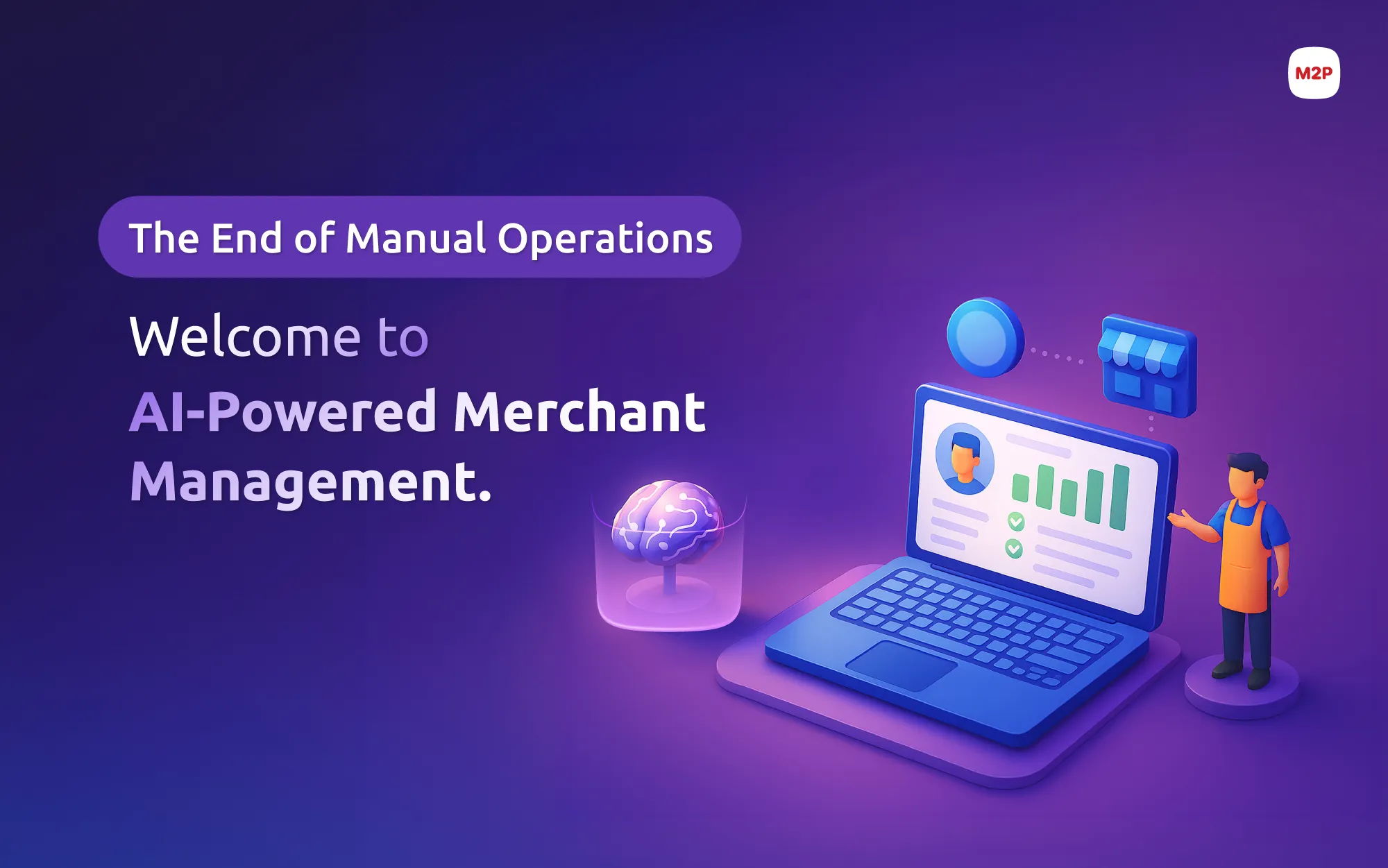
Every fintech provider is talking about AI. It’s the current industry buzzword, promising a frictionless future. But while much of the industry continues to speculate and run isolated pilot programs, a segment of forward-thinking merchant acquirers has quietly transitioned to full-scale deployment.
These early adopters aren't simply retrofitting generic chatbots onto legacy systems. They are operating on next-generation Merchant Management Systems (MMS) architected around purpose-built AI frameworks. By eliminating operational friction and delivering unprecedented intelligence, these platforms are creating a measurable, decisive competitive edge. For the rest of the market, it raises a critical question: as these advanced capabilities become the new baseline, how quickly will legacy operations become obsolete?
Here is a look under the hood at the AI agents already at work in the market, and the tangible impact they are delivering today.
The power of a modern, AI-driven system lies in its modular design. Rather than relying on a monolithic AI, leading frameworks serve as a central "brain" that plugs into various data sources (transaction databases, settlement engines, logs, API documentation) to create highly specialized AI “personas.”
Working seamlessly together, the primary agent types currently redefining operations include:
Query Chatbot: For instant, natural language answers to complex data lookups.
Diagnostics Expert: For deep, real-time root cause analysis of transaction failures.
Support Ticket Agent: For automated triage, investigation, and resolution of support issues.
Dashboard Navigation Helper: For interactive, in-platform guidance and user onboarding.
Configuration Assistant: For guiding developers and partners through complex API integrations.
Every user in the ecosystem—from internal operations managers to a merchant's developer—interacts with these agents through permission-gated interfaces, ensuring they receive instantly actionable, context-aware data.
The endless stream of routine queries is a major drain on traditional operations teams. By utilizing Query Chatbots and Diagnostics Experts in tandem, modernized acquirers are saving their operational teams an average of 10+ hours per week.
How it Works: Users query the system in plain English directly within their dashboard.
"What is the status of transaction ABC123?" — The AI instantly pulls from the transaction database.
"Show today's settlement summary for merchant XYZ." — It connects to the settlement engine for real-time figures.
"Why did transaction ABC fail?" — The Diagnostics Expert traces the transaction through internal logs and gateway responses to pinpoint the exact failure reason, turning hours of manual debugging into a matter of seconds.
The Impact: What used to be a manual, multi-step process is now a single, instant query. This allows skilled operational staff to focus exclusively on high-value exceptions, leaving competitors bogged down in repetitive data retrieval.
Support ticket backlogs are a notorious pain point in merchant acquiring. AI Support Ticket Agents are now automating the entire L1 support lifecycle. Firms leveraging this technology are seeing a 40-50% deflection of all incoming tickets and 50% faster resolution times for issues requiring human intervention.
Auto-Investigation: For a transaction issue, the AI instantly pulls the transaction status, gateway response codes, error logs, and the merchant’s current configuration before a human ever sees the ticket.
Auto-Resolution: Routine "how-to" questions are resolved instantly via product guides. Known errors are diagnosed and fed directly back to the merchant.
Intelligent Escalation: Novel issues are routed to L2 engineers, arriving with all preliminary investigations and context already attached.
The Impact: SLA compliance skyrockets, merchants get immediate answers, and support overhead is drastically reduced.
Onboarding new merchants and guiding developers through integration are historically time-consuming processes. Next-generation Navigation Helpers and Configuration Assistants are proving that this friction is optional.
For Merchants: Contextual wizards guide users through complex setups (e.g., "Walk me through setting up a new merchant with slab-based billing"), drastically minimizing misconfigurations and reducing onboarding time by up to 60%.
For Developers: AI assistants provide on-demand API specs, sequence diagrams, sample code, and best-practice architecture advice ("What is the recommended settlement cycle for an NBFC partner?").
The Impact: Acquirers utilizing these tools are reporting a 40% reduction in integration timelines. Partners get to market significantly faster, generating revenue sooner while generating fewer support tickets during the UAT process.
The capabilities outlined above are not on a distant roadmap—they are live in the market right now, creating tangible financial and operational value for those who have adopted them.
This is the new benchmark for efficiency in merchant management. The question is no longer if AI will change the industry, but how far behind your operations will fall if you wait to adapt.
Are your current platforms equipped to compete in an era of intelligent, automated operations?
Start a discussion with M2P Fintech today to discover how these advanced AI capabilities can be seamlessly integrated into your merchant acquiring strategy.
Fintech is evolving every day. That's why you need our newsletter! Get the latest fintech news, views, insights, directly to your inbox every fortnight for FREE!