

M2P Fintech
Fintech is evolving every day. That's why you need our newsletter! Get the latest fintech news, views, insights, directly to your inbox every fortnight for FREE!
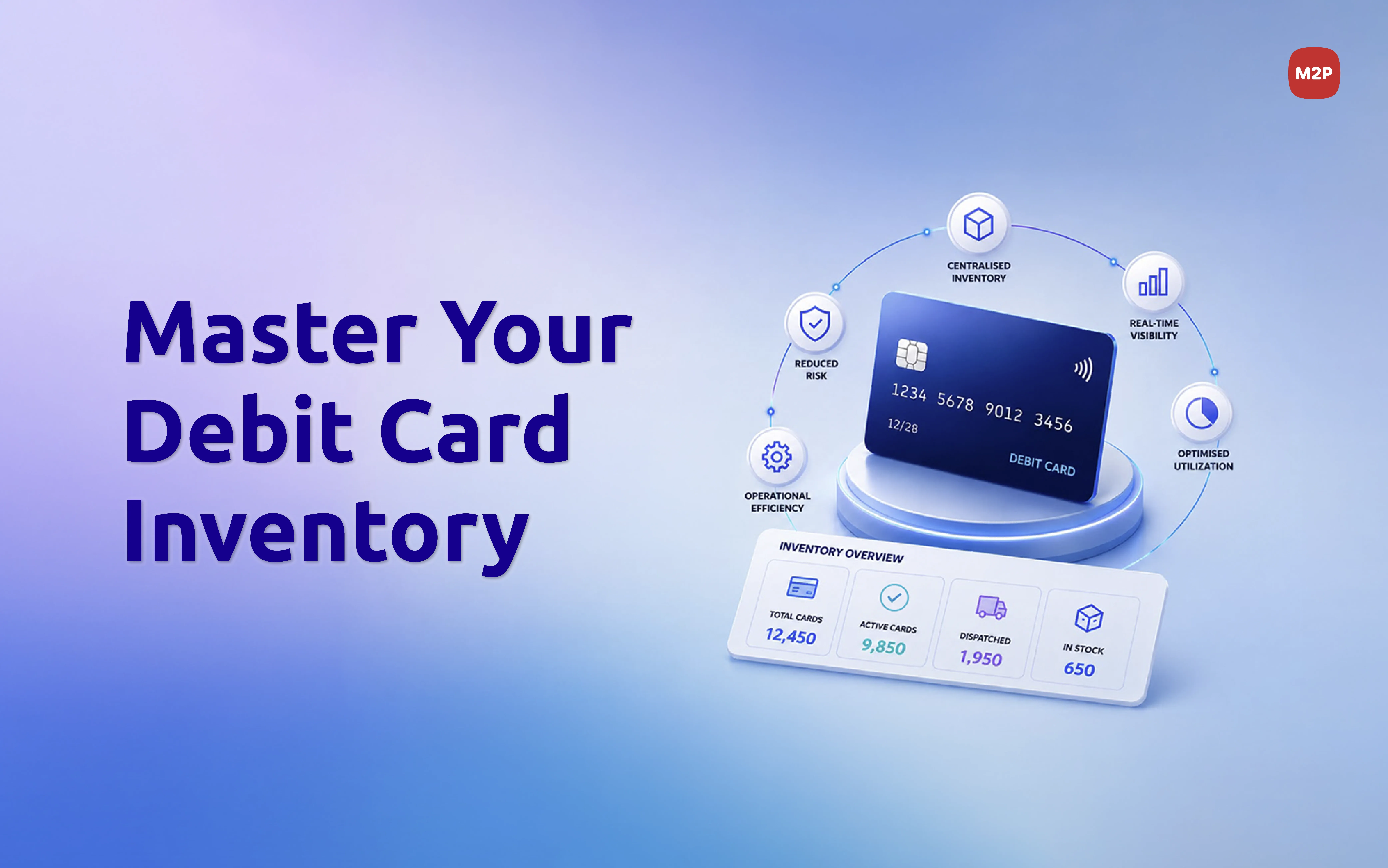
Every bank wants to issue cards faster, expand into new markets, and give customers a frictionless experience. But behind the scenes, most debit card programs are still run on the operational equivalent of duct tape: manual tracking, disconnected regional systems, and a compliance team that dreads audit season.
If your inventory control is decentralized, mainframe-dependent, or split across multiple vendors, the complexity isn't a minor inefficiency, it's actively costing you money and market position. Here's why, and what a centralized approach actually changes.
When executives price out a debit card program, they usually think of plastic, personalization, and postage. The real cost is quieter: the staff hours spent reconciling stock across branches, card manufacturers, and core banking systems by hand.
Manual processes can run 30% to 50% more expensive than digital alternatives in operational spend. Every hour someone spends tracking down a missing batch or fixing a data entry error is an hour not spent on strategic work.
Manual systems also produce errors in both directions:
Overstocking ties up capital in unissued plastic sitting in a vault
Understocking leaves branches unable to fulfill urgent requests, damaging trust with new account holders from day one
Speed matters more than most banks price in. When someone opens an account or requests a replacement card, they expect near-immediate access. Manual inventory management turns that into a multi-step bottleneck.
Here's the part that doesn't show up in an ops report: a delayed card is delayed interchange revenue. Until a card is in the customer's hands and activated, it earns the bank nothing. If fragmented processes are adding days or weeks to your delivery timeline, that's not just a customer experience problem. It's money left on the table, every single cycle.
Centralized systems close that gap by triggering printing and dispatch the moment an account is approved, collapsing the time-to-hands metric instead of just monitoring it.
Debit cards are sensitive financial instruments, and tracking them across disconnected regional systems creates real exposure. Physical logs can be altered, misplaced, or destroyed, which makes maintaining a clean chain of custody nearly impossible. If a batch goes missing in transit or from a branch vault, decentralized tracking makes it genuinely hard to pinpoint when and where it happened.
Regulators, meanwhile, expect clear, defensible audit trails. Pulling that data from five vendors and a dozen regional offices during an audit is its own special kind of nightmare.
Centralized inventory control replaces that with a single digital record. Every step of a card's journey, from manufacturer to mailbox, is tracked in real time. That's not just cleaner, it's the difference between a stressful audit and a routine one.
Here's a pattern that plays out constantly as banks expand: to launch quickly in a new market, teams partner with a local technical service provider. Repeat that across five markets, and you're no longer running one card program, you're running five, held together by different APIs, different databases, and the same logo.
Centralized inventory control breaks this pattern. Unifying operations into a single cloud-native workflow gives you one view of global stock, without compounding technical debt or handing your engineering team another integration to maintain every time you enter a new region.
Done well, centralized inventory control isn't just a tracking upgrade, it's a shift from reactive firefighting to proactive management. Integrated directly with your core banking suite, it gives your team a single source of truth to:
Accurately predict reorder timing before stock runs low
Automate reconciliation instead of doing it by hand every cycle
Dynamically manage operational limits without manual overrides
The result is an operations team that spends its time on program strategy instead of chasing down boxes of plastic.
This is exactly the problem the M2P Debit Card Stack is built to solve, giving you centralized control over your entire debit card program, from inventory to transaction processing, on a cloud-first, API-driven architecture that integrates with the Turing Platform.
What that looks like in practice:
API-first, modular architecture: assemble only the components you need, cutting integration time and dev cost
Centralized inventory management: real-time global stock visibility with automated reordering, no spreadsheets required
High operational resilience: cloud-native microservices built to handle peak volume without downtime
End-to-end lifecycle control: from digital onboarding and instant virtual issuance through physical dispatch and fraud monitoring, in one dashboard
Simplified compliance: immutable digital audit trails and automated reconciliation reports, ready when regulators ask
Reducing operational complexity isn't about cutting overhead for its own sake, it's about building a foundation that can actually scale. Centralized inventory control turns your operations team from a group managing spreadsheets and vendor calls into one focused on growth.
Don't let outdated infrastructure slow down your growth while your competitors pull ahead. Talk to us today to future-proof your debit card program.
What is centralized inventory control in debit card programs? It's the practice of managing a debit card's entire physical and digital lifecycle, production, dispatch, activation, and reconciliation, through a single unified system, rather than tracking it manually across branches, vendors, or regions.
How much does manual debit card inventory management actually cost a bank? According to McKinsey, manual operational processes can cost 30-50% more than digital equivalents. For card programs specifically, this shows up as staff hours spent reconciling stock, capital tied up in overstock, and lost interchange revenue from delayed issuance.
Does centralized inventory control help with compliance audits? Yes. Centralized systems maintain a real-time, immutable digital record of a card's full journey, which makes it possible to answer regulator audit requests quickly instead of pulling fragmented data from multiple vendors and regions.
What is the multi-vendor trap in card program expansion? It's what happens when a bank expands into new regions by partnering with local providers for each market, resulting in a patchwork of disconnected systems, APIs, and databases instead of one unified global program.
How does the M2P Debit Card Stack integrate with existing core banking systems? The M2P Debit Card Stack uses an API-first, modular architecture that integrates with the Turing Platform, allowing it to connect with existing core banking infrastructure without a full system overhaul.
Is the M2P Debit Card Stack suitable for banks operating across multiple countries? Yes, it's built specifically to give multi-region programs a single, cloud-native view of inventory and operations, removing the need to run separate systems per market.

Fintech is evolving every day. That's why you need our newsletter! Get the latest fintech news, views, insights, directly to your inbox every fortnight for FREE!