

M2P Fintech
Fintech is evolving every day. That's why you need our newsletter! Get the latest fintech news, views, insights, directly to your inbox every fortnight for FREE!
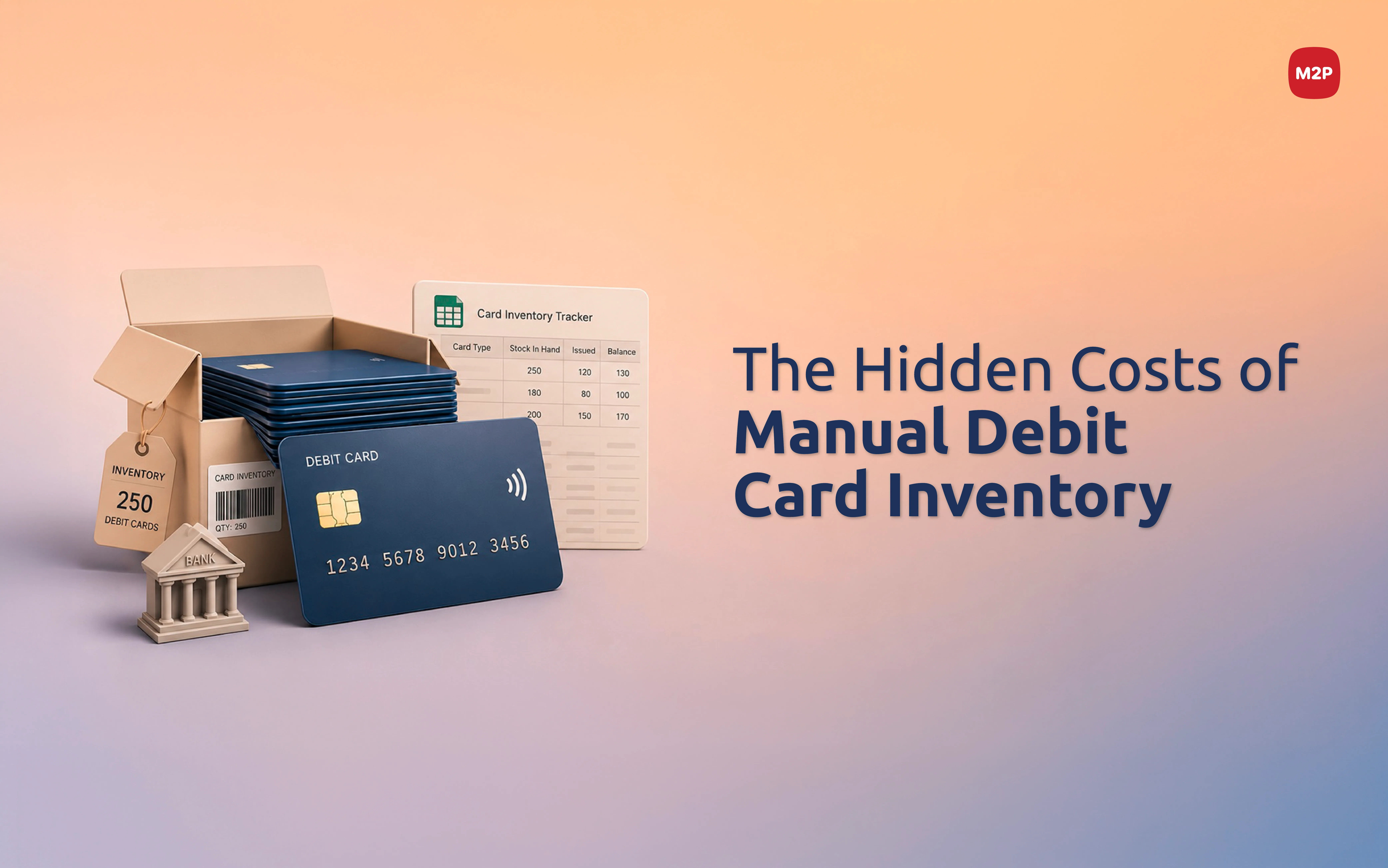
In today’s fast-paced banking environment, speed and efficiency are everything. Customers expect seamless, instant access to their financial tools. Yet, behind the scenes, many banks still rely on manual processes to manage their debit card inventory. Spreadsheets, physical counting, and outdated legacy systems remain surprisingly common across the industry. While this approach might seem like business as usual, it is quietly draining millions from your bottom line.
The reality is that manual debit card inventory is a relic of the past. It creates severe bottlenecks, increases the margin for human error, and ultimately degrades the end-user experience. For modern financial institutions looking to scale efficiently, clinging to these outdated methods is no longer a viable option. It is time to look closely at what these manual workflows are really costing you and why modernizing your approach is critical for long-term growth.
When you think about the cost of debit card issuance, the physical plastic and shipping fees probably come to mind first. However, the invisible costs associated with managing that inventory manually are far higher. Banks that rely on physical logs and spreadsheets require dedicated staff to track stock levels, reconcile discrepancies, and manage reorders.
This labor-intensive process is incredibly expensive. Employees spend hours cross-referencing data and manually updating internal systems. According to McKinsey, manual processes can cost 30–50% more than digital alternatives in operational spending.
Every hour your operations team spends tracking missing cards or fixing a spreadsheet error is an hour not spent on strategic growth or proactive customer service.
Furthermore, manual counting inevitably leads to errors. A simple data entry mistake can result in overstocking, which ties up valuable capital in unissued plastic, or worse, understocking, which leaves you completely unable to fulfill customer requests. The financial impact of these manual data errors compounds over time, eroding your profitability and operational efficiency.
Speed to market is a crucial competitive advantage in the modern banking sector. When a customer opens a new account or requests a replacement card, they expect it immediately. Manual card inventory management slows down the entire fulfillment cycle. Instead of instant or rapid dispatch, requests get bogged down in administrative red tape.
These operational bottlenecks do more than just frustrate your back-office team; they directly impact your revenue stream. A delayed debit card means a delayed activation. Until that card is actually in the customer's hands and activated for use, it generates zero interchange revenue for the bank. If your manual processes add days or even weeks to the delivery timeline, you are leaving substantial money on the table.
By transitioning to a digital, API-first card issuance process, banks can eliminate these costly delays. Automated systems trigger card printing and dispatch the moment an account is approved, drastically reducing the time between the initial request and final activation. This not only boosts your interchange revenue sooner but also establishes a highly responsive relationship with your customer from day one.
Debit cards are highly sensitive financial instruments. Managing them manually introduces significant security and compliance risks that automated systems are specifically designed to eliminate. Physical inventory logs can be easily lost, altered, or stolen, making it difficult to maintain a secure and verifiable chain of custody. If a batch of unissued cards goes missing, the lack of real-time tracking makes it incredibly hard to identify when and where the security breach occurred.
From a compliance standpoint, regulatory bodies demand strict oversight and immutable audit trails for financial assets. Manual record-keeping makes routine audits a nightmare. Pulling historical data, verifying stock counts, and proving compliance takes immense time and effort when you are forced to rely on paper or fragmented Excel spreadsheets.
Modern automated inventory platforms provide a comprehensive digital paper trail. Every card's lifecycle - from creation to dispatch is tracked securely in real-time. This level of transparency not only enhances your institutional security but also makes compliance reporting a straightforward, stress-free process.
Your internal backend inefficiencies eventually become your customer's problem. When inventory errors lead to sudden stockouts, customers are left waiting in the dark for their cards. In an era where digital-first banks offer virtual cards instantly, a physical card delay of a week or two is entirely unacceptable to the modern consumer.
Poor onboarding experiences carry incredibly high hidden costs. Customers who are frustrated by a slow start are significantly less likely to use your bank as their primary financial institution. They may abandon the new account entirely before they even make their first transaction. The cost of acquiring a new banking customer is high, and losing them due to avoidable backend inventory issues is a massive waste of your marketing and acquisition spend.
Providing a flawless experience requires a modernized backend infrastructure. By leveraging modern debit card solutions, banks can ensure they always maintain the right stock levels, dispatch cards rapidly, and even issue instant virtual cards while the physical plastic is still in transit.
The constant fear of running out of stock often drives banks using manual systems to overcompensate wildly. Without accurate, real-time data on consumption rates, the natural reaction is to order surplus inventory just to be safe. While this prevents the dreaded stockouts, it creates another expensive problem: wasted working capital.
Purchasing bulk inventory unnecessarily ties up funds that could be deployed effectively elsewhere. Additionally, physical debit cards have a finite shelf life. Changes in brand guidelines, updated EMV chip technology, or shifts in compliance requirements can render stockpiles of cards obsolete overnight. When you manage inventory manually, you run a much higher risk of having to write off thousands of outdated cards, literally throwing your money away.
Automated card systems provide predictive analytics and real-time visibility. They analyze your historical usage data to forecast demand accurately, enabling precise just-in-time ordering. This leaner approach to inventory management frees up capital and drastically reduces your risk of obsolescence.
In a digitally native world, your systems must talk to each other flawlessly. Manual inventory processes exist in isolated silos. The tracking spreadsheet doesn't communicate with the core banking system, and the core banking system doesn't talk to the printing vendor in real-time. This fragmentation is the root cause of the friction we see in legacy card programs.
When you implement an API debit card issuance approach, you bridge these operational gaps permanently. Application Programming Interfaces (APIs) allow your core banking platform to automatically trigger essential events downstream. The exact moment a customer is approved, an API call can instantly generate a virtual card for immediate use, while simultaneously placing an automated order for the physical inventory. This seamless data flow eliminates manual data entry entirely, prevents mapping errors, and ensures absolute consistency across all your operational touchpoints.
As your financial institution grows, your operational processes must be able to keep pace without breaking. Manual inventory management simply does not scale. What barely works for a few thousand cards a month completely collapses when you hit tens or hundreds of thousands of requests. The complexity multiplies, requiring more staff and more spreadsheets, and ultimately leading to exponentially more errors.
To truly future-proof your institution, you need a highly adaptable infrastructure. This is exactly where the M2P Debit Card Stack makes a transformative difference. By transitioning to our comprehensive, API-first platform, banks can eliminate logistical headaches and scale operations effortlessly.
Here is how the M2P Debit Card Stack directly solves the inventory and scalability challenge:
Real-Time Inventory Dashboards: Gain absolute visibility into your card stock across all branches and vendor locations in real-time, completely eliminating the need for manual spreadsheet tracking.
Automated Just-in-Time (JIT) Ordering: Our system analyzes consumption rates and automates reordering triggers, ensuring you never suffer from stockouts or waste capital on severe overstocking.
End-to-End Lifecycle Management: Manage everything from initial card issuance and instant PIN generation to hotlisting and replacement from a single, unified interface.
Instant Virtual Card Issuance: Keep your revenue flowing and customers happy by instantly issuing secure virtual cards while the physical plastic is still being processed and shipped.
Seamless Core Banking Integration: Our highly flexible API architecture plugs directly into your existing Core Banking System (CBS), ensuring data flows synchronously without any manual data entry or reconciliation errors.
A unified platform gives you a single pane of glass to view and manage your entire card ecosystem. Instead of being bogged down by backend operational friction, your team can focus exclusively on building innovative financial products and expanding into new markets with confidence.
Transitioning away from legacy systems is a significant step for any financial institution, but the long-term benefits of operational efficiency, cost savings, and enhanced customer satisfaction far outweigh the initial effort. By embracing automated, API-driven solutions, your bank can transform a traditional, labor-intensive cost center into a highly streamlined engine for growth.
However, as customer expectations continue to evolve rapidly and digital-first competitors aggressively capture market share, the window to modernize without losing ground is narrowing. Don't let outdated manual processes quietly drain your profitability and hold back your institution's true potential - talk to us today and discover how we can help you future-proof your card programs.

Fintech is evolving every day. That's why you need our newsletter! Get the latest fintech news, views, insights, directly to your inbox every fortnight for FREE!