

M2P Fintech
Fintech is evolving every day. That's why you need our newsletter! Get the latest fintech news, views, insights, directly to your inbox every fortnight for FREE!
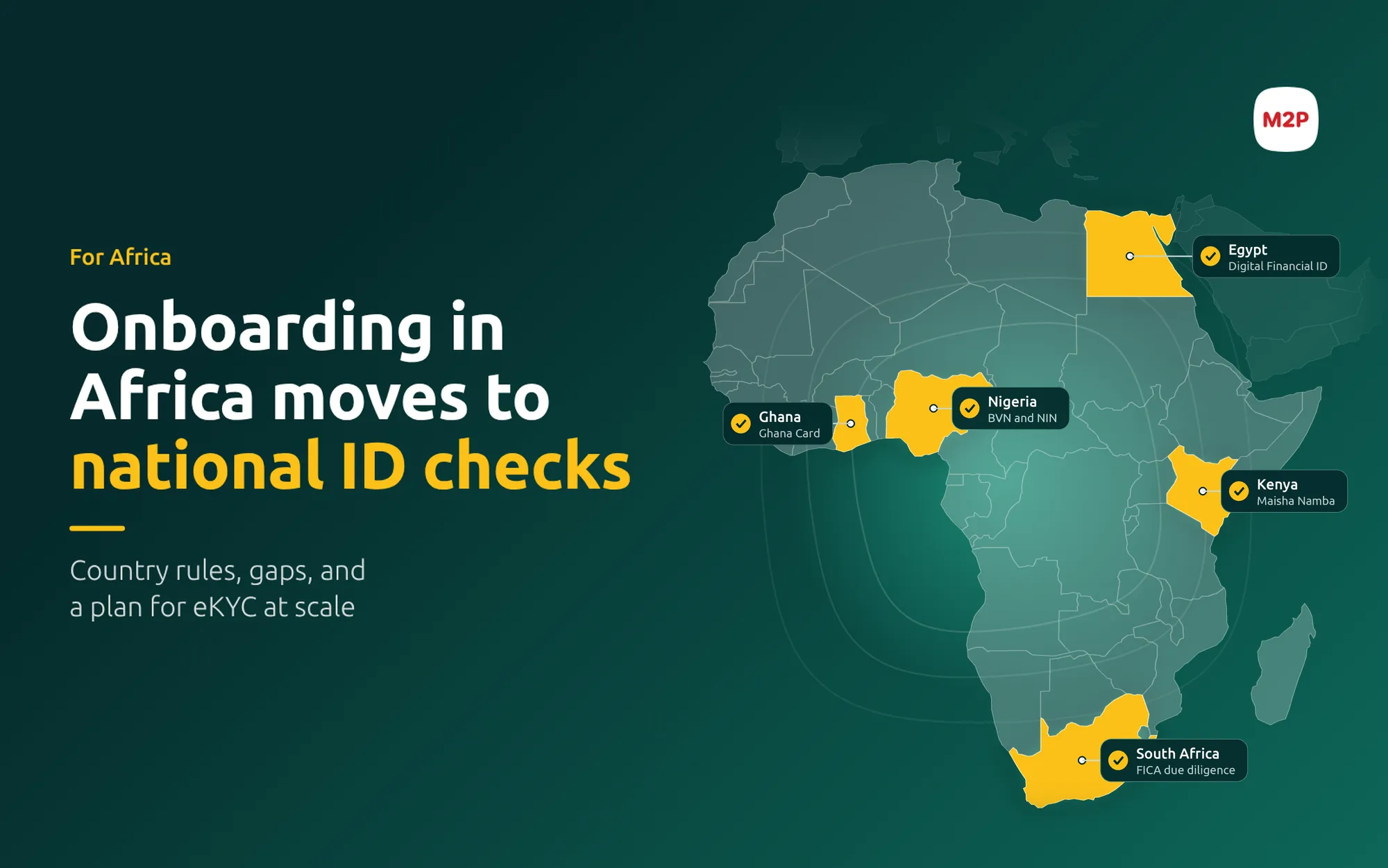
Opening an account in much of Africa still means a branch visit, a photocopied ID, and days of manual checks. eKYC in Africa is replacing that model. Nigeria, Ghana, and Egypt now tie customer onboarding to national identity systems, biometric matching, and liveness checks, and Kenya is rolling out a new lifelong digital ID.
This guide covers where the main markets stand as of November 2026, the rules that matter, the gaps institutions still face, and how banks, microfinance institutions, and fintechs can build remote onboarding that meets each regulator's expectations.
Electronic know your customer (eKYC) is digital identity verification done remotely, with no paper documents. A typical flow captures an ID document, matches the customer's face to it, runs a liveness check, and validates the details against a government database. The customer gets an account in minutes, and the institution gets an audit trail.
Most African eKYC flows follow the same six steps, whatever the national ID behind them:
Digital identity verification only works as well as step 3. Where the national record is incomplete or out of date, even a perfect selfie match fails.
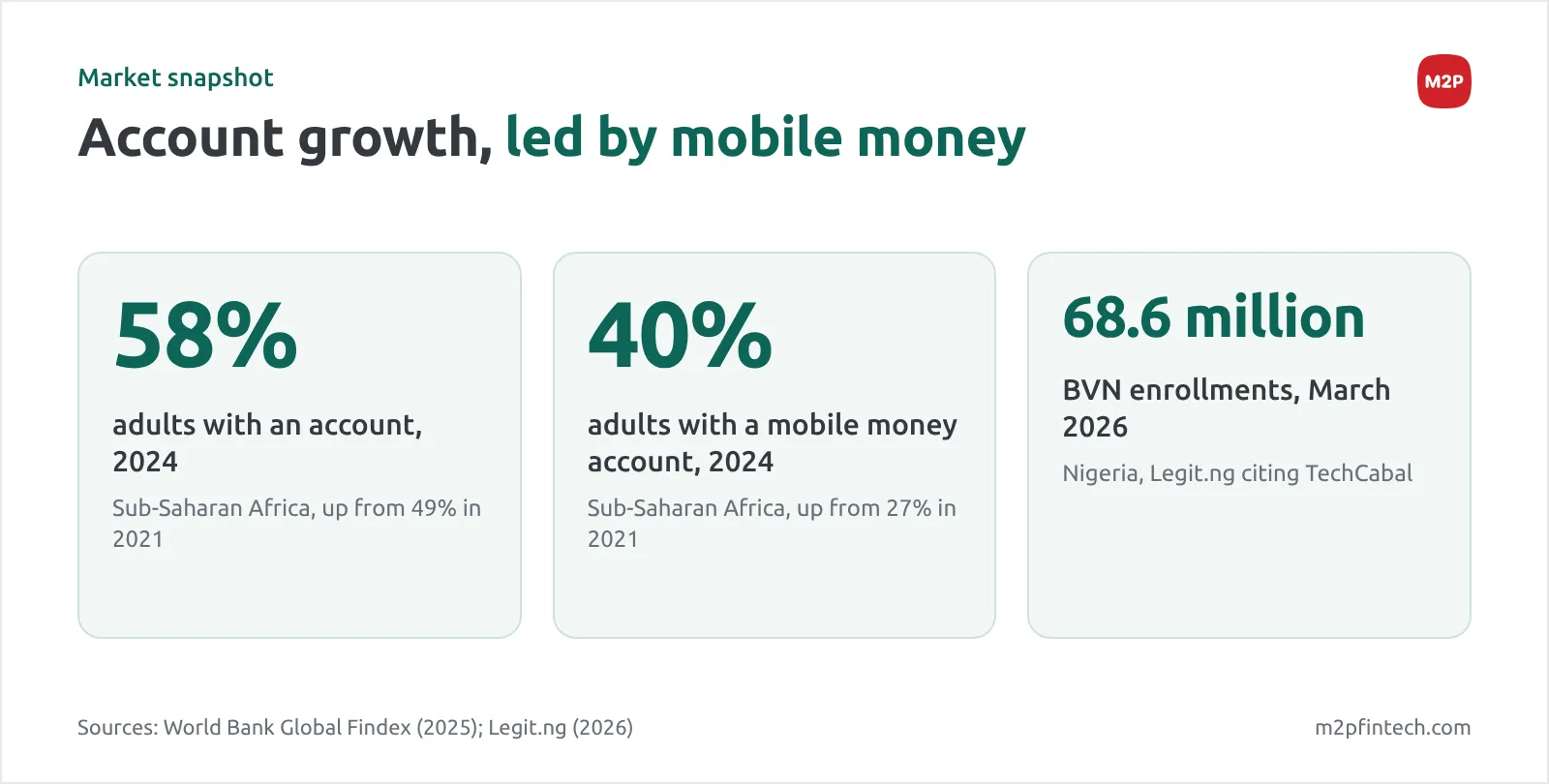
Account ownership in Sub-Saharan Africa rose to 58% of adults in 2024, and mobile money drove much of that growth. That makes eKYC in Africa the default route to an account, and identity checks the main control.
Indicator | Figure | Source |
|---|---|---|
Adults with an account, Sub-Saharan Africa, 2024 | 58% (up from 49% in 2021) | |
Adults with a mobile money account, Sub-Saharan Africa, 2024 | 40% (up from 27% in 2021) | |
BVN enrollments, Nigeria, March 2026 | 68.6 million | Legit.ng, citing TechCabal, 2026 |
African countries on the FATF grey list, October 30, 2026 | 4: Angola, Cameroon, Kenya, South Sudan |
Two trends sit behind these numbers. Regulators are linking every account to a single national identity, so a weak check at onboarding now shows up in supervision. And fraud is moving to the onboarding step itself: in October 2025 the Financial Action Task Force (FATF) warned that deepfakes can be produced at scale for cyber fraud, which puts pressure on selfie checks without strong liveness detection.
Each market anchors KYC Software compliance to a different national identity, so an onboarding flow built for one country rarely works unchanged in the next.
Country | Regulator | Identity anchor | Key rule for onboarding | Status, November 2026 |
|---|---|---|---|---|
Nigeria | Central Bank of Nigeria (CBN) | BVN and National Identification Number (NIN) | Every account and wallet linked to BVN or NIN; onboarding starts from NIBSS or NIMC records | In force; new BVN controls since May 1, 2026 |
Ghana | Bank of Ghana (BoG) | Ghana Card | Ghana Card is the only ID for customers; liveness check for digital onboarding | In force since October 2025 |
Egypt | Central Bank of Egypt (CBE) | Digital Financial Identity, run by Haweya | Remote account opening through one national eKYC platform | Rules issued August 23, 2026; launch date not announced |
Kenya | Central Bank of Kenya (CBK) | National ID, moving to Maisha Namba | Customer due diligence under anti-money laundering law | On the FATF grey list |
South Africa | Financial Intelligence Centre and prudential regulators | Identity number and documents | Risk-based due diligence under the Financial Intelligence Centre Act | Removed from FATF grey list, October 2025 |
The CBN's Customer Due Diligence Regulations 2023 allow electronic KYC and set minimum requirements for remote verification. A December 1, 2023 circular made BVN or NIN mandatory for every individual account and wallet, and said account opening should start by electronically retrieving BVN or NIN data from the Nigeria Inter-Bank Settlement System (NIBSS) or National Identity Management Commission (NIMC) databases.
Controls have since tightened. From May 1, 2026, customers can change the phone number linked to their BVN only once, and banks must keep a temporary watchlist that can hold a suspicious BVN for up to 24 hours. Nigeria left the FATF grey list in October 2025, and staying off it depends on these controls holding. Lenders automating credit decisions on top of these checks should also read our post on Nigeria's data protection rules for automated loan decisions.
The BoG's revised Supervisory Guidance Note, issued in October 2025 and published on January 8, 2026, says institutions shall use only the Ghana Card to identify and verify customers. For onboarding through apps and internet banking, identification is not risk-based: a liveness check is mandatory. The note also sets an escalation path for failed or no-match biometric results, and gives new customers 90 days to fix their records before an account becomes operational.
On August 23, 2026, the CBE issued rules for a Digital Financial Identity (DFI) system that lets retail customers be identified and verified electronically to open accounts remotely. The platform is run by Haweya, issues one digital financial identity per customer, supports liveness detection and ID reading, and keeps records in Egypt. Banks remain responsible for KYC compliance, and no launch date has been announced. It is the clearest example yet of eKYC in Africa run as shared national infrastructure. We covered the groundwork in e-KYC 2.0 in Egypt.
Kenya has been under FATF increased monitoring since February 2024 and was still on the list on October 30, 2026, with remaining actions on legal-entity transparency and money laundering prosecutions. Meanwhile, the Maisha Namba digital ID resumed its rollout after a court lifted an injunction in August 2024, amid continuing data protection concerns. Institutions onboarding in Kenya should expect closer scrutiny of customer due diligence from correspondent banks and investors until the listing ends.
The FATF removed South Africa and Nigeria from its grey list in October 2025. Due diligence remains risk-based under the Financial Intelligence Centre Act, and accountable institutions are seeing more detailed document requests as enforcement matures.
eKYC in Africa usually involves four or five parties, and the institution opening the account is accountable for all of them.
Player | Role in eKYC | Examples from this guide |
|---|---|---|
National identity authorities | Hold the official identity record and biometrics | NIMC (Nigeria), National Identification Authority (Ghana), Haweya with Egypt's Civil Status Authority |
Industry identity infrastructure | Runs shared databases banks query at onboarding | NIBSS, which operates the BVN database |
Regulators and financial intelligence units | Set due diligence rules and supervise compliance | CBN, BoG, CBE, CBK, South Africa's Financial Intelligence Centre |
Banks, microfinance banks, and SACCOs | Onboard customers and own the KYC decision | Commercial banks, microfinance banks, savings and credit cooperatives (SACCOs) |
Mobile money operators and fintechs | Onboard high volumes remotely, often with tiered accounts | Wallet providers and digital lenders |
Technology providers | Supply document reading, face matching, liveness, screening, and workflow tools | eKYC platforms and identity verification APIs |
The last group is where most build-or-buy decisions sit. Microfinance banks and SACCOs face the same rules as large banks with smaller teams, a point we covered in core banking for Africa's microfinance banks and SACCOs.
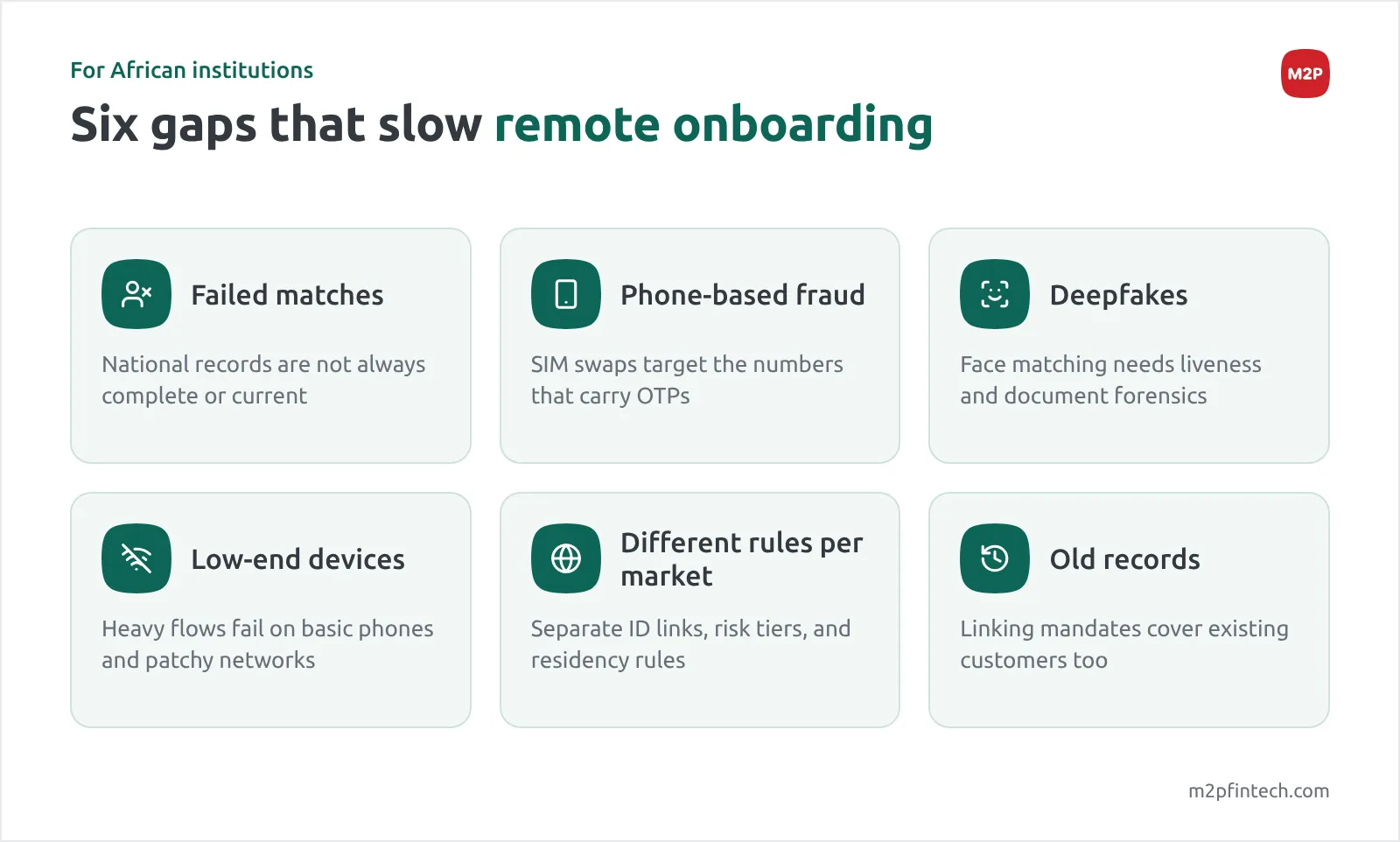
The rules now favor eKYC in Africa, but six practical gaps decide whether an institution can scale it.
Gaps
Opportunities
The same rules open three clear opportunities. Remote onboarding lets institutions reach customers far from branches at lower cost. Done well, eKYC in Africa also produces clean identity data, which makes faster digital lending and card issuance possible. And remediation projects, such as revalidating old accounts against national records, are a chance to fix data quality across the whole book. Merchant and agent onboarding needs the same checks for businesses, as our guide to merchant acquiring in Africa explains.
M2P Fintech's KYC Suite gives banks, microfinance institutions, and fintechs the building blocks for eKYC in Africa, configured to each regulator's rules:
The platform has processed 3.8 billion digital identification transactions and can handle 10 to 13 million transactions a day, depending on configuration. AI agents, including the Document Intelligence Agent and KYC Remediation Agent, can read documents and flag records that need revalidation, with compliance teams reviewing and approving every change.
Because KYC Suite connects to M2P's Core Banking System and Microfinance platform, verified customers can move straight into accounts and loans. Our complete guide to the KYC Suite covers each module in detail.
See how KYC Software Suite works for your market.
Book a demo with M2P


Fintech is evolving every day. That's why you need our newsletter! Get the latest fintech news, views, insights, directly to your inbox every fortnight for FREE!