

M2P Fintech
Fintech is evolving every day. That's why you need our newsletter! Get the latest fintech news, views, insights, directly to your inbox every fortnight for FREE!
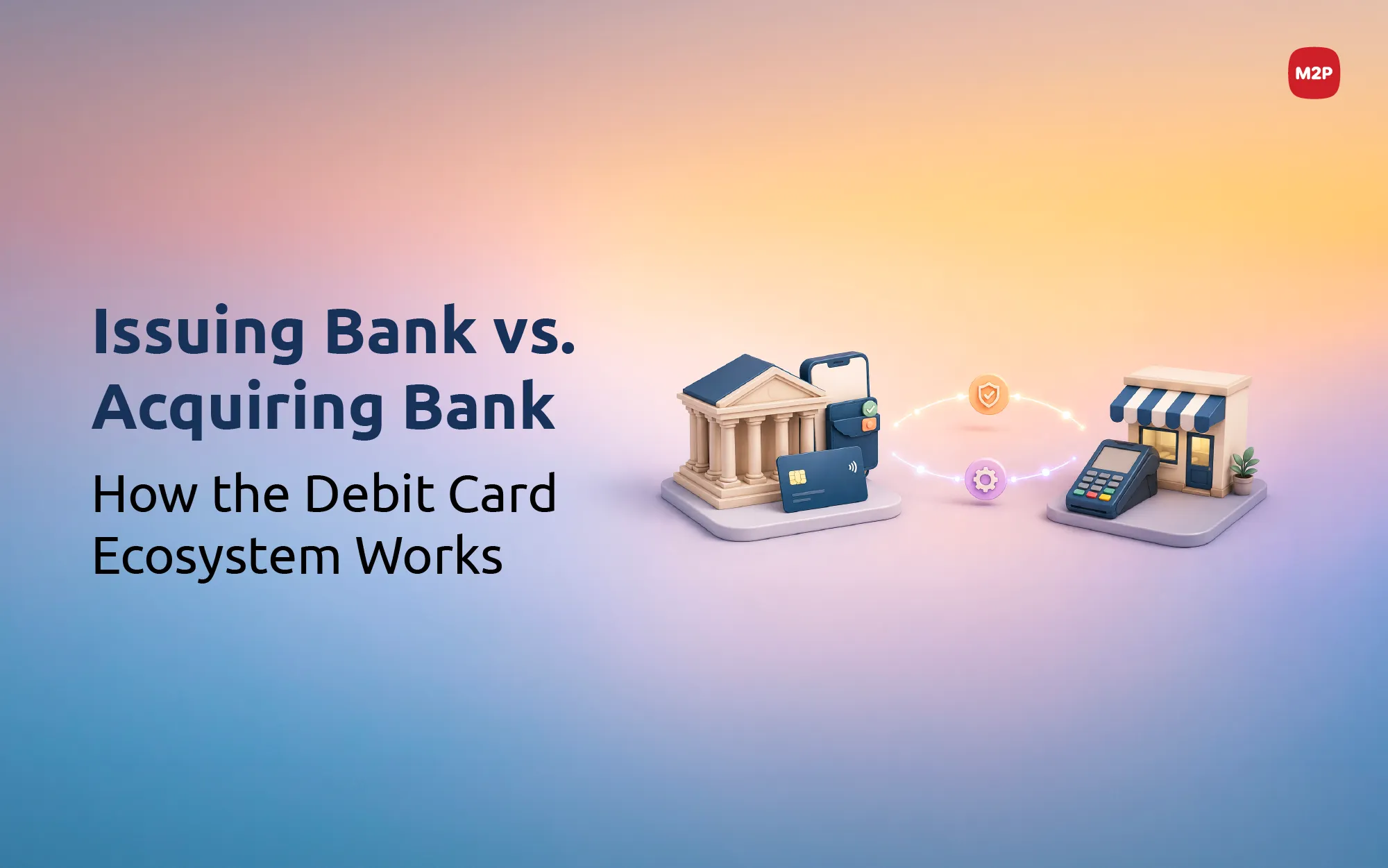
Every time a debit card is swiped, tapped, or entered online, two banks are working on opposite ends of that transaction - usually invisible to the customer, and often confused by the very professionals who work in banking and fintech.
If you've ever paused mid-conversation to ask "wait, is that the issuer or the acquirer?" - you're not alone. It's one of the most searched, most misunderstood pairings in payments. And understanding it properly isn't academic. It shapes how banks design card programs, how fintechs choose partners, and how fast or slow new card products get to market.
This guide breaks down exactly what an issuing bank does, what an acquiring bank does, how they work together in a single transaction, and how the rise of modern card issuing platforms and debit card APIs is changing what being an issuer even means in 2026.
An issuing bank or card issuer is the financial institution that actually issues the debit card to the customer. It's the bank whose name and logo appear on the card, and it's the entity holding the customer's account.
When someone opens a bank account and gets a debit card, that bank is the issuer. Its core responsibilities include:
Card issuance - creating and delivering the physical or virtual card to the customer
Account management - holding the customer's funds and account relationship
Authorization - approving or declining transactions in real time based on available balance, fraud checks, and risk rules
Debit card lifecycle management - everything from activation, PIN setup, and limit controls to renewal, replacement, and closure
Customer service and disputes - chargebacks, fraud claims, and card-related support
In short: the issuer is the yes or no behind every transaction. If you've ever had a card declined, that decision was made by the issuer - not the merchant, and not the acquirer.
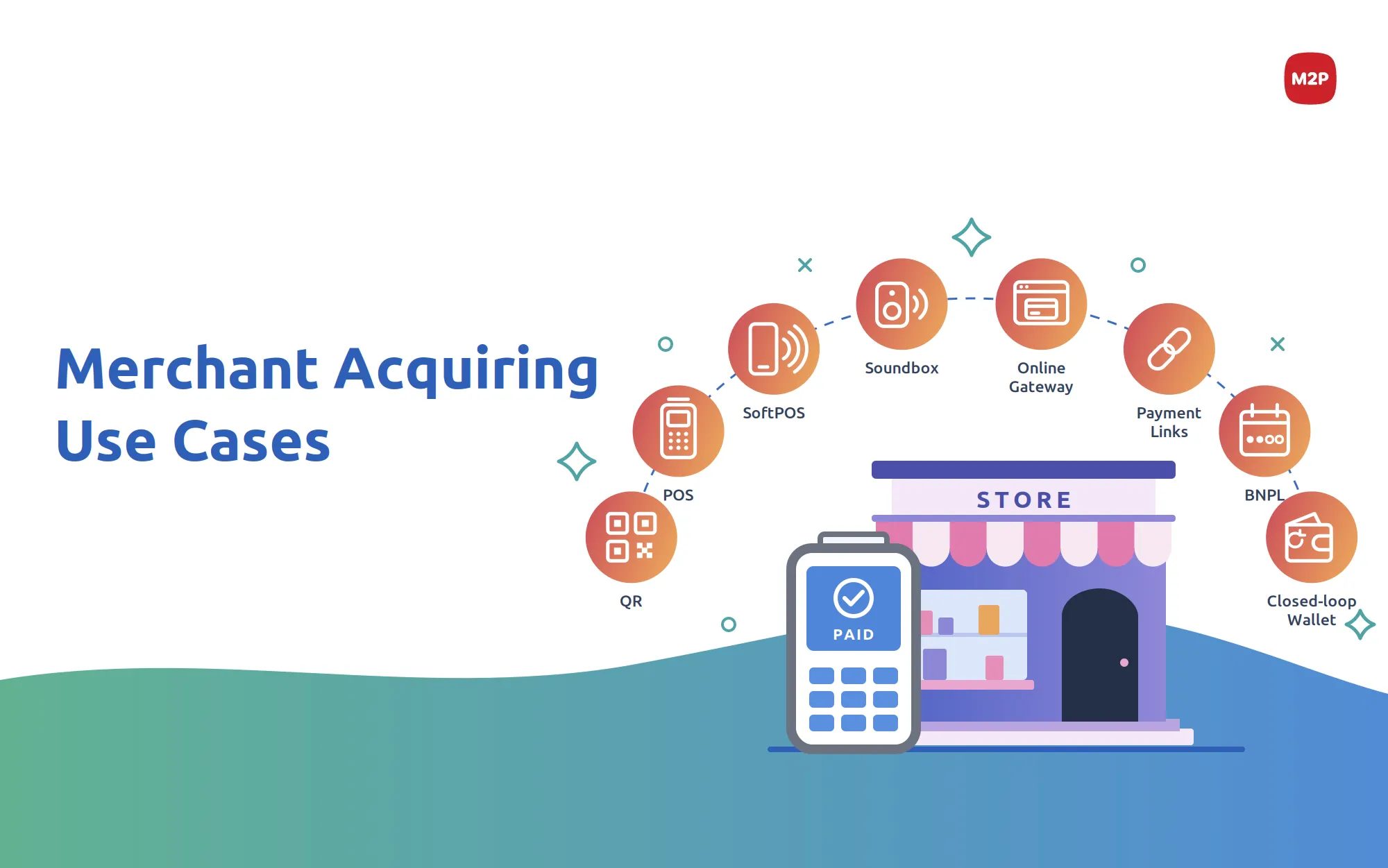
An acquiring bank is the financial institution that works with the merchant, not the customer. It "acquires" the transaction on behalf of the business accepting the payment.
The acquirer's job is to:
Provide the merchant with the infrastructure to accept card payments (POS terminals, payment gateways, or online checkout integrations)
Route the transaction to the correct card network (Visa, Mastercard, RuPay, etc.)
Settle funds into the merchant's account after a successful transaction
Handle merchant-side risk, underwriting, and compliance
If the issuer answers - does this customer have the money and are we approving this?, the acquirer answers let's get this merchant paid, and get the request to the right network.
Issuing bank | Acquiring bank | |
|---|---|---|
Represents | The cardholder | The merchant |
Issues | The debit/credit card | The payment acceptance infrastructure |
Core job | Approves/declines transactions | Routes and settles transactions |
Revenue | Interchange fee (from acquirer) | Merchant discount rate (from merchant) |
Risk owned | Cardholder fraud, credit risk | Merchant fraud, chargeback risk |
Example | The bank on your debit card | The company behind a merchant's card machine |
A useful shortcut: The issuer is on the customer's side of the counter. The acquirer is on the merchant's side.
Understanding the transaction flow end-to-end makes the issuer / acquirer relationship click. Here's what happens in the roughly 2-3 seconds between a card tap and an "Approved" message:
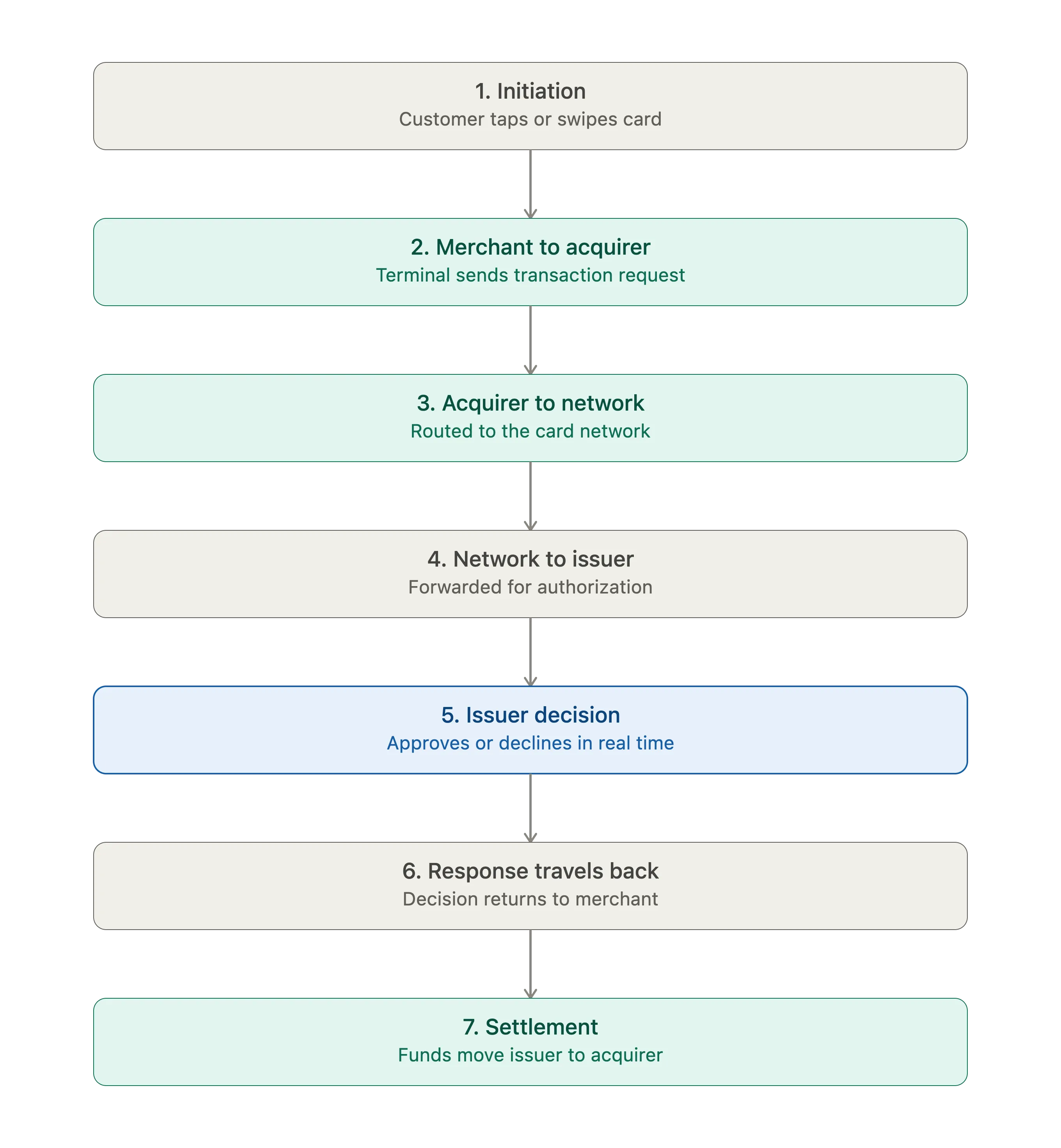
Initiation - The customer taps, swipes, or enters their debit card details at a merchant terminal or online checkout.
Merchant to Acquirer - The merchant's payment terminal or gateway sends the transaction request to its acquiring bank.
Acquirer to Network - The acquirer routes the request to the relevant card network (Visa, Mastercard, RuPay, etc.).
Network to Issuer - The card network forwards the request to the customer's issuing bank for authorization.
Issuer Decision - The issuer checks account balance, fraud signals, card status, and limits, then sends back an approve or decline.
Response Travels Back - The decision flows back through the network, to the acquirer, to the merchant terminal - completing the loop.
Settlement - Later (often same-day or T+1), actual funds move from the issuer to the acquirer, minus interchange, and finally to the merchant's account.
This entire flow depends on the issuer having modern infrastructure - because if the issuer's authorization system is slow, outdated, or rigid, every transaction downstream feels it. This is exactly why card management systems have become a competitive differentiator, not just
back-office plumbing.
For decades, issuer meant a handful of large banks with the balance sheet and license to hold deposits. That's changing.
Fintechs, neobanks, and non-bank financial companies increasingly want to issue their own debit card programs - co-branded cards, corporate expense cards, prepaid cards for gig workers, or embedded finance products inside an app. But they don't want to become a licensed bank to do it.
This is where modern card issuing platforms and debit card issuance software step in. Instead of building core banking and authorization infrastructure from scratch, these businesses plug into a card issuance solution that handles:
Debit card API integrations for instant, programmatic card creation
Virtual card issuance platform capabilities - issuing a fully functional virtual debit card in seconds, without waiting for plastic
Debit card lifecycle management - activation, limit-setting, freeze/unfreeze, replacement, and closure, all via API
Debit card processing software that handles authorization logic, fraud rules, and settlement in real time
In effect, a digital debit card solution built on a modern debit card management system allows a bank or fintech to act as the issuer of record while offloading the heavy technical lift to a specialized debit card issuing platform.
As more players become issuers, acquirers benefit from a larger, more diverse pool of card programs to route transactions from. But it also raises the bar - acquirers now need to support faster settlement cycles, more card types (virtual, tokenized, multi-currency), and higher transaction volumes from smaller, more numerous issuing partners.
Common Misconceptions, Cleared Up
The issuer and acquirer are always different banks." Not necessarily. In some transactions - for example, when a customer uses their debit card at a merchant that banks with the same institution - the issuer and acquirer can be the same entity. This is called an "on-us" transaction.
The card network (Visa/Mastercard/RuPay) is the issuer. No - the network is the rail connecting issuer and acquirer. It doesn't hold customer accounts or make approval decisions; it standardizes and routes the request.
Card issuance is just about printing a card. Card issuance today is a full technology stack - covering card management system logic, real-time authorization, tokenization, compliance, and lifecycle controls. The physical or virtual card is just the visible tip of it.
Whether you're a bank modernizing your card stack, or a fintech launching your first card program, the issuer / acquirer distinction should shape a few concrete decisions:
If you're issuing cards: you need a card issuance platform that can handle real-time authorization, robust debit card lifecycle management, and API-first flexibility - not a legacy system that takes weeks to configure a new card product.
If you're building for merchants (acquiring side): you need infrastructure that can keep pace with faster, more fragmented issuer ecosystems - including newer issuers running on modern card management systems.
If you're evaluating a partner: look for a debit card issuance software provider that supports both physical and virtual card issuance, has proven debit card API documentation, and can demonstrate compliance readiness (PCI DSS, tokenization mandates, and local regulatory requirements).
This is exactly the gap M2P's Debit Card Management System is built to close.
As more banks, NBFCs, and fintechs step into the role of new-age issuer, they need more than a license and a logo - they need the technology to actually operate as one. M2P provides a comprehensive card issuing platform that gives issuers:
Instant, API-driven card issuance - physical and virtual debit cards provisioned in seconds via a robust debit card API
End-to-end debit card lifecycle management - activation, controls, limits, replacement, and closure, fully programmable
A modern card management system built for real-time authorization, tokenization, and compliance - without the multi-week configuration cycles of legacy stacks
A virtual card issuance platform that lets fintechs and banks launch card programs without owning core issuing infrastructure end-to-end
In short: M2P acts as the technology bridge that lets any bank or fintech become a fast, compliant, modern issuer - without the years-long build that used to be the cost of entry.
Want to see what a modern issuer’s tech stack actually looks like? Talk to us today!
Frequently Asked Questions
1. What is the main difference between an issuer and an acquirer?
The issuer is the bank that provides the debit card and manages the cardholder's account - it decides whether to approve or decline a transaction. The acquirer is the bank that works with the merchant, providing the infrastructure to accept payments and routing transactions to the card network for settlement.
2. Who decides if a debit card transaction is approved or declined?
The issuing bank. It checks the account balance, fraud signals, card status, and risk rules in real time before sending an approve or decline response back through the network.
3. Can the same bank be both the issuer and the acquirer?
Yes. When a cardholder and a merchant bank with the same institution, that bank acts as both issuer and acquirer in the same transaction. This is known as an "on-us" transaction.
4. Is Visa or Mastercard the issuer of my debit card?
No. Card networks like Visa, Mastercard, and RuPay are the rails that connect issuers and acquirers - they route and standardize transaction requests. They don't hold customer accounts or make approval decisions; that's the issuer's role.
5. What does "card issuance" actually involve beyond printing a card?
Modern card issuance covers the full technology stack behind a card: real-time authorization, tokenization, debit card lifecycle management (activation, limits, freeze/unfreeze, replacement), fraud rules, and compliance - the physical or virtual card itself is just the visible output.
6. How can a fintech become a card issuer without owning core banking infrastructure?
By partnering with a card issuing platform or debit card management system that provides the technology layer - API-driven card issuance, lifecycle management, and authorization logic - while the fintech or its licensed partner bank remains the issuer of record.
7. What is a virtual card issuance platform?
It's a system that lets banks and fintechs generate fully functional virtual debit cards instantly, without waiting for physical card production - useful for digital-first products, gig worker payouts, and embedded finance use cases.
8. Why does the issuer's technology matter to the speed of a transaction?
Because the issuer's authorization system sits directly in the transaction path. If it's slow or outdated, every transaction - regardless of how modern the acquirer or merchant infrastructure is - feels the delay. This is why card management systems are now treated as a competitive differentiator rather than back-office plumbing.
9. What should I look for in a debit card issuance software provider?
Support for both physical and virtual card issuance, well-documented debit card APIs, real-time authorization capabilities, and demonstrable compliance readiness (PCI DSS, tokenization mandates, and local regulatory requirements).
Fintech is evolving every day. That's why you need our newsletter! Get the latest fintech news, views, insights, directly to your inbox every fortnight for FREE!